Infinity can assess perfume shipments from the UAE, subject to acceptance of the product’s Safety Data Sheet (SDS/MSDS), its UN classification and the proposed carrier and route. Alcohol-based fragrances commonly travel as dangerous goods; do not book them as ordinary parcels without a classification review.
For UAE fragrance brands, wholesalers, and e-commerce sellers, understanding this process is the difference between a smooth export and a shipment stuck in customs. This guide explains exactly how to handle shipping perfume from Dubai and the UAE, covering the regulations, documents, and carrier rules you need to know in 2026.
Why Perfume Counts as Dangerous Goods: UN 1266 Explained
Most commercial perfumes are alcohol-based, which makes them flammable. In the world of international logistics, this isn't a minor detail—it's the defining characteristic that classifies them as dangerous goods (DG). This classification is not optional; it's a global standard for safety in transport.
UN 1266, Class 3 Flammable Liquid
Many alcohol-based fragrances are classified as UN 1266, Perfumery products with flammable solvents. The correct classification depends on the actual formulation and transport information, not simply the word “perfume” on the retail label.
UN 1266 perfume falls under Class 3 Flammable Liquids. A definitional statement for this class is: Class 3 covers liquids that give off flammable vapors at or below a specific temperature, known as the flash point. According to international regulations like the IATA Dangerous Goods Regulations (DGR), this classification requires specific packaging, labeling, and documentation to ensure safe handling, especially during air transport where pressure and temperature changes can increase risk.
Flash Point and the Product Formulation
The flash point helps the dangerous goods specialist assess flammability. Read it alongside the other physical properties and transport information in the manufacturer’s SDS; do not assign a transport classification from a single temperature or from a similar product.
Packing Group II vs. Packing Group III
Within Class 3, a Packing Group (PG) indicates the degree of danger. The SDS for your product will specify this in Section 14.
- Packing Group II: Indicates a medium degree of danger. Use the packing group confirmed for the product, rather than estimating it from the perfume’s alcohol percentage.
- Packing Group III: Indicates a lower degree of danger. Its packaging and quantity provisions still require a shipment-specific check.
The Packing Group determines the strength of packaging required and the maximum quantity allowed per package, especially for air freight.
What About Oil-Based Attars?
Oil-based perfumes and attars need the same initial SDS review. Some formulations may be non-regulated for transport, but a blank Section 14 is not proof of that. Ask the manufacturer for complete transport information and have the forwarder confirm acceptance.
The MSDS (SDS): Start with the Product Information
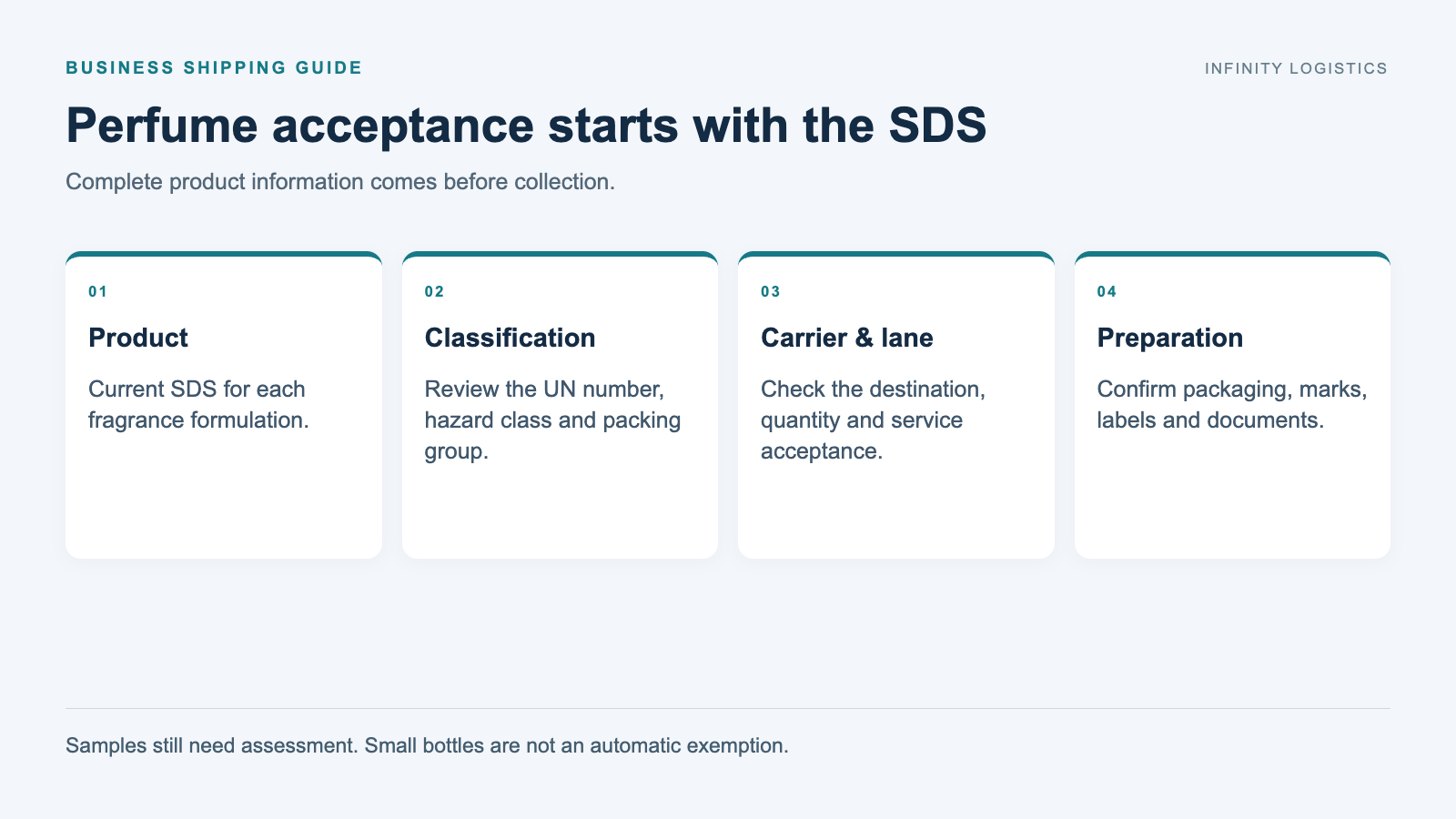
Send the SDS before packing or requesting collection. Missing or inconsistent product information can prevent Infinity and the carrier from confirming acceptance.
What is an SDS and Who Issues It?
An SDS is a structured document describing a product’s properties, hazards and handling precautions. Obtain a current, complete copy for the actual formulation from the manufacturer or supplier. A logistics provider should not invent missing product data.
Infinity needs the current SDS in English for each formulation in the shipment, including samples. Send the documents together with bottle quantities, packed weights, dimensions and destination details.
Section 9 and Section 14: The Decisive Data
When a DG specialist at Infinity Logistics receives your SDS, they look at two sections immediately:
- Section 9 — Physical and chemical properties: Includes flash point and other information used in the classification review.
- Section 14 — Transport information: Identifies the applicable UN number, proper shipping name, hazard class and packing group. The specialist checks that this information is complete and suitable for the transport mode.
If sections are missing or inconsistent, obtain clarification from the manufacturer before booking. The carrier may require additional information before accepting the cargo.
No SDS, No Booking. It's That Simple.
A common mistake is sending a product list and asking for a quote. A professional freight forwarder cannot give an accurate quote for perfume without the SDS. The SDS determines the shipping method, packaging requirements, labeling, documentation, and carrier-specific surcharges. Providing the SDS upfront is the fastest way to get a firm, bookable rate.
Express Courier or Air Freight: Which Route Fits?
Choosing between express and air freight for your perfume shipment depends on your consignment's size, urgency, and how it's regulated.
Express Courier for Accepted Small Consignments
Express can suit samples and smaller orders when the specific product, packaging, quantity and destination are accepted. Small bottle size alone does not make a fragrance eligible for ordinary parcel service.
- Best for: Smaller consignments accepted on the proposed dangerous goods express service.
- Limited quantities: These are regulated provisions, not a blanket exemption. Air shipments have their own packaging, marking, labelling and declaration requirements. A limited-quantity shipment by air can still require a Shipper’s Declaration; do not apply road or sea exemptions to an express air shipment.
- Acceptance first: Infinity checks the SDS/MSDS, UN class and lane before confirming a suitable dangerous goods express option. Key Account pricing does not itself establish dangerous goods approval.
Air Freight for Fully Regulated Consignments
General air freight can suit larger orders or consignments that the available express service cannot accept. The airline must approve the commodity and packing configuration before space is confirmed.
- Best for: Larger commercial orders, palletized goods, and bulk consignments.
- How it works: The DG specialist confirms the applicable packing instruction, quantity limits, packaging, labels and declaration for the airline and route.
- Requirement: Arrange classification and preparation with appropriately trained dangerous goods personnel. Infinity coordinates dangerous goods freight assessment and booking.
Sea Freight for Bulk Volume
Sea freight may suit large, non-urgent stock transfers. Maritime dangerous goods requirements follow the IMDG Code, and acceptance must be confirmed with the shipping line. A package prepared for sea transport is not automatically suitable for air transport.
Need a shipping quote?
Get AI-optimized rates from DHL, FedEx & UPS — up to 65% below retail. Quote in under 10 minutes.
Packing and Labelling Perfume for Air
Have the exact packing configuration checked before sealing the shipment. The points below explain the purpose of the packaging; they do not replace the applicable packing instruction or carrier approval.
Inner and Outer Packaging
For combination packaging approved for the shipment, the specialist checks the inner receptacles, cushioning, absorbent material and outer packaging together:
- Inner Packaging: Each bottle must be sealed to be leak-proof. Glass bottles must be individually wrapped in cushioning material (like bubble wrap) and placed in a way that prevents them from moving or touching.
- Absorbent Material: For liquids, enough absorbent material to soak up the entire contents in case of a leak is often required.
- Outer Packaging: Use the packaging specified by the applicable instruction and carrier. A strong retail or double-walled box is not automatically an approved dangerous goods package.
Labels and Marks
Apply the complete set of marks and labels specified for the shipment. Never copy a label from a different perfume shipment or treat the examples below as a complete labelling checklist.
- Limited quantities by air: Where permitted, the air limited-quantity mark includes a “Y”. Other required hazard labels, marks and documentation still apply.
- Fully regulated shipments: Applicable hazard labels, identification marks, shipper and consignee details and any handling labels must match the confirmed classification and packing instruction.
- Orientation arrows: Apply them where required by the packing instruction and liquid packaging configuration.
- FAA — How to Ship Dangerous Goods
Check the Destination's Rules Before You Book
Getting your perfume out of the UAE is only half the battle. The consignee (your buyer or receiver) must confirm that the product can be legally imported into the destination country.
The importer must confirm destination product registration, labelling and import permissions before dispatch. Duties, taxes and clearance responsibilities should be agreed in the quotation and Incoterms. Infinity can coordinate the customs clearance requirements with the shipment.
What to Send Your Forwarder for a Perfume Quote
Complete product information makes the quote faster and more reliable. Dangerous goods acceptance may need a technical review before Infinity can issue a firm booking confirmation.
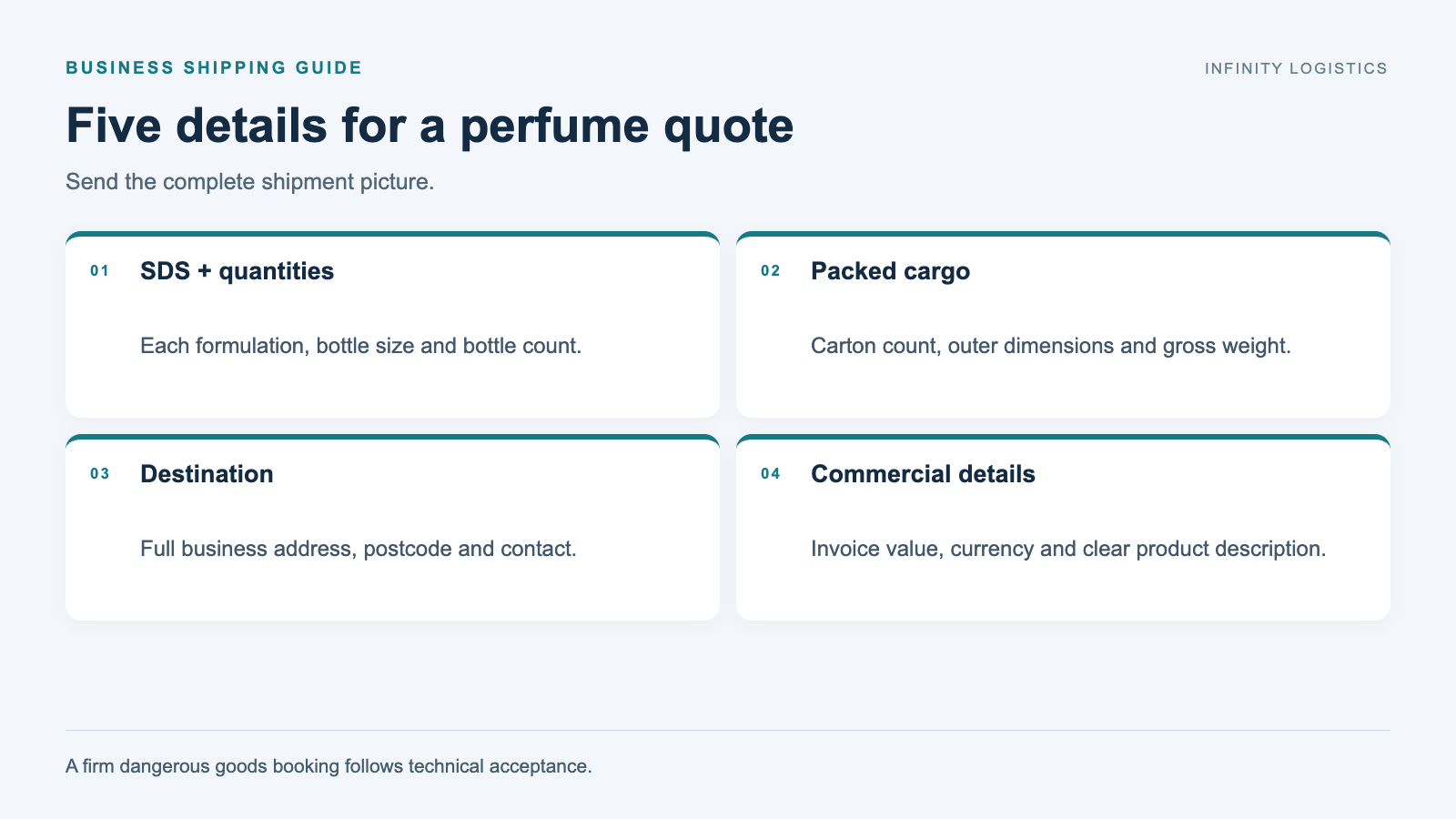
The 5-Point Checklist for a Perfume Shipping Quote:
- The Safety Data Sheet (SDS) for EACH fragrance. This is non-negotiable.
- Bottle size (in ml) and the number of bottles for each fragrance.
- Carton details: The number of cartons, their external dimensions (L x W x H in cm), and their gross weight (in kg).
- Full destination address, including postcode, and confirmation that it is a business consignee.
- Commercial Invoice value and currency. The Harmonized System (HS) code for perfume is generally 3303.00.
With these details, Infinity can review acceptance, calculate chargeable weight and compare suitable options. Request a perfume shipping quote and attach the SDS before arranging collection.
How Infinity Handles Perfume Shipments
Infinity Logistics assesses perfume exports subject to SDS/MSDS acceptance and UN classification. We are a WCA Inter Global member and were Highly Commended as Express Logistics Company of the Year at the Logistics Middle East Awards 2022.
Classification and Documentation First
The process starts with your SDS, product quantities and destination. Infinity checks classification, packing requirements, documentation and carrier acceptance before confirming the booking. Any missing product information goes back to the manufacturer for clarification.
Carrier Comparison at Key Account Rates
Infinity holds Key Account status with DHL, FedEx, and UPS simultaneously. We are the #2 DHL partner in the UAE. This gives us two advantages:
- Carrier options: Infinity reviews the available network and lane for the product’s classification. Acceptance by one carrier or on one route does not guarantee acceptance elsewhere.
- Pricing: We get business express rates up to 65% below retail. For every shipment, our system compares all three carriers in real time to find the optimal balance of speed, cost, and compliance for that specific lane.
A Quote Process Built for Speed and Accuracy
Send the SDS and complete shipment details at the start. Infinity can then compare eligible carrier options and explain the required preparation. A firm dangerous goods booking follows technical acceptance; the review time depends on the product and route.
Frequently Asked Questions
Is perfume dangerous goods?
Alcohol-based perfume commonly falls under Class 3 dangerous goods, often UN 1266. The actual product formulation and transport classification must be checked before shipping. Do not assume every fragrance has the same classification.
Do perfume samples need an MSDS?
Yes. Infinity requires the current SDS/MSDS for perfume samples as well as commercial orders. A sample’s small size or low invoice value does not remove the need to check its classification and carrier acceptance.
Can I send perfume by DHL, FedEx or UPS from Dubai?
Potentially, subject to SDS/MSDS review, UN class, packaging, quantity and route acceptance. Infinity confirms which service can accept the shipment before booking. Do not send perfume through an ordinary parcel service without declaring its contents.
What is the HS code for perfume?
The primary Harmonized System (HS) code for perfumes and toilet waters is 3303.00. This code is used by customs authorities worldwide to classify products for assessing duties and taxes. Providing this code on your commercial invoice helps ensure a smoother customs clearance process.
Are oil-based attars dangerous goods?
Some oil-based fragrances may be non-regulated for transport, but this must be confirmed from complete product information. Send the SDS to Infinity for assessment; an absent UN number or blank transport section is not sufficient proof.
Sources & References
Official and industry sources referenced in this guide:
Tags
Related Articles
Ready to optimize your logistics?
Whether you need express shipping, freight forwarding, or warehousing — our AI finds the best rates and routes for your business.