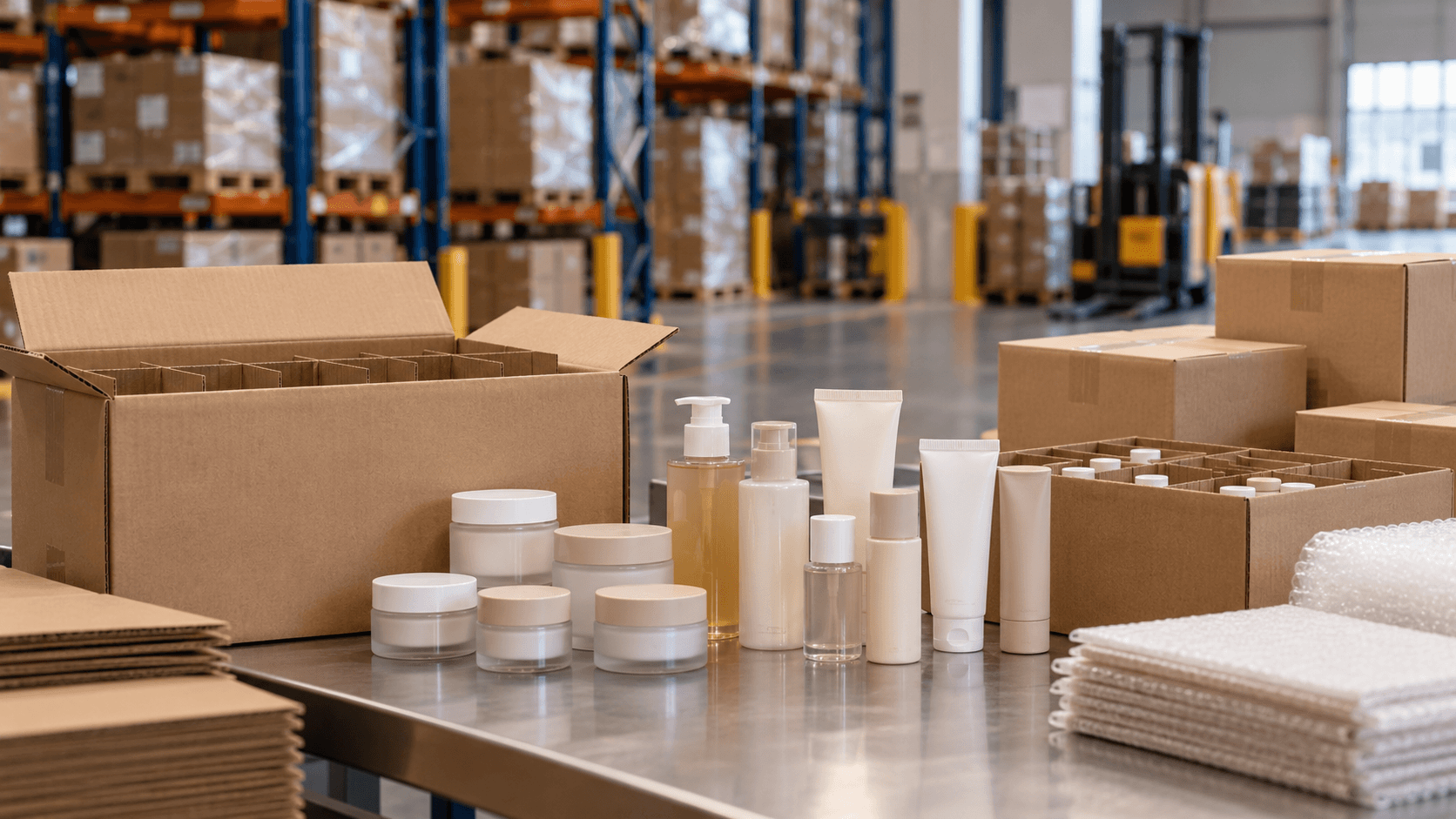
Yes, you can ship cosmetics from the UAE, but each product falls into one of two groups. Most creams, powders and solids ship as ordinary cargo, while aerosols and flammable liquids, such as alcohol-based perfume, ship as dangerous goods. The product's Safety Data Sheet (SDS) decides which group it is in, so check it before you ask for a quote.
This guide gives UAE-based cosmetics brands, distributors, and e-commerce sellers the framework to classify products, choose the right shipping mode, and prepare the correct documents. The goal is to avoid delays, rejections, and unexpected costs when shipping samples, retail orders, or bulk stock internationally.
Which Cosmetics Count as Dangerous Goods?
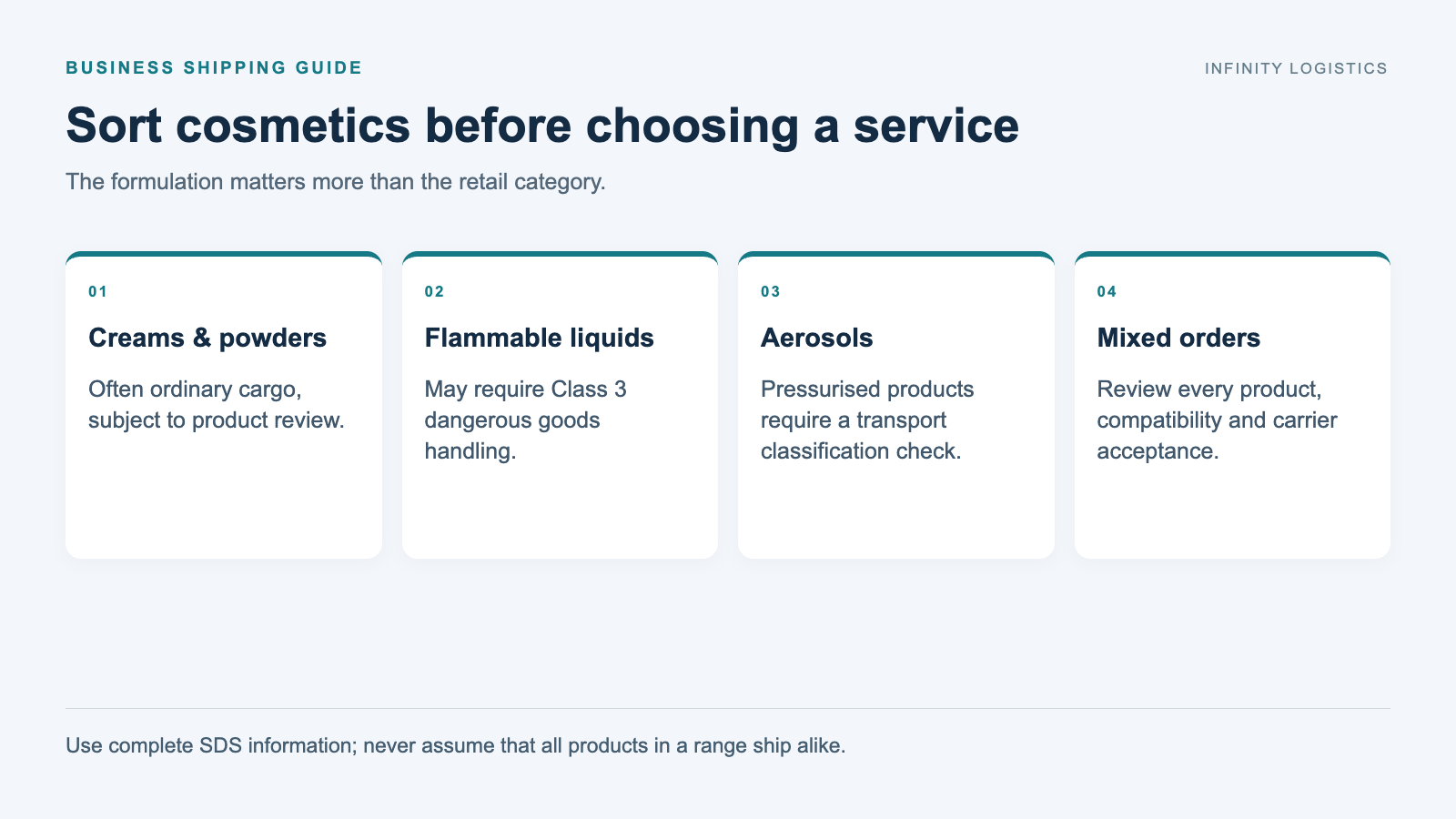
For transport purposes, cosmetics are judged by their chemical properties, not their marketing category. The IATA Dangerous Goods Regulations (DGR), which set the rules for dangerous goods by air, place certain products in hazard classes. Your first step is to sort your products into these groups.
Aerosols: Class 2 (Gases)
Any cosmetic in a pressurized spray can is an aerosol: hair spray, spray deodorant, setting spray and some spray-on sunscreens, for example. Aerosols are Class 2 (gases) dangerous goods, because the can holds gas under pressure. Section 14 of each product's SDS gives its exact classification, including whether the propellant is flammable.
Alcohol-Based and Other Flammable Liquids: Class 3
Some beauty products are flammable liquids, which are Class 3 dangerous goods. A liquid counts as flammable when its flash point, the lowest temperature at which it gives off enough vapor to ignite, is low enough. Products that often fall into this class include:
- Perfumes and colognes (high ethanol content)
- Nail polish and nail polish remover
- Some alcohol-based toners and facial mists
- Hand sanitizers with high alcohol content
Whether a product is Class 3 depends on its formulation and transport classification. If regulated, its packaging, handling and documentation must follow the applicable dangerous goods provisions; Infinity confirms the requirements for the selected mode and service.
Everything Else: Usually Ordinary Cargo
Most other cosmetics are typically not classified as dangerous goods and can ship as ordinary cargo. This includes:
- Creams, lotions, and serums (water-based or oil-based without flammable solvents)
- Powders (pressed or loose), eyeshadows, and blushes
- Lipsticks, lip balms, and solid stick deodorants
- Shampoos, conditioners, and non-aerosol hair treatments
Do not assume that a cosmetic is non-hazardous. Obtain complete product information and have the transport classification reviewed before booking.
A Note on Perfume
For fragrance-specific preparation and acceptance, see our guide to shipping perfume from the UAE.
The SDS: The Document That Decides the Route
Before you can get an accurate quote or book a shipment, you need the Safety Data Sheet (SDS) for every product. It is the document that decides how each product can travel.
What is an SDS and Who Issues It?
A Safety Data Sheet (SDS), formerly known as an MSDS, is a standardized 16-section document that details a product's chemical and physical properties, hazards, and safety precautions. It is the manufacturer's responsibility to create and provide an accurate SDS for their products. If you are a distributor or reseller, you must obtain the current SDS from your supplier.
Section 9: Flash Point
For liquid cosmetics, Section 9 of the SDS ("Physical and chemical properties") lists the product's flash point. Under the transport rules, a liquid with a flash point of 60°C or lower (closed cup) is generally a Class 3 flammable liquid and ships as dangerous goods.
Section 14: Transport Information
Section 14 ("Transport information") provides the official transport classification. This is what your freight forwarder will use to prepare your shipment. It will state:
- UN Number: A four-digit code identifying the substance (for example, UN 1266 for perfumery products).
- Proper Shipping Name: The official name used for transport (e.g., "Perfumery products").
- Transport Hazard Class: The DG class (e.g., Class 3).
- Packing Group: A rating of I, II, or III indicating the degree of danger.
If Section 14 states that the product is not regulated for transport, it can usually ship as general cargo. If it lists a UN number, it is dangerous goods. If Section 14 is blank, ask your supplier for a complete SDS before you book.
SDS Requirements for Shipping
For international shipping, your SDS must be current, complete, and in English. One SDS is required for each unique product formulation. Sending this document to your logistics partner first is the fastest way to get an accurate quote and a compliant shipping plan.
Samples, Retail Orders, and Bulk Stock: Express or Air Freight?
The right shipping mode depends on your consignment's size, urgency, and hazard classification.
Express for Samples and Small Consignments
Express courier services can suit accepted small, time-sensitive consignments such as samples and distributor top-ups. Infinity assesses dangerous goods express options for cosmetics subject to SDS/MSDS review, UN classification, quantity, packaging and the carrier’s acceptance on the specific lane.
Air Freight for Larger Consignments
For larger wholesale orders or palletized stock, air freight is usually more cost-effective than express, balancing speed and price for shipments too large for courier but still time-sensitive. Dangerous goods need the same care by air freight: Infinity's dangerous goods air freight service identifies each product's UN number, class and packing group and prepares the dangerous goods declaration before booking.
Sea Freight for Bulk, Non-Urgent Stock
For large, non-urgent stock, sea freight usually costs least per unit, though transit takes much longer. Dangerous goods rules apply by sea too, so the SDS is still needed. Infinity handles sea freight and warehousing, including logistics for retail brands moving bulk stock through Jebel Ali Port.
Packing Cosmetics So They Arrive Intact
Proper packing prevents leaks, breakage, and costly damage claims. The rules become even stricter for dangerous goods.
Secure Caps and Leak-Proof Inner Packaging
For all liquids, gels, and creams:
- Ensure all caps are tightly secured. Use tape over the cap for extra security.
- Place each container in a sealed, leak-proof plastic bag.
- Add absorbent material (like an absorbent pad) inside the bag for liquids.
- Use strong, high-quality inner containers (bottles, jars) that can withstand pressure changes during flight.
Protect Aerosol Caps
For aerosols, the main risk is accidental discharge. Protect the valve with a securely fitted cap that cannot be knocked off easily, pack the cans upright and cushion them so they cannot move.
Use Cushioning and a Strong Outer Box
Wrap each item in bubble wrap or other cushioning. Place the wrapped items in a sturdy, double-walled box and fill empty space with void-fill (air pillows or packing peanuts) so nothing shifts in transit. For dangerous goods, your forwarder confirms the packaging the rules require.
Need a shipping quote?
Get AI-optimized rates from DHL, FedEx & UPS — up to 65% below retail. Quote in under 10 minutes.
Hazard Labels: Only When Required
Only apply dangerous goods hazard labels (for example the flammable liquid or gas label) if the product's SDS confirms it is dangerous goods and your forwarder instructs you to. Labelling a non-hazardous shipment as dangerous goods can get it stopped and inspected. Infinity's dangerous goods process works from your SDS, so the marks and labels match the declaration.
Check the Destination's Cosmetics Rules Before You Book
Compliance doesn't end at the UAE border. Every country has its own rules for importing cosmetics, and the responsibility for compliance lies with the importer.
Product Registration and Notification
Some markets require cosmetics to be registered or notified before they are sold. For example, the EU requires cosmetic products to be notified before they are placed on its market, under Regulation (EC) No 1223/2009. The importer or its representative in the destination country handles this, and goods that do not meet the destination's rules can be held or refused.
The Importer Confirms Requirements
As the shipper, you must confirm with your consignee (the buyer or importer) that all local requirements have been met. They are responsible for understanding their country's regulations, acting as the legal importer of record, and providing any necessary permits or registration numbers. Do not ship until you have this confirmation.
Ingredient Restrictions Vary by Country
A formula that is legal in the UAE may not be allowed in another market, because ingredient rules differ from country to country. The importer checks that every ingredient in your product is permitted at destination.
Documents for a Cosmetics Shipment
A smooth customs clearance process depends on accurate and consistent documentation.
Commercial Invoice and Packing List
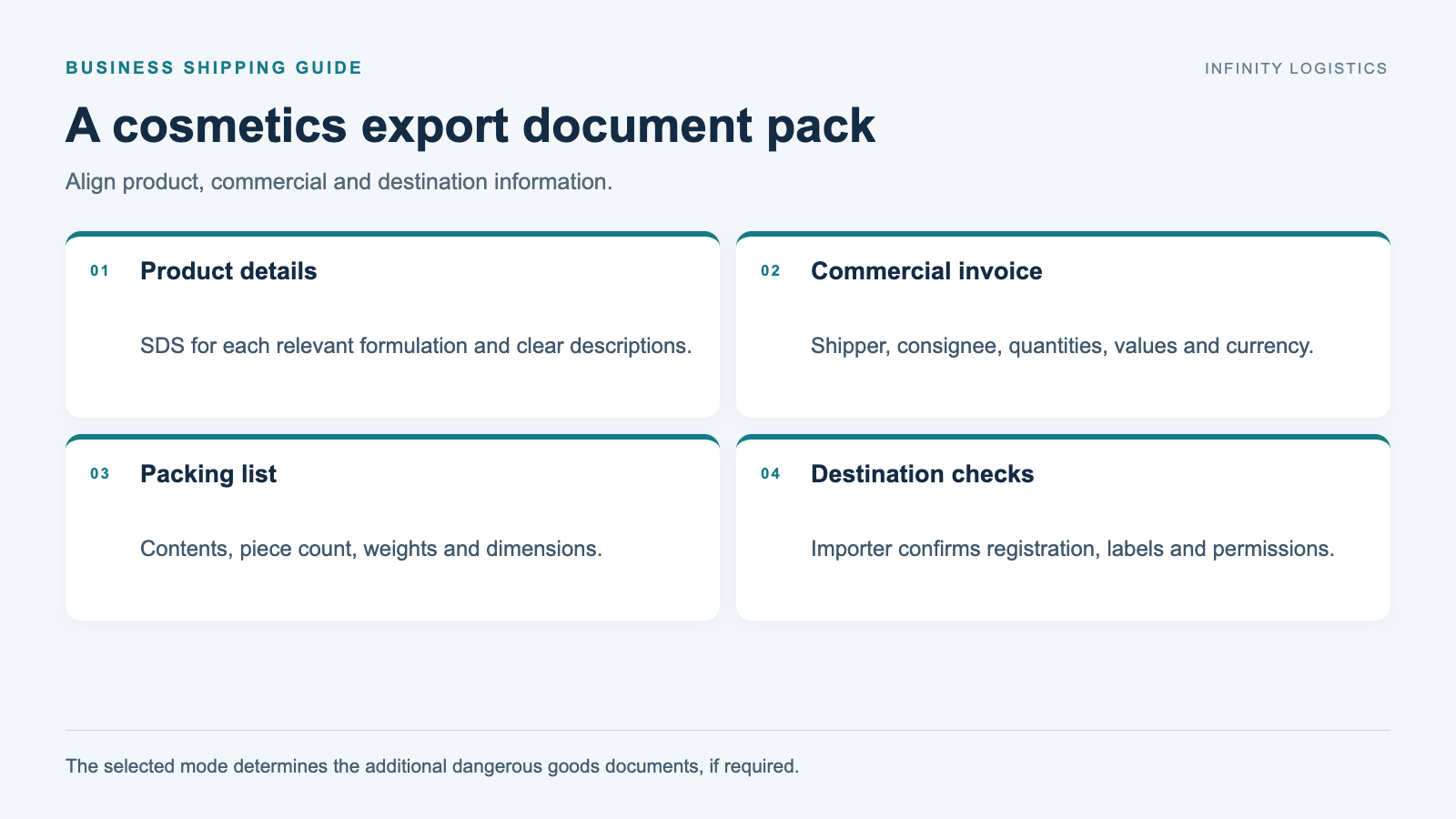
Your commercial invoice must include the shipper and consignee details, a clear description of each product, the quantity, unit value, and total value. The packing list details the physical contents of each box, including weights and dimensions. The product descriptions, quantities, and HS codes must match perfectly across both documents.
HS Codes
Every product needs a Harmonized System (HS) code, which customs uses to classify the goods and work out duty. Most cosmetics fall under Chapter 33 of the HS (perfumery, cosmetic or toilet preparations); your supplier or customs broker confirms the exact code for each product.
Using the correct HS code is essential for customs classification and duty calculation.
SDS and Dangerous Goods Declaration
Keep the SDS for each product. Where a product is regulated, Infinity checks the applicable classification, packing instruction, documentation and any special provisions for the mode and route. A dangerous goods declaration is prepared where required.
What to Send Your Forwarder for a Same-Day Quote
To get a fast, accurate quote for your cosmetics shipment, send your forwarder a complete information pack. Infinity's AI agents compare DHL, FedEx and UPS in real time, so most enquiries get a quote in under 10 minutes.
Checklist for a Fast Quote:
- SDS for each product: This is non-negotiable for any liquid, aerosol, or potentially flammable item.
- Product List: A detailed list with product names, quantities, and unit sizes (e.g., "500 units of 50ml Face Serum").
- Carton Details: The number of cartons, plus the dimensions (L x W x H) and gross weight of each.
- Destination: The full business address and contact details of the consignee.
- Invoice Value: The total commercial value of the shipment for customs and insurance purposes.
With this information, a forwarder can work out the right shipping mode and the chargeable weight, and price the shipment. Ready to start? Get a cosmetics shipping quote.
How Infinity Handles Cosmetics Shipments
Infinity Logistics handles cosmetics shipments from classification through to booking.
Classification and Documentation
Our process starts with your SDS. We identify each product's UN number, class, packing group and any special provisions, then prepare the dangerous goods declaration. Infinity is a WCA Inter Global member and the #2 DHL partner in the UAE.
Comparing DHL, FedEx, and UPS at Key Account Rates
Infinity holds Key Account status with DHL, FedEx and UPS at the same time. Our AI agents compare the three in real time for your shipment, and we offer business express rates up to 65% below retail.
One Partner for a Complex Process
Infinity is one point of contact for classification, documents, carrier booking and customs clearance, from our office in Ajman Free Zone and our warehouse in Dubai Investment Park.
Frequently Asked Questions
Are cosmetics dangerous goods?
Some are, and some are not. Aerosols and cosmetics that are flammable liquids, such as alcohol-based perfume, are dangerous goods for transport. Creams, powders and most water-based products typically are not. Section 14 of the product's Safety Data Sheet (SDS) gives the official classification.
Can I ship aerosol cosmetics by courier from Dubai?
Aerosol cosmetics may be accepted as dangerous goods on an approved service, subject to SDS/MSDS review, UN classification, quantities, packaging and the destination. Confirm carrier acceptance before preparing or booking the shipment.
Do cosmetic samples need an SDS?
Yes, if the sample is a liquid, an aerosol or contains potentially hazardous ingredients. Carriers ask for the SDS to confirm how it is classified before they accept it. Dangerous goods rules apply to samples in the same way as to commercial shipments.
Do I need to register cosmetics in the destination country?
Often, yes. Some markets, such as the European Union, require cosmetics to be notified before they are sold. This is the responsibility of the importer or its representative in the destination country, so confirm the requirements with your buyer before shipping.
Can perfume and cosmetics ship together?
They may be able to travel in one consignment, but compatibility, segregation and carrier acceptance must be checked first. Declare every product and provide its SDS. Perfume classified as dangerous goods must be prepared under the applicable air transport requirements.
Sources & References
Official and industry sources referenced in this guide:
- Dangerous Goods Regulations (DGR)
- [PDF] Customer Guide
- [PDF] Regulation (EC) No 1223/2009 of the European Parliament and of ...
- DHL Express Service & Rate Guide 2025: UAE - MyDHL+
- How to Ship Dangerous Goods
- [PDF] Code of Practice CoP 1.0 - Hazardous Materials Version 4.0 July 2024
- Legislation - Internal Market, Industry, Entrepreneurship and SMEs
Tags
Related Articles
Ready to optimize your logistics?
Whether you need express shipping, freight forwarding, or warehousing — our AI finds the best rates and routes for your business.