
How to Choose the Right Logistics Partner in Dubai for International Shipping
Why Choosing the Right Dubai Logistics Partner Matters for Your International Business
Selecting the right logistics partner in Dubai can make or break your international business operations. The impact on your bottom line is substantial—partner selection can drive shipping cost variations of 40-65% due to differences in scale, technology, and network efficiency among providers. According to Mordor Intelligence's UAE Freight & Logistics Market Report, the UAE freight market reached USD 23.05 billion in 2026 and is growing at a 6.55% CAGR, making strategic partner selection more critical than ever.
Dubai's position as a gateway between Asia, Europe, and Africa transforms logistics partner choice from an operational decision to a strategic imperative. The emirate's infrastructure, including Jebel Ali Free Zone (handling 32% of UAE FDI) and Dubai South, creates unparalleled global reach opportunities—but only with the right partner. Recent investments underscore this importance: UPS invested USD 100 million in Dubai South automation in March 2025, while DSV's USD 15.78 billion acquisition of DB Schenker in May 2025 reshaped the competitive landscape.
The hidden costs of working with multiple providers versus integrated solutions can inflate your logistics expenses by 20-40% through uncoordinated handoffs and administrative redundancies. Smart businesses are discovering that express logistics solutions with integrated capabilities eliminate these inefficiencies. The UAE 3PL market's growth to USD 6.53 billion by 2030 (6.5% CAGR) demonstrates how consolidated partners avoid redundancy in warehousing and last-mile delivery.
Time-to-market advantages with the right logistics infrastructure cannot be overstated. Advanced partners leveraging Dubai's strategic location can shave days off delivery times. For instance, DP World's Jebel Ali partnerships and the new Al Mafraq-Al Ghuwaifat Road (USD 3.5 billion investment) reduce Gulf-to-border transit by up to 80% versus maritime routes. This speed advantage is why two-thirds of UAE executives expect 2026 trade growth to match or exceed 2025, particularly amid surging e-commerce demand.
Key Criteria for Evaluating Dubai Logistics Companies
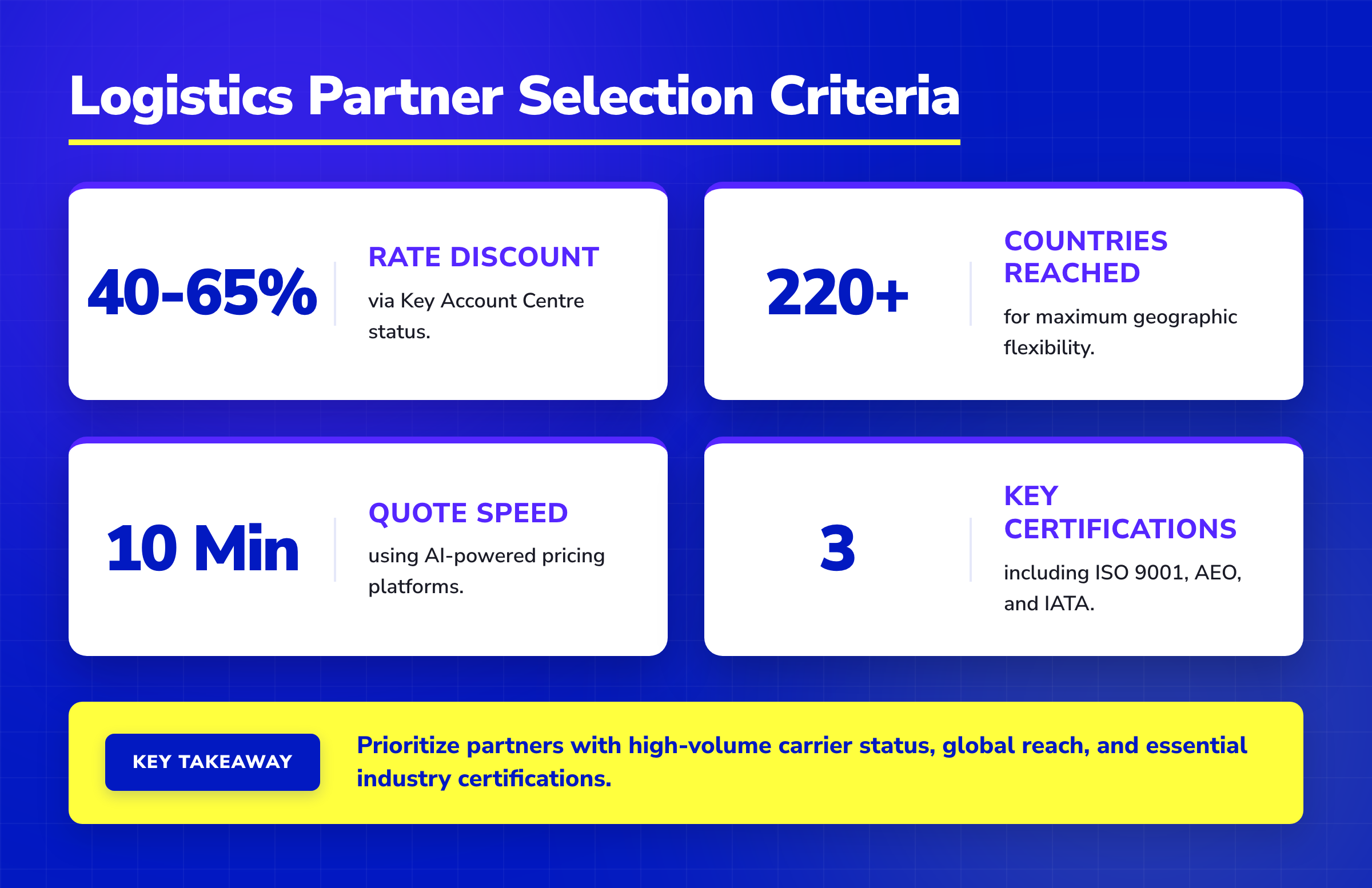
When evaluating Dubai logistics companies for international shipping, your assessment must go beyond surface-level comparisons. The most critical factor is carrier relationships and volume partnership status—specifically whether a provider holds Key Account Centre (KAC) status with major carriers like DHL, FedEx, and UPS. These partnerships secure preferential rates, priority capacity, and dedicated slots that retail-level providers simply cannot access. According to industry analysis, leaders like DP World excel in freight logistics through volume commitments enabling high-throughput handling.
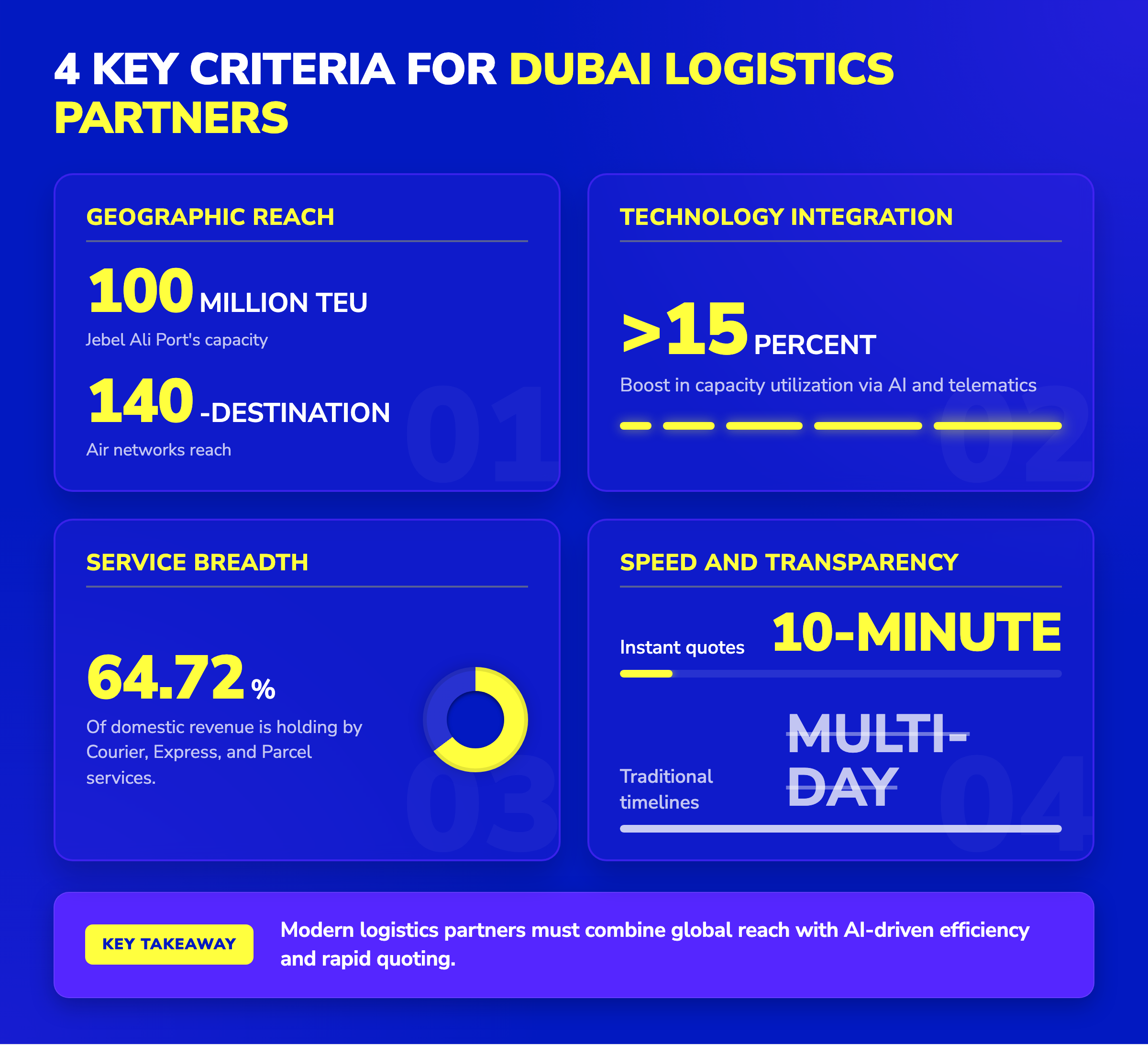
Geographic coverage and service reach represent another crucial evaluation criterion. Top Dubai logistics companies offer reach to 220+ countries, leveraging Dubai International Airport's 2 billion tons of air freight capacity (2023) and Jebel Ali Port's milestone of surpassing 100 million TEU capacity in January 2025—an 8.3% increase from 2024. Air freight contributed 46.62% of market revenue in 2025, with Emirates SkyCargo supporting a 140-destination network that enables truly global reach.
Technology integration and real-time tracking capabilities separate modern logistics providers from outdated alternatives. Leading firms now offer AI-powered logistics operations with instant quotes, container visibility, and telematics that boost capacity utilization by over 15%. Kuehne+Nagel's August 2024 autonomous fulfillment center in Dubai South exemplifies this technological edge, using robotics to accelerate e-commerce fulfillment speeds dramatically.
Service portfolio breadth—encompassing express, freight, and warehousing integration—determines whether a partner can truly serve as a one-stop solution. The UAE logistics market, valued at USD 30 billion in 2023, demonstrates clear preferences: freight dominated the market while CEP (Courier, Express, and Parcel) services held 64.72% of domestic revenue in 2025. Partners offering comprehensive freight forwarding alongside express services provide the flexibility modern businesses require.
Additional evaluation criteria include:
- Pricing transparency and quote speed: Industry-leading providers deliver quotes in 10 minutes versus the traditional timeline of hours or days
- Certifications and compliance: Look for ISO 9001:2015, AEO (Authorized Economic Operator), and IATA licensing as baseline requirements
- Customer service responsiveness: 24/7 support with dedicated account management for international shipping complexities
Understanding Different Types of Dubai Logistics Providers
Dubai's logistics sector features diverse provider types, each suited to different international shipping needs. Understanding these distinctions is crucial for selecting the right partner in a market valued at USD 23.05 billion in 2026, with the broader Middle East third-party logistics market reaching USD 81.3 billion in 2025.
Global carriers versus local aggregators versus freight forwarders represent fundamentally different approaches to logistics. Global carriers like DHL, FedEx, and UPS dominate express and time-sensitive international shipping with multimodal networks spanning 220+ countries, offering 2-3 day global express delivery and in-house customs clearance. However, they charge premium prices that may not align with every business model. Local aggregators such as Quiqup and Aramex focus on UAE-wide last-mile and regional GCC delivery, providing same-day service in Dubai/Abu Dhabi with 98%+ success rates. Freight forwarders like Kuehne+Nagel and DB Schenker specialize in air/sea freight management and customs brokerage for complex international movements.
The emergence of Key Account Centre aggregators has revolutionized how businesses access Key Account Centre partnerships. These aggregators offer dedicated volume partnerships for high-frequency shippers, providing tailored pricing, priority slots, and 98%+ delivery success for Asia-to-UAE routes. The benefits are substantial: discounted rates, seamless scaling for 1500+ e-commerce brands, and integrated freight forwarding that can reduce costs by 20-30% for volumes exceeding 1000 parcels per month.
One-stop logistics providers versus specialized service providers serve different strategic needs. One-stop providers like DP World and Agility Logistics deliver integrated solutions including ports, warehousing, freight, and 3PL services across UAE/GCC. They suit complex international supply chains requiring integrated warehousing solutions. Specialized providers like SHIPHYPE focus on niches such as e-commerce fulfillment with 100% accuracy targets or specific freight modes, offering deep expertise in narrow service areas.

The distinction between AI-powered and traditional operations models increasingly defines competitive advantage among Dubai logistics companies. AI-powered models from leaders integrate apps for real-time tracking, predictive routing, and automated customer service with 4.9/5 ratings. Traditional models rely on established networks without heavy technology emphasis. The Middle East 4PL market's growth at 8.5% CAGR from USD 1.12 billion in 2024 signals a clear shift toward technology-enabled logistics solutions.
How the Partner Selection Process Works
Selecting the right logistics partner in Dubai requires a systematic approach that evaluates capabilities across multiple dimensions. This process directly impacts your supply chain efficiency and international shipping costs.
Step 1: Define Your Shipping Requirements and Volume Patterns
Before engaging with Dubai logistics companies, establish a comprehensive operational profile of your shipping needs. According to industry guidance, this foundation must identify cargo type (general goods, high-value items, regulated materials, or oversized freight), transport modes (air, sea, road, or multimodal), shipment frequency and volumes, and destination markets. Volume patterns particularly matter for negotiating capacity guarantees and preferred partner agreements with shipping lines, which typically include space allocation and volume discounts.
Step 2: Request Quotes and Compare Rate Structures
When requesting freight quotations, look beyond base rates to assess comprehensive cost structures. A complete quotation should itemize freight charges, documentation fees, customs clearance costs, and local transport and handling. Transparency in pricing is critical—providers should clearly itemize all costs upfront to prevent hidden charges during shipment execution. This enables accurate total cost calculations and meaningful comparisons through real-time quote comparison tools.
Step 3: Evaluate Technology Capabilities and Integration Options
Technology infrastructure directly affects shipment visibility and operational efficiency. Key evaluation areas include shipment tracking capabilities with real-time visibility systems, integration compatibility with existing supply chain systems, customs documentation management platforms, and reporting functionality. Understanding whether customs clearance is managed in-house or outsourced to external agents is particularly important—in-house handling generally provides faster problem resolution and clearer accountability.
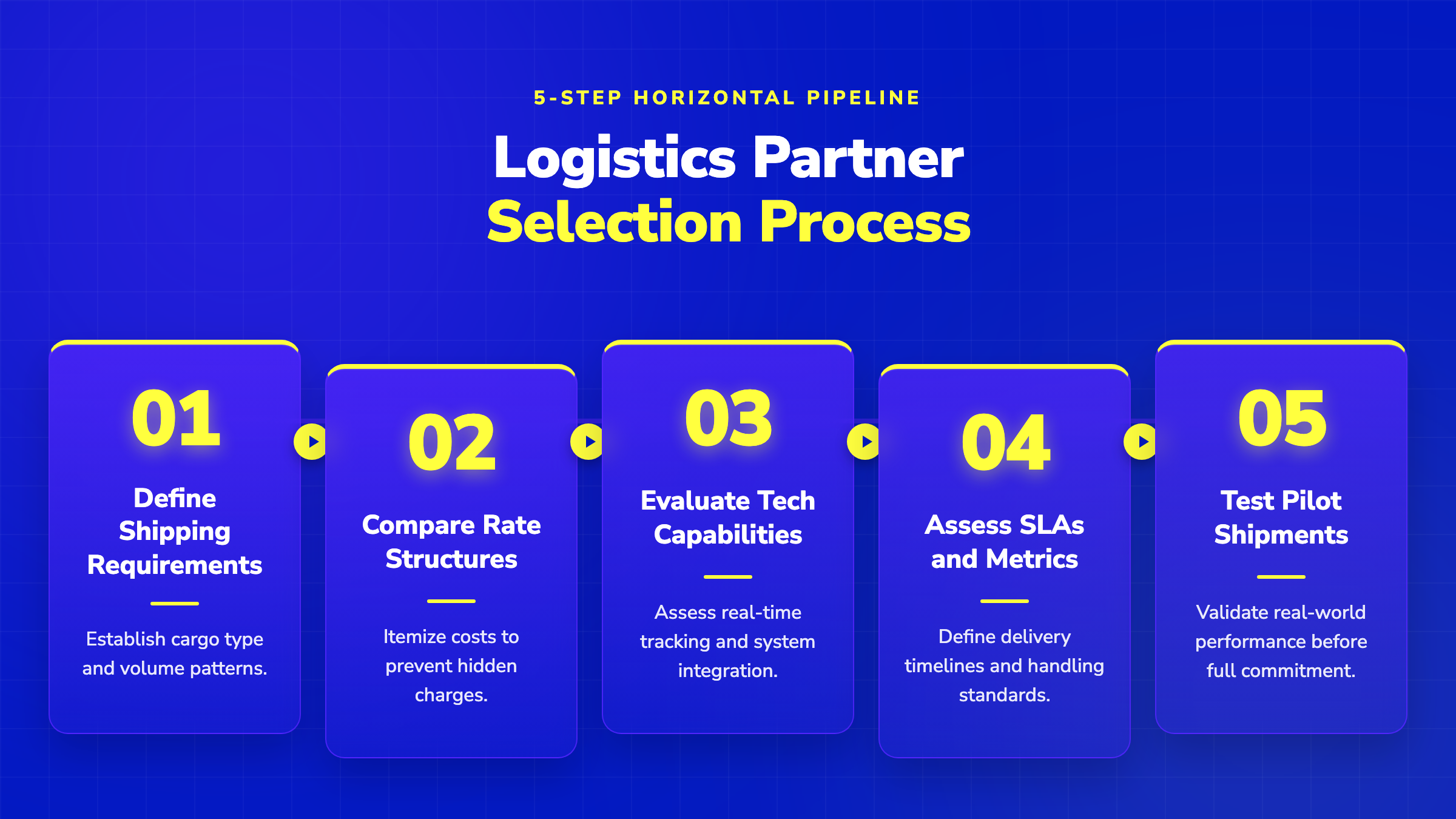
Step 4: Assess Service Level Agreements and Performance Metrics
Formal service level agreements (SLAs) should define specific performance expectations including delivery timelines, cargo handling standards, damage liability, and dispute resolution procedures. Critical evaluation factors include customs clearance expertise for restricted goods and GCC trade regulations, documentation quality with proactive issue flagging, track record with your specific cargo type, and adequate insurance coverage with efficient claims handling.
Step 5: Test with Pilot Shipments Before Full Commitment
Before committing to a long-term partnership, conduct pilot shipments to validate the provider's capabilities. This testing phase reveals real-world performance in areas like quote accuracy versus final billing, actual transit times compared to promises, problem resolution effectiveness, and communication quality during exceptions. A provider's ability to anticipate issues before they develop becomes evident through actual shipment execution rather than sales presentations.
Need a shipping quote?
Get AI-optimized rates from DHL, FedEx & UPS — up to 65% below retail. Quote in under 10 minutes.
Cost Optimization Strategies When Working with Dubai Logistics Companies
Maximizing value from your logistics partnerships requires understanding the cost drivers and optimization opportunities available in Dubai's competitive shipping market. Smart strategies can reduce your international shipping expenses by 30-65% while maintaining or improving service quality.
Volume consolidation benefits and Key Account rate access represent the most impactful cost optimization strategy. By combining multiple less-than-truckload (LTL) shipments into full truckload (FTL) deliveries, businesses lower per-unit transport costs significantly. A Dubai-based home décor e-commerce brand reduced yearly storage costs by 35% during Ramadan peaks through flexible scaling. Partnering with 3PL providers grants Key Account rate access with negotiated discounts unavailable to spot shippers—one tech accessories brand cut internal logistics costs by 28% via 3PL outsourcing, including volume-based rates for major carriers.
Multi-carrier comparison advantages unlock competitive pricing through simultaneous evaluation of DHL, FedEx, and UPS rates. Dubai logistics companies with multi-carrier platforms enable real-time bidding that balances cost, reliability, and delivery windows. A Dubai food delivery service using GPS-based optimization tools reduced fuel consumption by 18%, demonstrating efficiency gains that extend to carrier selection for international routes.
Hidden fees to watch for and transparent pricing models protect your bottom line from unexpected charges. Common hidden fees include:

- Dimensional weight surcharges that can double shipping costs
- Fuel levies that fluctuate without notice
- Unapproved rerouting costs during peak seasons
- Customs delay penalties not disclosed upfront
According to logistics cost optimization research, transparent providers offer itemized billing and contract flexibility to flag discrepancies via automated invoice matching. Real-time visibility tools prevent silent cost increases from delays, essential for freight forwarding to Europe or Asia.
Seasonal rate fluctuations and contract versus spot pricing require strategic planning. UAE logistics faces seasonal spikes during Ramadan, Eid, and major events, with demand surges affecting express shipping rates. E-commerce brands using flexible 3PL services during Expo 2020 avoided overhead costs by scaling through shared warehousing. Contract pricing with Key Account access provides stable, volume-discounted rates year-round, while spot pricing suits one-off shipments. Hybrid models that combine contracted base capacity with spot market flexibility can reduce costs by 25% during peak periods.
Technology-driven cost savings through automation represent an emerging optimization frontier. AI-powered route optimization, automated customs documentation, and predictive analytics reduce operational costs while improving service levels. These technologies are particularly valuable when integrated with multi-carrier comparison platforms that automatically select the most cost-effective option for each shipment.
Red Flags to Avoid When Selecting Your Logistics Partner
Identifying warning signs early in the evaluation process can save your business from costly mistakes and operational disruptions. In Dubai's fragmented freight logistics market, valued at USD 23.05 billion in 2026, these red flags indicate providers likely to underperform or create hidden costs.
Lack of carrier diversity or single-carrier dependency exposes your shipments to critical vulnerabilities. Relying on one carrier leaves you helpless during disruptions like missed sailings or route changes—a significant risk in UAE's multimodal trade hub. Capable providers must coordinate across modes for adaptability, as single-mode operators fail during disruptions common in GCC trade routes. The market's consolidation trend, including Q Logistics acquiring Aramex, highlights why diverse carrier networks prevent capacity bottlenecks.
No real-time tracking or outdated technology systems signal a provider unable to meet modern shipping demands. Outdated systems undermine visibility and erode trust in high-stakes international shipping where data quality drives forecasting and planning. Dubai logistics companies must offer AI-driven analytics and reliable data governance to compete effectively. Strategic alliances with technology providers for data sharing are essential, yet many lack this capability, risking delays in Dubai's air freight and Jebel Ali sea routes.
Unclear pricing structures or hidden fee models indicate weak transparency—a critical evaluation factor alongside operational capability. Hidden fees can inflate costs dramatically in a competitive landscape where volume discounts and capacity guarantees should be standard. Scam providers can cause losses exceeding shipment value, a particular hazard in cross-border electronics logistics.

Limited geographic coverage or service gaps create last-mile failures that damage customer relationships. Strong partners own the full journey from origin to delivery with GCC-wide networks. Coverage gaps expose vulnerabilities in UAE's role as a global gateway, particularly at borders with Saudi Arabia or Oman where cross-border documentation becomes critical.
Poor customer service responsiveness or account management becomes evident during crisis situations when immediate action is required. International shipping involves complex regulations, time-sensitive deliveries, and unexpected challenges that demand responsive support. Providers offering only email support or limited business hours cannot adequately serve international operations.
No compliance certifications or regulatory gaps represent serious operational risks. Missing certifications like ISO 9001:2015, AEO status, or IATA licensing indicate a provider operating below industry standards. These gaps often translate to customs delays, security issues, and inability to handle regulated goods properly.
Frequently Asked Questions About Dubai Logistics Companies
What is a Key Account Centre and how does it benefit my business?
A Key Account Centre is a volume partnership tier that major carriers like DHL, FedEx, and UPS offer to their highest-volume partners, providing access to significantly discounted rates, priority capacity allocation, and enhanced service levels. For businesses shipping from Dubai, working with a logistics provider that holds Key Account Centre status means accessing enterprise-level shipping rates typically 40-65% below retail pricing, even if your own volumes wouldn't qualify for these tiers independently. These partnerships also include benefits like dedicated customer service teams, faster customs clearance through established relationships, and priority handling during peak seasons when capacity is constrained.
How do I compare rates between different Dubai logistics providers?
Comparing rates effectively requires looking beyond headline prices to evaluate total landed costs including base freight charges, fuel surcharges, documentation fees, customs clearance costs, last-mile delivery charges, and any dimensional weight adjustments. Request itemized quotes that break down all components, and ensure quotes cover the same service levels (express vs. economy, door-to-door vs. port-to-port). Modern logistics platforms offer real-time multi-carrier comparison tools that display rates from multiple providers simultaneously, enabling apples-to-apples comparisons. Pay special attention to volume discount tiers—providers with Key Account Centre status can offer rates 40-65% below standard retail pricing for the same service quality.
What's the difference between working with carriers directly vs. aggregators?
Working directly with carriers like DHL, FedEx, or UPS gives you a single-carrier relationship but limits your options and negotiating power unless you ship very high volumes. Aggregators consolidate shipments from multiple businesses to achieve Key Account Centre status with multiple carriers simultaneously, passing volume-based savings to customers while providing choice across carriers. Aggregators also simplify operations by offering single-point billing, unified tracking across carriers, and technology platforms that automatically select the best carrier for each shipment based on destination, urgency, and cost parameters. This approach typically reduces shipping costs by 20-40% while improving service flexibility.
What should I look for when choosing an international shipping partner?
When selecting an international shipping partner in Dubai, prioritize providers demonstrating strong carrier relationships (ideally Key Account Centre status), geographic coverage to your target markets (220+ countries for maximum flexibility), real-time tracking technology with API integration capabilities, transparent pricing with no hidden fees, and relevant certifications (ISO 9001:2015, AEO, IATA). Additionally, evaluate their service portfolio breadth—can they handle express, freight, and warehousing under one roof? Look for providers offering 24/7 customer support, proactive shipment monitoring, and a track record with businesses similar to yours. Technology capabilities increasingly differentiate providers, with AI-powered platforms offering 10-minute quotes versus traditional providers taking hours or days.
Can I use multiple logistics providers or should I consolidate?
While using multiple logistics providers might seem to offer flexibility, consolidation with a single, capable provider typically delivers superior results through volume aggregation benefits, simplified operations, and consistent service quality. Consolidating your shipments with one provider who offers multi-carrier access gives you the best of both worlds—carrier diversity without operational complexity. This approach enables you to achieve higher volume tiers for better pricing, streamline billing and reporting, maintain consistent customs documentation processes, and build stronger relationships that translate to better service during peak periods or exceptions. However, ensure your consolidated provider offers true multi-carrier capabilities rather than dependence on a single carrier network.
What certifications should I verify when evaluating Dubai logistics companies?
Essential certifications for international logistics providers include ISO 9001:2015 for quality management systems, demonstrating consistent service delivery processes; AEO (Authorized Economic Operator) certification indicating trusted trader status for faster customs clearance; IATA certification for air freight handling capabilities and safety compliance; and relevant free zone licenses if operating from Dubai's logistics hubs like JAFZA or Dubai South. Additional certifications like ISO 14001 (environmental management) and TAPA (cargo security) indicate advanced operational standards. These certifications aren't just paperwork—they translate to tangible benefits including reduced inspection rates at borders, access to green lanes at customs, and eligibility to handle specialized cargo types that uncertified providers cannot transport.
Sources & References
This article draws on research and data from the following verified sources:
- UAE Freight & Logistics Market Share & Size 2031 Outlook
- Middle East Third-Party Logistics Market Size, Forecasts 2035
- Middle East Logistics and Warehousing Market Outlook to 2030
- UAE Third-Party Logistics Market to Worth US$ 6,529.7 Million By 2030
- UAE executives among the world's most confident on 2026 trade growth
- UAE Logistics Market Outlook to 2028
- Middle East Shipping and Logistics Market Analysis 2026
- UAE ranks among top countries with largest global maritime fleets
- Best Logistics Companies in UAE (2026) | Top 10 Ranked - Quiqup
- UAE Logistics Market Report, Size, Trends and Future Outlook
- LBX Logistics - Freight Forwarding in Dubai 2026 Industry Guide
- Dahla - How to Choose the Right Logistics Company in UAE: Practical 2026 Guide
- Inlex Partners - Starting a Logistics Business in Dubai 2026: Complete Setup Guide
- Kayrouzandassociates - Logistics Company Setup Dubai 2026: Complete Guide to Costs
- Effective Strategies to Reduce Logistics Costs - Alaan
- 5 Effective Ways to Reduce Logistics Costs in UAE - eShipper UAE
- UAE Express Delivery Market Report and Forecast 2026-2034
- UAE Logistics Market Size is Expected to Reach USD 95.2 Billion
- United Arab Emirates (UAE) CEP Market Analysis 2026
- The UAE Courier, Express, and Parcel Market Size & Outlook, 2033
Tags
Related Articles
Ready to optimize your logistics?
Whether you need express shipping, freight forwarding, or warehousing — our AI finds the best rates and routes for your business.