Yes, you can ship lithium batteries from the UAE by air and express, as dangerous goods (Class 9). Whether your shipment goes smoothly depends on two questions you answer before you start: is the battery lithium ion or lithium metal, and is it shipped by itself, packed with equipment, or inside equipment?
Many delays in shipping lithium batteries internationally come from incorrect classification, not from the battery itself. Get these two details right and the rest follows. This guide, written for UAE business shippers, explains what you need to know for 2026.
Can you ship lithium batteries from the UAE?
You can ship lithium batteries from the UAE by air and express if you follow the dangerous goods rules. Lithium batteries are Class 9 dangerous goods, and carriers only accept fully regulated battery shipments from approved accounts: DHL Express, for example, approves and audits shippers through its Restricted Commodities Team before they send any dangerous goods.
So choose a logistics partner that classifies, documents and packs dangerous goods under the IATA Dangerous Goods Regulations (DGR). The type of battery and how it is packed decide the rules, the labels, and whether it can fly on a passenger or a cargo-only aircraft.
Lithium ion or lithium metal: the first question
Your first step is to identify the battery's chemistry. This single detail determines which regulations and limits apply. There are two main types.
What is a Lithium-Ion Battery?
These are rechargeable batteries. They power the vast majority of consumer and business electronics. Think of laptops, smartphones, tablets, cameras, and power banks. Their capacity is measured in Watt-hours (Wh). This is the key metric for shipping lithium batteries by air.
What is a Lithium-Metal Battery?
These are typically single-use, non-rechargeable batteries. They are common in devices that require a long-life power source, such as watches, calculators, smoke detectors, and some remote sensors. Their capacity is measured by their lithium metal content in grams (g).
Where to Find the Battery Rating
You can find the Wh rating or lithium content in one of three places:
- On the battery itself: Many batteries show the rating on the casing.
- On the product's technical specification sheet: The device manual or product data sheet will list the battery specifications.
- On the Safety Data Sheet (SDS): The manufacturer or supplier provides an SDS, which details the battery's composition and transport information. While an SDS is not mandatory for transport under IATA DGR, most carriers and forwarders, including Infinity Logistics, request it to verify compliance.
If you only have the voltage (V) and amp-hours (Ah), you can calculate the Watt-hours: Wh = Volts (V) x Amp-hours (Ah).
UN 3480, 3481, 3090 and 3091 in one table
Once you know the chemistry, the next question is how the battery is packed. This determines its UN number, which is the universal code for classifying dangerous goods. Getting this right is essential for shipping lithium batteries internationally.
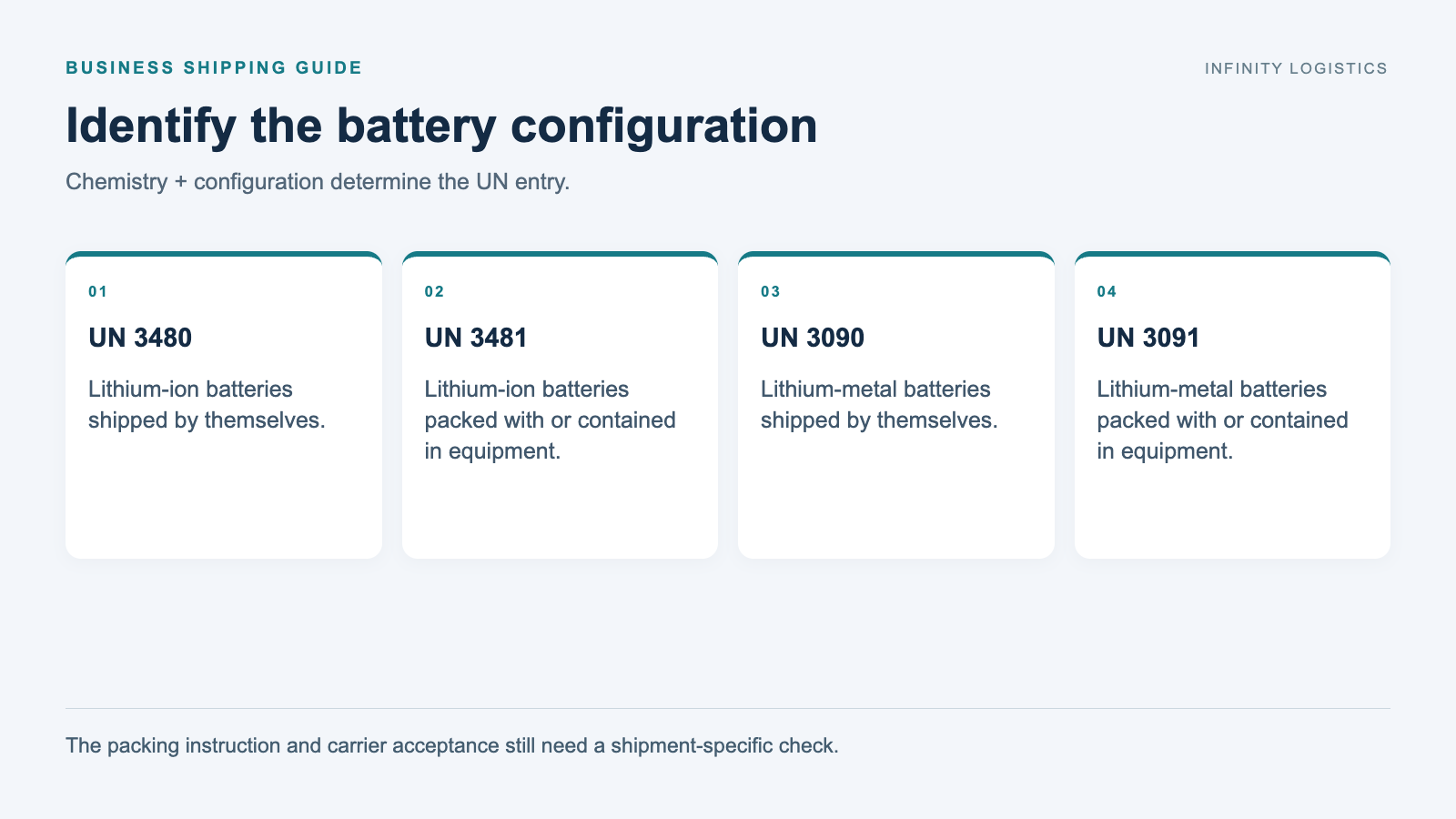
There are three configurations:
- Shipped by themselves ("loose"): The package contains only batteries. This includes bulk packs, spare batteries and power banks. Power banks are classed as batteries (UN 3480, or UN 3090 for lithium metal), not as equipment.
- Packed with equipment: The battery is in the same box as the device it powers, but not installed inside it (e.g., a new laptop with its battery in the same box).
- Contained in equipment: The battery is installed inside the device it powers (e.g., a smartphone or a piece of IT and networking equipment).
This table breaks down the UN numbers based on chemistry and configuration:
| UN Number | Battery Type | Configuration | Common Examples | Passenger Aircraft? |
|---|---|---|---|---|
| UN3480 | Lithium Ion (rechargeable) | By themselves ("loose") | Power banks, spare laptop batteries, e-bike batteries | Forbidden |
| UN3481 | Lithium Ion (rechargeable) | Packed with or Contained in Equipment | Laptops, smartphones, medical devices | Permitted (with restrictions) |
| UN3090 | Lithium Metal (non-rechargeable) | By themselves ("loose") | Bulk coin cells, spare industrial batteries | Forbidden |
| UN3091 | Lithium Metal (non-rechargeable) | Packed with or Contained in Equipment | Watches, sensors, calculators with batteries installed | Permitted (with restrictions) |
The key takeaway: loose lithium batteries (UN3480 and UN3090) are forbidden as cargo on passenger aircraft. They must fly on cargo aircraft only, which significantly impacts route and carrier options.
The 30% state-of-charge rule and what changed in 2026
For safety, the energy level of lithium-ion batteries is strictly controlled during air transport. This is known as the state of charge (SoC), which is how "full" the battery is.
What is State of Charge (SoC)?
SoC is the battery's current charge level as a percentage of its rated capacity. A 30% SoC means the battery is less than one-third full, which reduces the risk of thermal runaway in transit.
The Rule for Loose Lithium-Ion Batteries (UN3480)
IATA rules require lithium ion cells and batteries shipped by themselves (UN 3480, packing instruction 965) to be at a state of charge of no more than 30% of rated capacity. Shipping above 30% needs approval from both the State of Origin (for the UAE, the GCAA) and the State of the Operator (the airline's country), under Special Provision A331.
The Big Change for 2026: Batteries Packed With Equipment
The most significant recent change impacts batteries packed with equipment. According to the IATA DGR 67th Edition, effective 1 January 2026, the 30% SoC limit is now mandatory for:
all Section I shipments of lithium ion batteries packed with equipment (UN 3481, packing instruction 966), and Section II batteries above 2.7 Wh.
So if you ship a device with its battery packed separately in the same box, that battery must be at 30% state of charge or less, unless it is a small Section II battery of 2.7 Wh or less. For batteries contained in equipment (packing instruction 967), a state of charge of 30% or less (or an indicated battery capacity of 25% or less) is strongly recommended but not mandatory.
Documents to have ready: the SDS and the UN38.3 test summary
To get a fast and accurate quote, having the right documents ready is crucial. A forwarder cannot classify your shipment without them.
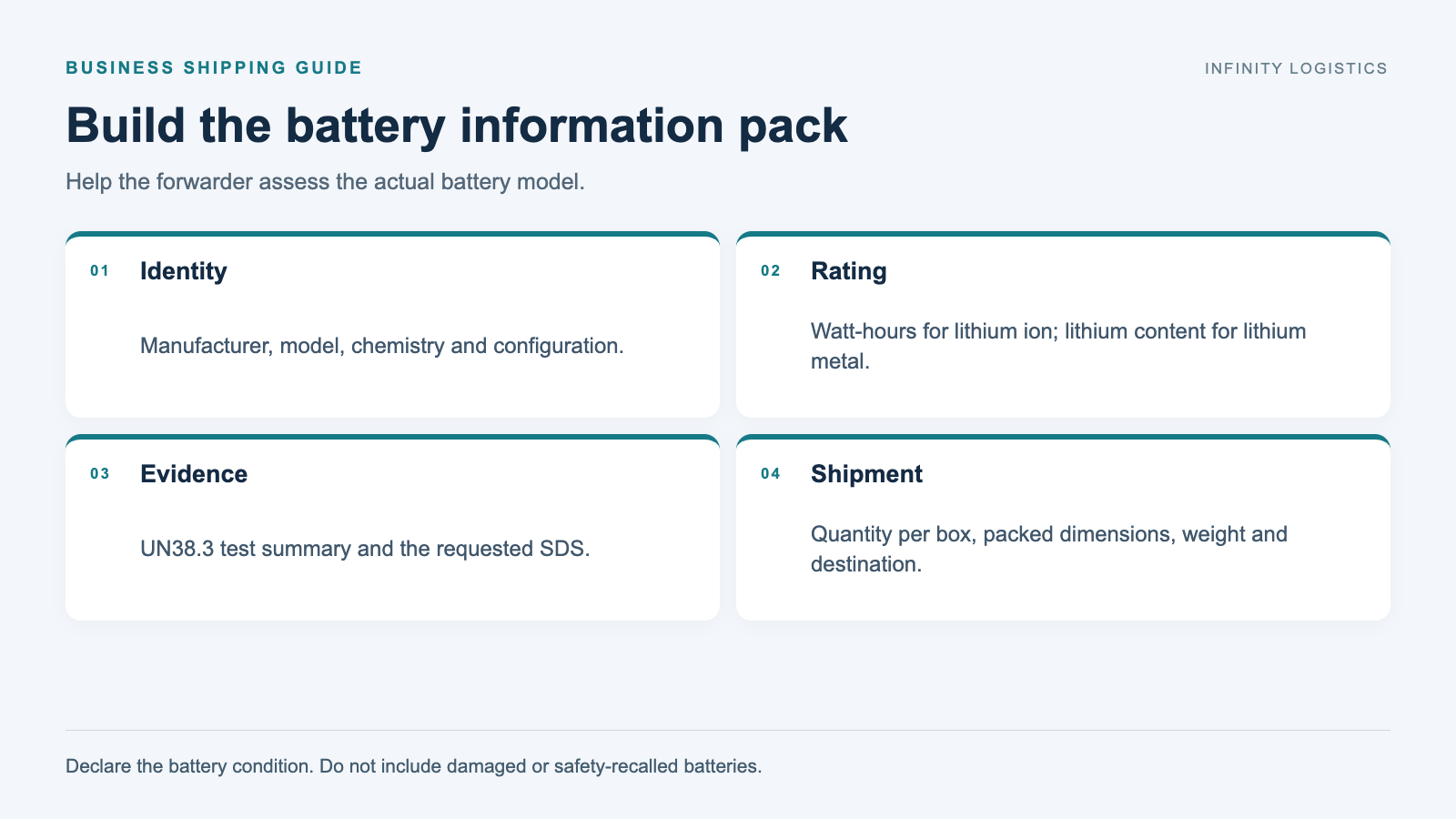
Safety Data Sheet (SDS)
An SDS (formerly MSDS) is a standard document from the battery manufacturer that gives its composition, hazards and handling. IATA does not require an SDS for transport, but carriers and forwarders commonly ask for it to confirm the battery's specifications and classification.
UN38.3 Test Summary
This is the most critical document. The lithium battery test summary is proof that the battery model has passed a rigorous set of safety tests defined in the UN Manual of Tests and Criteria. These tests simulate transport conditions like pressure, temperature, vibration, and impact.
- Who provides it? The battery manufacturer or distributor is obligated to make it available.
- How is it provided? It can be a PDF document, but regulations also permit a web link or QR code that leads to the summary online. Infinity Logistics can use a link or QR code to verify your battery's compliance.
Ask the manufacturer or distributor for the UN38.3 test summary for the battery model. Missing test evidence needs specialist review before booking; prototype and other special provisions must not be assumed to apply to a routine shipment.
Need a shipping quote?
Get AI-optimized rates from DHL, FedEx & UPS — up to 65% below retail. Quote in under 10 minutes.
Commercial Invoice
Your commercial invoice should be precise: state the battery type, UN number, packing configuration (for example, "Lithium-ion batteries contained in equipment") and quantity. Vague descriptions such as "electronics" or "spare parts" can lead to inspections and delays.
Express courier or air freight: which fits
Choosing between express and air freight depends on your shipment's size, urgency, and battery configuration.
When to Use Express Courier (DHL, FedEx, UPS)
Express is ideal for smaller, time-sensitive shipments, such as samples, prototypes, or direct-to-customer orders. Infinity Logistics provides dangerous goods express from Dubai using our Key Account status with all major carriers.
- Best for: Batteries contained in or packed with equipment (UN3481 / UN3091).
- Requirement: Carriers accept fully regulated battery shipments only from approved dangerous goods accounts. DHL Express, for example, requires an approved account for lithium batteries in its time-definite international network. Infinity's dangerous goods express service ships lithium batteries in phones, laptops, power banks and battery-powered equipment; send us the battery details and we confirm which carrier and service can accept them.
- Limitation: Batteries shipped by themselves (UN 3480 and UN 3090) are forbidden on passenger aircraft, and some express routes restrict battery shipments. Check acceptance for your lane before you book.
When to Use Air Freight
For larger commercial volumes, pallets and bulk consignments of batteries shipped by themselves, dangerous goods air freight on cargo aircraft is usually the route.
- Best for: Bulk consignments, including batteries shipped by themselves (UN 3480 / UN 3090).
- Requirement: These shipments must fly on cargo aircraft only and carry the appropriate label.
- Process: Infinity identifies the UN number and packing requirements, prepares the Shipper's Declaration for Dangerous Goods and books space on cargo aircraft.
- IATA Battery Guidance Document — 2026
What About Sea Freight?
For very large, non-urgent consignments, sea freight is a viable and cost-effective option. Shipments are governed by the IMDG Code. Infinity Logistics can assess this on a case-by-case basis.
Packing and labelling in plain terms
Proper packing is non-negotiable. The goal is to prevent short circuits and protect the batteries from damage.
- Protect the Terminals: All exposed battery terminals must be protected against short-circuiting. This can be done by covering them with non-conductive tape, placing each battery in a separate plastic bag, or using original retail packaging.
- Use Strong Outer Packaging: Place batteries in a strong, rigid outer box that meets the packing instruction for your battery type.
- Prevent Movement: Use cushioning and dividers to ensure batteries or devices cannot move or shift inside the box during transit.
- Apply the correct marks and labels: The applicable packing instruction determines which battery mark, hazard labels and handling labels are required. Have the complete package checked before dispatch.
The exact limits on the number of batteries per package are set by the IATA packing instruction for your battery (for example, PI 965 or PI 967). Infinity confirms these limits when quoting.
What to Send for a Battery Shipping Quote
Many battery shipments stall because information is missing. Send these details with your request and we can quote quickly:
- Battery Type: Is it Lithium-Ion or Lithium-Metal?
- Configuration: Is it shipped loose (by itself), packed with equipment, or contained in equipment?
- Battery Rating: What is the Watt-hour (Wh) rating for each Li-ion battery, or the lithium content in grams (g) for each Li-metal battery?
- Quantity: How many batteries are in each box, and how many total boxes are in the shipment?
- Documentation: Do you have the UN38.3 Test Summary and the Safety Data Sheet (SDS)? Please attach them to your request.
- Shipment Details: What are the dimensions (L x W x H) and gross weight of each packed carton?
- Destination: What is the full address and contact information for the business consignee?
With this information we can classify the shipment and compare carrier options quickly. Ready to start? Send your details and get a battery shipping quote.
How Infinity handles lithium battery shipments
Infinity Logistics, founded in 2017, ships lithium batteries through its dangerous goods express service, from our office in Ajman Free Zone and warehouse in Dubai Investment Park.
Our process is built for speed and compliance:
- Classification: Our dangerous goods team uses your SDS and UN38.3 summary to identify the UN number and packing instruction.
- Documentation: We check the air waybill and prepare a Shipper’s Declaration where required. Section II provisions apply only when the specific battery and shipment meet all qualifying conditions.
- Carrier Comparison: With Key Account status on DHL, FedEx and UPS at the same time, and as the #2 DHL partner in the UAE, we compare all three carriers in real time with our AI agents.
- Quoting: Complete battery details let us compare eligible services quickly. Business express rates can be up to 65% below retail; a firm booking remains subject to dangerous goods acceptance.
As a WCA Inter Global member, Highly Commended as Express Logistics Company of the Year at the Logistics Middle East Awards 2022, Infinity handles classification, documentation and transport in one place.
Frequently Asked Questions
Can I ship power banks from Dubai?
Yes, but under strict rules. Power banks are classed as batteries shipped by themselves (UN 3480), not as equipment. They must be at a state of charge of no more than 30%, be declared as Class 9 dangerous goods, and travel on cargo aircraft only. Infinity's dangerous goods express service ships power banks: send the battery details and the UN38.3 summary for a quote.
Do batteries inside a device still count as dangerous goods?
Yes, batteries contained within a device (e.g., a smartphone or laptop) are still classified as dangerous goods (UN3481 or UN3091). However, they are subject to less restrictive regulations than loose batteries and can often travel on passenger aircraft, provided they meet size (Wh rating) and quantity limits. The packaging must still be strong and prevent accidental activation.
What is a UN38.3 test summary?
A UN38.3 test summary records the required transport testing for a battery design. Obtain the summary for your actual battery model from its manufacturer or distributor and provide it for the shipment review.
Why can loose lithium batteries not go on passenger flights?
Batteries shipped by themselves (UN 3480 and UN 3090) are forbidden as cargo on passenger aircraft because a loose battery is more exposed to damage, short-circuiting and thermal runaway than one installed in equipment. Confining them to cargo aircraft is a safety measure in the IATA regulations.
Can damaged or recalled batteries be shipped?
Lithium batteries identified as damaged or defective for safety reasons, or recalled because they could generate dangerous heat, fire or a short circuit, are forbidden for air transport. Do not include them in a normal shipment. A specialist must assess any lawful alternative transport or disposal arrangement.
Sources & References
Official and industry sources referenced in this guide:
Tags
Related Articles
Ready to optimize your logistics?
Whether you need express shipping, freight forwarding, or warehousing — our AI finds the best rates and routes for your business.