
Dubai Freight Forwarding Companies: How to Choose the Right Partner
What Makes a Dubai Freight Forwarding Company Stand Out in 2026
In Dubai's dynamic logistics landscape, choosing the right forwarding company dubai has become more critical than ever. As the UAE freight forwarding market reaches USD 21.56 billion in 2025 and projects growth to USD 35.08 billion by 2032 at a 7.2% CAGR, according to Coherent MI's UAE Freight Forwarding Market report, businesses need partners who can navigate this complex ecosystem effectively.
Freight forwarding in Dubai's context involves coordinating international shipments through world-class infrastructure like Jebel Ali Port, which handles massive container volumes as the Gulf's premier gateway. The Mordor Intelligence Middle East Freight Forwarding Market report highlights that Dubai's strategic position enables efficient cargo consolidation and re-export between Asia, Europe, Africa, and beyond.
What truly differentiates a standout forwarding company dubai in 2026? Three key factors emerge: carrier relationships, technology integration, and comprehensive service scope. Leading forwarders maintain strong partnerships with major carriers, enabling access to deepwater hubs like Jebel Ali and Khalifa Port, which hold 41.89% sea freight market share in the Middle East. Technology has become equally crucial—Dubai Customs' blockchain platform now reduces declaration times to under 10 minutes, while companies like Aramex launched AI-powered digital freight platforms in November 2024.
The evolution from traditional forwarding to AI-powered logistics aggregation represents a fundamental shift in how businesses approach international shipping. Rather than managing multiple carrier relationships and manual processes, modern comprehensive freight forwarding solutions leverage technology to aggregate rates, automate operations, and deliver transparency that was impossible just a few years ago.
Essential Criteria for Evaluating Freight Forwarding Partners
When selecting a freight forwarder UAE, your evaluation should focus on four essential criteria that separate industry leaders from average operators. The Mordor Intelligence UAE Freight & Logistics Market report reveals that the market's 6.55% CAGR growth through 2031 is concentrated among providers who excel in these areas.
Carrier Network Coverage and Partnership Tiers
Leading Dubai-based forwarders like DHL Global Forwarding, DB Schenker, and CEVA Logistics maintain tiered partnerships that offer significant advantages. Key Account status provides high-volume clients with preferential rates, dedicated capacity, and priority handling—benefits that standard agents cannot access. DP World's expansion to 180 global offices by end-2024, including 100 new GCC sites, demonstrates how network density translates to better service for Key Account customers.
The consolidation trend reinforces this advantage. DSV's USD 15.78 billion acquisition of DB Schenker in May 2025 boosted Middle East multimodal coverage, while ADQ's July 2025 majority stake in Aramex consolidated regional parcel slots. These moves create economies of scale that benefit customers through lower rates and expanded service options.
Service Portfolio Breadth
Top providers bundle multiple services to create comprehensive solutions. According to market data, air freight generates 44.33% of UAE forwarding revenue in 2025, while sea freight and container shipping captures 41.89% Middle East market share. The most capable partners offer:
- Air freight with automated capacity allocation
- Sea freight with deepwater port access
- Road freight connecting GCC markets
- customs clearance services with blockchain integration
- Temperature-controlled storage for pharmaceuticals
- Bonded warehousing in free zones
Technology Capabilities
Modern freight forwarding demands advanced technology integration. Evaluate partners for real-time tracking, instant quoting, and API integrations that eliminate manual processes. Dubai Customs' blockchain platform sets the baseline—any forwarding company dubai without comparable digital capabilities will impose delays and visibility gaps on your supply chain.
The impact is measurable: UPS invested USD 100 million in Dubai South in March 2025 for automated sorting, while 40% of multinationals established Gulf free-zone distribution centers in 2024 for digital supply planning. These investments in AI-powered logistics operations translate directly to faster quotes, better visibility, and lower costs for shippers.

Geographic Expertise
Focus on expertise in key trade corridors: UAE-USA, UAE-Europe, UAE-China, and UAE-GCC. The Nexdigm UAE Freight Forwarding Market report notes that Dubai's hub status drives 52% of population and 70% of retail activity, making corridor expertise essential. Jebel Ali buffers Asia-Europe reroutes, while the UAE maintains the fastest growth in Middle East forwarding at 5.95% CAGR.
Understanding Freight Forwarding Costs and Rate Structures
The cost landscape for freight forwarding in Dubai has become increasingly complex, driven by multiple operational pressures affecting rate structures. Understanding these dynamics is crucial when evaluating any freight forwarder UAE partnership.
Primary rate determinants include weight, dimensions, origin/destination pairs, and commodity classification. However, the traditional model of static pricing has fundamentally shifted. According to Statista's freight forwarding market analysis, modern forwarders leverage dynamic, real-time pricing systems that account for carrier capacity, fuel volatility, and market demand fluctuations.
The cost environment presents particular challenges in 2026. Fuel price swings elevated trucking costs by up to 20% in 2024, and these pressures persist. Additionally, the Federal Climate Law's emission-reporting requirement, effective May 2025, mandates telematics and auditing systems costing USD 50,000-200,000 for mid-size carriers—expenses passed through to shippers.
Hidden Costs to Watch For
Beyond base freight rates, businesses must account for multiple ancillary charges that can significantly impact total logistics spend:
- Fuel surcharges: Volatile and indexed to crude oil prices
- Documentation fees: Essential for international shipments, particularly for air freight services from Dubai
- Handling charges: Especially relevant for companies utilizing Dubai Airport Freezone facilities
- Compliance fees: Driver licensing and fleet upgrade mandates increase operational costs
Volume Discounts and Key Account Centre Advantages
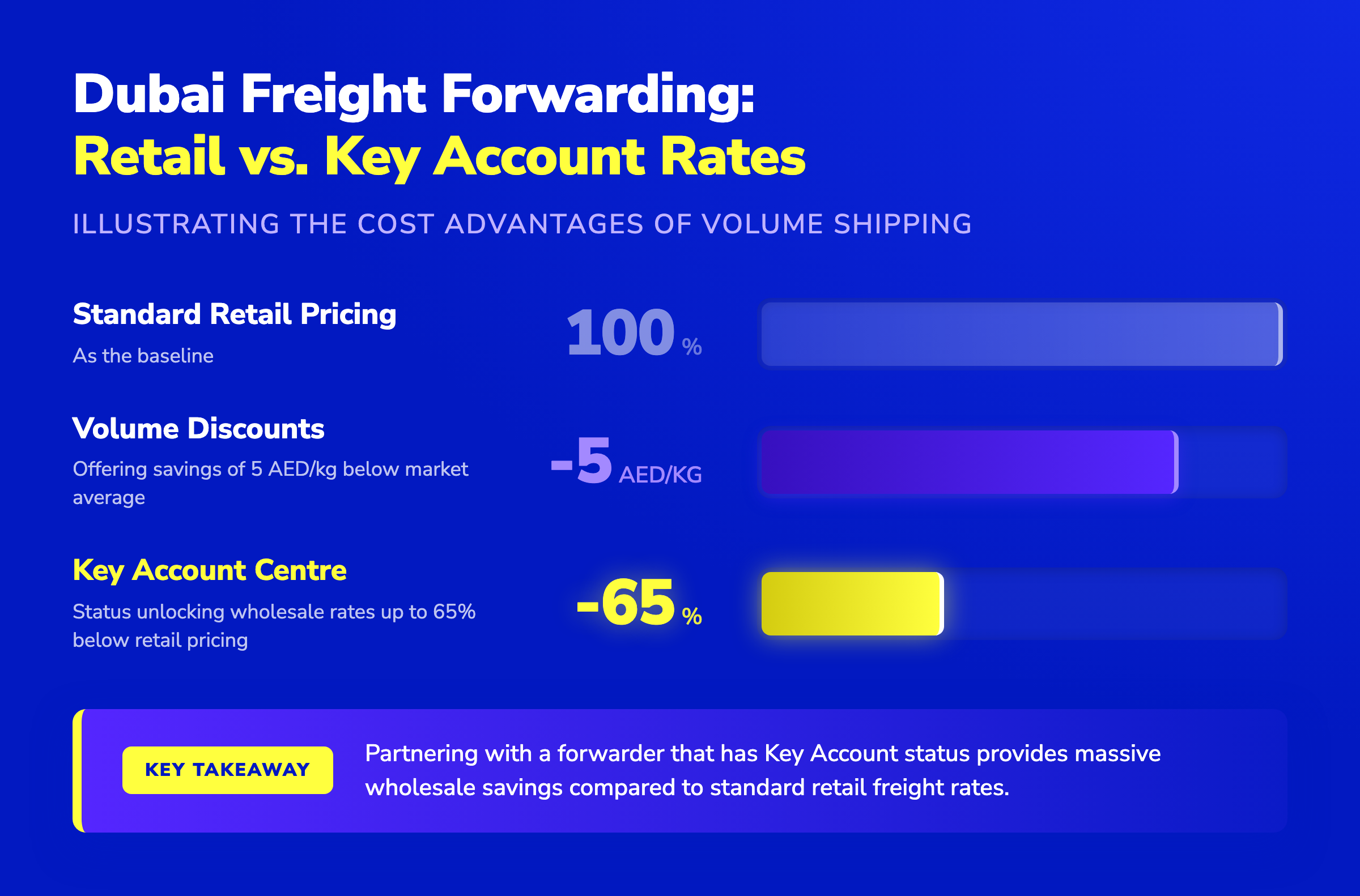
Leading Dubai freight forwarders offer volume-based pricing structures that reward consistent shippers. For example, established firms provide express-level air cargo delivery with rates 5 AED/kg below market average through direct flights and dedicated warehouse facilities. This represents tangible volume advantages for high-frequency shippers.
A Key Account Centre represents the highest tier of carrier partnership, providing exclusive access to wholesale rates typically 65% below retail pricing. This status, achieved through massive shipment volumes, enables freight forwarders to pass significant savings to their clients while maintaining service quality.
How Modern Freight Forwarding Works: The AI-Powered Process
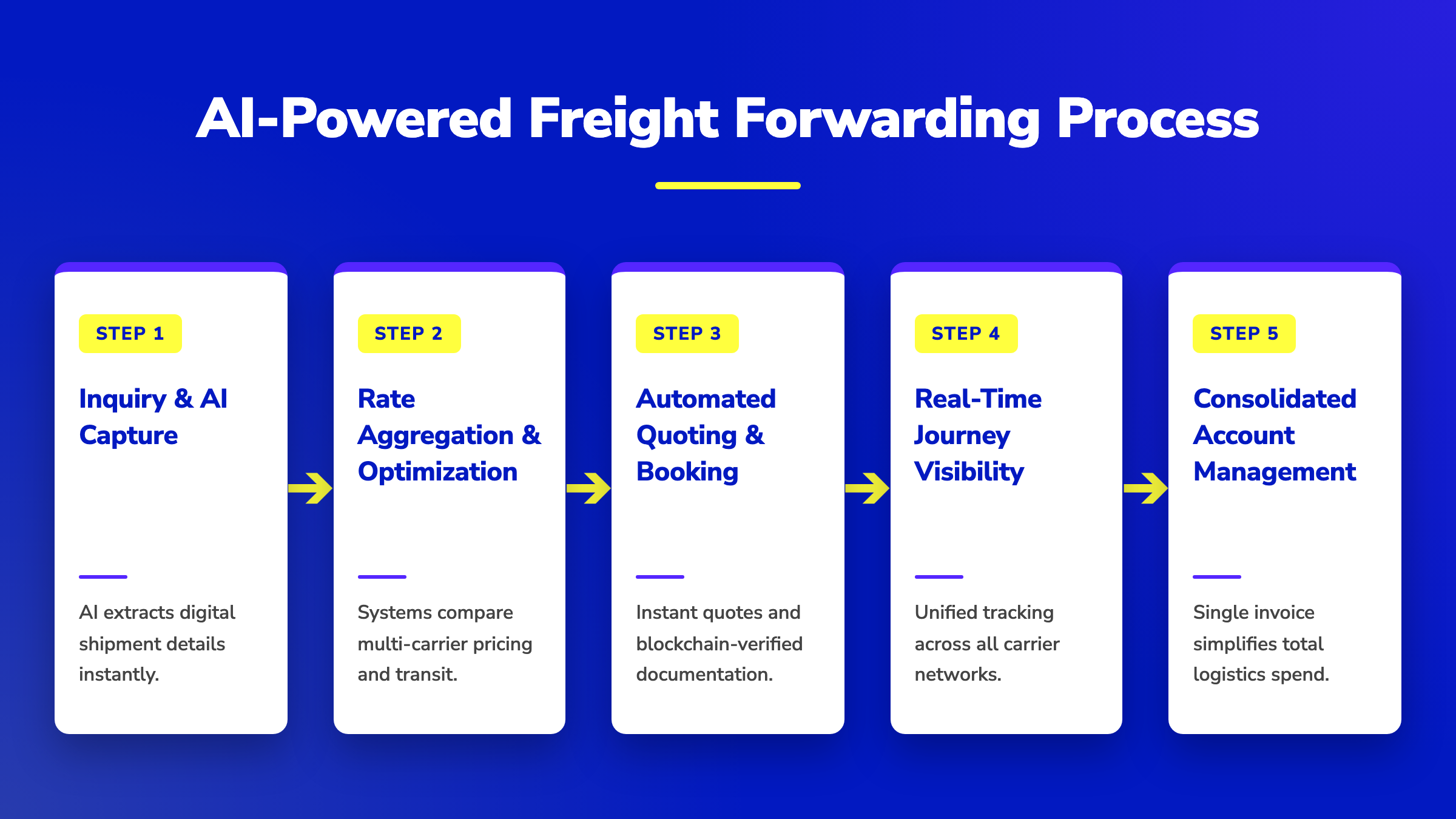
The transformation from manual freight forwarding to AI-powered operations has revolutionized how businesses ship internationally from Dubai. Understanding this process helps you evaluate whether a forwarding company dubai operates with modern efficiency or outdated methods.
Step 1: Customer Inquiry Submission
Customers initiate requests through digital channels—email, phone, or web forms. The UAE's government digitization programs have simplified customs procedures and enabled omnichannel models. According to the Mordor Intelligence report, global integrators like UPS invested USD 100 million in Dubai South in March 2025 for automated sorting to handle rising inquiry volumes efficiently.
Step 2: AI-Powered Requirement Capture
AI agents automatically extract shipment details and classify cargo types. With air freight generating 44.33% of 2025 forwarding revenue, accurate classification is crucial. The Ken Research GCC AI-Powered Logistics report values the regional AI logistics market at USD 1.2 billion, with tools reducing stockouts by 30% through accurate demand capture.
Step 3: Multi-Carrier Rate Aggregation
Systems query multiple carrier rate sheets simultaneously, leveraging real-time data feeds. DP World's USD 2.5 billion investment pushed national throughput past 100 million TEU in January 2025, enabling seamless multi-carrier access at hubs like Jebel Ali.
Step 4: Intelligent Comparison and Optimization
AI analytics compare options across price, transit time, and service levels. The technology optimizes for specific needs—whether fast transit for e-commerce or cost efficiency for bulk shipments. Sea forwarding grows at 8.12% CAGR (2026-2031) due to these digitized quotes and tracking capabilities.
Step 5: Transparent Quote Generation
Unlike traditional forwarders who take days, AI-powered systems deliver comprehensive quotes within hours. This speed advantage stems from automated rate calculation and instant carrier availability checks, eliminating manual back-and-forth communications.
Step 6: Booking and Documentation
Once approved, the system automatically confirms bookings and generates required documentation. Integration with Dubai Customs' blockchain platform ensures compliance while reducing processing time to under 10 minutes.
Step 7: Real-Time Visibility
Throughout the shipment journey, unified tracking provides complete visibility across all carriers. This single-dashboard approach contrasts sharply with traditional forwarding, where customers juggle multiple carrier portals.
Step 8: Consolidated Account Management
Perhaps most importantly, businesses receive one invoice covering all carriers and services. This consolidation through express logistics aggregation simplifies accounting and provides clear cost visibility across your entire logistics spend.
Need a shipping quote?
Get AI-optimized rates from DHL, FedEx & UPS — up to 65% below retail. Quote in under 10 minutes.
Red Flags: What to Avoid When Choosing a Forwarding Company
Identifying warning signs early can save your business from costly logistics failures. Here are critical red flags to watch for when evaluating any freight forwarder UAE.
Limited Carrier Relationships
Avoid companies with single-carrier dependency or limited networks. The Coherent MI market analysis shows that major leaders like DHL Global Forwarding and Kuehne+Nagel operate multimodal networks spanning air, sea, and road services. Companies relying on single carriers cannot adapt to capacity constraints—particularly critical given that air freight contributed 46.62% of UAE market revenue in 2025.
Lack of Technology Integration
Manual quoting processes represent a significant operational red flag. Digital platforms now provide instant quotes and real-time container tracking, setting the technology baseline. Companies without API integration, automated customs documentation, or real-time tracking will impose hidden delays on your supply chain.
Non-Transparent Pricing
Legitimate forwarding companies provide upfront, itemized pricing. Avoid partners who obscure customs brokerage fees, duty drawback charges, or ancillary service costs. The market's shift toward digital platforms has made pricing transparency a competitive differentiator—companies that cannot provide clear cost breakdowns are operating outside market norms.
Poor Communication Standards
Slow response times indicate operational fragmentation. With DHL pledging USD 570 million regionally for automated operations and UPS investing USD 100 million in Dubai South, the industry standard is now same-day responses and real-time updates. Companies that take days to quote or cannot provide shipment visibility likely lack the infrastructure to handle your business effectively.
Missing Compliance Certifications
Verify essential certifications including ISO 9001, AEO status, and IATA licensing. These aren't mere formalities—they indicate operational maturity and regulatory compliance essential for smooth international shipping.
Industry-Specific Forwarding Requirements in Dubai
Different industries require specialized logistics solutions from their forwarding company dubai partner. Understanding these unique requirements ensures you select a provider with relevant expertise.
E-Commerce and Retail
E-commerce operators demand fast transit times and efficient small parcel consolidation. With the UAE freight forwarding market growing from USD 21.56 billion in 2025 to USD 35.08 billion by 2032, according to Coherent MI, this growth is substantially fueled by cross-border e-commerce. Dubai's position between Asia, Europe, and Africa enables efficient consolidation through Jebel Ali Port and Al Maktoum International Airport.
Healthcare and Pharmaceutical
Pharmaceutical logistics require temperature-controlled storage and strict regulatory compliance. The Mordor Intelligence report notes that 40% of multinationals established Gulf distribution centers in 2024, many focusing on GDP-certified storage in free zones like JAFZA for temperature-sensitive products.
Oil and Gas
Energy sector logistics demand project cargo expertise and dangerous goods handling capabilities. Saudi Arabia's 39.30% share of Middle East freight forwarding stems from Vision 2030 infrastructure investments. Red Sea security incidents in 2024 pushed freight rates up 15-20%, highlighting the need for forwarders with alternative routing capabilities.
FMCG and Trading
High-volume consolidation and cost optimization drive FMCG requirements. Sea freight secured 41.89% of Middle East market share in 2024 through cost-efficient bulk movements. Free trade zones offering 100% foreign ownership and 0% corporate tax enable efficient customs processing for international cargo movements.
Automotive
Automotive logistics require specialized handling and parts distribution networks. Dubai captured 18% of Middle East air freight forwarding in 2023, according to GitNux industry statistics, demonstrating the emirate's capability in time-sensitive automotive parts distribution.
Frequently Asked Questions About Dubai Freight Forwarding Companies
What is a Key Account Centre and how does it benefit my business?
A Key Account Centre is a volume partnership tier that major carriers like DHL, FedEx, and UPS offer to their largest shipping partners. This exclusive status provides access to wholesale rates typically 65% below retail pricing, priority handling during peak seasons, dedicated capacity allocation, and enhanced customer service. For businesses shipping regularly from Dubai, partnering with a freight forwarder that holds Key Account Centre status across multiple carriers means accessing these premium benefits without meeting the massive volume requirements individually. This translates to significant cost savings and better service reliability for your international shipments.
How do I compare freight forwarding rates accurately?
Accurate rate comparison requires looking beyond base freight charges to include all associated costs. Start by requesting itemized quotes that break down ocean/air freight rates, fuel surcharges, documentation fees, customs clearance charges, and any handling fees. Consider transit times alongside pricing—a slightly higher rate with faster delivery might offer better value. Also evaluate volume discounts and contract terms. Modern AI-powered freight forwarders provide instant, transparent quotes that include all fees upfront, making comparison straightforward. Remember that the lowest initial quote often excludes critical services, so ensure you're comparing complete door-to-door solutions.
What's the difference between a freight forwarder and a logistics aggregator?
Traditional freight forwarders act as intermediaries, booking space with carriers and managing documentation. They typically work with limited carrier options and use manual processes for quoting and booking. A logistics aggregator, particularly one powered by AI technology, goes beyond this model by integrating with multiple carriers simultaneously, using technology to compare rates in real-time, and offering unified account management across all shipping options. Aggregators leverage volume partnerships (like Key Account Centre status) across multiple carriers to secure better rates than individual forwarders can access. They also provide single-invoice billing and unified tracking, simplifying logistics management for businesses.
What should I look for when choosing a forwarding company in Dubai?
When selecting a Dubai freight forwarder, prioritize companies with extensive carrier networks, proven technology capabilities, and relevant industry expertise. Look for Key Account or preferred partner status with major carriers, which indicates volume-based pricing advantages. Verify their technology platform offers real-time tracking, instant quoting, and API integration with your systems. Check for essential certifications like ISO 9001, AEO status, and IATA licensing. Evaluate their geographic coverage in your key trade lanes, particularly UAE-USA, UAE-Europe, and UAE-China routes. Finally, assess their industry-specific capabilities—whether temperature-controlled logistics for pharmaceuticals or project cargo handling for oil and gas.
Can I use my existing carrier accounts through a freight forwarder?
Yes, many freight forwarders offer "freight management" services where they handle logistics coordination while billing through your existing carrier accounts. However, this approach typically forfeits the significant cost advantages of aggregated volume pricing. Freight forwarders with Key Account Centre status can offer rates 65% below what individual businesses access directly, even with corporate accounts. The savings from aggregated rates usually far exceed any loyalty benefits from direct carrier relationships. Additionally, using the forwarder's accounts provides single-invoice convenience and eliminates the complexity of managing multiple carrier relationships, making it the preferred option for most businesses.
How long does it take to get a freight forwarding quote in Dubai?
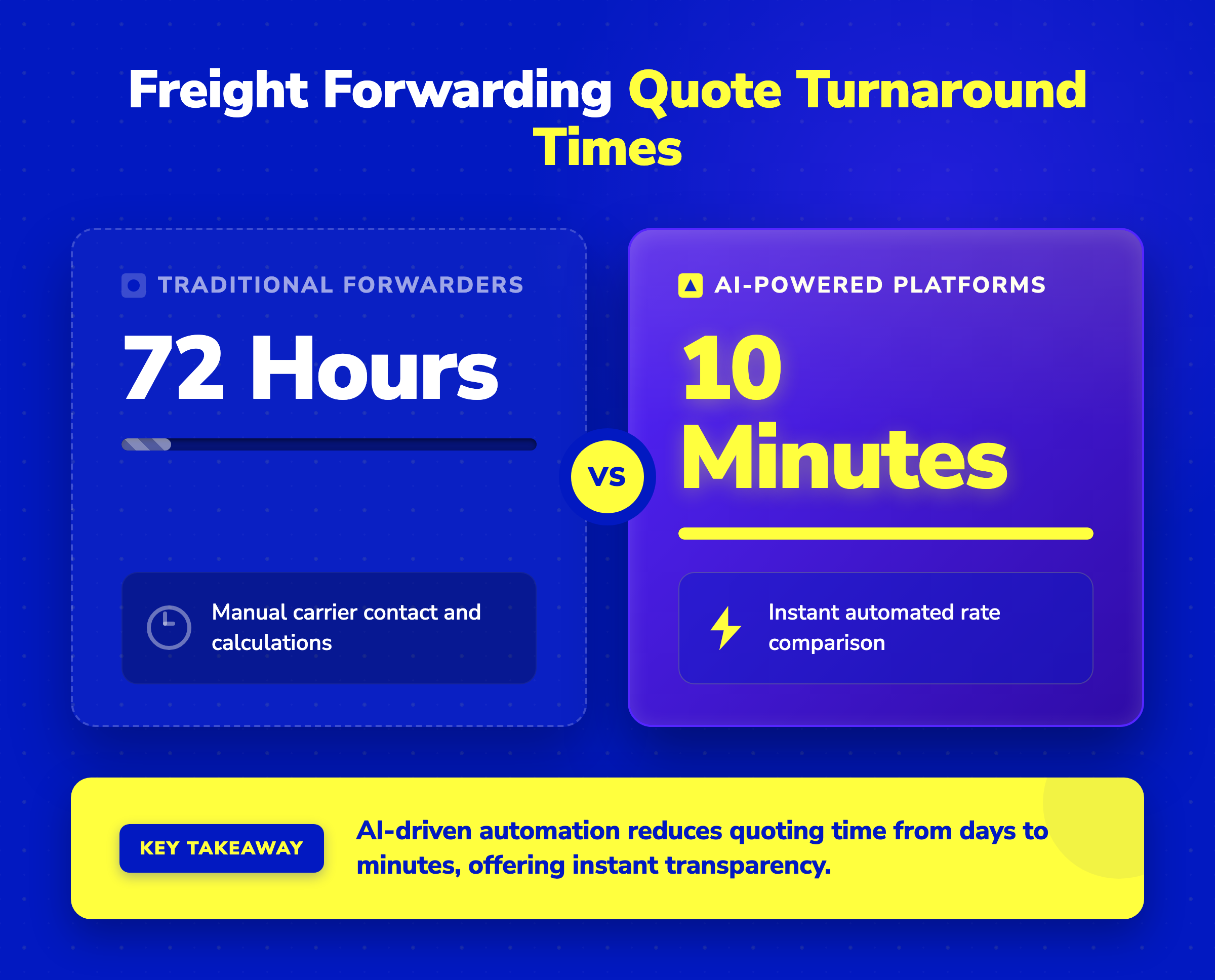
Quote turnaround times vary dramatically between traditional and modern freight forwarders. Traditional forwarders often take 24-72 hours or more, as they manually contact carriers, calculate rates, and prepare proposals. In contrast, AI-powered freight forwarding platforms can generate comprehensive quotes within 10 minutes to a few hours. These systems instantly access real-time carrier rates, calculate all associated charges, and present transparent comparisons across multiple options. For complex shipments requiring special handling or multiple modes of transport, even advanced systems might need up to 24 hours. The speed difference reflects the technology gap—manual processes simply cannot match the efficiency of automated, AI-driven quotation systems.
Sources & References
This article draws on research and data from the following verified sources:
- Middle East Freight Forwarding Market Size, Share & 2030 Growth
- UAE Freight Forwarding Market Size Opportunities 2025-2032
- UAE Freight Forwarding Market Outlook to 2035 - Nexdigm
- Goodfirms - Freight Forwarding Companies in Dubai
- Financial Models Lab - International Freight Forwarding Startup Costs
- Statista - Freight Forwarding - United Arab Emirates Market Forecast
- UAE's AI market set to hit US$46 billion by 2030, says report
- GCC AI-Powered Logistics Forecasting Market | 2024 – 2030 - Ken Research
- UAE Generative Ai Market Size & Outlook, 2026-2033
- Top AI trends shaping freight forwarding in 2026 - Air Cargo Week
- UAE Ranks First Globally in AI Adoption, Fueled by Government ...
- GitNux - Freight Forwarding Industry Statistics: Market Data Report 2026
- UAE Express Delivery Market Report and Forecast 2026-2034
- UAE Logistics Market Size is Expected to Reach USD 95.2 Billion
- Middle East and Africa Shipping and Logistics Market Analysis 2026
Tags
Related Articles
Ready to optimize your logistics?
Whether you need express shipping, freight forwarding, or warehousing — our AI finds the best rates and routes for your business.