
International Shipping Routes from UAE: Complete Guide to Global Corridors
Understanding International Shipping Routes from the UAE
International shipping routes are defined as established maritime, air, and land pathways used by vessels, aircraft, and vehicles to transport goods across borders, serving as critical arteries for global trade that enable efficient cargo movement from origin to destination. Their strategic importance lies in facilitating connectivity between major markets, reducing transit times, and supporting economic growth. According to AJG Dubai, disruptions in key routes can risk $190 billion annually in global trade, highlighting their critical role in the global economy.
The UAE's strategic location at the crossroads of East-West trade routes positions it as a pivotal transshipment hub linking Asia, Europe, and Africa. This geographical advantage has transformed the Emirates into one of the world's most important logistics centers. According to eShipper UAE's analysis, the logistics market reached USD 21.63 billion in 2025, driven by eCommerce expansion and multimodal services, with sea and inland waterway transport projected at a 9.07% CAGR through 2030.
Jebel Ali Port in Dubai, the Middle East's busiest and largest man-made harbor, anchors this role alongside Khalifa Port in Abu Dhabi. UAE ports handled 21 million TEUs in 2023—a record for trade facilitation. The maritime sector contributed AED 135 billion (approximately USD 36.7 billion) to national GDP in 2023, underscoring its economic weight, while UAE entities operate 106 ports worldwide across 78 countries.
Key factors determining route efficiency include:
- Geography: The UAE's position bridges Eastern and Western markets, enabling routes via the Strait of Hormuz and integration with GCC networks like Etihad Rail's west-east spine, which cuts trucking costs by up to 40%
- Infrastructure: World-class ports, free zones like JAFZA and KIZAD offering tax exemptions and streamlined customs, and digital systems boost efficiency
- Trade Agreements: Harmonized customs, free zones, and extensions like those to Oman's Sohar Port support frictionless cross-border clearance
The UAE offers four major shipping modes to serve diverse business needs. Express services handle time-sensitive small parcel delivery via air or integrated networks, ideal for eCommerce. Air freight manages high-value, urgent cargo via Dubai International Airport hubs. Sea freight dominates bulk container shipping through Jebel Ali, growing at the fastest rate of 9.07% CAGR. Road freight provides essential last-mile and inter-emirate haulage, though it's shifting to rail for distances over 200 km due to regulations. These multimodal solutions integrate under one contract to optimize costs and efficiency amid UAE's push for sustainability.
Major International Shipping Corridors from UAE
UAE ports like Jebel Ali and Khalifa Port serve as key gateways for global shipping corridors, leveraging multimodal logistics infrastructure to connect with Europe, the UK, USA, and Asia. According to Mordor Intelligence, the market is projected to grow at a 7.4% CAGR through 2026. Sea freight dominates with a 50% market share in freight forwarding as of 2021, supporting high-volume routes despite recent disruptions in the Strait of Hormuz and Arabian Gulf.
These corridors benefit from UAE's strategic position linking Asia, Africa, and Europe, though 2025-2026 tensions have led to route suspensions by carriers like Maersk and MSC. According to The National, emergency freight rates of $1,800-$3,800 per container have been imposed on Arabian Gulf ports due to these disruptions.
UAE to Europe Corridor
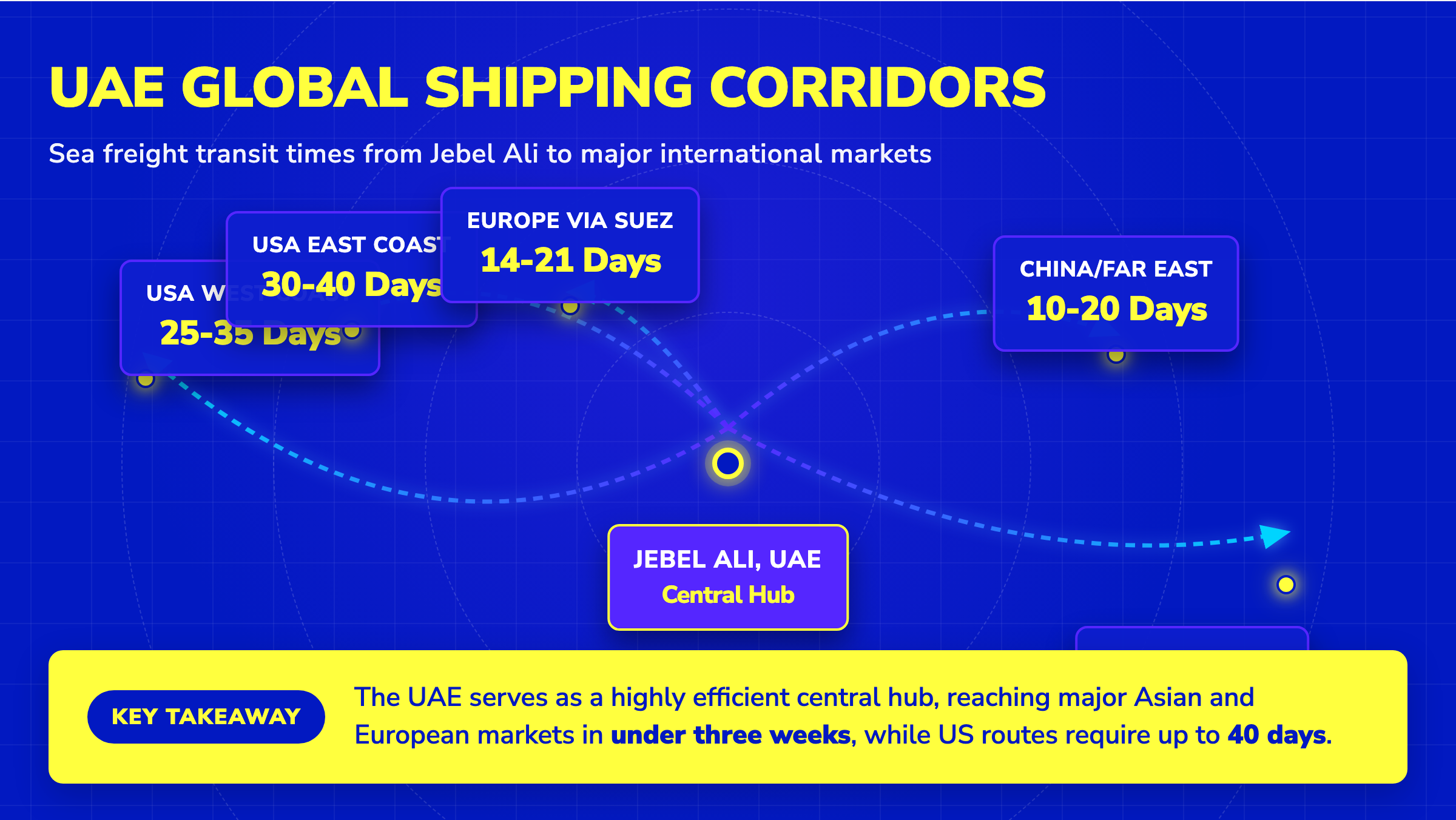
Key destinations include major ports via the Suez Canal and Strait of Hormuz, such as Rotterdam, Hamburg, and Southampton, handling bulk commodities, containers, and reefer cargo from UAE hubs like Jebel Ali. Transit times typically range 14-21 days via Suez, but Houthi threats and 2023-2025 disruptions have forced rerouting around the Cape of Good Hope, adding 10-14 days and spiking rates.
Volume statistics show the Suez Canal vital for Europe-Asia trade. According to Gulf News, the route carries approximately 4.9 million barrels per day of oil (daily value $392M) and 8% of global LNG, with UAE contributing significantly as a Persian Gulf exporter. Multimodal corridors enhance efficiency, positioning UAE as a consolidation hub for forwarders shifting from direct Asia-Europe routes.
UAE to UK Route Specifics
The UAE-UK route focuses on Dubai to Felixstowe/Southampton, driven by demand for cargo from dubai to uk including electronics, textiles, and perishables in express shipping and freight forwarding. Jebel Ali's connectivity supports this as a crossroads for goods to Europe. For businesses looking to send parcel to uk from dubai, sea freight's dominance (50% share) underscores its role in cost-effective shipping solutions.
Brexit impact has increased customs complexities and costs, but UAE free zones and reforms mitigate barriers, sustaining flows amid Gulf's rise as a resilient hub. Recent Gulf suspensions indirectly affect UK-bound rerouting via Europe, making it essential to work with experienced partners who understand these evolving requirements. For detailed guidance on this corridor, explore our UAE to UK shipping guide.
UAE to USA Corridor
East Coast options target New York/New Jersey and Savannah via Suez or Cape routes (transit approximately 30-40 days), while West Coast routes like Los Angeles/Long Beach go direct Pacific (25-35 days) or via Panama. Jebel Ali plays a key role for Asia-US East Coast transshipment. According to The Straits Times, disruptions like Maersk's halt on UAE cargo elevate costs, impacting US supply chains reliant on Gulf hubs.
UAE to China and Far East
Routes to Shanghai, Ningbo, and Singapore emphasize manufacturing supply chains, with UAE as a reverse gateway for components and exports via Arabian Sea-Indian Ocean paths (transit 10-20 days). These corridors support Asia-Gulf trade expansion, integral to UAE's 7.4% CAGR logistics growth, with sea freight enabling bulk flows for e-commerce and industrial warehousing.
The Strait of Hormuz carries approximately 20.9 million barrels per day of oil ($1.67B daily value) critical for China and India, positioning UAE in resilient Far East chains amid rerouting from congested traditional lanes.
UAE to Australia Corridor
The cargo to australia from dubai corridor has experienced significant growth, driven by bilateral trade agreements and increasing demand for UAE exports. Transit times typically range from 20-30 days for sea freight, with major ports of call including Melbourne, Sydney, and Brisbane. For businesses requiring faster delivery, air freight options reduce transit to 3-5 days. Explore our comprehensive UAE to Australia logistics solutions for detailed route information and documentation requirements.
UAE to GCC and Middle East
Regional trade facilitation through the GCC customs union provides seamless connectivity to Saudi Arabia, Kuwait, Qatar, Bahrain, and Oman. Road freight dominates this corridor, with Etihad Rail's expansion reducing costs by up to 40% for longer distances. The GCC market of 55 million consumers creates substantial demand for cross-border logistics services.
UAE to Africa Corridor
Emerging market opportunities in Africa leverage UAE's position as a gateway to the continent. Key destinations include South Africa, Kenya, Nigeria, and Egypt, with Jebel Ali serving as the primary consolidation hub for African-bound cargo. Growing trade volumes reflect Africa's economic expansion and UAE's role in facilitating South-South trade corridors.
Express vs Freight: Choosing the Right Service Mode
Selecting the optimal shipping mode for international shipping from UAE requires understanding the distinct advantages of each service type. While comprehensive data on specific carrier market shares is limited, industry insights reveal clear patterns in service selection based on shipment characteristics and business requirements.
Express Logistics: Speed and Reliability
Express services through global carriers like DHL, FedEx, and UPS excel for documents, parcels, and urgent shipments requiring delivery within 1-5 business days. These services are ideal for high-value, time-sensitive goods such as electronics, pharmaceuticals, and fashion items. Express logistics leverage extensive air networks, with Dubai International Airport serving as a major hub connecting to 140+ destinations globally.
The express segment benefits from integrated tracking systems, door-to-door service, and simplified customs clearance procedures. For businesses needing rapid international delivery, express services provide the fastest transit times, though at premium pricing compared to freight options.
Air Freight: Balancing Speed and Volume
Air freight bridges the gap between express and sea freight, accommodating larger commercial cargo while maintaining relatively fast transit times of 5-10 days. According to Mordor Intelligence, air freight contributed 46.62% of UAE logistics market revenue in 2025, highlighting its importance for time-sensitive goods.
This mode suits businesses shipping palletized goods, seasonal inventory, or products requiring temperature control. Consolidation options allow smaller shippers to access competitive rates by combining cargo, making air freight accessible for mid-volume shipments.
Sea Freight: Cost-Effective Bulk Solutions
Sea freight captured a commanding 50% market share in freight forwarding in 2021, reflecting UAE's port capacities and maritime connectivity crucial for bulk and cross-border shipments. Full Container Load (FCL) and Less than Container Load (LCL) options provide flexibility for various shipment sizes.
However, current disruptions have impacted this sector significantly. According to Business Times, CMA CGM imposed an emergency conflict surcharge of US$2,000 per 20-foot container for regional bookings, directly affecting cost comparisons between service modes.
Comparison Framework for Service Selection
When choosing between express and freight options, consider these key factors:
- Shipment urgency: Express for 1-5 days, air freight for 5-10 days, sea freight for 20-45 days
- Cargo volume: Express for parcels up to 70kg, air freight for pallets, sea freight for containers
- Budget constraints: Sea freight offers lowest per-unit costs for non-urgent shipments
- Product characteristics: Perishables and high-value items favor air/express, bulk commodities suit sea freight
- Documentation requirements: Express services often include simplified customs handling
For businesses seeking optimal carrier selection and pricing, our get your real-time express quote system compares options across multiple carriers instantly. Those requiring larger volume solutions can explore our comprehensive freight forwarding services for customized routing and consolidation options.
Key Factors Affecting International Shipping Routes
International shipping routes from UAE, particularly via Dubai's Jebel Ali port, are influenced by geographic considerations like distance and infrastructure, trade agreements streamlining customs, seasonal variations tied to geopolitical risks, and carrier capacity constrained by rerouting and surcharges. Understanding these factors is crucial for businesses optimizing their global logistics strategies.
Geographic Considerations: Distance, Infrastructure, Port Connectivity
UAE's strategic position as a trade nexus linking Asia, Africa, and Europe relies on advanced multimodal corridors integrating ports like Jebel Ali, airports, and inland hubs. According to recent market analysis, this infrastructure supports a logistics market CAGR of 7.4% through 2026. Jebel Ali adjoins one of the world's largest industrial parks, enabling efficient cargo flow to Africa, Europe, and the US East Coast.
However, geographic advantages can become challenges during disruptions. Distances increase significantly when vessels must route around Africa's southern tip, avoiding shorter Suez and Hormuz paths. Sea freight dominated with 50% market share in freight forwarding in 2021, bolstered by port capacities, though 2026 disruptions saw DP World briefly suspend Jebel Ali operations amid Strait of Hormuz risks.

Trade Agreements and Customs Procedures by Destination
Government initiatives, including free zones and customs reforms, lower trade barriers and enhance efficiency for routes to Asia, Africa, and Europe, driving UAE's role in global corridors. According to Eureporter, UAE executives show high confidence, with nearly two-thirds expecting 2026 trade growth to match or exceed 2025 levels, supported by regulatory diversification.
These procedures facilitate cross-border demand but face challenges from regional import declines. According to IndexBox, UAE shipping imports dropped sharply to $364M in 2024 after peaking at $530M in 2023, highlighting the volatility in trade flows.
Seasonal Variations and Peak Shipping Periods
Unlike traditional seasonal patterns, UAE shipping faces peak disruptions tied to geopolitical tensions rather than weather-based seasons. In early 2026, carriers like MSC halted Middle East bookings, while Maersk and Hapag-Lloyd suspended Hormuz and Suez passages, rerouting around Africa due to security threats.
According to The Straits Times, CMA CGM imposed a US$2,000 per 20-foot container emergency surcharge and sheltered vessels, with Japanese lines (Nippon Yusen, Kawasaki Kisen, Mitsui O.S.K.) halting Persian Gulf operations. These disruptions create artificial peak periods that businesses must navigate through flexible routing strategies.
Carrier Capacity and Frequency on Different Routes
Major carriers reduced Middle East capacity in 2026, with significant impacts on global supply chains. According to Supply Chain Brain, MSC (top carrier) stopped bookings, AP Moller-Maersk and Hapag-Lloyd avoided Hormuz, and COSCO evaluated alternative ports, risking global supply chain snarls and spot rate rises.
UAE's sea freight infrastructure supports high frequency on expanded trade routes, but Hormuz changes impact freight markets significantly. Pre-disruption forecasts anticipated 2026 Suez normalization after 2023-2025 Africa detours. Industrial warehousing (over 50% share in 2021) aids buffering, yet protracted issues threaten Dubai's trade hub status.
Regulatory Requirements and Documentation by Corridor
Each shipping corridor from UAE requires specific documentation and compliance measures. European routes demand EORI numbers and CE marking compliance. US-bound shipments require ISF filing 24 hours before loading. Australian cargo faces strict biosecurity requirements through the BICON database. Understanding these requirements is essential for smooth customs clearance.
For expert guidance on navigating complex documentation requirements, businesses can leverage our customs clearance expertise to ensure compliance across all major trade corridors.
Cost Variables: Fuel Surcharges, Handling Fees, Customs Duties
Shipping costs fluctuate based on multiple variables beyond base freight rates. Fuel surcharges adjust monthly based on oil prices, while terminal handling charges vary by port. Recent disruptions have introduced emergency surcharges, with some carriers adding $1,800-$3,800 per container for Arabian Gulf ports. Customs duties depend on product classification and destination country trade agreements, making accurate HS code classification crucial for cost optimization.
How International Shipping Works: The Complete Process
International shipping from the UAE follows a streamlined digital process leveraging AI and API integrations, enabling rapid quoting and carrier selection. According to Mordor Intelligence, this efficiency supports a freight and logistics market valued at USD 23.05 billion in 2026, growing at a 6.55% CAGR to USD 31.63 billion by 2031.
Need a shipping quote?
Get AI-optimized rates from DHL, FedEx & UPS — up to 65% below retail. Quote in under 10 minutes.
Step 1: Customer Submits Shipment Requirements
Shippers initiate the process via digital channels including email, phone, or web forms. This aligns with UAE's logistics digitalization where e-commerce growth demands advanced delivery solutions, boosting order fulfillment accuracy to over 99.5% through automation in fulfillment centers. Domestic CEP flows held 64.72% revenue share in 2025, but international submissions target UAE's 140-destination air network via Emirates SkyCargo and Jebel Ali's 100 million TEU capacity achieved in January 2025.
Step 2: AI Agents Capture Critical Details
AI-driven platforms extract key data including commodity type (such as petrochemicals or electronics), destination, package dimensions, and urgency level. This technology reduces administrative friction in a market where digital platforms provide instant quotes and real-time tracking. The system mirrors transportation segment trends, valued at USD 19.68 billion in 2024, with telematics increasing capacity utilization by over 15%.
Step 3: Real-Time Rate Comparison Across Carriers
Systems integrate APIs from dominant CEP players DHL, FedEx, and UPS—leaders in UAE's moderately concentrated CEP market—for live rate comparisons on express services. According to Data Insights Market, air freight forwarding represents 44.33% of forwarding revenue in 2025, supporting time-sensitive express shipments. To experience this technology firsthand, get your real-time express quote through our AI-powered platform.
Step 4: System Recommends Optimal Carrier and Service Level
Algorithms recommend the best carrier and service based on cost, speed, and sustainability factors. For instance, DHL might be selected for express parcels, while sea forwarding (growing at 8.12% CAGR 2026-2031) suits bulk cargo. The system factors UAE's multimodal shifts like Etihad Rail reducing trucking costs by 40%, optimizing for both efficiency and environmental impact.
Step 5: Quote Delivery in Under 10 Minutes
Transparent pricing arrives within 10 minutes, including all fees, surcharges, and estimated duties. This rapid response time reflects the broader freight forwarding market dynamics, where digital integration drives competitiveness in a USD 169.7 billion market projected to reach USD 241.6 billion by 2030 at 6.1% CAGR.
Step 6: Booking Confirmation and Pickup Scheduling
Once approved, booking confirmation occurs within 20 minutes, with automated pickup scheduling from any UAE location. The process leverages Dubai's infrastructure, including revamped Dubai International Airport cargo aprons that shrink air-sea transshipment times, ensuring swift collection and processing.
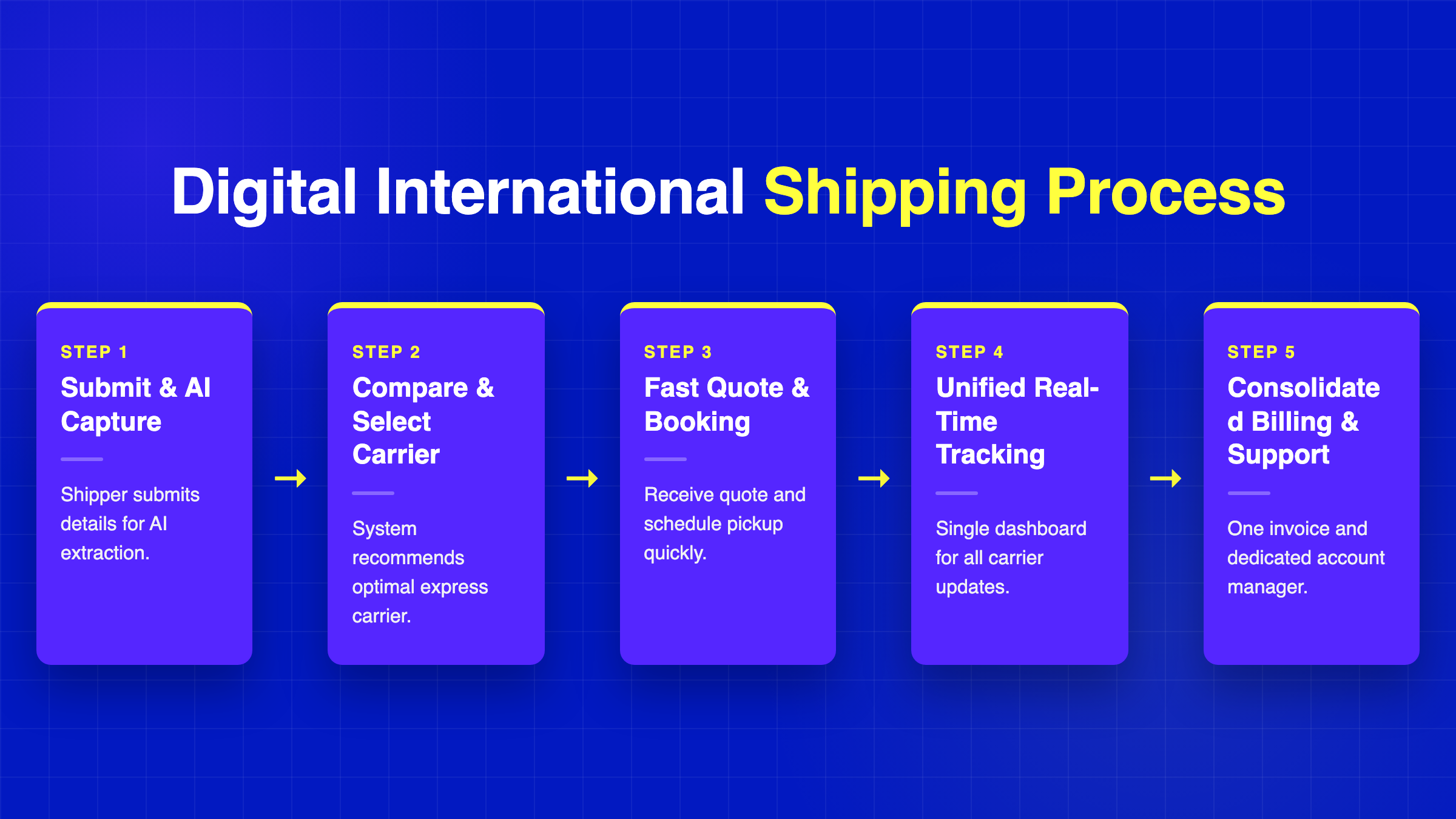
Step 7: Unified Tracking Across All Carriers
A single dashboard provides real-time visibility regardless of the carrier selected. This unified approach addresses a key pain point in international shipping, where businesses typically juggle multiple carrier portals. The tracking system integrates with our AI-powered logistics operations for predictive updates and proactive issue resolution.
Step 8: One Invoice, One Account Manager
Regardless of using DHL for one shipment and FedEx for another, businesses receive consolidated invoicing and dedicated account management. This simplification is particularly valuable given the complexity of managing multiple carrier relationships, each with different billing cycles, formats, and payment terms. The unified approach streamlines accounting and provides consistent support across all shipping needs.
Route-Specific Considerations and Best Practices
Understanding route-specific requirements is crucial for successful international shipping from UAE. Each destination has unique documentation needs, regulatory frameworks, and preferred carriers that can significantly impact delivery times and costs.
UAE to UK: Brexit Documentation, VAT Implications, Preferred Carriers
Post-Brexit shipments from UAE to UK require specific documentation including commercial invoices, certificates of origin, and UK-specific customs declarations via the UK's Customs Declaration Service (CDS). This system replaced the EU's framework in 2021, creating new compliance requirements for dubai to uk cargo movements.
VAT implications involve UK import VAT at 20% on most goods, payable at import with potential deferment via postponed VAT accounting for registered importers. UAE exports benefit from zero-rated VAT under GCC rules, but UK duties apply based on commodity codes. Businesses looking to send parcel to uk from dubai must factor these costs into their pricing strategies.
Preferred carriers include DP World (Dubai-based global port operator with extensive UK terminal networks) and majors like Maersk and MSC, leveraging UAE's Jebel Ali port dominance. However, recent disruptions have impacted this route significantly. According to Gulf News, vessel traffic through the Strait of Hormuz dropped to 2 ships per day from an average of 138 as of March 2025, leading carriers to suspend UK-bound Middle East routes.
UAE to USA: ISF Filing Requirements, TSA Regulations, Port Options
Importer Security Filing (ISF) is mandatory for ocean shipments to USA, requiring 10 data elements filed 24 hours pre-loading via the Automated Manifest System. Non-compliance incurs fines up to $5,000 per violation, making accurate documentation critical for cargo from dubai to uk and US destinations.
TSA regulations mandate secure supply chain protocols under the Air Cargo Advance Screening (ACAS) for air freight from UAE hubs like Dubai International Airport. Key US port options include New York/New Jersey (handling 8.5M TEUs in 2024), Los Angeles/Long Beach (9.1M TEUs), and Savannah, with Jebel Ali as primary UAE origin.
According to Supply Chain Brain, Hormuz disruptions have prompted top carriers to cut Mideast bookings, impacting USA routes with higher freight rates amid Dubai's Jebel Ali port suspensions.
UAE to Europe: EORI Numbers, CE Marking, Customs Union Benefits
EU-bound shipments need an Economic Operators Registration and Identification (EORI) number for all non-EU traders. CE marking is required for products like electronics and machinery to certify compliance with EU safety standards. These requirements apply whether shipping via express services or traditional freight forwarding.
Benefits from EU Customs Union include tariff-free trade for compliant goods, streamlined declarations via EU's Single Administrative Document, and reduced border delays. UAE's free zones enhance efficiency with customs reforms lowering barriers. However, carriers like CMA CGM and Hapag-Lloyd have suspended Hormuz/Suez passages, imposing surcharges of $2,000 per 20-foot container and rerouting around Africa, delaying Europe trade by 10-14 days.
UAE to Australia: Biosecurity Requirements, GST Implications, Quarantine Procedures
Australia's Department of Agriculture, Fisheries and Forestry (DAFF) enforces strict biosecurity via the Biosecurity Import Conditions (BICON) database. Requirements include import permits, treatments such as fumigation, and inspections for high-risk goods like food and wood products. This makes cargo to australia from dubai particularly complex for certain commodity types.
GST at 10% applies on most imports over AUD 1,000, collected at border with UAE goods often eligible for preferential rates under the UAE-Australia CEPA (2024). Quarantine involves mandatory onshore isolation (up to 30 days for vessels) and MAF fumigation. Non-compliance risks destruction of goods and fines up to AUD 500,000.
UAE to China: Import Licenses, Quality Certifications, Port Congestion
China-bound shipments require import licenses for restricted goods, quality certifications like CCC marking for electronics, and careful port selection to avoid congestion. Major ports like Shanghai and Ningbo offer direct services from Jebel Ali, but businesses must monitor capacity constraints during peak seasons. The manufacturing supply chain between UAE and China benefits from established trade corridors, though documentation requirements remain stringent.
UAE to GCC: Customs Union Advantages, Road Freight Options
GCC customs union membership provides significant advantages for regional shipping, including unified customs procedures and reduced documentation. Road freight dominates this corridor, with the new Etihad Rail network reducing costs by up to 40% for longer distances. Businesses can leverage these advantages through our Key Account Centre partnerships for optimal regional distribution.
Best practices across all routes include using digital platforms for compliance filings, partnering with experienced logistics providers for multimodal integration, monitoring geopolitical risks via maritime security alerts, and opting for insured shipments amid ongoing carrier route adjustments.
Technology and Innovation in Route Optimization
AI-powered route optimization is becoming central to UAE logistics operations, with companies leveraging real-time data analysis to reduce fuel costs and improve delivery efficiency. According to Jeebly's 2026 logistics trends analysis, UAE logistics providers are increasingly deploying artificial intelligence systems that enable drivers to avoid congestion, select optimal routes, and enhance fleet productivity through predictive modeling.
AI-Powered Route Selection and Carrier Optimization
AI-driven routing systems are transforming how freight forwarders and express carriers manage shipments across global networks. The technology enables real-time optimization of delivery routes by analyzing traffic patterns, weather conditions, and operational constraints simultaneously. For international shipping operations, these systems help carriers balance multiple objectives—minimizing transit times, reducing fuel consumption, and meeting customer delivery windows—across complex multimodal networks spanning Asia, Africa, and Europe.
The UAE's position as a global re-export hub amplifies the value of these technologies. Emirates SkyCargo's 140-destination network and the region's role as a transshipment bridge for 55 million GCC consumers create complex routing scenarios where AI optimization delivers measurable cost savings. Digital platforms now furnish instant quotes and real-time container tracking, cutting administrative friction and enabling SMEs to bypass traditional brokerage queues.
Real-Time Tracking and Visibility Across Global Networks
Real-time data visibility has become essential for managing international shipments through UAE ports and airports. According to Mordor Intelligence, digital platforms integrated into freight forwarding operations provide instant tracking capabilities for containers moving through Jebel Ali Port, which processed over 100 million TEU in January 2025, an 8.3% increase over 2024 volumes.
This transparency enables shippers to monitor high-value goods throughout their journey, particularly critical for pharmaceutical and electronics shipments requiring specialized handling. The integration of tracking systems across multimodal corridors—combining sea, air, rail, and road transport—creates end-to-end visibility for international shipments.
Predictive Analytics for Transit Time Accuracy
Predictive analytics platforms are enhancing forecast accuracy for international transit times by analyzing historical shipping data, seasonal patterns, and geopolitical factors affecting major trade routes. According to Metro Global, the global container shipping fleet currently deploys 3.6 million TEU of capacity across 520 vessels, with more than 10% of this capacity directly affected by Middle East disruptions.
For air freight operations, which contributed 46.62% of UAE logistics market revenue in 2025, predictive systems optimize scheduling around capacity constraints and specialized requirements like cool-chain chambers for pharmaceuticals. Sea forwarding is projected to advance at 8.12% CAGR (2026-2031), with digitized paperwork and predictive systems widening the appeal of Jebel Ali and Fujairah gateways.

API Integration with DHL, FedEx, UPS for Instant Rate Comparison
Digital platforms have fundamentally transformed how rates and services are accessed in the express logistics sector. These platforms now furnish instant quotes and real-time container tracking, enabling SMEs to bypass traditional brokerage queues. This shift toward automated, transparent pricing reflects broader industry movement toward API-driven connectivity.
The UAE's freight forwarding market, valued at USD 23.05 billion in 2026 and growing at 6.55% CAGR toward USD 31.63 billion by 2031, increasingly relies on digital integration to compete. Multimodal bundles that blend sea-air or rail-sea combinations promise competitive transit times at lower carbon intensity, with forwarding margins hinging on data transparency and network breadth.
Automated Documentation and Customs Clearance Processes
Automation in documentation and customs clearance significantly reduces processing times and errors. Digital systems now handle complex documentation requirements across multiple jurisdictions, automatically generating commercial invoices, packing lists, and certificates of origin. This automation proves particularly valuable for businesses managing high-volume international shipping operations across diverse regulatory environments.
Smart Consolidation for Cost Optimization on Major Routes
According to Intel Market Research, the global Ship Route Optimization Tool market was valued at USD 216 million in 2025 and is projected to reach USD 590 million by 2034. Middle Eastern ports are leveraging these systems to manage increasing traffic through the Suez Canal and Persian Gulf, enabling smart consolidation strategies that reduce per-unit shipping costs.
The UAE's logistics sector is expected to grow at a 7.4% CAGR through 2026, underpinned by infrastructure advancements and digital adoption. Sustainability imperatives are also driving technology investment, with operators adopting route optimization to reduce carbon footprints and meet mandatory emission reporting requirements. Experience these innovations through our AI-powered logistics operations platform.
Choosing the Right International Shipping Partner
Selecting a reliable international shipping partner in the UAE freight forwarding and logistics sector ensures cost savings, operational efficiency, and global reach. According to Mordor Intelligence, the market is projected to grow from USD 23.05 billion in 2026 at a 6.55% CAGR to USD 31.63 billion by 2031, driven by e-commerce and multimodal transport.
Key Account Centre Status: Access to 65% Below Retail Pricing
Partners with Key Account Centre (KAC) certification from major carriers like DHL, FedEx, or UPS provide volume-based discounts, often reaching up to 65% below retail rates for high-volume shippers in UAE's CEP and freight markets. This status is critical in Dubai's competitive landscape, where international players dominate the moderately concentrated CEP market.
According to EIN Presswire, this enables SMEs to access enterprise-level pricing amid 7.20% freight forwarding growth from 2021-2026 fueled by e-commerce. UAE's 3PL sector, valued at a dominant 48.3% Middle East share in 2025 (USD 86.11 billion regional market), amplifies these savings through integrated ecosystems at Jebel Ali and Khalifa Ports.
Multi-Carrier Capabilities vs Single Carrier Limitations
Multi-carrier partners offer flexibility across air, sea, and road, outperforming single-carrier setups by mitigating capacity risks and optimizing costs. Air freight held 46.62% revenue share in 2025, while sea forwarding grows fastest at 8.12% CAGR (2026-2031). Single-carrier limitations expose shippers to route gaps and rate volatility, particularly problematic when sea freight rates rose from USD 0.002/ton/km in 2017 to USD 0.005 in 2021.
Multi-carrier platforms enable seamless switching between options. According to Grand View Research, these platforms handle nearly 50% of GCC inbound cargo via UAE ports in 2022. Leaders like DP World and DHL integrate multimodal options, supporting UAE's role as a re-export hub to top partners India and China (11% export share each in 2023).
| Aspect | Multi-Carrier Advantages | Single-Carrier Limitations |
|---|---|---|
| Flexibility | Access to 140+ air destinations via Emirates SkyCargo; sea tonnage at 8.55% CAGR | Route/capacity constraints; vulnerable to surges |
| Cost & Reliability | Negotiated rates via KAC; escrow/digital matching for transparency | Higher exposure to volatility; limited backups |
| Market Share Example | Air forwarding: 44.33% revenue (2025) | Growth favors diversified providers |
Have a quick question? Get answers instantly on WhatsApp.
Technology Integration and Real-Time Visibility
Advanced partners leverage digital platforms for real-time tracking, instant quotes, and blockchain, reducing administrative friction in UAE's freight market. IT-enabled 3PL services claimed 30.4% Middle East share in 2025, with UAE leading via Jebel Ali's digitized operations for sea-air handoffs.
According to Data Insights Market, international CEP flows grow at 7.85% CAGR (2026-2031), powered by transportation management systems ensuring visibility to 55 million GCC/Africa consumers. Explore how our Key Account Centre partnerships deliver this technology advantage.
Route Coverage and Frequency Across Target Destinations
Top partners cover UAE's key corridors to India/China (11% exports each, 2023) and beyond, with high-frequency services from Dubai International and Jebel Ali (100 million TEU capacity). Multi-carrier firms like DHL, Aramex, and Kuehne+Nagel provide daily air/weekly sea to 140+ destinations, supporting re-export to GCC/Africa/South Asia.
UAE channels half of GCC inbound flows (2022), with roadways dominating transport share. International parcels emphasize frequency for e-commerce, contrasting domestic CEP's 64.72% revenue (2025). This comprehensive coverage ensures businesses can reach any global destination efficiently.
Customs Clearance Expertise and AEO Certification
Partners with Authorized Economic Operator (AEO) certification provide expedited customs clearance, reduced inspections, and priority processing at borders. This certification, combined with deep knowledge of destination-specific requirements, significantly reduces clearance times and compliance risks. Our customs clearance expertise ensures smooth processing across all major trade corridors.
One-Stop Shop Capabilities: Express, Freight, Warehousing Integration
Leading logistics partners offer integrated solutions combining express services, freight forwarding, and warehousing under one roof. This integration simplifies supply chain management, reduces coordination complexity, and provides cost synergies. With 6 warehouses spanning 55,000+ sqft across JAFZA, DAFZA, and DMCC free zones, comprehensive providers deliver end-to-end solutions for businesses of all sizes.
Volume Partnership Benefits and Scalability
Volume partnerships deliver progressive benefits as shipping volumes grow. Starting with basic discounts, businesses can access dedicated account management, customized reporting, and strategic logistics consulting as they scale. This scalability ensures that growing businesses maintain competitive shipping costs while accessing enhanced services that support their expansion into new markets.
Industry Applications and Use Cases
UAE's international shipping routes from ports like Jebel Ali in Dubai support critical sectors through freight forwarding, express shipping, and logistics corridors. According to recent market analysis, the overall market is projected to grow at a 7.4% CAGR through 2026, driven by multimodal infrastructure and trade diversification. Sea freight holds a dominant 50% market share in freight forwarding as of 2021, enabling bulk cross-border shipments via key routes.
However, the industry faces significant challenges. According to Business Times, recent disruptions have seen vessel traffic through the Strait of Hormuz plunge from approximately 138 ships per day to just 2 in early 2025, prompting major carriers to suspend bookings and impose surcharges like CMA CGM's $2,000 per 20-foot container.
E-commerce: Cross-Border Fulfillment and Customer Delivery
UAE's logistics hubs facilitate e-commerce growth via industrial warehousing, which captured over 50% market share in 2021. This infrastructure, fueled by demand for fulfillment centers near transport arteries and last-mile delivery in free zones, supports the booming online retail sector. Dubai's Jebel Ali, adjoining a major industrial park, serves as a crossroads for goods from Asia to Africa, Europe, and the US East Coast.
According to Eureporter, UAE executives remain highly confident, with nearly two-thirds expecting 2026 trade growth to match or exceed 2025 levels, bolstering e-commerce logistics resilience despite regional challenges.
Manufacturing: Supply Chain and Component Shipping
Multimodal corridors from UAE ports enable seamless component shipping for manufacturing, linking Asia-Africa-Europe trade routes and enhancing supply chain efficiency through customs reforms and free zones. Jebel Ali's role in re-exporting manufactured goods faces risks from Hormuz and Red Sea rerouting, which adds 10-14 days via the Cape of Good Hope and spikes freight rates.
These disruptions particularly impact just-in-time inventory systems for Dubai's industrial parks. Government initiatives continue to promote diversification, positioning UAE as a regional nexus for manufacturing freight forwarding despite current challenges.
Healthcare: Temperature-Controlled Pharmaceutical Logistics
Demand for cold storage warehousing, part of the industrial warehousing segment that dominated with over 50% share in 2021, supports temperature-controlled pharma logistics from UAE hubs. This specialized infrastructure integrates with sea and air freight for time-sensitive global delivery of vaccines, biologics, and other temperature-sensitive medications.
Strategic port connectivity via Hormuz and Bab al-Mandeb ensures reliable pharma supply chains. According to Gulf News, these routes handle 4-5 million barrels per day of oil and 8-12% of seaborne LNG trade, though 2025 disruptions have increased insurance costs and delay risks for express shipments.
Oil & Gas: Equipment and Parts Distribution Globally
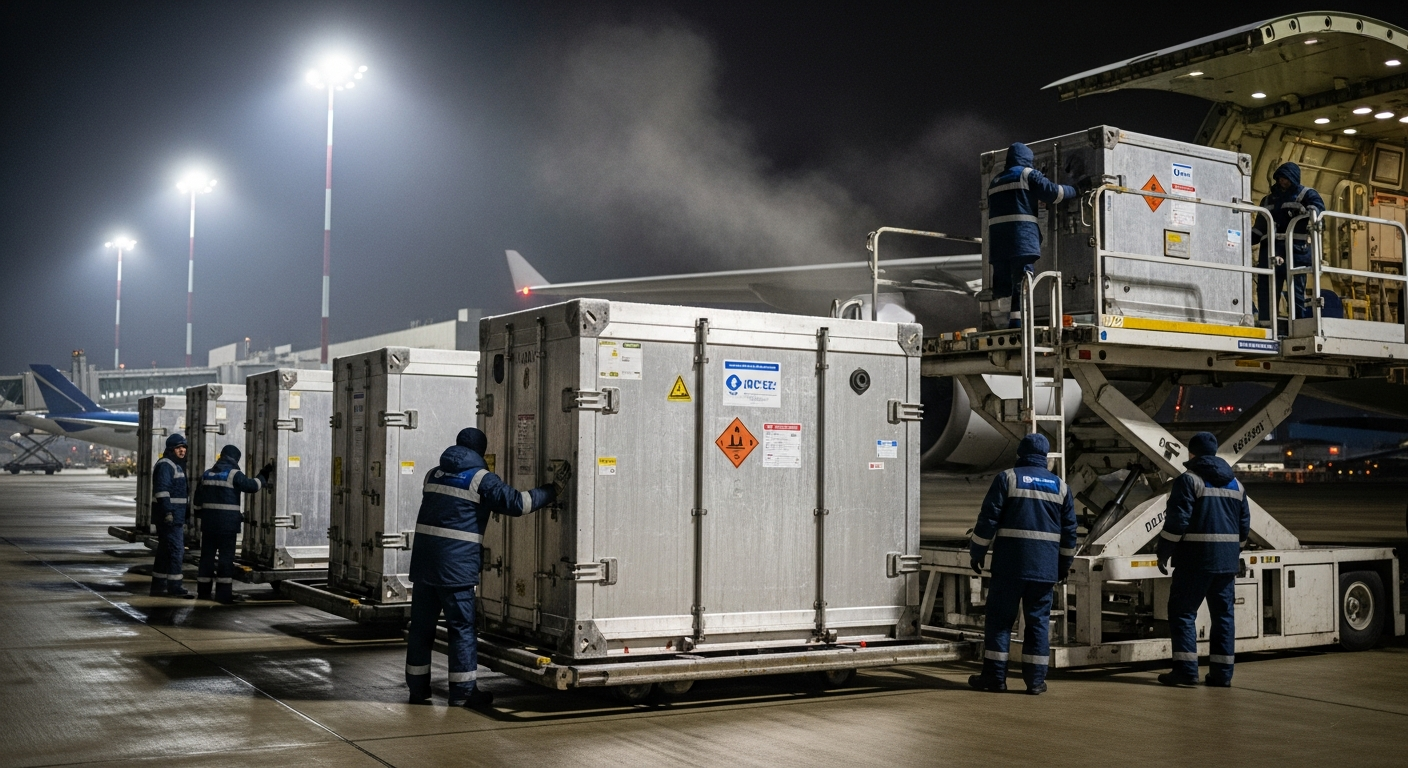
UAE leverages the Strait of Hormuz for oil & gas equipment distribution, with approximately 20.9 million barrels per day transiting (about 20% of global oil consumption), alongside parts freight via Jebel Ali for Middle East producers. This corridor is crucial for distributing drilling equipment, pipeline components, and maintenance parts to regional energy operations.
However, disruptions in 2025-2026 have severely impacted this sector. According to The Straits Times, carrier suspensions by Maersk, COSCO, and Japanese lines have halted routine traffic and forced alternative ports, threatening global supply chains for rigs, pipelines, and maintenance parts.
Fashion: Seasonal Inventory and Fast Fashion Logistics
The fashion industry relies on UAE's strategic location for rapid distribution of seasonal collections and fast fashion items. Express air services from Dubai International Airport enable 48-72 hour delivery to major fashion capitals, while sea freight handles bulk seasonal inventory movements. The combination of speed and cost-effectiveness makes UAE an ideal hub for fashion brands serving Middle Eastern, African, and South Asian markets.
FMCG: Regional Distribution and Market Expansion
Fast-moving consumer goods (FMCG) companies utilize UAE's extensive logistics network for regional distribution across the GCC and broader Middle East. The combination of free zone benefits, efficient customs procedures, and multimodal transport options enables FMCG brands to maintain optimal inventory levels while rapidly responding to market demand. Industrial warehousing facilities provide the necessary infrastructure for high-volume storage and distribution operations.
Each industry benefits from UAE's comprehensive logistics ecosystem, though current geopolitical challenges require adaptive strategies and flexible routing options to maintain supply chain continuity.
Frequently Asked Questions
What is the fastest international shipping route from UAE?
The fastest international shipping routes from UAE utilize express air services through Dubai International Airport and Abu Dhabi International Airport. For urgent documents and parcels, express carriers like DHL, FedEx, and UPS offer next-day delivery to major cities in the GCC region and 2-3 day delivery to Europe, USA, and key Asian destinations. Dubai International Airport's extensive network of 140+ destinations enables rapid connectivity, with express services typically delivering within 24-72 hours for most international routes. The UAE to GCC corridor offers the absolute fastest transit times, with same-day delivery available to select cities in Saudi Arabia, Kuwait, and Oman through dedicated express networks.
How do Key Account Centre rates compare to retail pricing?
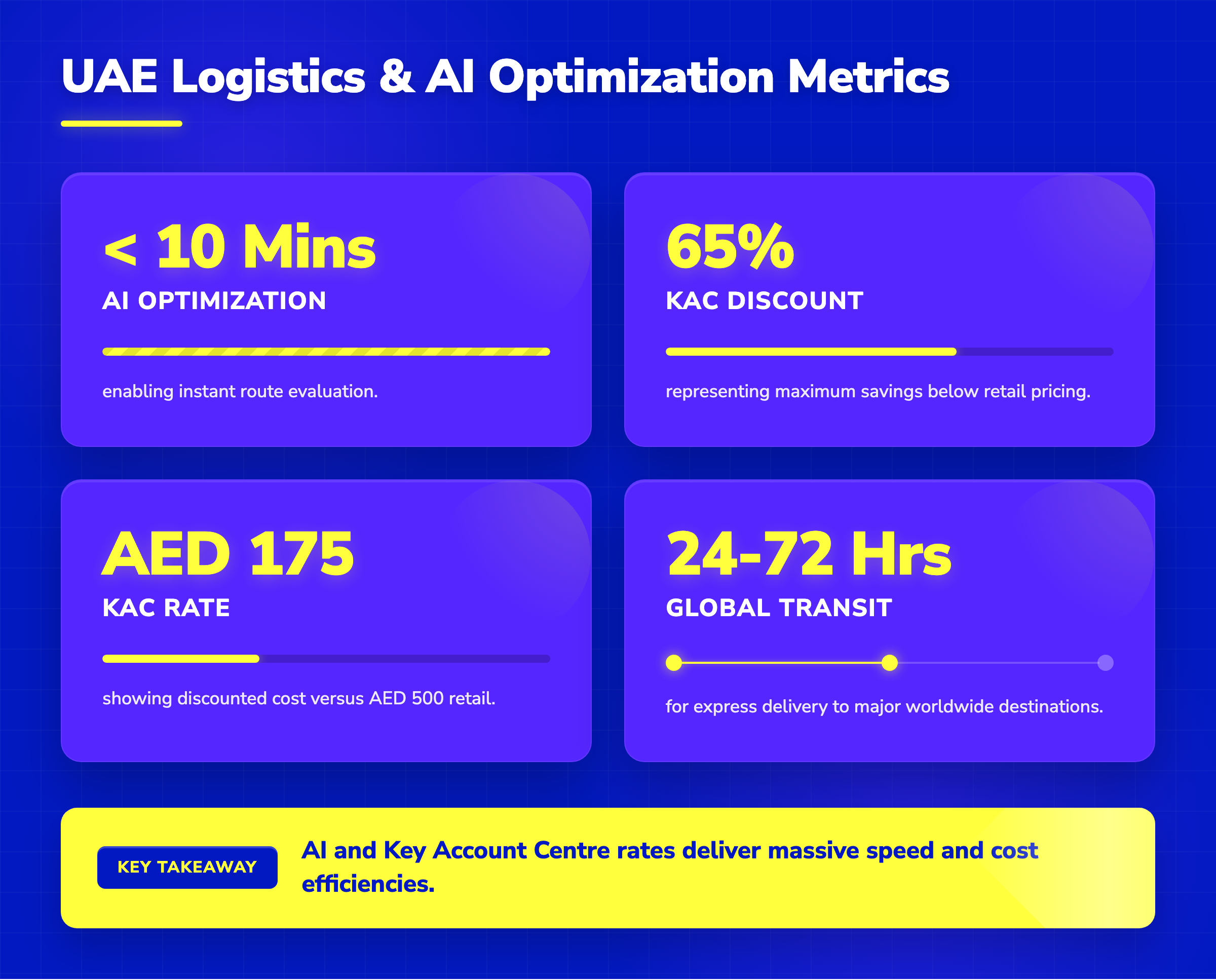
Key Account Centre (KAC) rates typically offer savings of up to 65% below standard retail pricing for express and freight services. This preferential pricing tier is reserved for high-volume shippers who meet specific volume commitments with carriers like DHL, FedEx, and UPS. For example, a shipment that might cost AED 500 at retail rates could be priced at AED 175 through KAC agreements. These savings apply across all service types—express parcels, air freight, and even some ground services. The exact discount depends on shipping volume, lane utilization, and contract terms, but businesses shipping regularly can achieve substantial cost reductions that significantly impact their bottom line. Small and medium enterprises can access these rates through certified logistics partners who aggregate volumes across multiple clients.
What documentation is required for different international routes?
Documentation requirements vary significantly by destination. For UAE to Europe shipments, you'll need commercial invoices, packing lists, certificates of origin, and EORI numbers for customs clearance. UK-bound cargo requires additional Brexit-specific documentation including UK customs declarations via CDS. USA shipments mandate Importer Security Filing (ISF) submitted 24 hours before vessel loading, along with standard commercial documentation. Australia enforces strict biosecurity requirements, requiring BICON database compliance, import permits, and potentially fumigation certificates. China-bound shipments need import licenses for restricted goods and quality certifications like CCC marking. All routes require accurate HS code classification and may need additional certificates depending on the commodity type—such as health certificates for food products or CE marking for electronics to Europe.
Can I use my existing DHL/FedEx/UPS account through an aggregator?
While many businesses have existing accounts with express carriers, using these directly often means missing out on volume-based discounts. Logistics aggregators with Key Account Centre status can typically offer better rates than individual company accounts due to their consolidated volumes. However, some aggregators do allow "account takeover" services where they manage your existing account while applying their preferential rates. The best approach depends on your shipping volume—if you're shipping less than 100 parcels monthly, aggregator rates will almost certainly beat your direct account pricing. For very high volumes (1000+ shipments monthly), it's worth comparing both options. Most businesses find that the combination of better rates, unified billing, and single-point account management through an aggregator provides superior value.
What's the minimum volume needed for preferential rates?
Contrary to common perception, businesses don't need massive shipping volumes to access preferential rates through logistics aggregators. While direct Key Account Centre status with carriers typically requires 500-1000+ monthly shipments, aggregators pool volumes across all their clients, allowing even small businesses shipping 10-20 parcels monthly to benefit from volume pricing. The key is working with an established aggregator who already maintains top-tier status with major carriers. Some aggregators offer tiered pricing where rates improve as your volume grows, starting with immediate savings of 20-30% even for low-volume shippers, scaling up to 65% discounts for high-volume accounts. This democratization of enterprise-level pricing has transformed the logistics landscape, making competitive international shipping accessible to businesses of all sizes.
How does AI route optimization work in practice?
AI route optimization in logistics uses machine learning algorithms to analyze multiple data streams in real-time—including traffic patterns, weather conditions, carrier capacity, customs processing times, and historical performance data. When you submit a shipment request, the AI system instantly evaluates thousands of possible route combinations across different carriers and service types. For example, it might determine that while DHL offers the fastest service to London, FedEx provides better value for your specific shipment size and urgency level. The system also predicts potential delays, suggesting alternative routes proactively. In practice, this means receiving an optimized shipping solution in under 10 minutes that balances cost, speed, and reliability based on your specific requirements. The AI continuously learns from outcomes, improving its recommendations over time and adapting to changing market conditions like the recent Suez Canal disruptions that forced rerouting around Africa.
Sources & References
This article draws on research and data from the following verified sources:
- Deep Dive: UAE Shipping & Dubai Logistics Market Trends
- UAE Freight & Logistics Market Share & Size 2031 Outlook
- World's Most Critical Shipping Lanes at Increasing Risk | AJG Dubai
- Why the Gulf States are Becoming a Gateway for Freight Forwarders in 2026
- Global trades lifelines: 6 shipping lanes that keep the world economy moving
- Shipping lines cut Middle East routes, posing risk to trade flows
- Shipping costs set to rise as companies halt cargo through Arabian Gulf
- Gulf Shipping Disruptions and UAE Port Operations - House of Shipping
- Shipping lines cut Middle East routes posing risk to trade flows - Business Times
- Shipping Middle East Market Overview 2024 - IndexBox
- Top Shippers Cut Mideast Bookings Amid Dubai Port Suspension - Supply Chain Brain
- UAE executives among the world's most confident on 2026 trade growth - Eureporter
- Grand View Research - UAE Logistics Market Outlook
- Data Insights Market - UAE CEP Market Analysis
- Transformations Awaiting the Maritime Shipping Sector in 2026 - Future UAE
- Ship Route Optimization Tool Market Outlook 2026-2034 - Intel Market Research
- Logistics Trends 2026 UAE: Future of Delivery with Jeebly
- Middle East: Disruption ripples through global supply chains - Metro Global
- Freight Forwarding - United Arab Emirates Market Forecast - Statista
- UAE's Freight Forwarding Market to grow 7.20% from 2021-2026
- The Report Cubes - UAE Express Delivery Market Report and Forecast 2026-2034
- OpenPR - UAE Logistics Market Size is Expected to Reach USD 95.2 Billion
- Nexdigm - UAE Logistics Market Report, Market Size, Market Future Outlook
Tags
Related Articles
Ready to optimize your logistics?
Whether you need express shipping, freight forwarding, or warehousing — our AI finds the best rates and routes for your business.