
Cargo Services to Dubai: International Shipping Routes & Solutions
Understanding Cargo Services to Dubai: Your Gateway to Middle East Trade
Dubai stands as a premier global trade hub, connecting businesses to over 195 countries through its world-class logistics infrastructure. According to Dubai News, the emirate's strategic position has enabled Dubai International Airport to handle 2.2 million tonnes of cargo in 2024, while DP World's Jebel Ali Port supports massive container traffic as a regional powerhouse. The UAE's total foreign trade is forecast to approach $1 trillion by end-2026, with the Asia corridor comprising about one-third of this volume.
The types of cargo services to Dubai available reflect the diverse needs of international businesses. Express logistics services, powered by digital platforms like Dubai Trade's delivery order system, have revolutionized cargo release times from 48 hours to under 10 minutes, with 98% of customs transactions now electronic. Air freight services leverage Dubai International Airport's 2.2 million tonnes annual capacity, making it ideal for time-sensitive shipments. Sea freight operations, led by Jebel Ali Port's expanded capacity within DP World's 88.3 million TEU network, handle the bulk of high-volume container traffic. Road freight complements these multimodal networks, experiencing strong growth amid elevated trade demand.
The Key Account Centre advantage transforms how businesses access enterprise-level shipping rates. Rather than meeting high-volume requirements independently, companies can leverage aggregated volume partnerships that provide priority access, customized solutions, and significant cost savings. This is particularly crucial as Dubai's cross-border e-commerce sector is projected to reach AED 50.6 billion ($13.8 billion) by 2029, growing at a 9.4% CAGR from AED 32.3 billion in 2024. Through Key Account Centre partnerships, even smaller businesses gain access to negotiated rates typically reserved for large-volume shippers, democratizing premium logistics services.
When you explore our comprehensive route network, you'll discover how volume aggregation delivers enterprise rates without the traditional volume commitments. This approach is essential in Dubai's competitive market, where digital customs clearance capabilities—such as 72% of Abu Dhabi shipments cleared pre-arrival in 2024—create opportunities for efficiency gains that translate directly to cost savings.
Major International Shipping Routes to Dubai
International shipping routes to Dubai face dynamic challenges and opportunities in 2026. According to Business Times, major carriers including MSC, Maersk, and Hapag-Lloyd have implemented route adjustments and surcharges ranging from $1,500 to $3,800 per 20-foot container due to regional disruptions. Despite these challenges, Dubai's Jebel Ali Port remains a critical crossroads for Asia-Africa-Europe-US trade flows, supported by the extensive infrastructure of Jebel Ali Free Zone (JAFZA).
Primary shipping corridors demonstrate Dubai's global connectivity. The USA-Dubai route relies heavily on Jebel Ali as a distribution hub for US East Coast goods, though current market conditions have led to rerouting via Africa with corresponding rate increases. The UK-Dubai corridor, traditionally linked via Suez, now sees adjusted routing with carriers like Hapag-Lloyd implementing war risk surcharges. Europe-Dubai routes benefit from Jebel Ali's major European company warehousing facilities, though CMA CGM has imposed emergency surcharges of $2,000 per 20-foot container. The China-Dubai corridor, vital for Asian trade, has seen carriers like COSCO evaluating alternative ports amid booking constraints.
Secondary routes including Australia-Dubai, Far East-Dubai, and Africa-Dubai face ripple effects from global rerouting strains. Japanese shipping lines including Nippon Yusen, Kawasaki Kisen, and Mitsui O.S.K. have adjusted their Persian Gulf transit strategies. The Africa-Dubai route remains crucial for Asia-Africa trade flows, with Jebel Ali serving as a key transshipment point despite operational challenges.
Transit times have extended significantly due to rerouting requirements, with capacity constraints from booking suspensions and "end-of-voyage" declarations affecting service reliability. Ocean freight faces the most significant impact with surcharges ranging from $1,800 to $3,800 per container for regional ports. Meanwhile, express logistics services provide faster alternatives for urgent shipments, though air cargo capacity remains tight amid regional disruptions.
When comparing carrier coverage across DHL, FedEx, and UPS networks, each offers distinct advantages for cargo services to Dubai. While specific market share data for 2026 remains limited, these global integrators maintain robust networks serving Dubai's position as a non-Asian top port. The key differentiator lies not in carrier selection but in accessing their Key Account Centre partnerships, which can deliver rates up to 65% below standard pricing through aggregated volume advantages.
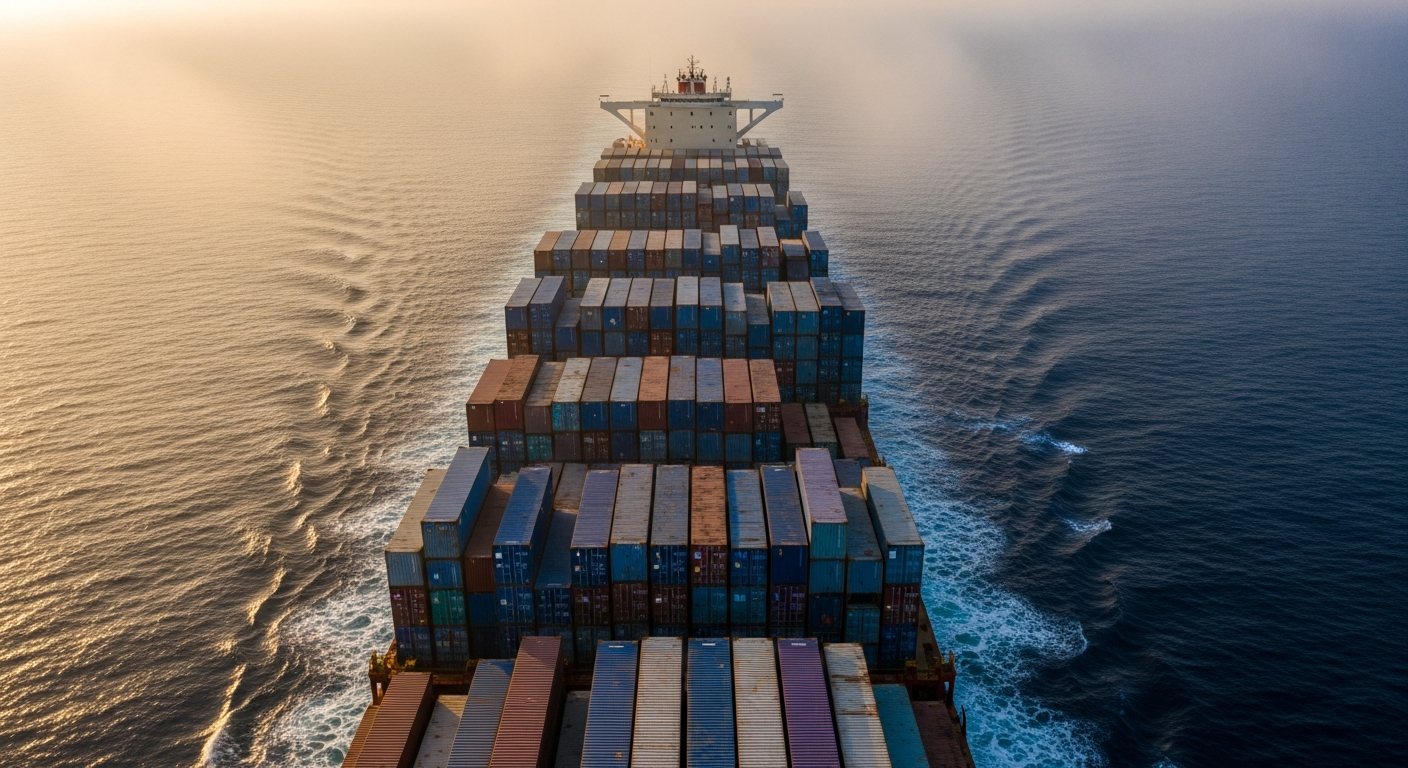
Express vs Freight: Choosing the Right Cargo Service Type
Selecting the appropriate cargo service type for Dubai shipments requires understanding the distinct advantages of each option. According to Mordor Intelligence, the UAE freight and logistics market valued at USD 23.05 billion in 2026 is growing at 6.55% CAGR to reach USD 31.63 billion by 2031, with air freight capturing 46.62% of market revenue share in 2025.
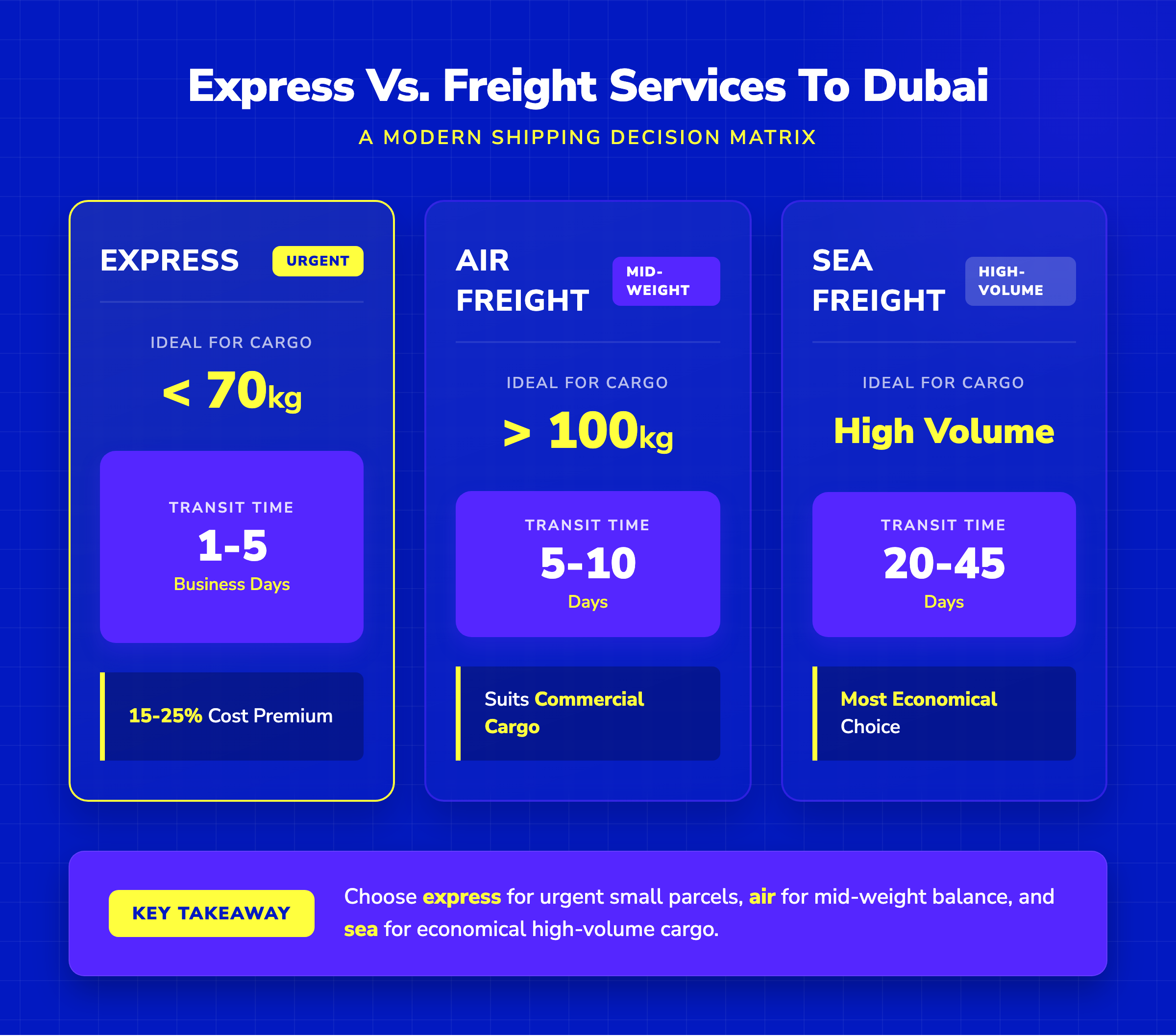
Express logistics excels for documents, parcels, and urgent shipments under 70kg. This service category thrives on Dubai and Abu Dhabi's population density, where 52% of UAE residents generate 70% of retail sales, enabling same-day delivery promises at scale. Domestic courier, express, and parcel (CEP) services held 64.72% revenue share in 2025, with international parcels growing at 7.85% CAGR through 2031. The e-commerce boom has pushed fulfillment accuracy above 99.5% through automation, while multimodal strategies have cut transit times by 15%. UPS's USD 100 million Dubai South investment in March 2025 exemplifies how carriers are automating last-mile sorting to handle high-volume express shipments efficiently.
For commercial cargo and consolidated shipments over 100kg, air freight solutions offer the optimal balance of speed and capacity. Air freight's dominance with 46.62% of UAE market revenue in 2025 is powered by Emirates SkyCargo's 140-destination network and Dubai International Airport's top global ranking for international tonnage. This mode particularly suits pharmaceuticals and high-tech goods requiring cool-chain facilities, with investments in cargo infrastructure reducing air-sea transshipment dwell times significantly.
Sea freight provides FCL (Full Container Load) and LCL (Less than Container Load) options for high-volume, cost-sensitive cargo. Leading volume growth at 8.55% CAGR through 2031, sea freight is anchored by Jebel Ali Port's achievement of 100 million TEU throughput with an 8.3% year-over-year increase in January 2025. DP World's USD 2.5 billion expansions, including a 1.55 million square foot Jebel Ali logistics park launched in July 2024, support both FCL shipments for bulk cargo and LCL consolidations for smaller volumes seeking cost efficiency.
The decision framework for choosing cargo services to Dubai centers on four key factors:
- Urgency: Express offers same-day possibilities for critical documents; air freight delivers in days for commercial cargo; sea freight requires weeks but offers maximum cost savings
- Weight: Express handles parcels under 70kg efficiently; air freight suits 100kg+ consolidated shipments; sea freight excels for high-volume FCL/LCL loads
- Value: High-value pharmaceuticals and electronics benefit from express or air freight's security and speed; bulk commodities maximize savings via sea freight
- Commodity Type: Documents and e-commerce parcels fit express channels; commercial cargo utilizes air freight's balance; containers of raw materials or finished goods leverage sea freight economics
With supply chain platforms reducing delays by 25% and automated sorting boosting processing speeds by 40%, the key is matching service type to business requirements while leveraging aggregated Key Account rates for maximum savings.
Need a shipping quote?
Get AI-optimized rates from DHL, FedEx & UPS — up to 65% below retail. Quote in under 10 minutes.
How Cargo Services to Dubai Work: The Complete Process
Modern cargo services to Dubai leverage sophisticated digital platforms and AI-driven tools to streamline international shipping. The UAE freight and logistics market, valued at USD 23.05 billion in 2026 according to Mordor Intelligence, integrates express carriers like DHL, FedEx, and UPS through automated processes that deliver efficiency gains in a sector growing at 6.55% CAGR through 2031.
Step 1: Shipment details capture via email, phone, or web form. The process begins when shippers submit essential information including origin, destination, weight, dimensions, and commodity type through multiple channels. This seamless onboarding is crucial in Dubai's e-commerce-driven logistics hub, where parcel revenue grows at 7.52% CAGR due to same-day delivery demands. Digital platforms streamline this initial capture, reducing administrative friction for SMEs accessing Jebel Ali's 100 million TEU capacity.
Step 2: AI agents analyze requirements and route classification. Artificial intelligence evaluates shipment parameters against regulatory, modal, and risk factors to classify optimal routes. This might mean selecting air cargo via Emirates SkyCargo's 140 destinations for high-value goods or accommodating sea freight delays that added 7-10 days to lead times in 2024 due to Red Sea disruptions. The AI-led approach optimizes routing decisions in real-time, supporting air freight forwarding's 44.33% revenue share in 2025.
Step 3: Real-time API queries across DHL, FedEx, UPS for Key Account rates. The system queries APIs from major carriers to access negotiated Key Account rates, essential in volatile markets. According to Gulf News, global container rates fell 4.7% to $2,107 per 40-foot container in late January 2026, while Gulf surcharges ranged from $800 to $3,800 per container. Air cargo demand rose 5.6% in January 2026 with capacity up only 3.6%, underscoring the importance of real-time rate benchmarking.
Step 4: AI comparison engine selects optimal carrier and service level. The AI-powered logistics operations engine compares costs, transit times, emissions, and reliability across carriers. It might select air freight for pharmaceuticals requiring tight capacity management or sea freight capitalizing on the 8.55% CAGR tonnage growth through 2031. This automation delivers 8-16% rate savings potential amid global oversupply projections of 36% capacity increase by 2027.
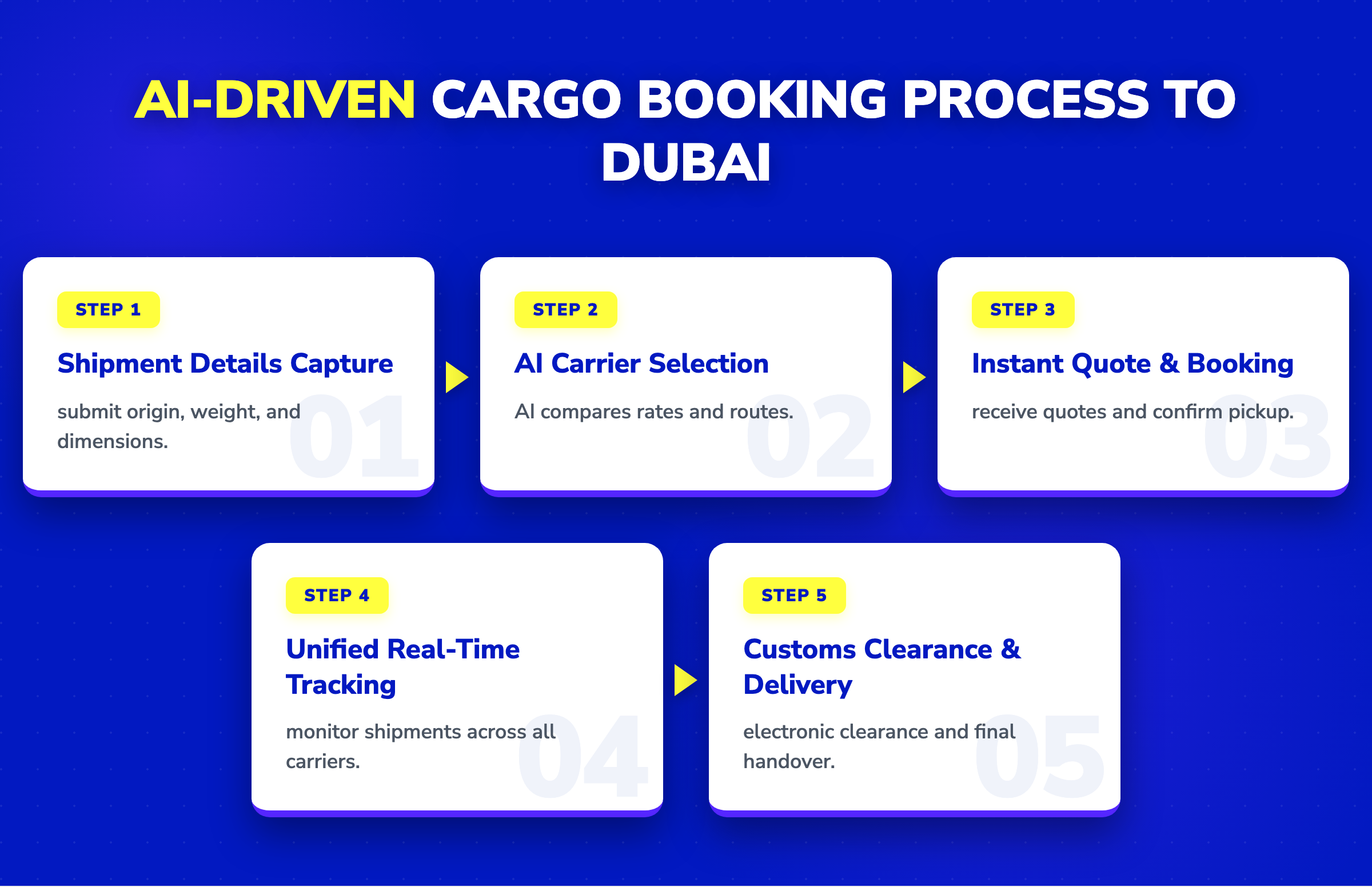
Step 5: Quote delivery in under 10 minutes with transparent breakdown. Unlike traditional forwarders requiring days for quotes, AI-powered systems deliver comprehensive pricing within 10 minutes, including all fees, surcharges, and transit times transparently broken down by component.
Step 6: Booking confirmation and pickup scheduling within 20 minutes. Upon acceptance, the system automatically confirms bookings with the selected carrier and schedules pickup at the shipper's convenience, maintaining the speed advantage throughout the process.
Step 7: Unified tracking across all carriers with real-time updates. Regardless of whether DHL, FedEx, or UPS handles the shipment, customers access unified tracking through a single interface, eliminating the need to navigate multiple carrier systems.
Step 8: Customs clearance coordination and final delivery in Dubai. The process concludes with coordinated customs clearance services and final delivery, leveraging Dubai's digital customs infrastructure where 98% of transactions are electronic and pre-arrival clearance is standard.
This streamlined process enhances resilience for businesses shipping to Dubai, where the economy relies on imports for 85% of food and 70% of consumer goods. The automation and AI-driven optimization provide a competitive edge in a market where disruptions like the 25% rate increases seen in 2024 demand agility and efficiency.
Key Factors Affecting Cargo Costs to Dubai
Understanding the dynamic factors that influence cargo services to Dubai pricing is essential for effective logistics planning. According to The Flying Engineer's 2026 Pricing Guide, air cargo rates to and from the Middle East range from $2.80 to $4.50 per kilogram, often lower than global averages due to Dubai's hub status but subject to significant surcharges amid regional disruptions.
Dynamic pricing factors create variable costs that static rate cards cannot accurately capture. Weight and dimensions form the foundation of cargo pricing, with air cargo charges based on the greater of actual or volumetric weight (calculated as length × width × height / 6000 for centimeter/kilogram conversion). This makes bulky items costlier per kilogram, though rates drop significantly at volume thresholds: 100kg shipments average $6.50/kg, while 1000kg loads can achieve $4.50/kg on established routes.
Origin country significantly impacts pricing due to trade volumes and competition levels. Middle East to Europe routes cost $2.80–$4.50/kg with 1-2 day transit times, while Asia to North America ranges from $3.80–$7.50/kg. Africa to Europe commands premium rates of $5.50–$9.00/kg, reflecting lower volume lanes. Commodity type adds another layer of complexity, with special handling for dangerous goods, lithium batteries, pharmaceuticals, or perishables adding 20-40% to base rates. Fuel surcharges alone can represent 15-30% of base pricing.
Service level selection dramatically affects total costs. Express services delivering in 1-3 days cost 15-25% more than standard 5-7 day options due to priority capacity on freighters or passenger belly cargo. Door-to-door services include customs handling and final delivery, adding airport fees and broker costs, while port-to-port options exclude these services but suit bulk sea freight at $0.10–$0.50/kg for 20-45 day transit times. In 2026, Cole International reports that FedEx applied $0.50–$1.50 per pound demand surcharges on Middle East routes for express parcels.
Volume advantages through Key Account Centre aggregation provide substantial savings for businesses shipping to Dubai. High-volume shippers accessing freight forwarders' Key Account Centres benefit from 20-40% discounts on loads exceeding 1000kg through long-term contracts and consolidated buying power. This aggregation model reduces per-kilogram costs through carrier negotiations and shared capacity utilization at Dubai hubs like Jebel Ali.
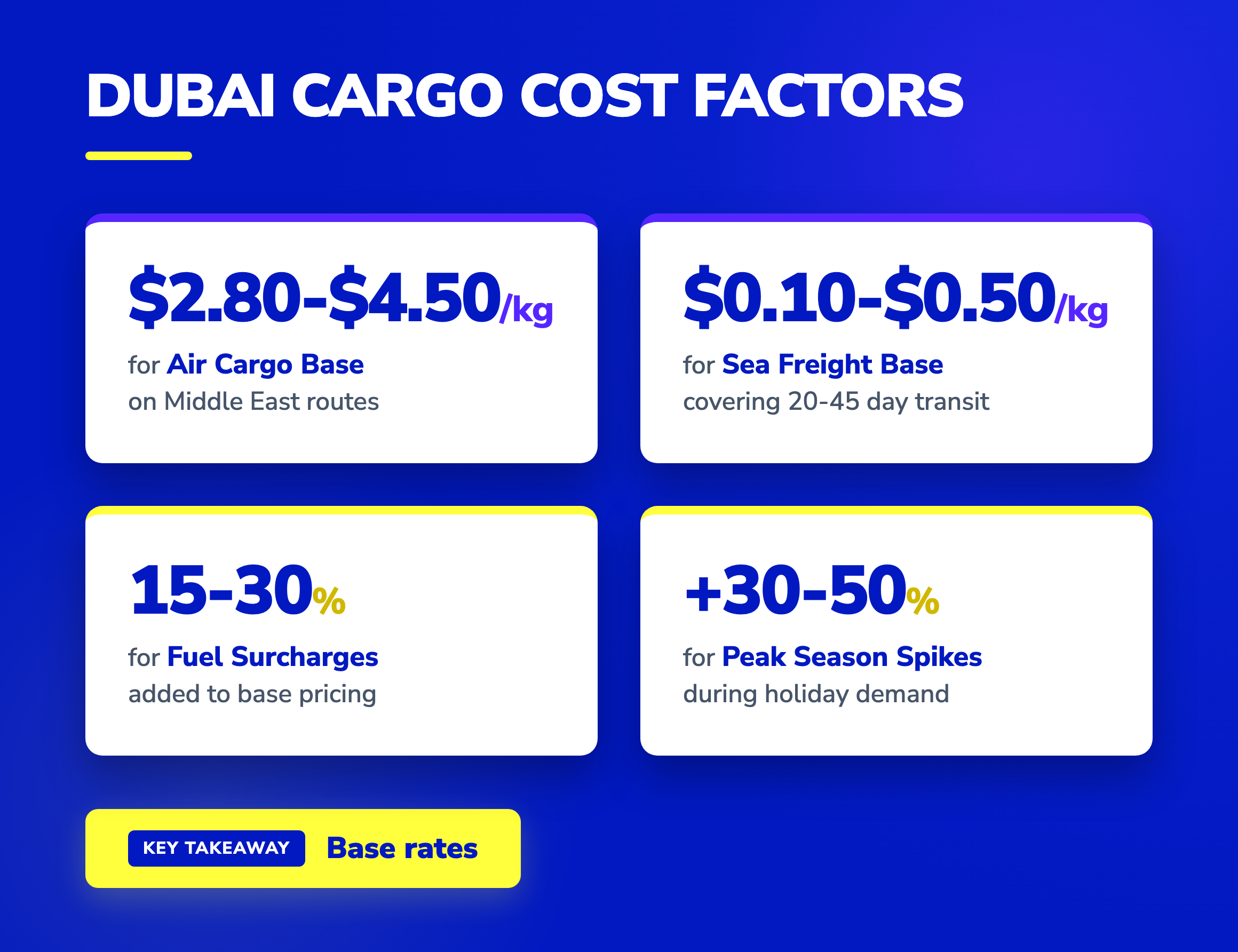
Seasonal fluctuations and capacity constraints create pricing volatility throughout the year. Holiday peaks such as Diwali and the November-December shopping season spike rates by 30-50% due to e-commerce demand. The 2026 Middle East situation has added multiple surcharges: Maersk's Emergency Bunker surcharge effective globally from March 25, CMA CGM's Conflict Surcharge including UAE from March, and Hapag-Lloyd's War Risk charges ranging from $1,500 to $3,500 per TEU. According to Gulf News, rerouting via Cape of Good Hope has delayed ocean transit by 20-25 days while tightening air capacity.
Real-time API pricing has become essential for accurate quoting in this volatile environment. Traditional static rate cards fail to capture the dynamic nature of international cargo pricing, where jet fuel costs representing 20-30% of expenses fluctuate daily and airspace closures can instantly constrain routes. Only real-time systems connected to carrier APIs can provide the accurate, up-to-the-minute pricing that businesses need for informed decisions about their cargo services to Dubai.
Customs and Documentation for Dubai Cargo Imports
Navigating UAE customs requirements efficiently is crucial for successful cargo imports to Dubai. The Federal Customs Authority (FCA) mandates electronic submission via the Dubai Trade portal for all cargo imports, with Authorized Economic Operator (AEO) certification offering significant advantages. According to the World Customs Organization, the UAE AEO program serves 107 certified operators, delivering 85% faster clearance times and covering 35% of UAE trade through mutual recognition agreements with partners including the EU and GCC nations.
The benefits of AEO certification for cargo services to Dubai are substantial. Certified operators enjoy inspection prioritization with VIP treatment at terminals, elimination of supporting document requirements post-filing, and low or zero risk scores with flexible inspection locations. The 85% reduction in clearance time translates directly to faster cargo movement and lower operational costs. Additional advantages include automatic refunds, priority call center service, and the expansion of benefits through mutual recognition agreements covering 35% of total trade volume.
Essential documents for Dubai cargo imports follow a standardized framework designed for efficiency. The commercial invoice must detail value, HS codes, and country of origin, while the packing list itemizes contents with precise weights and dimensions. Air shipments require an Air Waybill (AWB), while sea cargo needs a Bill of Lading (BL), all submitted electronically through Dubai Customs' integrated system. As noted in the AEO Benefits guide, certified status eliminates post-filing paper submissions, significantly reducing data requirements and enabling complete electronic archiving.
The distinction between free zone and mainland clearance procedures significantly impacts import strategies. Free zones such as Jebel Ali Free Zone (JAFZA) and Dubai Airport Free Zone (DAFZA) offer simplified clearance where goods enter duty-free without formal customs declaration if remaining within the zone. This makes them ideal for re-export operations or logistics hub activities, with transit times averaging just 1-2 hours with minimal documentation. In contrast, mainland clearance requires full FCA declaration with duties averaging 5% on CIF value and potential physical inspections unless AEO-certified. Standard processing takes 24-48 hours, but AEO firms benefit from priority handling that reduces this by up to 85%.
Understanding restricted and prohibited items prevents costly delays and penalties. The UAE prohibits narcotics, counterfeit goods, ivory, and used tires entirely. Restricted items requiring special permits include alcohol and tobacco products, pork products, and certain electronics without ESMA approval. Dubai Customs seized 1.2 million restricted items in 2023-2024, emphasizing the importance of compliance. Importers must declare all items via advance manifest, with violations incurring fines up to AED 100,000.

For dangerous goods classification and handling requirements, specialized procedures apply based on IATA and IMO regulations. Lithium batteries, chemicals, and other hazardous materials require specific packaging, labeling, and documentation. Digital documentation through the Dubai Trade portal has revolutionized this process, with paperless clearance now standard for compliant shipments. This digital transformation aligns with Dubai's position as a global logistics hub, where efficiency in customs procedures directly impacts the competitiveness of cargo services to Dubai.
Frequently Asked Questions About Cargo Services to Dubai
Have a quick question? Get answers instantly on WhatsApp.
What is a Key Account Centre and how does it reduce shipping costs?
A Key Account Centre is a volume partnership tier that major carriers like DHL, FedEx, and UPS offer to their highest-volume customers, providing access to significantly discounted rates and premium services. When logistics providers achieve Key Account Centre status across multiple carriers simultaneously, they can aggregate shipment volumes from multiple clients to maintain these elite partnerships. This aggregation model allows businesses of all sizes to access enterprise-level rates that are typically 40-65% below standard retail pricing, without needing to meet high individual volume requirements. The cost reduction comes from the logistics provider's ability to negotiate based on combined volumes, passing these savings directly to clients while maintaining the same service quality and reliability as shipping directly with the carrier.
How long does cargo take to reach Dubai from major origins?
Transit times to Dubai vary significantly based on origin, service type, and current market conditions. Express services from major US cities typically deliver within 2-3 business days, while shipments from UK and European origins generally arrive in 2-4 days. Asian origins like China, Singapore, and Hong Kong usually require 1-3 days for express delivery. Air freight adds 1-2 days to these timelines for commercial cargo, while sea freight from US East Coast ports takes approximately 35-40 days, European ports 20-25 days, and Asian ports 7-14 days. However, according to recent market data, regional disruptions in 2026 have extended some transit times, particularly for sea freight requiring rerouting around Africa, which can add 20-25 days to standard schedules.
What's the difference between JAFZA, DAFZA, and DMCC for cargo delivery?
JAFZA (Jebel Ali Free Zone Authority) is the largest free zone in the UAE, located adjacent to Jebel Ali Port, making it ideal for sea freight and heavy industrial cargo with direct port access for container shipments. DAFZA (Dubai Airport Free Zone Authority) specializes in air cargo operations, positioned next to Dubai International Airport, perfect for time-sensitive express shipments and high-value goods requiring immediate air connectivity. DMCC (Dubai Multi Commodities Centre) focuses on commodities trading and precious metals, offering specialized facilities for gold, diamonds, and agricultural products with enhanced security and specialized handling capabilities. Each free zone provides duty-free storage, simplified customs procedures, and 100% foreign ownership, but the choice depends on your cargo type, preferred transport mode, and specific industry requirements.
What should I look for when choosing a cargo service provider to Dubai?
When selecting a cargo service provider for Dubai shipments, prioritize providers with simultaneous Key Account Centre status across major carriers (DHL, FedEx, UPS) to ensure access to the best rates regardless of route or service type. Look for technology capabilities including real-time quoting systems that can deliver accurate prices within minutes rather than days, and unified tracking platforms that work across all carriers. Verify their credentials including ISO 9001:2015 certification for quality management, AEO certification for faster customs clearance, and IATA licensing for air freight operations. The provider should offer transparent pricing with no hidden fees, comprehensive insurance options, and dedicated account management for consistent support. Additionally, ensure they have established presence in both origin and destination markets with proven experience handling your specific commodity types and trade lanes.
Can I track my shipment regardless of which carrier is used?
Yes, modern logistics providers with advanced technology platforms offer unified tracking systems that consolidate shipment visibility across all carriers into a single interface. This means whether your cargo travels via DHL, FedEx, UPS, or any combination of carriers for different legs of the journey, you can monitor progress through one tracking portal without switching between different carrier websites. These unified systems provide real-time updates on shipment location, customs clearance status, and estimated delivery times, often with proactive notifications for any delays or issues. The tracking integration typically includes API connections to each carrier's system, ensuring that the information displayed is always current and accurate, giving you complete visibility of your cargo services to Dubai from pickup to final delivery.
How do I know if express or freight service is right for my Dubai shipment?
The choice between express and freight services depends on four key factors: urgency, weight, value, and commodity type. Express services are ideal for shipments under 70kg that need delivery within 1-5 business days, such as documents, samples, or urgent spare parts, though they cost 15-25% more than standard options. Air freight suits commercial cargo over 100kg requiring delivery within 5-10 days, offering a balance between speed and cost for electronics, textiles, or perishables. Sea freight provides the most economical option for high-volume shipments that can accommodate 20-45 day transit times, perfect for raw materials, furniture, or any cargo where cost savings outweigh urgency. Consider your product's value-to-weight ratio, customer delivery expectations, and inventory carrying costs when making this decision, and consult with logistics experts who can analyze your specific requirements to recommend the optimal service mix for your business needs.
Sources & References
This article draws on research and data from the following verified sources:
- UAE Strengthens Position as Global Hub for Digital Trade
- UAE Trade Hub 2026: Growth and Key Risks - FreightAmigo
- Gulfood 2026 Sets Global Trade Record Across Two Mega Venues
- UAE PMI Hits 12-Month High Feb 2026: Economy Expands
- Business Times - Shipping lines cut Middle East routes posing risk to trade flows
- Straits Times - Shipping lines cut Middle East routes, posing risk to trade flows
- The National - Shipping costs set to rise as companies halt cargo through Arabian Gulf
- Dubai Customs - Al Furdah Q1 Magazine
- UAE Freight & Logistics Market Share & Size 2031 Outlook
- UAE Logistics Market Report, Market Size, Market Future Outlook
- UAE Logistics Market Size & Outlook, 2024-2030
- Container shipping heads toward a harder 2026 as Red Sea reopening pressures rates - Gulf News
- Gulf conflict disrupts air cargo capacity and pushes freight rates higher - Air Cargo Week
- E-Commerce Air Freight Dubai 2026: The Complete Fulfillment Guide - Airbuzz Intl
- Air Cargo Shipping Cost Per Kg by Route (2026 Pricing Guide)
- Shipping Costs Rise as Middle East Unrest Disrupts Air and Ocean Freight
- Air freight faces tighter capacity, higher costs and more complex routing decisions
- Air freight rates expected to spike as Iran war escalates - FreightWaves
- What is AEO Certification, origins and benefits | Savino Del Bene
- AEO Benefits – Authorized Economic Operator
- Authorised Economic Operator (AEO) programme
- The Benefits of an AEO Certified Customs Agent
- United Arab Emirates ARTICLE 7 - World Customs Organization
- UAE Authorized Economic Operator (UAEO) Program National
- AEO | EY - Global
- The Report Cubes - UAE Express Delivery Market Report and Forecast 2026-2034
- OpenPR - UAE Logistics Market Size is Expected to Reach USD 95.2 Billion
- Cognitive Market Research - Middle East and Africa Shipping and Logistics Market Report
Tags
Related Articles
Ready to optimize your logistics?
Whether you need express shipping, freight forwarding, or warehousing — our AI finds the best rates and routes for your business.