
Container Shipping & Sea Freight Guide: FCL, LCL & Ocean Logistics from Dubai
Understanding Container Shipping: FCL vs LCL Ocean Freight
Container shipping is the transportation of goods in standardized containers via ocean vessels, forming the backbone of over 90% of global trade by volume. According to Container Statistics, the industry handles approximately 193.5 million TEUs annually, with Dubai serving as a pivotal hub for international logistics and freight forwarding due to its strategic location at key trade crossroads.
In the context of global trade, container shipping enables efficient, scalable movement of cargo worldwide. The sector's market reached USD 825.5 million in 2025 and is projected to grow to USD 914.6 million in 2026 at a CAGR of 8.22%, as reported by industry analysis. The Middle East expansion to USD 118.4 million in 2026 (13.12% share) is particularly significant, bolstered by UAE's infrastructure for express shipping and forwarding.
FCL vs LCL Explained
FCL (Full Container Load) means a shipper books an entire container for exclusive use. This option is ideal for large volumes, offering faster transit times, better security, and door-to-door control. It's commonly used in Dubai's freight forwarding for bulk exports like textiles or machinery. With FCL, your cargo travels sealed from origin to destination without handling by other parties.
LCL (Less than Container Load) involves multiple shippers' goods consolidating into one container. This solution suits smaller shipments and is cost-effective via consolidation hubs in UAE ports like Jebel Ali. However, LCL involves longer handling times and higher risk of damage due to the consolidation and deconsolidation process. For businesses exploring sea freight services, understanding this distinction is crucial for optimizing costs and transit times.
Container Types and Specifications
Standard dry containers dominate ocean freight from Dubai, with three main sizes serving different cargo needs:
- 20ft Container: Dimensions of 20' x 8' x 8'6", capacity of 1 TEU, maximum payload of approximately 28 tons. Commonly used for smaller FCL loads and perishables.
- 40ft Container: Dimensions of 40' x 8' x 8'6", capacity of 2 TEU, maximum payload of approximately 30 tons. The standard choice for electronics and consumer goods.
- 40ft High Cube: Dimensions of 40' x 8' x 9'6", capacity equivalent to 2.25 TEU, maximum payload of approximately 30 tons. Popular for oversized cargo like furniture, especially for Middle East exports.
According to AlixPartners' 2026 Container Shipping Outlook, global fleet capacity measured in TEUs grew 19% (5.1 million TEU) since Q3 2023, with 3-4% expansion projected for 2026.
When to Choose FCL vs LCL
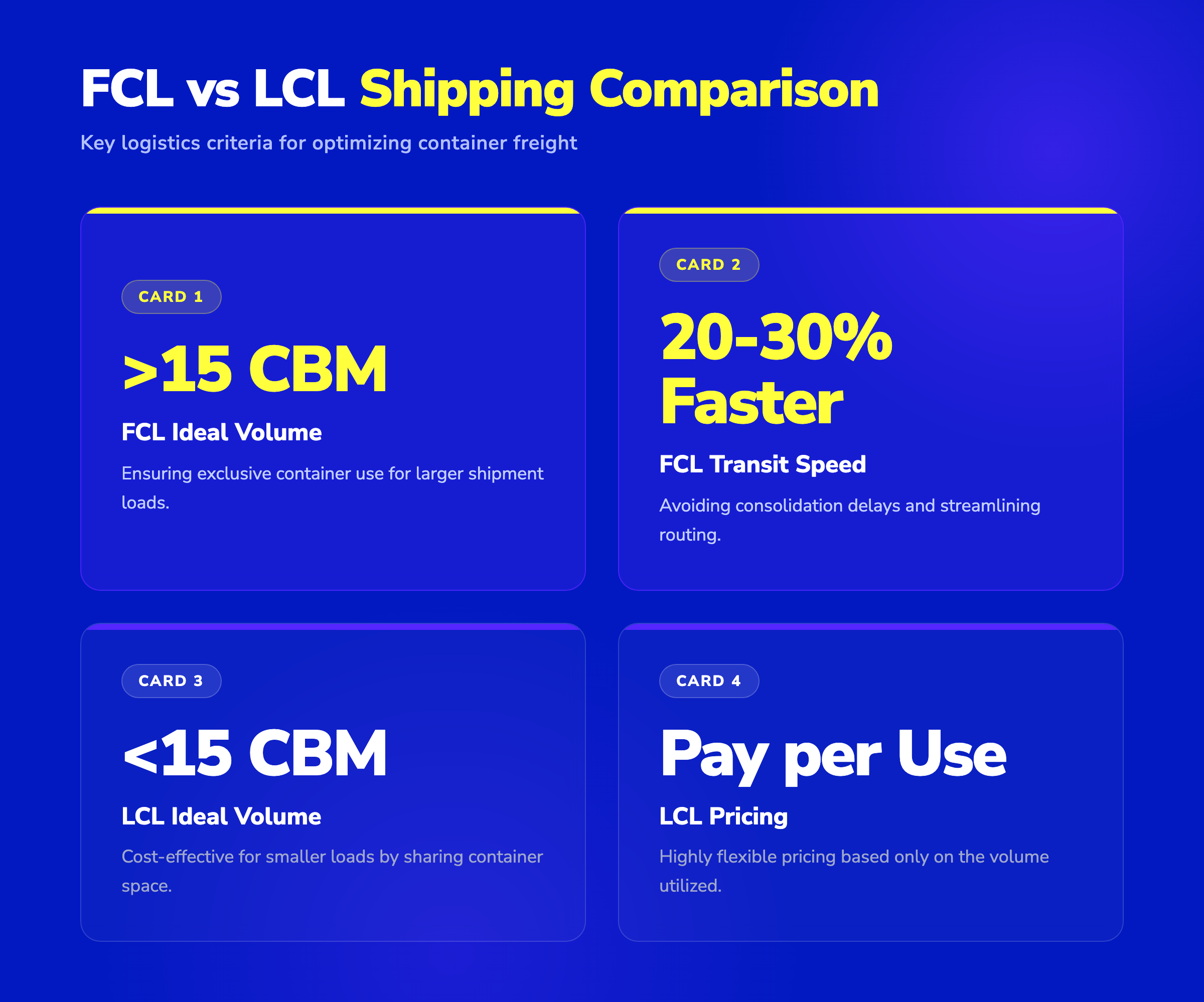
Choose FCL when your cargo volume exceeds 15-20 cubic meters (roughly half a 40ft container) or for high-urgency shipments. FCL provides 20-30% faster transit times—for example, 25-35 days from Asia to Europe via Dubai—and lower per-unit costs at scale. This option is preferred in UAE for time-sensitive express freight amid 2026 demand growth of 3% globally.
Choose LCL shipping for volumes under 15 cubic meters. This option saves 40-60% on costs through consolidation at Dubai forwarders, making it ideal for SMEs shipping samples or partial loads. The trade-off is 1-2 week delays from the grouping process. In 2025, uneven regional growth (Middle East showing +10%) favors LCL for flexible rerouting options.
Recent market data from Xeneta's 2026 Ocean Outlook shows that rates in October 2025 fell 20% year-on-year but remained 10% above 2023 levels, signaling opportunities for FCL bookings in overcapacity scenarios projected for 2026.
Dubai's Strategic Position in Global Container Shipping
Dubai has established itself as a critical global transshipment hub connecting East-West trade routes, with Jebel Ali Port serving as the region's flagship container facility and a top-10 global player. The emirate's strategic geographic location, combined with world-class infrastructure and free zone advantages, positions it as a vital node in international container shipping networks.
Dubai's Role as a Major Transshipment Hub
Dubai functions as a key transshipment point linking major trade lanes between Asia and Europe, Africa, and the Americas. This positioning allows Dubai to capture significant gateway traffic, with an estimated 75% of total throughput derived from gateway operations rather than local consumption, according to House of Shipping's Ports & Terminals Market Insight.
The UAE Container Shipping Market is projected to grow at 7.2% CAGR, reaching $15 billion by 2030, as reported by Ken Research. This growth is driven by increasing trade volumes and the country's strategic geographic positioning as a logistics hub. DP World's $2.5 billion infrastructure program pushed national throughput capacity past 100 million TEUs in January 2025, representing an 8.3% jump over 2024 volumes.
Jebel Ali Port - World's Largest Man-Made Harbor
Jebel Ali Port is the largest man-made harbor in the world and the Middle East's premier maritime hub. In 2024, the port handled 15.5 million TEUs—its highest throughput since 2015—representing 18% of DP World's global total of 88.3 million TEUs, according to Fast Company ME.
With four terminals, Jebel Ali is the largest container port in the Middle East Gulf and serves as the region's key hub. Globally, Jebel Ali ranks among the top 10 ocean freight container ports, with an annual container volume of around 18 million TEUs. This represents a significant recovery post-COVID, as the port has recently "flourished" and moved back into the top 10 list.
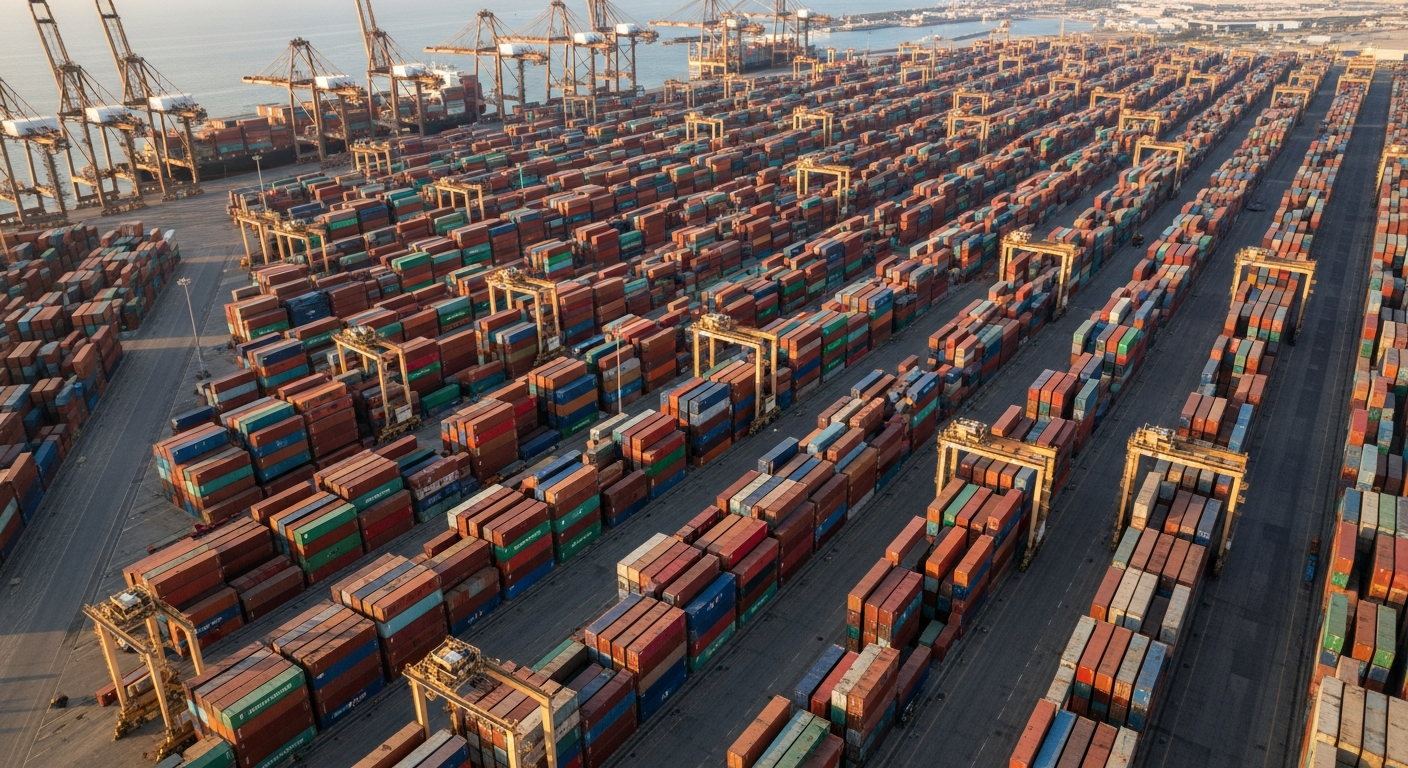
DP World, the operator of Jebel Ali, consolidated its position as the largest global container port operator by revenue in 2023, generating $6.4 billion in revenue for its Ports and Terminals division, up 5.1% year-over-year, with adjusted EBITDA reaching $3.3 billion, as reported by Global Maritime Hub.
Free Zone Advantages for Container Shipping Operations
Dubai's free zone infrastructure provides significant competitive advantages for container shipping and logistics operations. Companies operating from free zones benefit from 100% foreign ownership, zero corporate tax for up to 50 years, and streamlined customs procedures. These zones, including JAFZA (Jebel Ali Free Zone), DAFZA, and DMCC, offer integrated solutions combining warehouse facilities with efficient port access.
According to GCC Business Watch, Dubai was ranked fifth globally and first in the Arab region in the 2025 International Shipping Centre Development Index, reflecting its comprehensive maritime ecosystem spanning navigation services, shipbuilding and repair, logistics, and vessel handling.
Key Shipping Routes from Dubai
As a transshipment hub, Dubai connects major East-West trade routes efficiently. The concentration of economic activity in Dubai and Abu Dhabi, which jointly housed 52% of the population and generated more than 70% of retail sales in 2024, creates dense parcel concentrations that make rapid delivery economically viable. Dubai International Airport retained its top global ranking for international tonnage, complementing Jebel Ali's mega-terminal capacity for rerouted Asia-Europe trade.
The Dubai Maritime Transport Plan 2030, aligned with the Dubai Economic Agenda D33, aims to expand maritime transport and strengthen Dubai's marine network, ensuring continued growth in freight shipping capabilities and global connectivity.
Container Shipping Process: How Ocean Freight Works
The container shipping process involves a coordinated sequence of steps from initial booking through final delivery, encompassing documentation, vessel operations, port handling, and customs procedures. Understanding this end-to-end workflow is essential for businesses engaged in international trade through Dubai.
End-to-End Container Shipping Workflow
The container shipping journey begins with booking and documentation preparation. Shippers or freight forwarders initiate the process by reserving container space with shipping lines, providing cargo details and destination information. This is followed by preparation of essential shipping documents that accompany the cargo throughout its journey.
Once documentation is prepared, cargo undergoes container consolidation and loading. For FCL shipping solutions, containers are loaded at the shipper's facility or at a consolidation center. The shipper receives a container number and booking reference, which are used to track the shipment throughout transit.
Critical Documentation Requirements
Three primary documents are essential for international container shipments:
- Bill of Lading (B/L): The master document serving as proof of shipment, receipt of goods, and contract of carriage. It establishes ownership and is required for customs clearance and payment collection.
- Commercial Invoice: Details the transaction between buyer and seller, including product descriptions, quantities, unit prices, and total value. This document is critical for customs valuation and import duties assessment.
- Packing List: Itemizes the contents of each container, specifying weights, dimensions, and packaging details. This facilitates cargo verification at ports and customs checkpoints.
Container Loading and Vessel Scheduling
Vessel scheduling is coordinated based on shipping line schedules and port availability. Container vessels operate on fixed routes with published sailing dates. Transit times vary significantly based on origin-destination pairs, vessel type, and routing. For example, shipments from Dubai to major European ports typically require 20-30 days of ocean freight transit, while intra-regional Gulf shipments may take 3-7 days.
Port Operations and Terminal Handling
At the port of loading, containers enter the terminal handling phase. In Dubai, the Dubai Maritime Authority (DMA) has implemented Administrative Decision No. 2 of 2023, which restructured how terminal charges are assessed and collected, as detailed in Conqueror Network's analysis.
Key operational changes include:
- Terminal Handling Charges (THC) and port clearance fees are now imposed when settling payments through Dubai Trade Single Window for both import and export declarations
- Truck Loading and Unloading Charges (TLUC) and shifting charges are collected through a dedicated service on Dubai Trade Single Window
- All Delivery Orders in Dubai are now digitally issued through the Dubai Trade Digital Delivery Order platform, streamlining the release process
Customs Clearance and Final Delivery
Customs clearance represents a critical juncture in the shipping process. Dubai Customs' blockchain platform reduces declaration time to under 10 minutes, substantially trimming clearance overhead. This efficiency, combined with our customs clearance services, positions Dubai as a competitive gateway for regional and international trade.
The UAE maintains significant container handling capacity across multiple ports. Khalifa Port in Abu Dhabi, the region's first semi-automated container terminal, currently handles 7.8 million TEUs annually, with capacity expected to increase to 9.6 million TEUs by 2025. Jebel Ali in Dubai remains the Gulf's top container gateway, providing the region's largest throughput capacity.
According to Mordor Intelligence, the Middle East Freight Forwarding Market is estimated at USD 21.81 billion in 2025 and is expected to reach USD 28.60 billion by 2030, with the United Arab Emirates posting the region's fastest expansion at a 5.95% CAGR.
LCL Consolidation Services: Shared Container Solutions
LCL shipping combines cargo from multiple shippers into a single container, with each business paying only for the space it actually occupies. Rather than requiring businesses to book and pay for an entire full container (FCL), LCL allows companies to ship smaller consignments efficiently by sharing container space with other shippers. The consolidation process handles collection, paperwork, loading, and coordination—eliminating the need for individual businesses to manage these logistics components separately.
How LCL Consolidation Works
LCL is the optimal choice when cargo is under 15 cubic metres (CBM), when testing new markets or suppliers with smaller volumes, when budget is the primary concern, or when shipment frequency is irregular. According to Shippify's 2026 Sea Freight Guide, as a general rule at Jebel Ali port, if cargo exceeds 15 CBM, FCL becomes almost always cheaper per unit than LCL once terminal handling and consolidation fees are factored in.
Benefits of Shared Container Space
LCL consolidation delivers several critical advantages for cost-conscious shippers:
- Cost Savings: You eliminate payment for unused air space inside a container. Businesses avoid locking cash into full container bookings, reducing financial pressure on smaller operations.
- Flexibility: Companies can ship when ready without delaying orders to increase volume. This enables frequent smaller shipments that prevent warehouse overloading and maintain better inventory flow.
- Market Testing: Smaller shipments mean lower risk when entering new markets—if a market doesn't perform, losses remain controlled.
- Scalability: As volumes grow, shipments scale naturally without requiring sudden system overhauls.
LCL Consolidators in Dubai
Dubai's position as a regional logistics hub makes it ideal for LCL operations. The emirate sits at the intersection of major trade routes connecting Asia, Europe, Africa, and the GCC region. Modern ports, efficient customs processes, and strong infrastructure enable lcl consolidators in dubai to maintain regular consolidation schedules without disruption.
Key consolidator functions include coordinating between shipping lines, customs authorities, warehouse teams, and overseas agents. Major operators like Expeditors International—a Fortune 500 company with 350+ locations across 100+ countries—maintain specialized facilities in Dubai. According to Expeditors, they operate a 10,000 SQM warehouse with 1,500 SQM of Container Freight Station (CFS) space in a special economic zone.
For businesses seeking efficient LCL consolidation services, Dubai's integrated free zones capitalize on increasing demand for sea-air combination freight movement and technology adoption, positioning the emirate as a preferred regional supply chain and distribution gateway.
Typical LCL Transit Times and Pricing
Standard LCL transit time from Dubai ranges from 12 to 18 days, depending on destination and routing. Pricing structure for LCL shipping from Dubai is charged per cubic metre (CBM). Standard LCL rates from Jebel Ali in 2026 range from USD 55 to USD 120 per CBM, making it significantly more cost-effective than FCL for smaller shipments.
The global Less-than-Container-Load (LCL) shipping market was estimated at USD 36.58 billion in 2025, according to DataInsights Market, reflecting significant demand for consolidated shipping solutions. The United Arab Emirates Freight and Logistics Market was valued at USD 23.05 billion in 2026 and is growing at a compound annual growth rate (CAGR) of 6.55%, projected to reach USD 31.63 billion by 2031.
Container Types and Cargo Compatibility
Understanding container types and their cargo compatibility is essential for optimizing freight shipping operations from Dubai. Standard dry containers dominate UAE container shipping, with 20ft (TEU) and 40ft (FEU) units handling general cargo like electronics, textiles, and consumer goods.
Need a shipping quote?
Get AI-optimized rates from DHL, FedEx & UPS — up to 65% below retail. Quote in under 10 minutes.
Standard Dry Containers
According to Grand View Research, ISO-standard containers represent 98.32% of UAE shipping container revenue in 2020, supporting Jebel Ali Port's throughput of over 20.3 million TEU in 2022 and 21.1 million TEU in 2023.
The main container specifications include:
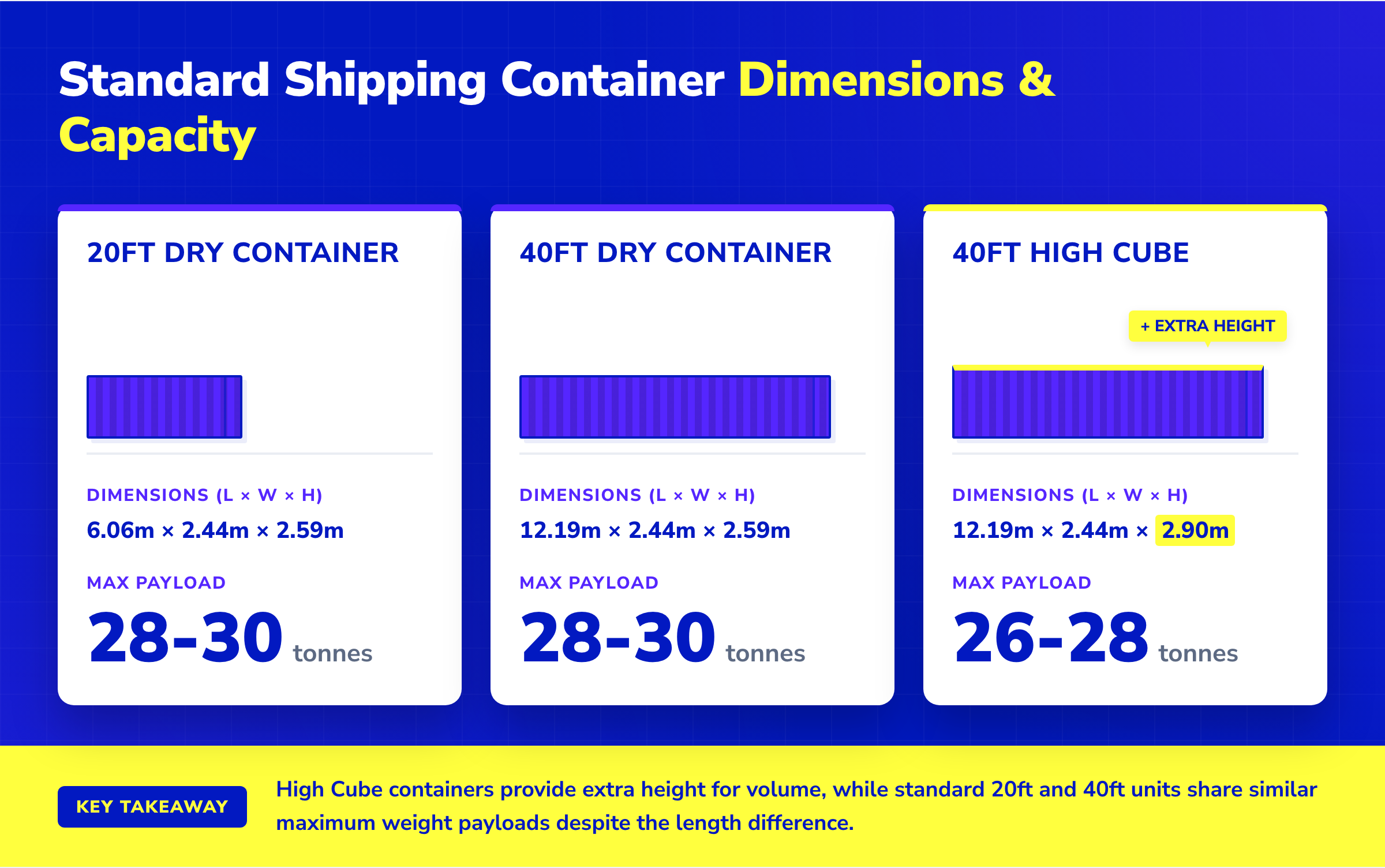
- 20ft Dry Container: Dimensions of 6.06m x 2.44m x 2.59m, maximum payload of 28-30 tonnes. Standard for LCL/FCL from Jebel Ali, serving as the 1 TEU base unit.
- 40ft Dry Container: Dimensions of 12.19m x 2.44m x 2.59m, maximum payload of 28-30 tonnes. Handles 70%+ of Dubai's container traffic.
- 40ft High Cube: Dimensions of 12.19m x 2.44m x 2.90m, maximum payload of 26-28 tonnes. Preferred for e-commerce surges with extra 0.6m³ volume.
Specialized Containers
Specialized containers enable multimodal freight forwarding from Dubai to global markets:
- Refrigerated (Reefer) Containers: Critical for temperature-sensitive cargo like pharmaceuticals and food, supporting Dubai's re-export hub role and air-sea transshipment at Dubai International Airport/Jebel Ali.
- Open-Top Containers: Ideal for oversized cargo such as project equipment and UAE's oilfield equipment exports.
- Flat-Rack Containers: Handle heavy machinery and pipes, with collapsible sides and 40+ tonne capacity, used extensively in DP World's 38% Middle East throughput share.
Cargo Weight Limits and Volume Calculations
Cargo weight limits adhere to ISO 1496-1 standards: 20ft containers have a maximum gross weight of 30.48 tonnes (payload ~28 tonnes), while 40ft containers also max at 30.48 tonnes (payload ~26-28 tonnes). These limits are enforced at UAE ports to prevent axle overloads on inland drayage. Volume calculations use TEU (20ft = 33-38m³ usable) or FEU (67-76m³), with High Cube adding 10-15% capacity.
Dangerous Goods Containers and Compliance
Dangerous goods (DG) containers require IMDG Code compliance, with dedicated 20/40ft units segregated for classes 1-9 (e.g., chemicals, batteries). UAE mandates DGSA certification, UN-approved packaging, and placarding per Dubai Customs and Jebel Ali Free Zone rules. Compliance is critical amid Red Sea risks, as sea forwarding grows at 8.12% CAGR (2026-2031), with digital tracking reducing DG handling errors.
According to ReportLinker, in 2023, UAE ranked 8th globally with 19.4 million TEU, projected to reach 20 million TEU by 2028 (0.5% CAGR), emphasizing safe DG protocols for express shipping.
Container Selection Criteria
Dubai's freight forwarders bundle these container types for FCL/LCL ocean logistics, leveraging DP World's USD 2.5 billion investment pushing national capacity past 100 million TEU in 2025 (8.3% YoY growth). The UAE freight logistics market is projected to hit USD 23.05 billion in 2026 (6.55% CAGR), with Jebel Ali buffering Asia-Europe reroutes despite 36% global capacity rise (2023-2027) pressuring rates to $2,107/FEU (Jan 2026).
Major Shipping Routes and Transit Times from Dubai
Due to ongoing Middle East crises in early 2026, including suspensions at Dubai's Jebel Ali port, blockages in the Strait of Hormuz, Suez Canal, and Bab el-Mandeb Strait, standard container shipping routes and transit times from Dubai are severely disrupted. According to Mathez Freight, major carriers like Maersk, CMA CGM, Hapag-Lloyd, COSCO, and others are rerouting via the Cape of Good Hope, adding 10-15 days to voyages.
Dubai to Europe
Normal peacetime transit for UAE to Europe shipping was 14-18 days via Suez Canal. However, current 2026 conditions enforce detours via the Cape of Good Hope, extending transit times to 24-33 days total. The Suez and Bab el-Mandeb routes are suspended, with Maersk and Hapag-Lloyd implementing full rerouting protocols. According to Business Times, average daily Bab el-Mandeb transits dropped to 33 ships as of March 8, 2026, down significantly from normal levels.
Dubai to North America
Traditional UAE to USA container services operated on 20-25 days via Suez or 18-22 days via Asia. Current disruptions add 10-15 days, resulting in 30-40 days total transit time. Persian Gulf blockades have halted direct sailings, with COSCO vessels hovering in safe waters. Jebel Ali congestion creates ripple effects impacting US East Coast flows.
Dubai to Far East
Intra-Asia routes, typically 7-12 days direct, face variable conditions. While not directly affected by Middle East disruptions, hub saturation at Singapore and Port Klang creates delays. According to Straits Times, some carriers including MSC and ONE have suspended services to Gulf ports. Asian airlines have cut Dubai flights by 2,000 in 24 hours, reducing cargo capacity by 18%.
Dubai to Africa
Dubai to East/West African ports normally takes 10-15 days. Current conditions add 10-15 days via Cape routing for some services. Maersk's Middle East Operational Update indicates the carrier accepts bookings to Jeddah, King Abdullah, and Aqaba from March 16, though East Africa routes face risks from Bab el-Mandeb restrictions.
Intra-GCC and Regional Services
Regional services within the GCC, typically 3-7 days, face significant disruptions. Market data shows capacity crunch with spot rates rising due to reduced availability. Maersk's Strait of Hormuz emergency rates reached US$1,800/20' dry and US$3,000/40' dry (including 14-day storage), with reefers adding US$300-600 extra on long hauls.
Freight forwarders in Dubai/UAE advise buffer times, air freight shifts, and monitoring detention charges (US$25/TEU/day post-14 days). Jebel Ali, handling Asia-Africa-Europe-US flows, faces protracted global supply chain risks according to industry analysts.
Container Shipping Costs and Pricing Factors
Container shipping rates from Dubai are influenced by multiple dynamic factors including fuel prices, demand fluctuations, seasonality, container availability, and global events like Red Sea disruptions. Understanding these factors is crucial for businesses planning their ocean freight budgets.
Factors Affecting Container Shipping Rates
Fuel costs directly impact surcharges, while high demand on routes from Jebel Ali Port—one of the world's busiest terminals—drives up rates. According to Gulf News, in 2026, freight rates face downward pressure from potential Red Sea reopening, with global container ship capacity projected to rise 36% from 2023-2027 amid weakening demand estimated at -1.1% contraction.
Recent data shows the Containerized Freight Index at 1,706.95 points on March 20, 2026 (down 0.20% daily), as reported by Trading Economics. The World Container Index rose in March 2026 due to route shifts away from Strait of Hormuz and Suez, while the Drewry World Container Index fell 4.7% to $2,107 per 40-foot container for the week ended January 29, 2026.
Base Freight Rates vs Additional Charges
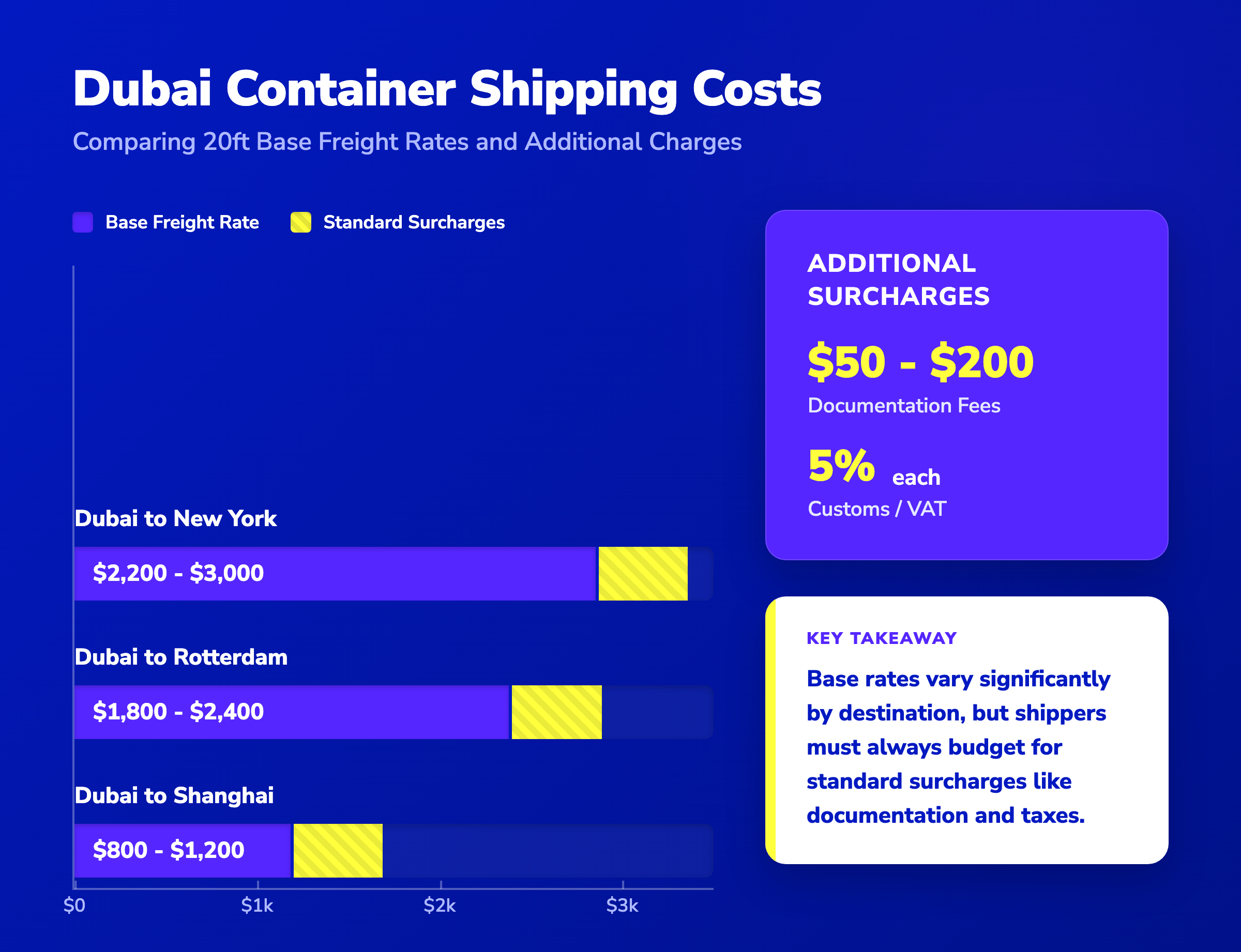
Base freight rates cover ocean freight transport from Dubai ports like Jebel Ali, quoted per container for FCL or per CBM for LCL. According to The Alliance Shipping's Rate Guide, examples include:
- Dubai to Rotterdam: $1,800-$2,400 for 20ft container
- Dubai to Shanghai: $800-$1,200 for 20ft container
- Dubai to New York: $2,200-$3,000 for 20ft container
- Dubai to Mombasa: $1,400-$1,900 for 20ft container
Additional charges include:
- Bunker Adjustment Factor (BAF): Compensates for fuel price volatility
- Currency Adjustment Factor (CAF): Adjusts for exchange rate fluctuations
- Terminal Handling Charges (THC): Covers port operations, now transparently invoiced separately via Dubai Trade under DMA Administrative Decision No. 2 of 2023
- Truck Loading/Unloading Charges (TLUC): For container movement at terminals
- Documentation fees: Processing shipping documents
- Hazardous/OOG surcharges: For special cargo handling
FCL vs LCL Cost Comparison
FCL (Full Container Load) becomes more economical for larger shipments. A standard 20ft TEU holds 21,000-27,000 kg, while a 40ft FEU accommodates 26,000-28,000 kg. LCL (Less than Container Load) suits smaller volumes, priced per CBM (whichever is greater: actual or volumetric weight at 1 CBM ≈ 1,000 kg).
The break-even point typically occurs at 15 CBM. Above this volume, FCL becomes cheaper than LCL due to consolidation fees. For example:
- 40ft FCL Dubai-Hamburg at $2,800 for 25,000 kg = $0.11/kg
- LCL Dubai-Singapore 2 CBM/500 kg at $90 = $0.18/kg
Hidden Costs to Consider
Key hidden costs that can significantly impact your freight shipping budget include:
- Demurrage: Port storage fees after free time (typically 5-7 days)
- Detention: Charges for containers kept outside the port beyond allowed time
- Documentation fees: Can add $50-200 per shipment
- Insurance: Typically 0.5-2% of cargo value
- Customs duties and VAT: 5% duty on CIF value plus 5% VAT in UAE (exempt in free zones)
According to Globalia Logistics Network, Dubai's 2023 DMA Decision No. 2 mandates separate invoicing for THC/TLUC via Dubai Trade, ending charge freezing and adding transparency—but trans-shipment costs to Gulf ports have risen.
How Volume Partnerships Deliver Savings
Volume partnerships with carriers can significantly reduce shipping costs. Businesses shipping regularly can negotiate contract rates 20-40% below spot market prices. Working with established freight forwarders who have strategic partnerships with major carriers like Maersk and MSC provides access to these preferential rates even for smaller shippers. Our integrated approach combining container shipping with 3PL fulfillment services creates additional cost efficiencies through consolidated operations.
Choosing the Right Container Shipping Partner
Selecting the right freight forwarder for your container shipping needs is crucial for ensuring reliable, cost-effective ocean freight services from Dubai. With the UAE ranking as the 8th global container market handling 19.4 million TEUs in 2023, choosing a partner with proven expertise becomes essential.
Key Criteria for Selecting a Freight Forwarder
According to ReportLinker's UAE Shipping Container Industry Outlook, businesses should prioritize freight forwarders based on proven track records in handling high-volume container traffic, strategic port access (particularly Jebel Ali and Khalifa), regulatory compliance, and cost efficiency. Key evaluation criteria include:
- Expertise in FCL/LCL shipments within UAE's USD 1.78 billion container terminal operations market (2025)
- Reliability metrics with on-time delivery rates above 90%
- Integration with UAE's business-friendly ports, ranked top in MENA per World Bank 2022 data
- Financial stability and operational scale to handle market fluctuations
Importance of Carrier Partnerships
Freight forwarders with direct alliances to Maersk, MSC, and CMA CGM ensure capacity access amid global oversupply, where container ship capacity rises 36% from 2023-2027. According to Mordor Intelligence, these carriers dominate UAE routes via Jebel Ali (largest Middle East Gulf port, 13.7 million TEUs in 2021) and Khalifa (7.8 million TEUs capacity, expanding to 9.6 million by 2025).
Strategic partnerships mitigate disruptions like Red Sea issues, supporting UAE's re-export hub status (3rd globally) and 1.1% annual container demand growth since 2005. DP World, a key operator, added 3 million TEUs capacity by end-2023, enhancing carrier-linked throughput for businesses utilizing freight shipping services.
Technology Integration and Tracking Capabilities
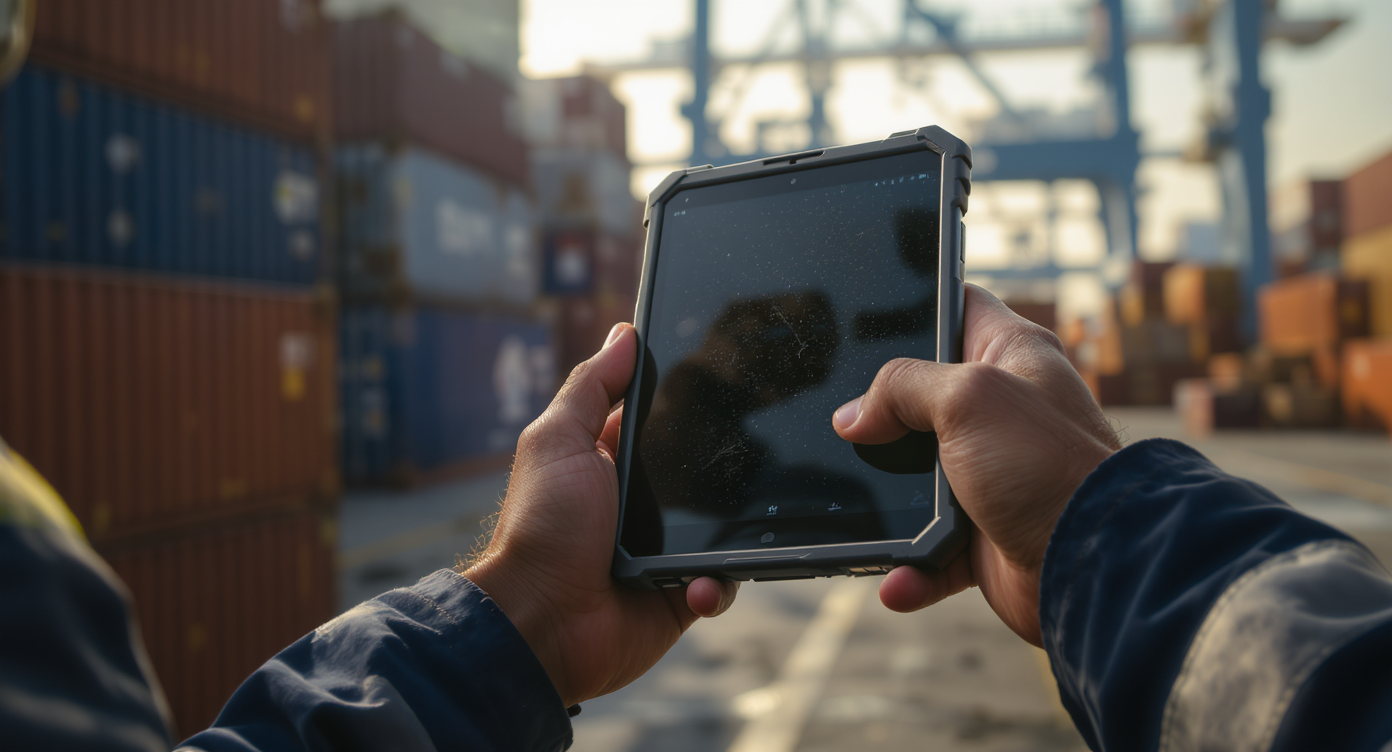
Choose forwarders offering real-time GPS tracking, AI-driven route optimization, and blockchain for documentation. This technology integration is critical in UAE's digitized logistics landscape, where Khalifa Port's semi-automated systems handle all Abu Dhabi container traffic. According to Grand View Research, technology reduces delays in high-growth markets like UAE shipping containers (USD 23.8 million in 2020 to USD 55.8 million by 2028, 11.2% CAGR).
Forwarders integrated with port systems like Jebel Ali's achieve higher vessel utilization above global averages. Real-time visibility becomes especially important for express FCL/LCL shipments from Dubai free zones, enabling proactive management of potential delays or route changes.
Free Zone Warehouse Facilities and Value-Added Services
Opt for partners with Jebel Ali Free Zone or Khalifa facilities providing bonded storage, consolidation, and cold chain for reefer cargo. These capabilities are vital as Dubai's Jebel Ali supports specialized cold storage for food/pharma redistribution. According to House of Shipping's Market Update, value-added services like repacking and customs clearance leverage UAE's nine ports, including 19,000 sqm cold storage expansions for medical supplies.
These integrated services cut costs in a market facing 2026 rate pressures (global demand -1.1% if Red Sea reopens) and support ISO containers (98.32% revenue share). Partners offering comprehensive solutions combining ocean freight with warehousing deliver superior value through operational synergies.
Customer Service and Account Management Quality
Quality customer service distinguishes leading freight forwarders in Dubai's competitive market. Look for partners providing:
- Dedicated account managers familiar with your industry and shipping requirements
- 24/7 customer support for urgent shipment queries
- Proactive communication about potential delays or market changes
- Transparent pricing with no hidden charges
- Expertise in handling documentation and compliance requirements
The combination of strategic carrier partnerships, advanced technology, integrated warehouse facilities, and superior customer service ensures your container shipping operations run smoothly from Dubai to global destinations.
Container Shipping Documentation and Compliance
Proper documentation and compliance are critical for successful container shipping operations from Dubai. Understanding the requirements ensures smooth customs clearance and avoids costly delays in your ocean freight shipments.
Have a quick question? Get answers instantly on WhatsApp.
Essential Shipping Documents and Their Purposes
According to Proconnect Logistics' 2026 Customs Guide, key documents for container shipping and sea freight from Dubai include:
- Commercial Invoice: Details seller/buyer information, goods description, quantity, value, HS codes, and country of origin. This document enables customs valuation and duty assessment.
- Packing List: Specifies package count, dimensions, and weights for verification and handling purposes.
- Bill of Lading (B/L): Serves as proof of shipment, contract of carriage, and title document for sea freight, containing ports, consignee, and cargo description details.
- Certificate of Origin: Issued by the Chamber of Commerce to confirm manufacturing country, supporting duty rates, trade agreements, and exemptions.
- Import/Export Declaration: Filed via Dubai Trade portal declaring contents, value, and HS codes.
- Trade License Copy: Verifies legal trading status in UAE.
- Delivery Order: Authorizes cargo release post-duty payment.
- Customs Duty Payment Proof: Confirms 5% duties on CIF value plus 5% VAT (exempt in free zones like JAFZA).
For sea freight, submit 2 originals plus 2 copies of invoice/packing list, 1 original B/L plus 2 non-negotiables, and MSDS for hazardous items, as detailed by IMEX Shipping.
UAE Customs Requirements and AEO Certification Benefits
UAE customs clearance in Dubai mandates registration via Dubai Customs or Dubai Trade, online declaration submission, duty/VAT payment, and inspection (physical or X-ray). According to Amexpro, the process takes 24-48 hours for complete documents, longer for complex shipments.
Duties are 5% of CIF value, with VAT at 5%, though free zone exemptions apply. AEO (Authorized Economic Operator) certification streamlines compliance for certified firms by reducing inspections and accelerating clearance—aligning with Dubai's efficiency focus, where incorrect documentation causes most delays. Businesses operating in JAFZA or DWC register via free zone authorities for simplified procedures.
International Trade Compliance and Regulatory Considerations
Compliance for freight shipping involves accurate HS codes for duty/restriction checks, origin verification for trade pacts, and permits from bodies like Dubai Municipality for regulated goods such as electronics and pharmaceuticals. According to Clarion Shipping, Dubai enforces global standards for safety/security, with mismatches in documentation/inventory leading to holds, penalties, or seizures.
For exports, businesses must declare via Dubai Customs with invoice, packing list, origin certificate, and relevant permits. Sea freight from Dubai requires export license verification and labeling per UAE standards. Special permits apply for restricted goods including chemicals and food products, with HS Code accuracy being critical to avoid penalties.
Digital Documentation Trends and Paperless Processes
Dubai Trade portal enables fully digital submission of declarations, invoices, and documents, minimizing paper usage. According to C4 Customs' 2026 Guide, Electronic Bill of Lading (eB/L) and blockchain pilots reduce errors and delays, with 2026 guidelines emphasizing online verification for faster clearance.
Trends show 90%+ of UAE clearances are now digital (inferred from portal mandates), cutting processing time by hours. However, incomplete digital filings still cause the majority of delays according to freight forwarders. The integration of digital systems with our customs clearance services ensures smooth documentation processing for all container shipments.
Common Documentation Errors and How to Avoid Them
Based on LBX Logistics' 2026 Industry Guide, common documentation errors include:
- Incorrect or inconsistent HS codes across documents
- Mismatched quantities or values between commercial invoice and packing list
- Missing or expired certificates of origin
- Incomplete consignee information on Bill of Lading
- Failure to obtain required permits for restricted goods
To avoid these errors, implement a documentation checklist, verify all information matches across documents, ensure HS codes are current and accurate, obtain all permits before shipping, and work with experienced freight forwarders familiar with UAE regulations.
Frequently Asked Questions
What's the difference between FCL and LCL shipping?
FCL (Full Container Load) means you book an entire container exclusively for your cargo, while LCL (Less than Container Load) involves sharing container space with other shippers' goods. FCL is ideal for shipments exceeding 15 cubic meters, offering faster transit times (20-30% quicker), better security since the container remains sealed from origin to destination, and lower per-unit costs for large volumes. LCL suits smaller shipments under 15 CBM, providing 40-60% cost savings through consolidation but with 1-2 weeks additional transit time due to the consolidation and deconsolidation process at origin and destination ports.
How long does container shipping take from Dubai?
Container shipping transit times from Dubai vary significantly by destination and current global conditions. Under normal circumstances, Dubai to Europe takes 14-18 days via Suez Canal, Dubai to North America requires 20-25 days, Dubai to Far East needs 7-12 days, and Dubai to Africa takes 10-15 days. However, as of 2026, ongoing Middle East disruptions have extended these times considerably, with major carriers rerouting via Cape of Good Hope, adding 10-15 days to most routes. Current realistic transit times are: Europe 24-33 days, North America 30-40 days, with some Asia and Africa routes also affected by port congestion and vessel availability issues.
What documents are required for container shipping?
Essential documents for container shipping from Dubai include the Commercial Invoice (detailing goods, value, and HS codes), Packing List (specifying dimensions and weights), Bill of Lading (serving as proof of shipment and title document), Certificate of Origin (confirming manufacturing country), Import/Export Declaration (filed via Dubai Trade portal), Trade License Copy, and Customs Duty Payment Proof. For sea freight specifically, you need 2 originals plus 2 copies of invoice/packing list, 1 original Bill of Lading plus 2 non-negotiables, and MSDS sheets for any hazardous materials. Special permits from Dubai Municipality may be required for restricted goods like chemicals, pharmaceuticals, or food products.
How do I choose between FCL and LCL for my cargo?
Choose FCL when your cargo volume exceeds 15 cubic meters (approximately half a 40ft container), when shipping high-value or fragile goods requiring exclusive container use, for time-sensitive shipments needing faster transit, or when your per-unit shipping cost becomes lower with full container booking. Select LCL for volumes under 15 CBM, when testing new markets with smaller quantities, for irregular shipping frequencies that don't justify full containers, or when cash flow requires paying only for space used rather than an entire container. Calculate both options' total landed costs including handling fees, as FCL becomes more economical above the 15 CBM threshold at most Dubai ports.
What should I look for when selecting a container shipping provider?
When selecting a container shipping provider in Dubai, prioritize companies with direct partnerships with major carriers like Maersk, MSC, and CMA CGM for reliable capacity and competitive rates. Look for providers offering integrated services combining ocean freight with warehousing in Dubai free zones (JAFZA, DAFZA, DMCC), real-time tracking technology and digital documentation capabilities, proven expertise in both FCL and LCL shipments with on-time delivery rates above 90%, and transparent pricing without hidden charges. Additionally, ensure they have AEO certification for faster customs clearance, 24/7 customer support for urgent queries, and experience handling your specific cargo type whether standard dry containers or specialized reefer/hazardous goods.
Can I track my container shipment in real-time?
Yes, modern container shipping from Dubai offers comprehensive real-time tracking capabilities. Leading freight forwarders provide GPS-enabled container tracking showing exact vessel location, estimated arrival times, and any route deviations. Through online portals and mobile apps, you can monitor your shipment's progress from port of loading through transshipment points to final destination. Advanced systems also provide milestone notifications for key events like container loading, vessel departure, customs clearance, and delivery. This visibility is particularly crucial given current market volatility, allowing you to proactively manage inventory and inform customers of any delays. Integration with port systems at Jebel Ali and carrier platforms ensures accurate, up-to-date information throughout your cargo's journey.
Sources & References
This article draws on research and data from the following verified sources:
- 2026 Ocean Outlook - Xeneta
- 2026 Container Shipping Outlook - AlixPartners
- Declining Import Cargo Volume Expected to Continue in 2026 - NRF
- Global container shipping volumes and statistics - Container Statistics
- Container Shipping Overcapacity & Rate Outlook 2026 - Freightos
- GCC Business Watch - Dubai Ranked Among World's Top Five Shipping Centres in 2025
- House of Shipping - Ports & Terminals Market Insight Q2
- Transmodal - The Top 10 Ocean Freight Container Ports of 2023
- Global Maritime Hub - DP World and ICTSI Show Strongest Revenue Growth in 2023
- Mordor Intelligence - UAE Freight & Logistics Market Share & Size 2031 Outlook
- Ken Research - UAE Container Shipping Market Growth Trends
- Fast Company ME - Dubai Named One of the World's Top Five Shipping Hubs
- Conqueror Network - DMA Impact on Container Shipping Industry
- Globalia Logistics Network - DMA's New Measure Impact on Ocean Freight
- Beroe - Container Shipping Procurement Outlook 2026
- AmexPro Global Shipping - LCL Consolidation Services in Dubai
- IMEX Shipping - The Future of LCL Consolidation Services in the UAE
- Express Freight Oman - LCL Consolidators in Dubai Are Essential for Small Shipments
- Expeditors - Dubai's Cost-Effective LCL Shipping and Streamlined Supply Chain
- Shippify - Sea Freight Services in Dubai Complete 2026 Guide
- DataInsights Market - Less-than-container Load (LCL) Shipping Analysis 2026
- EXTRANS GLOBAL - Air Freight News Week 10 2026
- Gulf News - Container shipping heads toward a harder 2026
- ReportLinker - UAE Shipping Container Industry Outlook 2024
- CEIC Data - UAE Container Port Throughput
- Grand View Research - UAE Shipping Container Market
- Mathez Freight - Crisis in the Middle East 2026
- Business Times - Shipping lines cut Middle East routes
- Straits Times - Shipping lines cut Middle East routes
- Maersk - Middle East Operational Update 9 – March 2026
- Marken - 2026-03-18 Supply Chain Update Middle East
- Sea Freight Rates from Dubai: Rate Calculation Guide 2025-26
- Containerized Freight Index - Price - Chart - Historical Data - News
- Global Container Freight Rates Rise as World Container Index Climbs
- Reefer Shipping Containers Market Outlook 2026-2032
- Proconnect Logistics: Customs Clearance Documents in Dubai (2026 Guide)
- LBX Logistics: Freight Forwarding in Dubai 2026 Guide
- Scribd: Official Shipping Guidelines WHX Dubai 2026
- Claris Shipping: Dubai Import Regulations
- C4 Customs: Documents Required for Customs Clearance in Dubai (2026 Guide)
- Tonlexing: International Shipping Documents Checklist (2026 Guide)
- UAE Express Delivery Market Report and Forecast 2026-2034
- UAE Logistics Market Size is Expected to Reach USD 95.2 Billion
Tags
Related Articles
Ready to optimize your logistics?
Whether you need express shipping, freight forwarding, or warehousing — our AI finds the best rates and routes for your business.