
Bill of Lading Guide: Understanding Your International Shipping Documentation
What is a Bill of Lading and Why It Matters for International Trade
A bill of lading is far more than just another shipping document—it's the cornerstone of international trade that serves as a legal contract, receipt, and proof of ownership all in one. For Dubai-based businesses navigating the complexities of global commerce, understanding this critical document can mean the difference between smooth customs clearance and costly delays at ports like Jebel Ali.
At its core, a bill of lading serves three essential functions that make it indispensable for international shipping. First, it acts as a receipt, confirming that the carrier has received your goods in the specified condition. Second, it functions as a contract of carriage, establishing the agreed terms between shipper and carrier, including freight charges and delivery obligations. Third, and perhaps most importantly, it serves as a document of title, representing ownership of the goods and enabling their transfer through endorsement.
The critical importance of proper bill of lading documentation becomes clear when considering UAE customs requirements. According to the Arab American Chamber of Commerce, legalized bills of lading are mandatory for customs clearance and cargo release in the UAE. Without proper documentation, shipments face delays, fines, or outright denial of entry by customs authorities. This is particularly crucial given that Dubai's Jebel Ali Port handled over 100 million TEU in throughput by January 2025, representing an 8.3% increase from the previous year.
For importers and exporters operating in Dubai's dynamic trade environment, the legal implications are significant. Under the UAE's Federal Decree-Law No. 43 of 2023 (the new Maritime Law), precise bill of lading drafting is essential to establish holder rights and avoid misdelivery claims. Exporters retain title until the bill of lading is transferred, using it as security for payment through letters of credit. Meanwhile, importers must present the original or negotiable bill of lading for cargo release—failure to do so exposes them to demurrage fees or shipment rejection.
Understanding these fundamentals is just the beginning. For businesses looking to master international shipping documentation, our comprehensive bill of lading glossary provides detailed definitions and practical guidance for every aspect of this essential document.
Types of Bills of Lading: Ocean, Air, and Express Logistics
Not all bills of lading are created equal. The type of bill of lading required depends on your chosen mode of transport, each with distinct characteristics that affect how your cargo moves through the global supply chain. Understanding these differences is crucial for Dubai businesses leveraging the emirate's position as a global logistics hub.
Ocean bills of lading dominate sea freight movements, whether you're shipping Full Container Load (FCL) or Less than Container Load (LCL) shipments. These documents are particularly critical at UAE ports, where they must be legalized for customs clearance and compliance. According to Mordor Intelligence, UAE sea freight is projected to grow at 8.12% CAGR from 2026-2031, driven by capacity additions at major ports and digitized documentation processes. For businesses using our sea freight solutions, proper ocean bill of lading preparation ensures smooth cargo movement through Jebel Ali's expanding facilities.
Air waybills replace traditional bills of lading for air freight cargo, functioning as non-negotiable receipts and contracts without title transfer capabilities. This makes them ideal for high-value or time-sensitive shipments moving through Dubai International Airport's modernized cargo facilities. Unlike ocean bills, air waybills cannot be endorsed or transferred, which actually speeds up the release process—perfect for express shipments requiring rapid customs clearance. Companies utilizing our air freight services benefit from streamlined documentation that matches the speed of air transport.
Express bills of lading from carriers like DHL, FedEx, and UPS represent the cutting edge of shipping documentation. These documents blend B2B, B2C, and C2C service capabilities with guaranteed delivery times, typically using non-negotiable formats to maximize processing speed. The express logistics sector's growth is remarkable—UPS alone invested USD 100 million in Dubai South in March 2025 for automated sorting facilities to handle the e-commerce boom driving this segment.
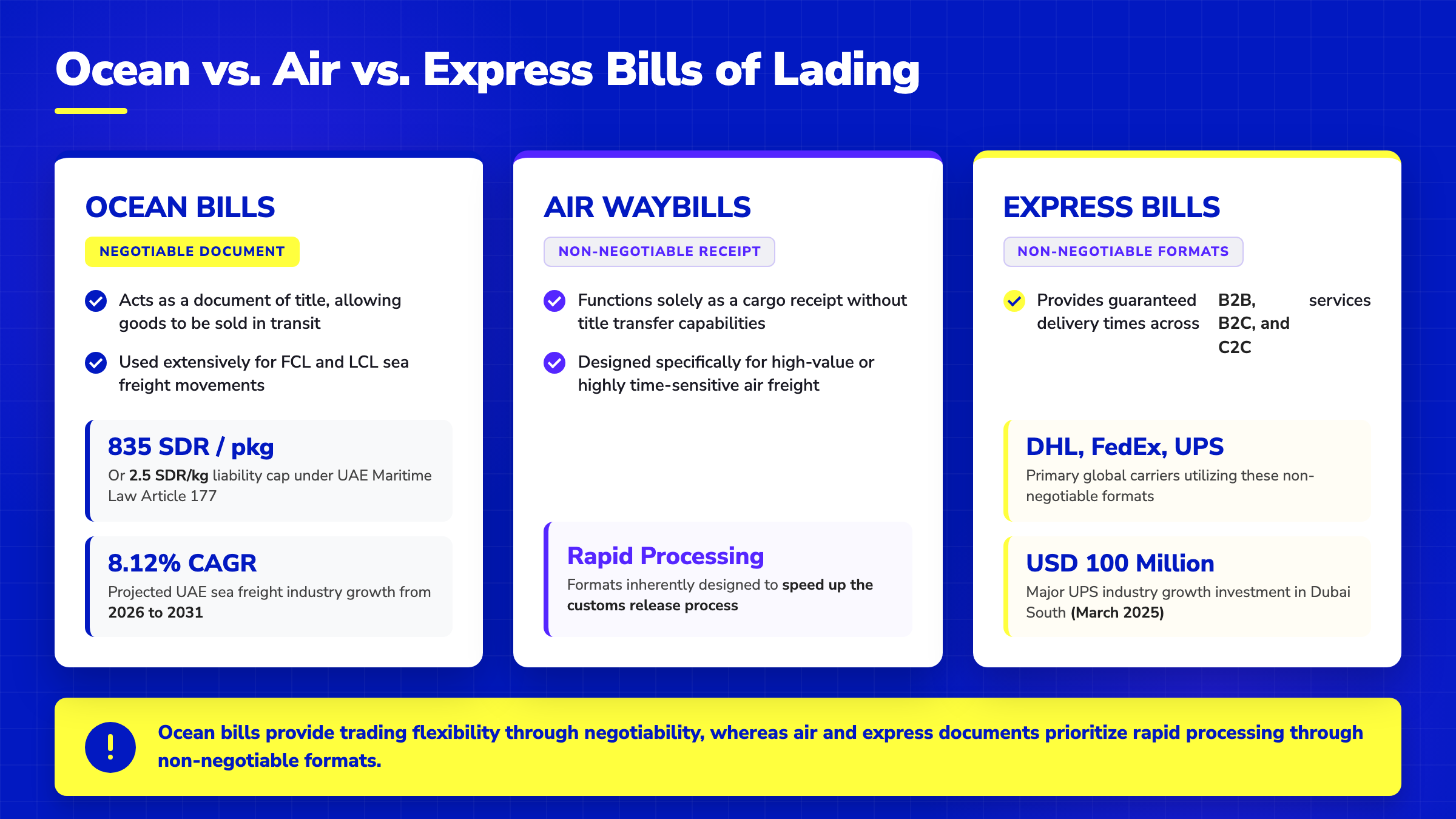
The distinction between negotiable and non-negotiable bills fundamentally affects how cargo ownership transfers. Negotiable bills of lading can be transferred by endorsement, acting as true documents of title that allow goods to be sold while in transit. Under UAE Maritime Law Article 177, the lawful holder of a negotiable bill can sue for claims, with carrier liability capped at 835 SDR per package or 2.5 SDR per kilogram. Non-negotiable or "straight" bills, common in express shipping and trusted partnerships, name a specific consignee and cannot be transferred, reducing fraud risk while limiting trading flexibility.
Essential Information Required on Every Bill of Lading
Precision in bill of lading documentation isn't just good practice—it's a legal requirement that can make or break your international shipments. The UAE's stringent documentation standards, reinforced by the 2023 Maritime Law reforms, demand complete and accurate information on every bill of lading to ensure smooth customs clearance and cargo delivery.
Shipper and consignee details form the foundation of any bill of lading. According to UAE Maritime Preload Cargo Information (MPCI) requirements, documents must include complete information for the shipper, consignee, notify party, freight forwarders, and agents, along with their MPCI Party ID identifiers. This comprehensive party identification isn't bureaucratic excess—it ensures proper customs declaration and establishes clear accountability throughout the shipping chain. Even minor discrepancies in consignee names can trigger automatic holds in Dubai Customs systems, delaying clearance by days or weeks.
Cargo description, weight, and dimensions must be documented with exceptional accuracy. The bill of lading must contain the goods description along with the Harmonized System (HS) code, which is critical for customs classification and duty assessment. Weight specifications, dimensional data, and packaging type details all contribute to proper cargo handling and regulatory compliance. Container details and seal numbers provide additional security verification, particularly important given the scale of operations—the UAE processed 327,768 bills of lading in recent tracking periods.
Port information requires equal precision. Complete routing details must specify the port of loading and discharge, place of receipt and delivery, and any transshipment ports. For shipments transiting through UAE, all bills of lading must be declared as "Direct Bill of Lading" as mandated by the National Authority for Imports and Exports (NAIC). This requirement directly impacts businesses using Dubai as a regional distribution hub.
Freight terms—whether prepaid or collect—establish the financial obligations between shipper and carrier. Ambiguous terms create payment disputes that can hold cargo at customs, particularly problematic in Dubai's high-volume logistics environment. Clear specification of Incoterms (FOB, CIF, etc.) prevents confusion about responsibility boundaries and payment obligations.
Special handling instructions and hazardous goods declarations complete the essential information set. These details ensure proper cargo care throughout the journey and compliance with safety regulations. Under the modernized UAE Maritime Law, electronic bills of lading (e-B/Ls) now carry the same legal weight as paper originals, provided they maintain authentication standards—a significant advancement for businesses seeking to digitize their customs clearance documentation requirements.
How AI-Powered Logistics Streamlines Bill of Lading Processing
The integration of artificial intelligence into logistics operations is revolutionizing how bills of lading are processed, with industry-wide AI adoption reaching 35% among logistics firms and delivering an average 190% ROI on investments. For Dubai businesses managing complex international shipments, AI-powered logistics operations eliminate the manual errors and delays that have plagued traditional documentation processes for decades.
AI agents automatically capture shipment details from customer inquiries using advanced machine learning and optical character recognition (OCR) technology. These systems parse emails, PDFs, and scanned bills of lading instantly, extracting critical details like origin, destination, and commodity information without human intervention. According to Thinking Inc's 2026 AI in Logistics Guide, generative AI models achieve 94% accuracy in processing unstructured logistics documents, with Kuehne+Nagel's pilot program reducing document processing time by 72%. This autonomous processing enables sales teams to respond to customer inquiries in seconds rather than days—a game-changer for time-sensitive express shipments.
Real-time integration with carrier systems transforms how bills of lading flow through the supply chain. AI platforms enable seamless API connections with DHL, FedEx, and UPS for instant data exchange, automating customs filings and compliance validation. DHL's implementation of 5,000 AI bots has boosted collection efficiency by over 50%, while dynamic route optimization cuts fuel costs by 15% and urban delivery times by 12%. This real-time connectivity ensures that bill of lading data flows seamlessly across all carriers, supporting instant documentation generation that keeps pace with express shipping speeds.
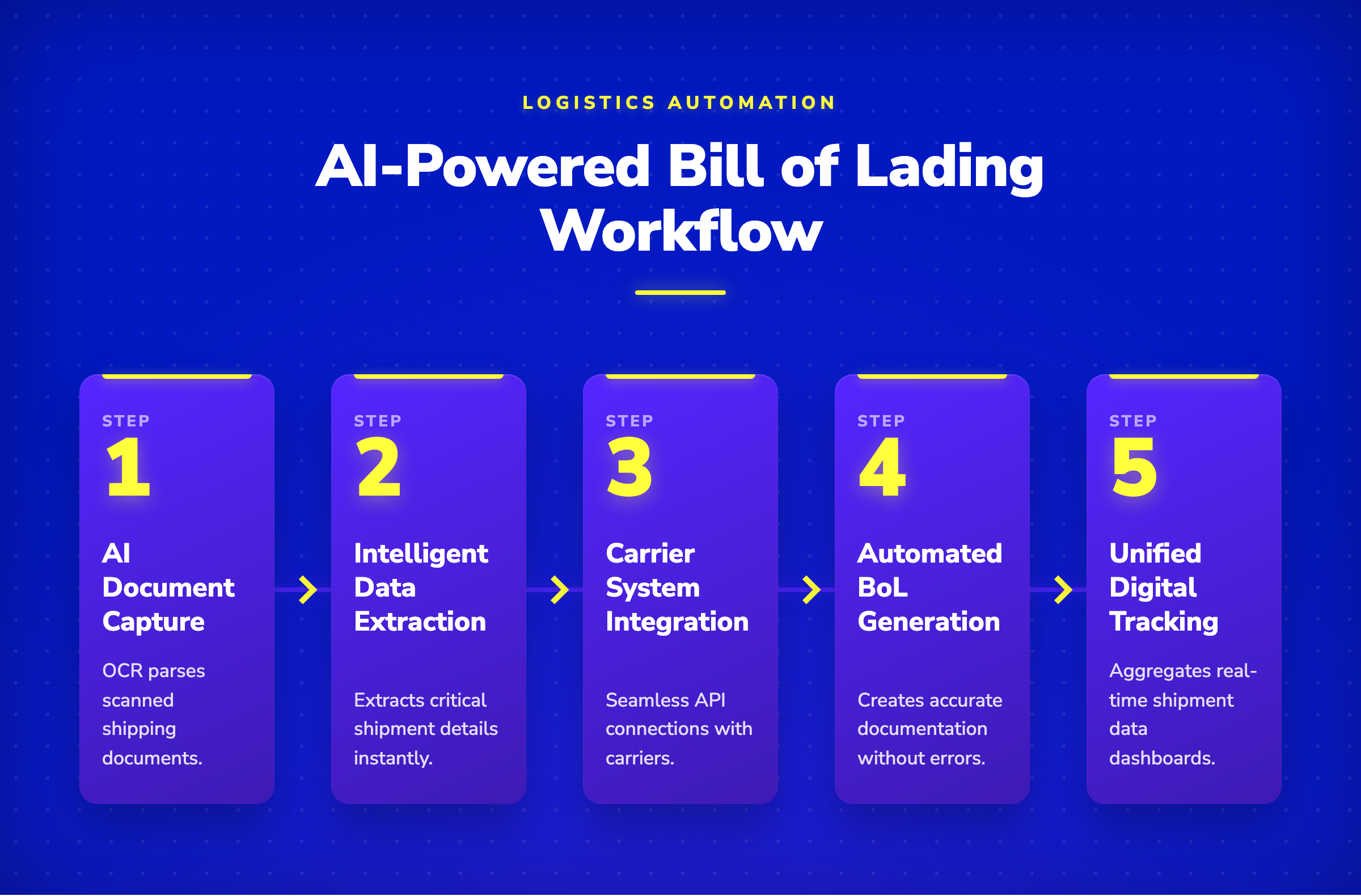
Automated bill of lading generation virtually eliminates data entry errors through sophisticated confidence scoring. Systems achieving 95% or higher confidence automatically generate and process bills of lading, while those scoring 80-95% route to expedited review. This tiered approach has yielded remarkable results—Info-X reports that Kuehne+Nagel saw 61% fewer classification errors across 2.1 million declarations in 43 countries. Computer vision and machine learning ensure 99.2% accuracy in data capture, with some systems eliminating 25 or more human touches per shipment.
Digital tracking integration brings all carrier data into unified dashboards that aggregate real-time information from multiple sources. These AI-orchestrated platforms support natural language queries—imagine asking "What's the average transit time from Dubai to Berlin?" and receiving instant, accurate answers. According to The Intellify, this integration improves carrier selection by 12-20% while enabling demand sensing that boosts forecast accuracy by 15-30%. For businesses ready to experience these benefits firsthand, you can get instant shipping quotes powered by our AI technology.
Common Bill of Lading Mistakes That Delay Customs Clearance
Even minor errors on a bill of lading can trigger significant delays at UAE customs, particularly at high-volume ports like Jebel Ali. Understanding these common mistakes—and how to avoid them—is essential for maintaining smooth supply chain operations in Dubai's fast-paced logistics environment.
Incomplete or inaccurate consignee information ranks among the most costly documentation errors. When the consignee name on the bill of lading doesn't match the registered importer in Dubai Customs systems, automatic holds are triggered, requiring time-consuming amendments. According to UnCargo's 2026 shipping guide, these discrepancies often result in hidden fees and re-submission requirements. The problem is compounded by UAE's mandatory attestation rule under Cabinet Resolution No. 38 of 2022, which requires all import documents valued at AED 10,000 or more to be verified by MoFAIC—non-compliance incurs AED 500 fines per violation.
Missing or incorrect HS codes create classification nightmares that prompt intensive customs scrutiny. The National Law Review notes that UAE authorities cross-check bill of lading descriptions against attested documents for discrepancies, particularly as part of anti-trade-based money laundering efforts. Misdeclaration under UAE Federal Decree-Law No. 43 of 2023 allows carriers to offload goods or charge the highest freight rate, with shippers liable for damages. With the UAE processing 327,768 bills of lading in recent periods, even a small error rate creates substantial delays across the freight forwarding sector.
Freight terms confusion causes payment delays that ripple through the supply chain. Ambiguous Incoterms on bills of lading create disputes about responsibility for freight payments, leading to customs payment holds. In Dubai's logistics ecosystem, where the market is projected to reach USD 23.05 billion in 2026 at a 6.55% CAGR according to Mordor Intelligence, such delays compound quickly, especially during port disruptions.
Inadequate cargo descriptions violate UAE Maritime Law requirements and enable customs to hold shipments indefinitely. Vague details lacking nature, value, or preservation needs expose shippers to carrier claims for misdeclaration damages. The New Maritime Law emphasizes precise bill of lading drafting with a strict one-year time bar for disputes under Article 187—making accuracy crucial from the start.
How Key Account Centre status prevents documentation errors: As a Key Account Centre with top-tier volume partnerships across major carriers, businesses gain access to pre-validated documentation templates, automated compliance checks, and dedicated support teams who understand UAE-specific requirements. This exclusive status transforms documentation from a compliance burden into a competitive advantage, ensuring your shipments clear customs smoothly while competitors struggle with amendments and delays.
Need a shipping quote?
Get AI-optimized rates from DHL, FedEx & UPS — up to 65% below retail. Quote in under 10 minutes.
Bill of Lading vs Other Shipping Documents: Understanding the Differences
While the bill of lading serves as the master document for international shipping, it works in concert with other essential paperwork to create a complete documentation package. Understanding how each document differs—and how they work together—is crucial for ensuring smooth customs clearance in the UAE.
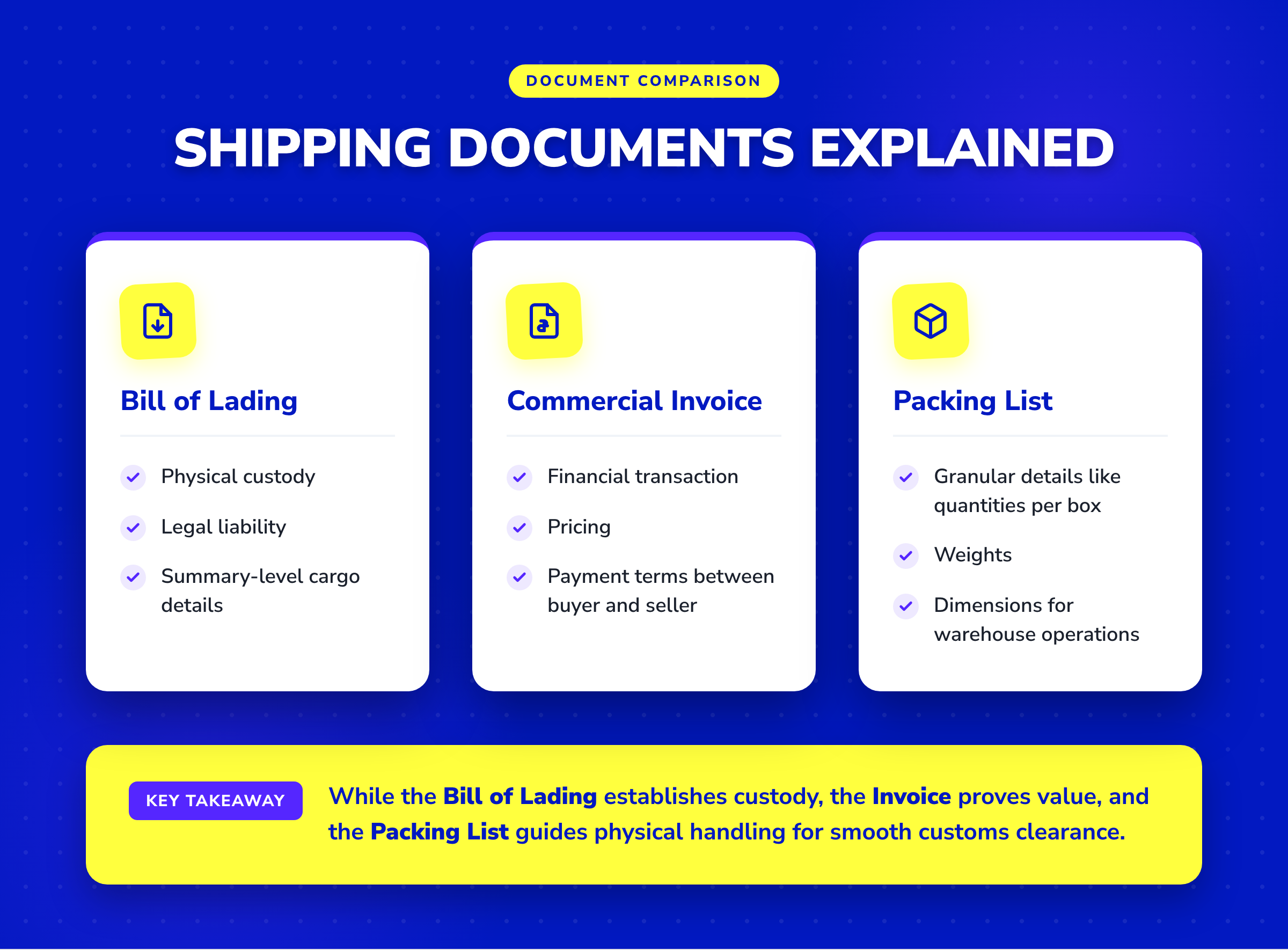
Bill of lading vs commercial invoice distinctions often confuse new exporters, yet these documents serve entirely different purposes. The bill of lading establishes the physical custody and movement of goods, creating a legal relationship between shipper and carrier. In contrast, the commercial invoice documents the financial transaction between buyer and seller, detailing pricing, payment terms, and product specifications. Think of it this way: the bill of lading tells customs what's moving and who's responsible, while the commercial invoice explains what it's worth and who's paying.
Packing list vs bill of lading cargo details represent different levels of detail for different audiences. The packing list provides granular information—individual item descriptions, quantities per box, specific weights and dimensions—essential for warehouse operations and receiving verification. The bill of lading typically contains summary-level information: total weight, number of packages, and general cargo description. While the packing list helps workers identify and handle specific items, the bill of lading establishes legal custody and liability for the entire shipment.
Certificate of origin requirements for trade agreements have become increasingly important as the UAE expands its trade partnerships. These certificates verify where goods are manufactured, directly affecting tariff classifications and eligibility under Comprehensive Economic Partnership Agreements (CEPAs). According to SeAir's UAE Trade Guide, the UAE's non-oil trade with CEPA partners increased by USD 36.8 billion in 2024—a 42% increase over 2023—largely driven by proper origin documentation. While bills of lading establish custody during transport, certificates of origin unlock preferential trade terms that can dramatically reduce costs.
Insurance certificates and their relationship to bills of lading provide crucial financial protection beyond carrier liability limits. Under UAE maritime law, carrier liability is capped at 835 SDR per package or 2.5 SDR per kilogram—often far below actual cargo value. Insurance certificates document additional coverage, protecting shippers from losses that exceed these statutory limits. The bill of lading may reference insurance requirements but doesn't provide coverage itself; the insurance certificate is your actual financial protection.
Complete documentation package for UAE customs clearance requires all these documents to work in harmony. The UAE freight and logistics market, valued at USD 23.05 billion in 2026 and growing at 6.55% CAGR, demands precision across all documentation. Digital platforms now provide instant quotes and real-time tracking, cutting administrative friction and enabling businesses to manage their complete documentation package efficiently. This technological advancement is reshaping how shipping documents—including bills of lading—are processed throughout the region's logistics ecosystem.
Frequently Asked Questions
What happens if a bill of lading is lost or damaged?
If a bill of lading is lost or damaged, immediate action is required to prevent cargo delivery delays and potential fraud. For negotiable bills of lading, the shipper must typically obtain a court order and provide a bank guarantee (usually 150-200% of cargo value) to the carrier before a replacement can be issued. The process involves notifying all parties immediately, filing a formal declaration of loss, publishing notices in trade publications, and obtaining indemnity letters from banks. For non-negotiable bills or express shipments with carriers like DHL, FedEx, or UPS, the process is simpler—carriers can often issue duplicate documentation upon verification of identity and shipment details. In the UAE, where bills of lading require legalization for customs clearance, lost documents may need re-attestation through MoFAIC, adding 3-5 business days to the replacement process.
Can I modify a bill of lading after it's issued?
Modifying a bill of lading after issuance is possible but requires careful procedures to maintain legal validity. Minor corrections like spelling errors or address updates can often be handled through a carrier's amendment process, requiring written consent from both shipper and consignee. However, substantial changes—such as altering the consignee, destination port, or cargo description—require more complex procedures. Under UAE Maritime Law (Federal Decree-Law No. 43 of 2023), any modifications must be properly documented and may require re-legalization for customs acceptance. Express carriers typically allow amendments up to 24 hours before arrival at the destination, while ocean carriers may require formal "switch bill of lading" procedures. All parties must agree to modifications in writing, and carriers often charge amendment fees ranging from USD 50-200 depending on the complexity of changes.
How long should businesses keep bill of lading records?
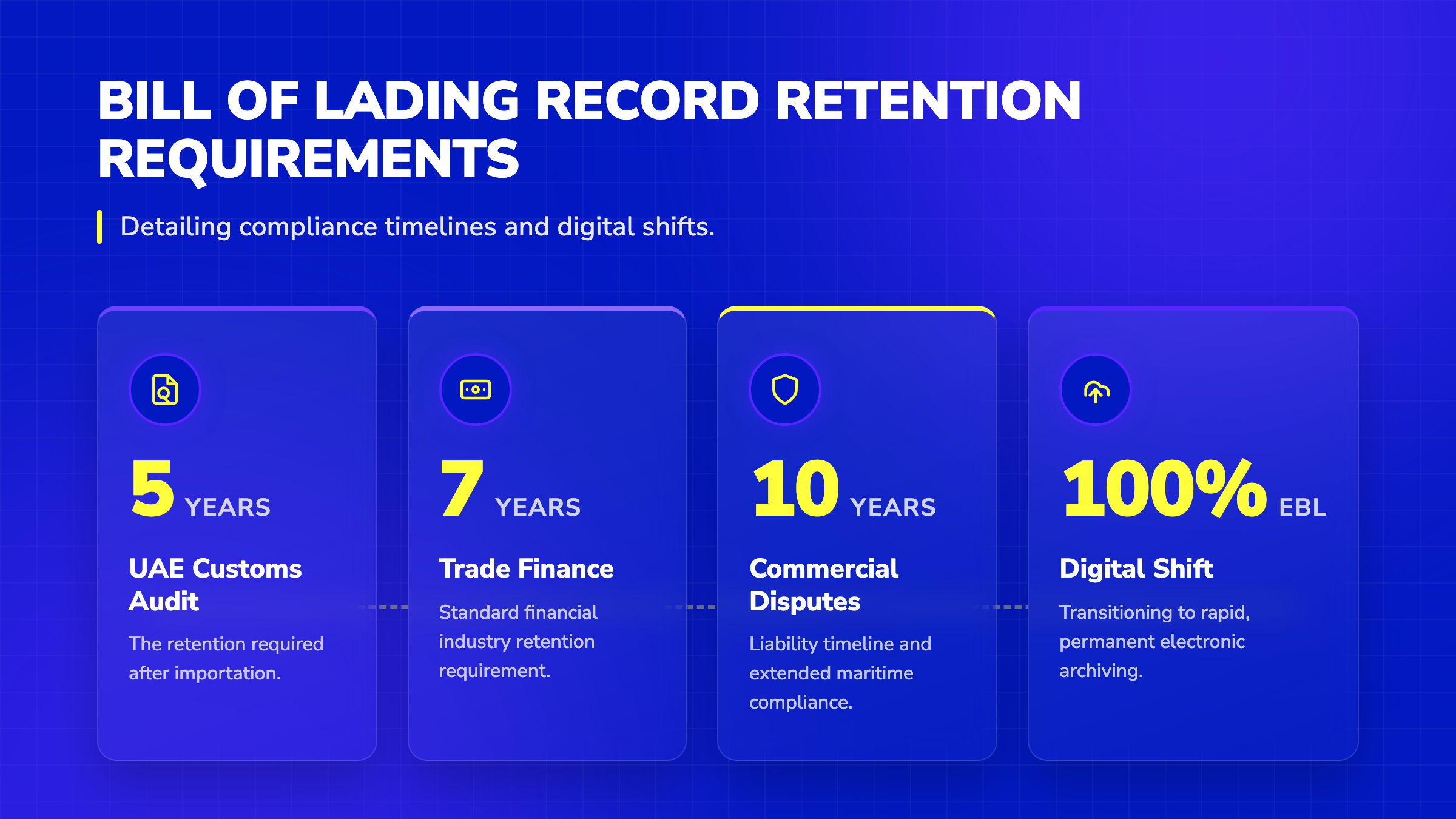
Businesses should retain bill of lading records for a minimum of 5-7 years, though specific requirements vary by jurisdiction and type of trade. In the UAE, customs authorities may request documentation for up to 5 years after importation for audit purposes. For international transactions involving letters of credit or trade finance, banks often require 7-year retention periods. Digital storage is acceptable and increasingly preferred—the UAE's 2023 Maritime Law recognizes electronic bills of lading as legally equivalent to paper originals. Best practices include maintaining both the original bill of lading and all related correspondence, amendments, and delivery receipts. Companies engaged in regulated industries (pharmaceuticals, food, chemicals) may face longer retention requirements up to 10 years. Cloud-based document management systems with proper backup procedures ensure compliance while reducing physical storage costs.
What's the difference between original and copy bills of lading?
Original bills of lading are the actual negotiable instruments that represent title to goods and must be surrendered to take delivery of cargo. Typically issued in sets of three originals (marked "Original"), any one of which can be used to claim goods—after which the others become void. Copy bills of lading are non-negotiable reference documents marked "Copy" or "Non-Negotiable" used for information purposes only. They cannot be used to take delivery of cargo or transfer ownership. In the UAE logistics market, original bills are required for customs clearance of ocean freight, while express shipments via DHL, FedEx, or UPS typically use non-negotiable waybills where the distinction is less relevant. Banks financing international trade through letters of credit always require original bills of lading as security for payment.
When do I need a negotiable vs non-negotiable bill of lading?
Choose a negotiable bill of lading when you need flexibility to sell goods in transit, require document-based payment security (letters of credit), are shipping to unknown final buyers, or want to maintain control until payment is received. These are standard for commodity trading and wholesale transactions where ownership may change during transport. Select a non-negotiable (straight) bill of lading for shipments between related companies, regular customers with established credit, express or air freight requiring fast release, or when using open account payment terms. Non-negotiable bills dominate the express logistics sector—DHL, FedEx, and UPS primarily use straight consignment notes for their speed advantage. In Dubai's fast-paced trade environment, non-negotiable bills can reduce clearance time by 24-48 hours since they don't require original document presentation, making them ideal for time-sensitive shipments while negotiable bills better serve high-value trades requiring payment protection.
What should I look for when choosing a logistics provider for bill of lading processing?
When selecting a logistics provider for bill of lading processing, prioritize those with proven technology integration and carrier partnerships. Look for providers offering AI-powered documentation systems that eliminate manual data entry errors—top providers achieve 94% accuracy rates in automated document processing. Key Account Centre status with major carriers (DHL, FedEx, UPS) indicates volume-based expertise and access to priority support for documentation issues. Verify the provider offers real-time tracking integration across all carriers through a unified dashboard, enabling instant visibility of your bill of lading status. For UAE-specific operations, ensure they understand local requirements including MoFAIC attestation procedures and MPCI compliance. The provider should offer both electronic and traditional bill of lading options, with e-B/L capabilities becoming essential as the UAE recognizes digital documents under the 2023 Maritime Law. Cost savings of 65% below retail rates are achievable with the right provider, but documentation accuracy and speed are equally valuable—look for providers guaranteeing 10-minute quote generation with complete documentation packages included.
Sources & References
This article draws on research and data from the following verified sources:
- UAE Bill of Lading Legalization - US Arab Chamber of Commerce
- Bill Of Landing Legalization for UAE | AACC
- Meaning of Bill of Lading (BL) in Shipping - Total Freight International
- Bill of lading: meaning, types, example, and purpose - CargoX
- What Is Bill of Lading (BoL)? Guide & Example - Trade Finance Global
- Bill of Lading - what is it and why is it important? - Maersk
- UAE Freight & Logistics Market Share & Size 2031 Outlook
- Shipping 2026 - UAE | Global Practice Guides
- UAE Trade & Import Guide 2025-26: Top Products, Shipping Process
- UAE Logistics Market Trends 2023 | PDF | Gulf Cooperation Council
- United Arab Emirates U.S. Import Summary and Bills of Lading
- Middle East Shipping and Logistics Market Analysis 2026
- ZIM - New requirement for shipments to United Arab Emirates
- Clarion Shipping - Dubai Import Regulations: What Businesses Must Prepare Before Shipping
- ABS Partners - Bills of Lading Disputes in the UAE: Legal Framework and Remedies
- AI in Logistics & Supply Chain — Complete 2026 Guide
- AI in Freight Forwarding: What Is Changing in 2026 - Info-X
- AI in Supply Chain Statistics: The Real Impact by the Numbers
- AI in Logistics 2026: AI, Autonomy & Digital Twins - The Intellify
- How AI and ML are transforming logistics - COAX Software
- Logistics trends for 2026: From AI to the rise of automation
- AI in Logistics and Supply Chain Market Size & Share 2025 - 2034
- New UAE Rule Regarding Mandatory Attestation of Import Invoices Could Help Combat TBML
- Shipping lines cut Middle East routes posing risk to trade flows
- Loss-making year for GulfNav - The Maritime Standard
- Transport and Logistics Industry Management in the UAE
- How to Avoid Hidden Fees in International Shipping: 5 Tips for 2026 Importers in Dubai
- TradeImeX - UAE Import Data
- UAE Express Delivery Market Report and Forecast 2026-2034
- UAE Logistics Market Size is Expected to Reach USD 95.2 Billion
- United Arab Emirates (UAE) CEP Market Analysis 2026
- The UAE Courier, Express, and Parcel Market Size & Outlook, 2033
Tags
Related Articles
Ready to optimize your logistics?
Whether you need express shipping, freight forwarding, or warehousing — our AI finds the best rates and routes for your business.