
To export goods from the UAE, you need a trade licence that covers your activity, a customs registration, the correct documents, and an electronic export declaration. A freight forwarder can manage the declaration and shipping, but getting the initial paperwork right is your responsibility. This guide walks you through the complete export procedure in Dubai and the wider UAE for 2026.
Exporting from the UAE is mostly paperwork done in the right order. Delays usually start at a few points: a licence that does not cover the goods, a missing customs registration, or an inaccurate commercial invoice. Here is the six-step process.
The 2026 UAE Export Checklist:
- Get a trade licence that allows export.
- Register with customs to get your customs code.
- Check if your goods need an export permit.
- Prepare the core export documents (invoice, packing list).
- File the customs export declaration.
- Hand over to your carrier and get the transport document.
Need to ship now? Get an export quote from Infinity Logistics.
Step 1: A Licence That Allows Export
Before you can ship anything, your company must be legally allowed to trade. The first step in the export procedure is making sure your business licence is correct. Without it, you cannot register with customs or appear as the exporter of record.
Trade Licence Activity Must Cover the Goods
Your UAE trade licence must have activities that cover "trading", "import/export" or the specific goods you intend to ship. For example, a licence that only covers foodstuff trading will not cover electronics. If the activities on your licence do not match the goods, expect problems at customs registration or clearance, so check this first.
Mainland vs. Free Zone Licence
The type of licence you hold determines your operational scope:
- A mainland licence from an authority like Dubai's Department of Economy & Tourism (DET) allows you to trade directly within the UAE and export internationally.
- A free zone licence (for example from JAFZA, DMCC or Ajman Free Zone, where Infinity's office is) is common for companies focused on international trade and re-export.
Licence costs vary significantly by emirate, free zone, and activity. Always check with your specific licensing authority for accurate pricing.
Step 2: Register with Customs and Get Your Customs Code
Once your licence is in order, you must register your business with the customs authority of the emirate you are exporting from. This registration provides you with a unique customs business code, a mandatory identifier for all customs transactions.
Dubai Customs Business Registration
For businesses looking to export from Dubai, registration is handled online via the Dubai Trade portal. According to the official Dubai Customs service guide, the process is straightforward:
- Documents Required: A copy of your valid trade licence, plus the passport and Emirates ID copy of the company's authorized person.
- Fee (at the time of writing): The service fee is AED 100. An additional AED 20 Knowledge and Innovation fee applies to services of AED 50 and above, making the total AED 120.
- Timeline: The process is completed in one working day.
Once approved, you receive your customs code by email. You use it on every customs declaration.
Other Emirates Have Their Own Authorities
The steps and fees above are Dubai Customs'. Abu Dhabi, Sharjah and Ajman have their own customs authorities and portals, so if you export through another emirate, check that authority's registration requirements.
Step 3: Check Whether Your Goods Need a Permit
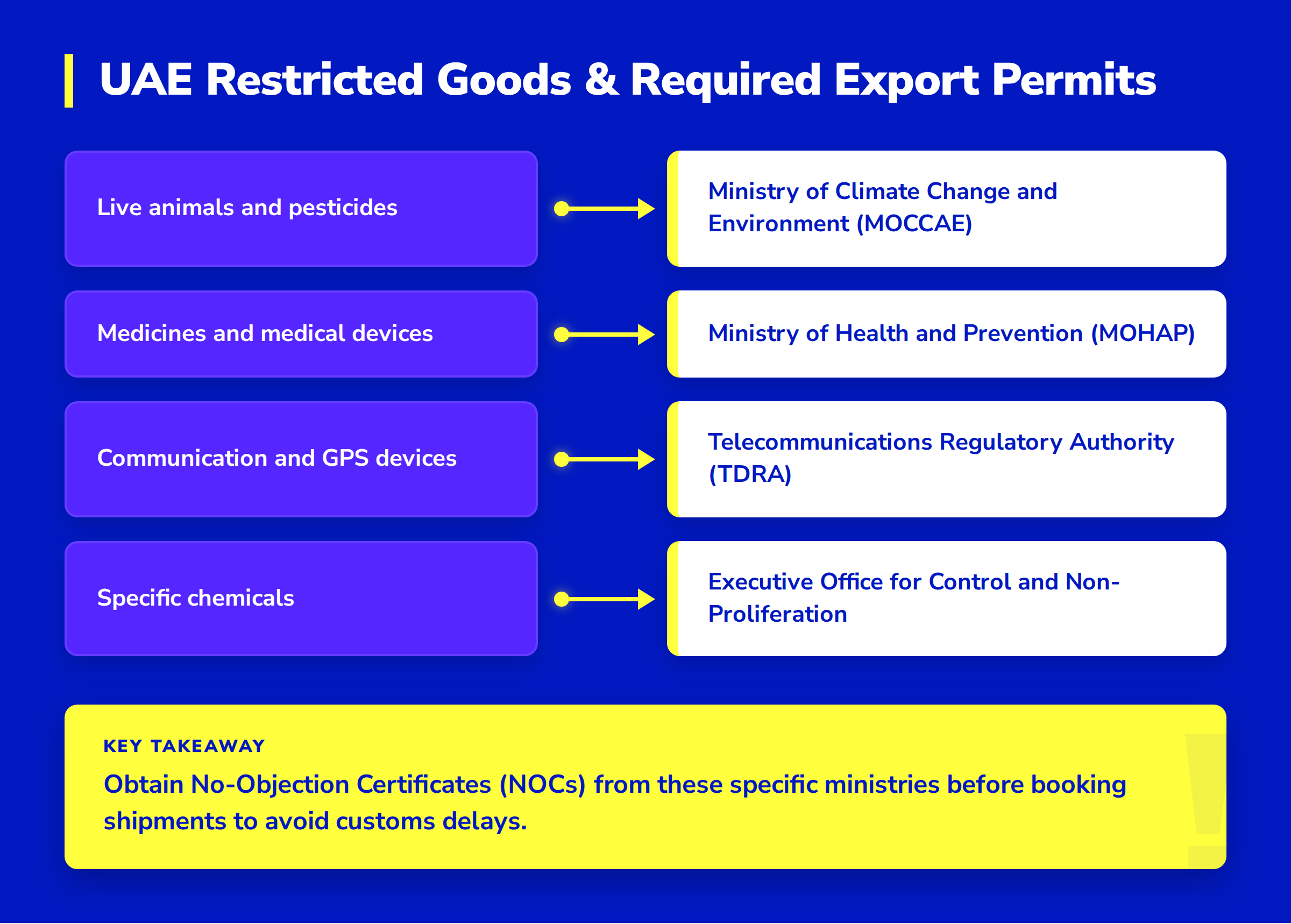
Certain goods are classified as "restricted" or "controlled" and require an export permit or No-Objection Certificate (NOC) from a specific government authority before they can be shipped. This is a common but avoidable cause of delays. Get your permits *before* you book your shipment.
What are Restricted Goods?
Restricted goods are not banned, but they need prior approval from the authority that controls them. UAE customs authorities publish these lists, including Dubai Customs and Abu Dhabi Customs. Abu Dhabi Customs' list, for example, includes:
- Live animals, animal products and pesticides: Ministry of Climate Change and Environment (MOCCAE).
- Medicines and medical devices: Ministry of Health and Prevention (MOHAP).
- Wired and wireless communication devices, radio transmitters and GPS devices: Telecommunications and Digital Government Regulatory Authority (TDRA).
- Chemicals that can be used to make chemical weapons: Executive Office for Control and Non-Proliferation.
Securing Export Permits
The process involves applying to the relevant authority with your shipment details. Shipping controlled goods without the permit can get the shipment stopped by customs. Infinity's export customs clearance includes export permit processing, so tell us early if your goods may need one.
Step 4: Prepare the Export Documents
With your licence, customs code, and permits ready, the next step is preparing the core documentation pack. Accuracy and consistency across these documents are vital for a smooth export procedure in Dubai.
The Commercial Invoice
This is the most important document. It must be issued by your licensed UAE company and contain:
- Full details of the exporter (you) and the consignee (your buyer).
- A unique invoice number and date.
- A detailed description of each item, not generic terms.
- Quantity, unit price, and total value in a specified currency.
- The country of origin for each item.
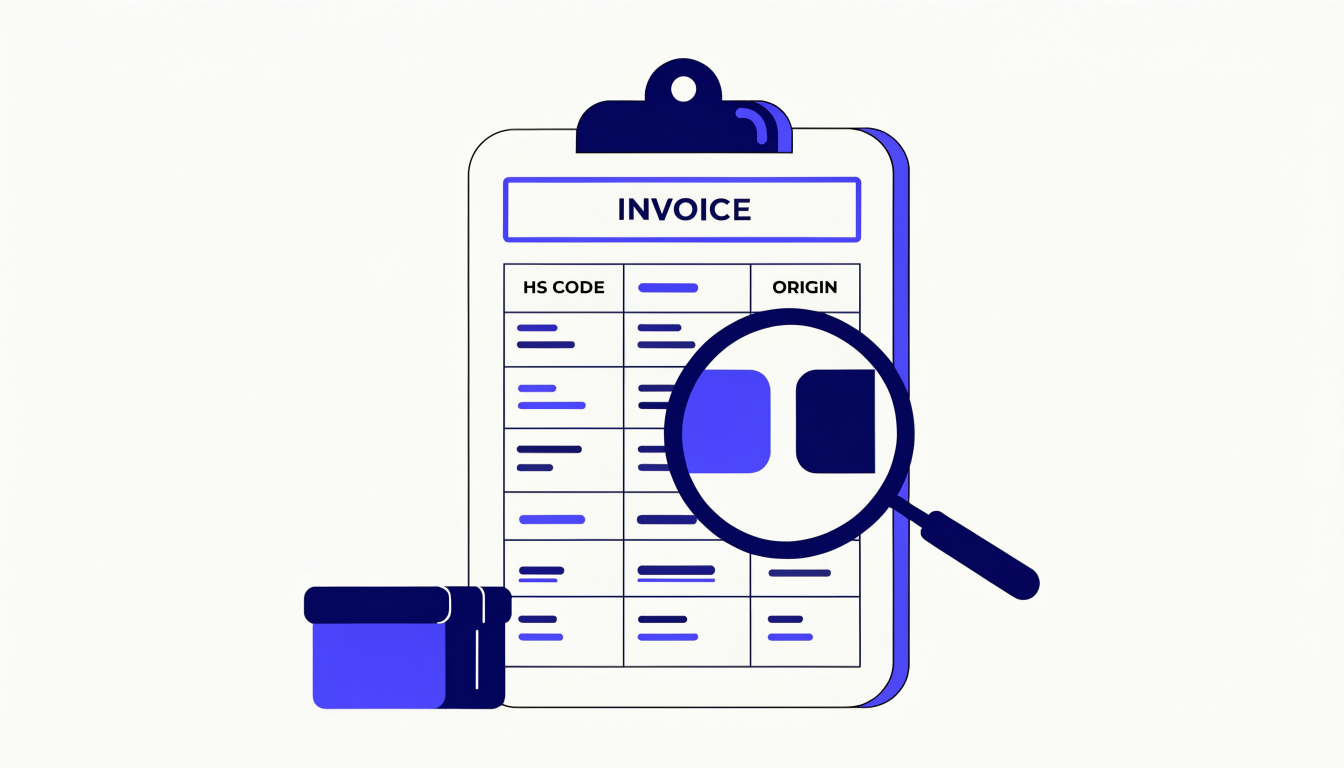
- The Harmonized System (HS) code for each item.
- Incoterms® 2020 (e.g., FOB, CIF, EXW) to define responsibilities.
The Packing List
The packing list must align perfectly with the commercial invoice. It details how the goods are packed, including:
- Number and type of packages (e.g., cartons, pallets).
- Net and gross weight for each package and the total shipment.
- Dimensions of each package.
- Shipping marks and numbers on the packages.
Harmonized System (HS) Codes
An HS code is a globally recognized customs tariff number used to classify products. You must assign the correct HS code to every item on your commercial invoice and packing list. Incorrect codes can lead to customs disputes, delays, and fines at the destination.
The Certificate of Origin (CoO)
A Certificate of Origin is a document that certifies the country where your goods were made. It is often required by the buyer's country for customs clearance or to claim preferential tariffs under a trade agreement. In Dubai, CoOs are typically issued by Dubai Chambers. Infinity's export customs clearance includes certificate of origin processing, so the application can be prepared with your invoice and transport documents.
Step 5: The Export Declaration
Commercial exports need an export declaration filed with customs. In Dubai, this is an electronic filing with Dubai Customs that declares the goods for export.
Declaration Types and Process
The declaration is filed through Dubai's Mirsal 2 system, typically via the Dubai Trade portal. The specific declaration type depends on the destination. According to the Dubai Customs Services Guide, common types include:
- Export from Local to ROW: For goods shipping from the UAE mainland to the Rest of the World.
- Export from Local to FZ: For goods moving from the mainland into a UAE free zone.
- Export Statistical Declaration: A lower-fee declaration type (AED 50 at the time of writing) used for some movements; your broker will confirm whether it applies to your shipment.
Need a shipping quote?
Get AI-optimized rates from DHL, FedEx & UPS — up to 65% below retail. Quote in under 10 minutes.
Who Can File the Declaration?
Any company holding a valid customs business code can file a declaration, and licence holders can authorise a customs broker or freight forwarder to file on their behalf. Infinity's export customs clearance covers the declaration as well as the documents behind it.
Fees and Charges
At the time of writing in 2026, Dubai Customs lists the fee for standard export declarations (Local to ROW and Local to FZ) as AED 100. An additional AED 20 Knowledge and Innovation fee is also applied. These fees are paid electronically during the declaration process.
Step 6: Hand Over to the Carrier and Track
Once the export declaration is approved by customs, you can hand your cargo over to your chosen carrier. At this stage, you will receive the final key document: the transport document.
Choosing Your Shipping Method
Your choice of carrier depends on your cargo's size, value, and urgency. Infinity Logistics provides a full suite of options, including worldwide express and air, sea and road freight.
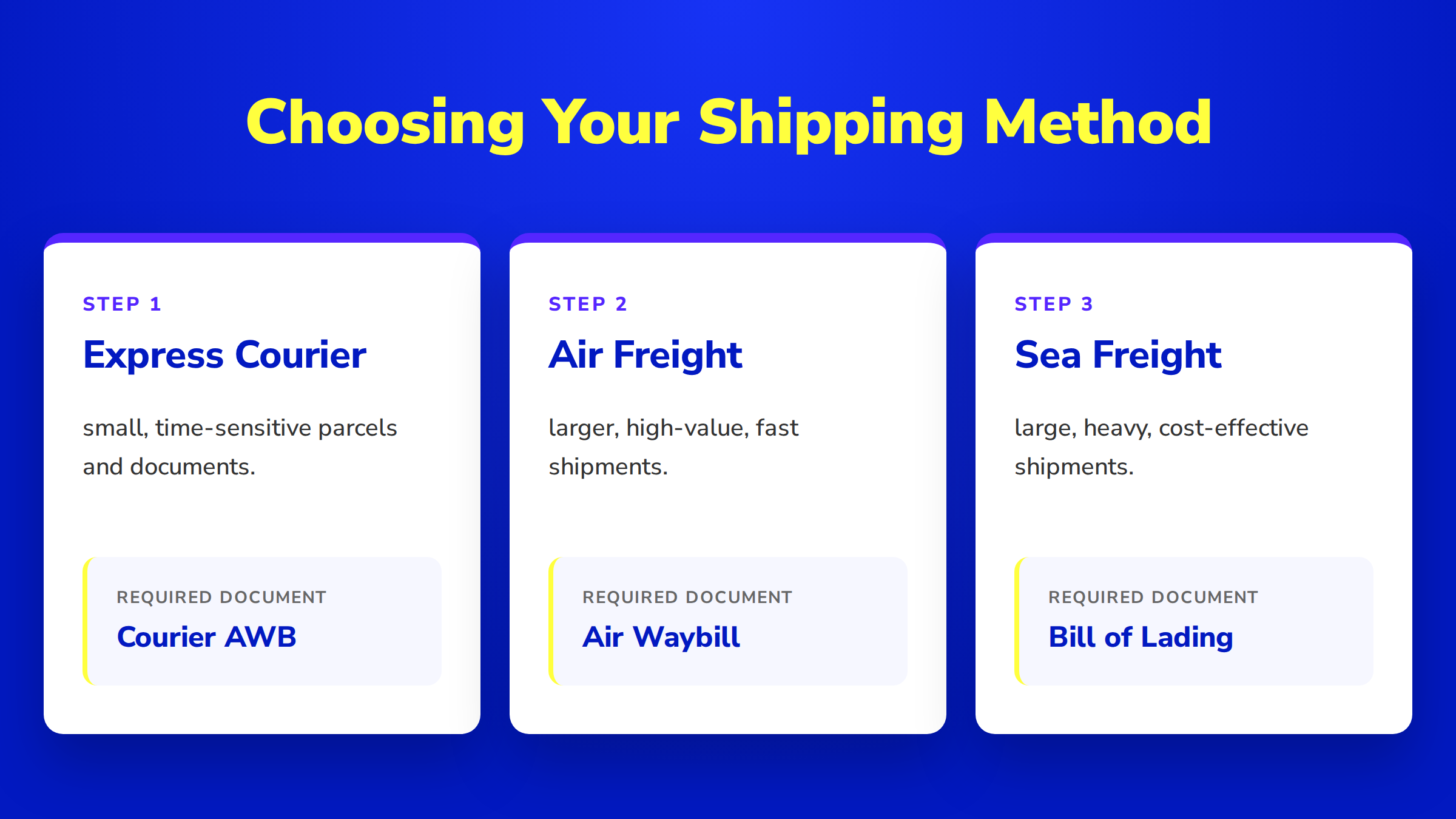
| Mode | Transport Document | Best For |
|---|---|---|
| Express Courier | Courier Air Waybill (AWB) / Tracking Number | Small parcels, documents, and time-sensitive shipments. Infinity offers business rates up to 65% below retail on DHL, FedEx, and UPS. |
| Air Freight | Air Waybill (AWB) | Larger or high-value shipments that need to arrive quickly. |
| Sea Freight | Bill of Lading (B/L) | Large, heavy, or non-urgent shipments where cost is a primary factor. |
Keep Your Documents Together
For compliance and auditing, it is essential to keep a complete record of your export. Your final file for each shipment should contain:
- The Commercial Invoice
- The Packing List
- The Dubai customs export declaration
- The transport document (Air Waybill or Bill of Lading)
- Any export permits or the Certificate of Origin
This set is your record of the export.
Re-exporting Goods You Imported
Dubai is a major global hub for re-exports—the process of shipping out goods that were previously imported. This is not the same as a standard export and requires a specific customs procedure.
When you re-export, you file a re-export declaration with customs that links the outbound shipment to the original import, showing the goods are the same. Dubai Customs lists a "Re Export to ROW (after import for re-export)" declaration for this. Depending on the emirate and how the goods were imported, duty paid on import may be refundable on re-export within a set time, so check the rules with the customs authority or your broker before you ship. The key is a clear document trail from the import declaration to the re-export.
How Infinity Handles Exports
Infinity Logistics, founded in 2017, can take the export off your hands: documents, customs and the carrier, with one partner.
Our services are built for UAE businesses:
- Export clearance: We handle your export customs clearance, including export permits and certificate of origin processing.
- Key Account rates: As the #2 DHL partner in the UAE and a Key Account holder with FedEx and UPS, we offer business express rates up to 65% below retail.
- Quotes in under 10 minutes: Our AI agents compare DHL, FedEx and UPS in real time.
- WCA Inter Global member: with warehousing in JAFZA, DIP and Al Quoz, and freight on our main export routes.
We were Highly Commended as Express Logistics Company of the Year at the Logistics Middle East Awards 2022. Get an export quote today.
Frequently Asked Questions
What is an import export license in UAE?
There isn't a single "import export license" in the UAE. Your ability to import or export depends on the activities listed on your trade licence, issued by a mainland licensing authority (in Dubai, the Department of Economy and Tourism) or a free zone authority. To trade internationally, your licence must include trading or import/export activities. You then register with customs to get a customs code.
What is a customs business code?
A customs business code (also called a client code or importer/exporter code) is a registration number a UAE customs authority, such as Dubai Customs, issues to a company. It identifies your company on every customs declaration: import, export or transit.
Can a forwarder file my Dubai customs export declaration?
Yes. A licensed customs broker or freight forwarder, like Infinity Logistics, can be authorised to file your Dubai customs export declaration. You provide the commercial documents (invoice, packing list) and your customs code, and the forwarder submits the declaration in Dubai Customs' Mirsal 2 system and pays the fees.
Which documents do I need to export from UAE?
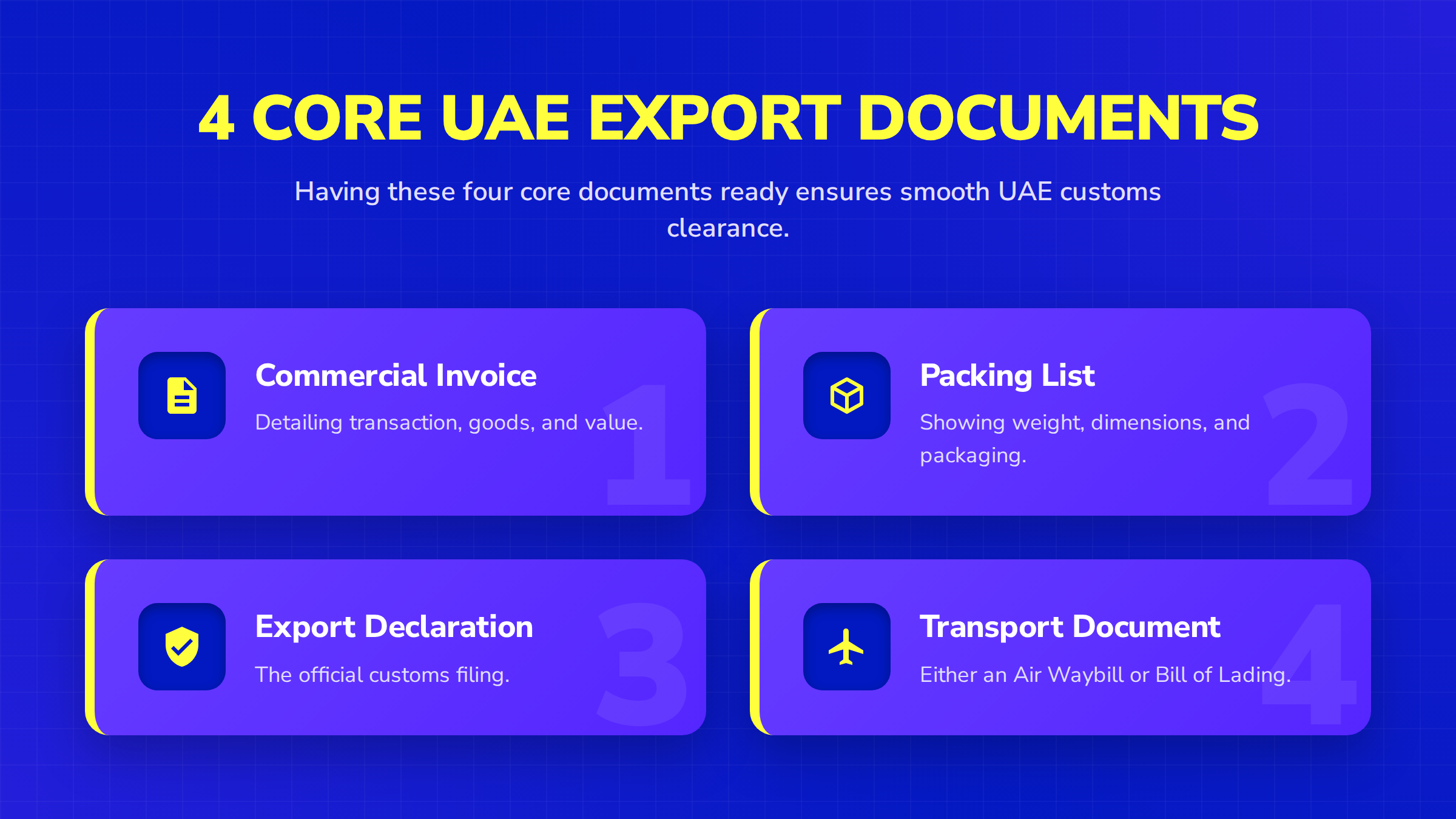
For a standard commercial export, you will need a core set of UAE export documents:
- Commercial Invoice: Details the transaction, goods, and value.
- Packing List: Details the shipment's weight, dimensions, and packaging.
- Export Declaration: The official customs filing.
- Transport Document: An Air Waybill for air freight or a Bill of Lading for sea freight.
Do I need a Certificate of Origin for every export?
No. A Certificate of Origin (CoO) is needed when the importing country's customs asks for it to verify origin, when a bank requires it under a letter of credit, or when your buyer needs it to claim preferential tariffs under a trade agreement. Confirm with your buyer whether they need one.
Sources & References
Official and industry sources referenced in this guide:
- [PDF] DUBAI CUSTOMS SERVICE GUIDE
- Request Business Registration - Dubai
- Prohibited and Restricted Goods - dubaicustoms.gov.ae
- Sharjah Customs-Re-Export
- dubai customs
- United Arab Emirates - Customs Regulations
- الصفحة الرئيسية | المكتب التنفيذي للرقابة وحظر الانتشار
- Restricted and Prohibited Goods - Abu Dhabi Customs
- [PDF] The UAE National Export Control System
- NOC for shipments - Export | Service Details
- Technical Guidelines for Consumer Document Title Products Import and Re-export
Tags
Related Articles
Ready to optimize your logistics?
Whether you need express shipping, freight forwarding, or warehousing — our AI finds the best rates and routes for your business.