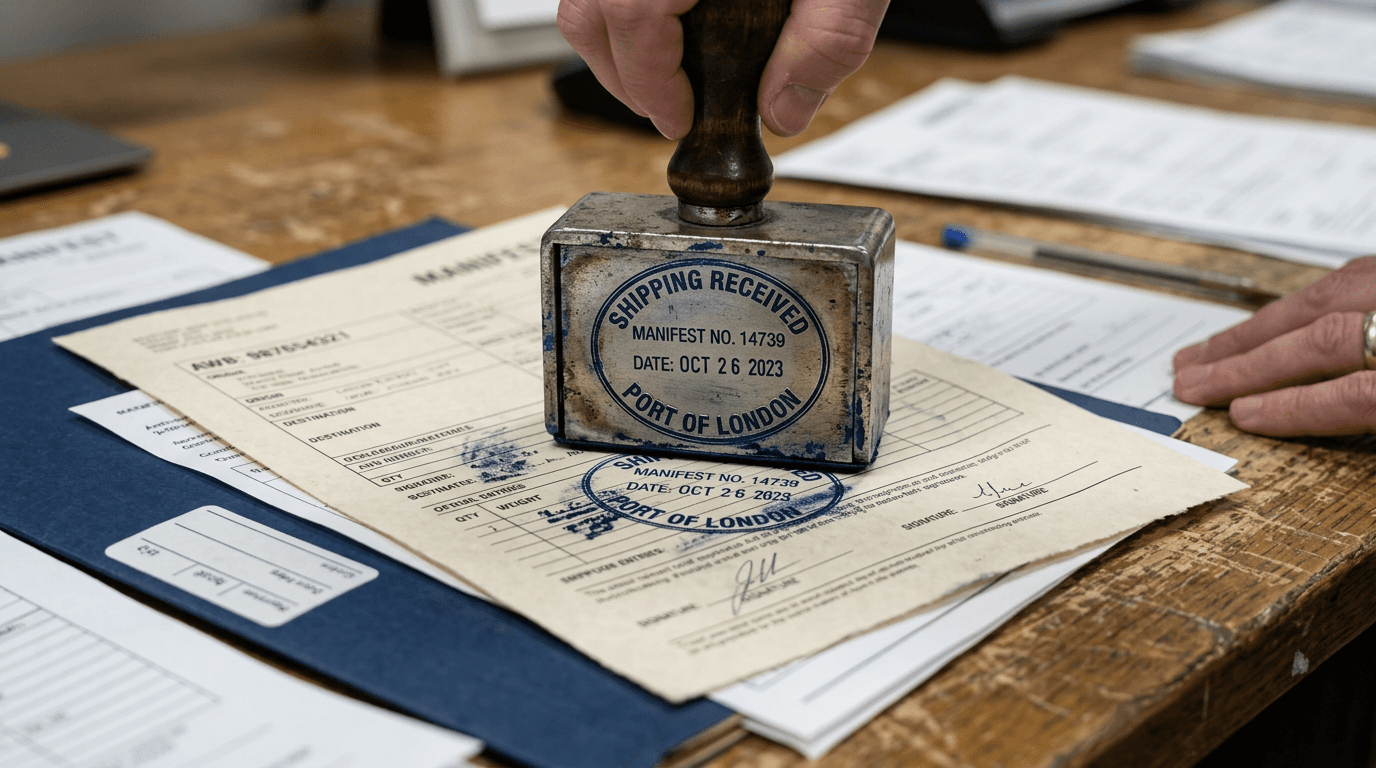
You need a Certificate of Origin in the UAE when your buyer's customs authority, a trade agreement, or a bank letter of credit requires it. The type of certificate and the issuing authority—either the Dubai Chambers or the Ministry of Economy and Tourism—depend entirely on what you are shipping and where it is going.
For most businesses exporting or re-exporting from the UAE, this single document can be the difference between a smooth customs clearance and costly delays. Getting it right before the goods move is critical. This guide provides the step-by-step process for securing the correct certificate of origin in Dubai for your 2026 shipments, ensuring your paperwork is ready before your cargo leaves.
Do you need a certificate of origin? The short answer
You do not need a certificate of origin (CoO) for every export. It becomes mandatory only when requested. Here’s a quick checklist:
- Is your buyer’s customs authority asking for it? Some countries require a formal CoO to clear goods, especially for regulated products or high-value shipments.
- Are you claiming preferential duty rates under a trade agreement? To benefit from lower or zero tariffs under agreements like the GCC or other CEPAs the UAE is party to, you need a specific preferential certificate of origin.
- Does your payment method involve a Letter of Credit (L/C)? Banks often list a Certificate of Origin as a required document for payment release. The terms of the L/C are non-negotiable.
If the answer to any of these is yes, you need a certificate. The next question is, which one?
What a certificate of origin is
A Certificate of Origin is a formal trade document that certifies the country where goods were produced, manufactured, or processed. It is not about where the goods are shipping from, but where they are from. Its primary purpose is to help customs authorities in the importing country determine the correct duties and taxes.
How it determines customs duty
The origin of your goods dictates the tariff rate the buyer pays. Goods from a country with a free trade agreement might have 0% duty, while goods from another might face standard tariffs or even anti-dumping duties. The CoO provides customs with the official proof needed to apply these rules correctly.
The link to your commercial invoice
The CoO is always issued alongside a detailed commercial invoice. According to Dubai Chambers Board of Directors Resolution No. (7) of 2024, all information on the certificate application must exactly match the commercial invoice. Any discrepancy in details like the exporter, consignee, goods description, or value will lead to rejection and delays, so check the invoice and packing list against the application before you submit it.
Preferential vs non-preferential certificates
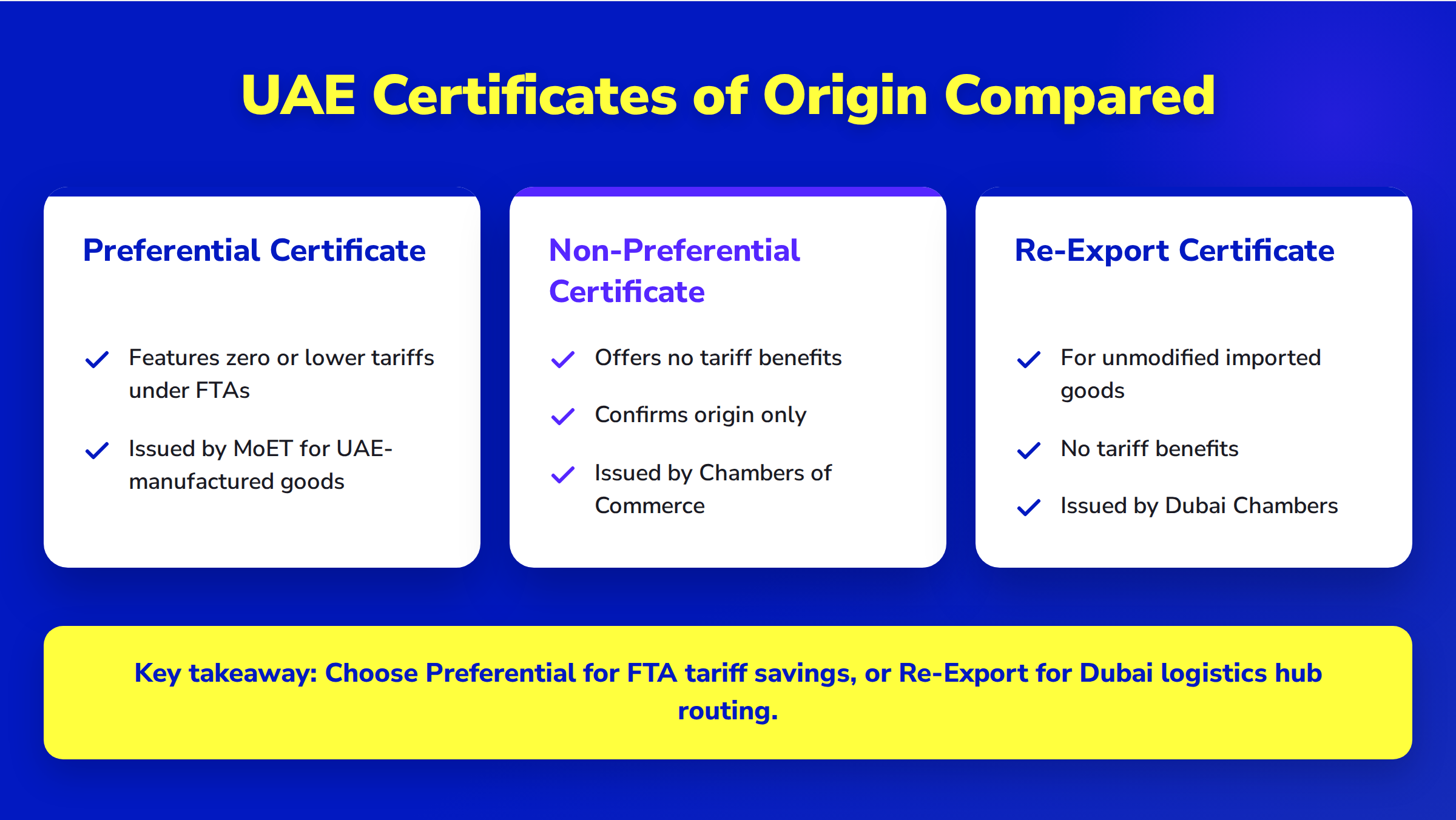
Understanding the difference between preferential and non-preferential certificates is crucial. Choosing the wrong one can cost your buyer a significant amount in unnecessary duties. A preferential certificate of origin is a trade document that certifies goods meet the origin rules of a specific trade agreement, allowing the importer to claim lower or zero tariffs. A non-preferential certificate of origin simply confirms the country of origin without granting any tariff benefits.
Preferential Certificate of Origin
This certificate proves that your goods qualify for reduced or zero customs duties under a specific Free Trade Agreement (FTA) that the UAE is part of, such as agreements with the GCC or the European Free Trade Association (EFTA).
- Who issues it? The UAE Ministry of Economy and Tourism (MoET) is the primary authority for issuing preferential certificates.
- When to use it? Only for goods manufactured in the UAE that meet the specific "rules of origin" defined in the trade agreement. This often involves a minimum percentage of local value addition.
Non-Preferential Certificate of Origin
This is the most common type of certificate. It simply proves the country of origin for customs purposes but does not provide any tariff advantages. It is used when no trade agreement applies or when the goods don't meet the preferential origin criteria.
- Who issues it? Typically issued by Chambers of Commerce, such as Dubai Chambers for its members.
- When to use it? For all other exports where a formal origin declaration is required by the buyer, bank, or destination customs.
Re-Export Certificate of Origin
A significant portion of Dubai's trade involves re-export—importing goods and then exporting them to another country without substantial modification. For these shipments, you need a re-export certificate of origin. This is a type of non-preferential certificate that declares the original country of origin while showing the goods are being re-exported from the UAE. It is a critical document for traders using Dubai as a logistics hub. Dubai Chambers is the main issuer of the re-export certificate of origin for its members.
Who issues certificates of origin in the UAE
In the UAE, the authority that issues your certificate depends on your company's location, the type of goods, and the certificate required.
Dubai Chambers for its members
For most businesses in Dubai, Dubai Chambers is the go-to authority. Under its 2024 regulations, it issues two main types of certificates for its active members:
- Non-preferential certificates for goods made in the UAE.
- Certificates for foreign goods intended for re-export.
This makes the Dubai Chamber certificate of origin the standard for the majority of trading and re-export activities in the emirate.

Ministry of Economy and Tourism (MoET)
The federal MoET handles certificates for specific cases, primarily:
- Preferential certificates of origin for UAE-made products qualifying under FTAs.
- Certificates for registered producers (with an industrial license) and exporters trading in locally manufactured goods.
Exporters must be registered in the MoET system to use this service.
Other Emirates' Chambers of Commerce
If your business is licensed in another emirate, you will apply to your local Chamber of Commerce. Authorities like the Abu Dhabi Chamber, Sharjah Chamber, and Ajman Chamber provide this service for their respective members, each with their own specific online portal and requirements.
Documents you need
Whether applying to Dubai Chambers or the Ministry, your application must be supported by clear and consistent documentation. The commercial invoice is the foundation, and everything else must match it.
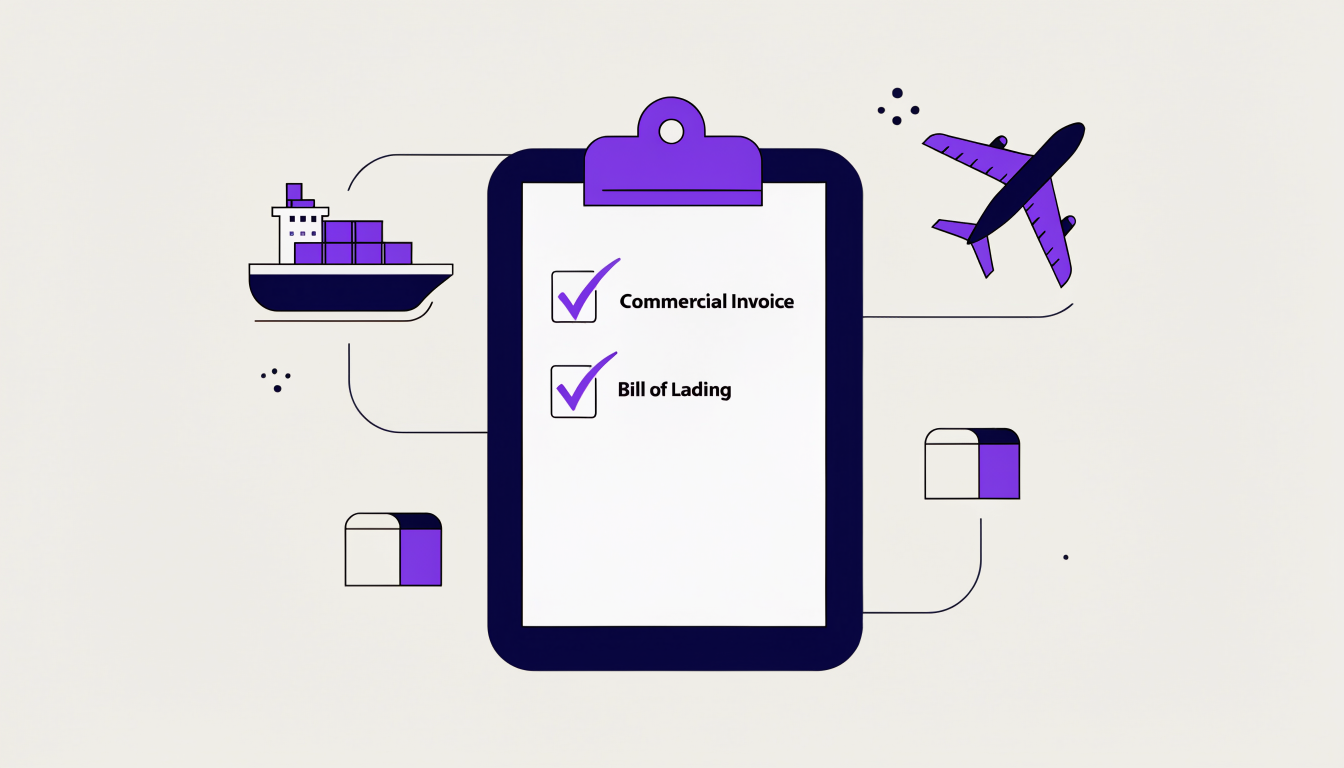
- Commercial Invoice: This is non-negotiable. It must be on your company letterhead, signed and stamped, and contain the full details of the exporter, consignee, goods, value, and country of origin. The invoice date must be on or before the application date.
- Bill of Lading or Air Waybill: For direct shipments, a copy of the transport document is required to confirm the shipping route. This is a standard requirement for sea freight and air freight. Infinity Logistics can help prepare this as part of your booking.
- Industrial Licence and Factory Invoice: If you are claiming "Made in UAE" origin, you must provide a copy of your valid industrial license and the invoice from the factory, proving the goods were produced locally.
- Dubai Customs Transit Bill: For goods passing through the UAE in transit (transshipment), Dubai Chambers asks for a copy of the Dubai Customs transit bill.
- Packing List: While not always mandatory, the issuing authority may request it, especially for multi-item shipments. It should align perfectly with the commercial invoice.
Infinity's export customs clearance includes certificate of origin processing, so the paperwork can be prepared alongside the rest of your export documents.
Need a shipping quote?
Get AI-optimized rates from DHL, FedEx & UPS — up to 65% below retail. Quote in under 10 minutes.
How long it takes and what it costs
Timelines and fees are predictable and published by the authorities. The costs and speed differ between Dubai Chambers and the Ministry of Economy. All figures are at the time of writing in 2026.
Dubai Chambers
- Processing Time: According to the Dubai Chambers service manual, a certificate is typically issued within two hours if all requirements are met. This rapid turnaround is ideal for time-sensitive air freight and express shipments.
- Cost: The standard fee is AED 100 per certificate. Additional fees apply for long documents: AED 5 for each commercial invoice page after the fifth page, and AED 5 for every page of the packing list.
Ministry of Economy and Tourism (MoET)
- Processing Time: The MoET service page states an average service delivery time of one working day. Applications can be submitted 24/7 via their online portal.
- Cost: Fees are tiered by invoice value, from AED 10 to AED 200 at the time of writing.
Common mistakes that delay the certificate
Getting your certificate of origin in Dubai delayed is frustrating and expensive. Most delays are caused by simple, avoidable errors. Here are the top three culprits.

1. Invoice and certificate details do not match
This is a common reason for rejection. The Dubai Chambers' 2024 resolution is strict: information must match exactly. This includes consignee names, goods descriptions, quantities, and values. Even a small typo can halt the process, so compare every field with the invoice before submitting.
2. Wrong type of certificate for the destination
Applying for a standard non-preferential certificate when your buyer needs a preferential one to get a tariff discount is a common error. This forces the buyer to pay full duty and can damage your business relationship. Always confirm with your buyer precisely what their customs authority requires: a standard Chamber certificate, a preferential Ministry certificate, or a specific format like an Arab League CoO.
3. Applying after the goods have shipped
You must apply for the certificate *before* the goods are exported. The commercial invoice date must be on or before the application date. Trying to get a certificate after the fact is difficult and often impossible, leaving your shipment stuck at destination customs without the required paperwork. Plan ahead and make the certificate part of your pre-shipment checklist.
How Infinity handles certificates of origin
Infinity Logistics folds the certificate of origin into your export, so documents, carrier choice and customs sit with one partner.
End-to-end document management
Our export customs clearance includes certificate of origin processing. We collect the documents, check that every detail matches the commercial invoice, and prepare the application for the right authority, whether that is Dubai Chambers for a re-export or the Ministry for a preferential certificate. We are a WCA Inter Global member.
Integrated with top express carriers
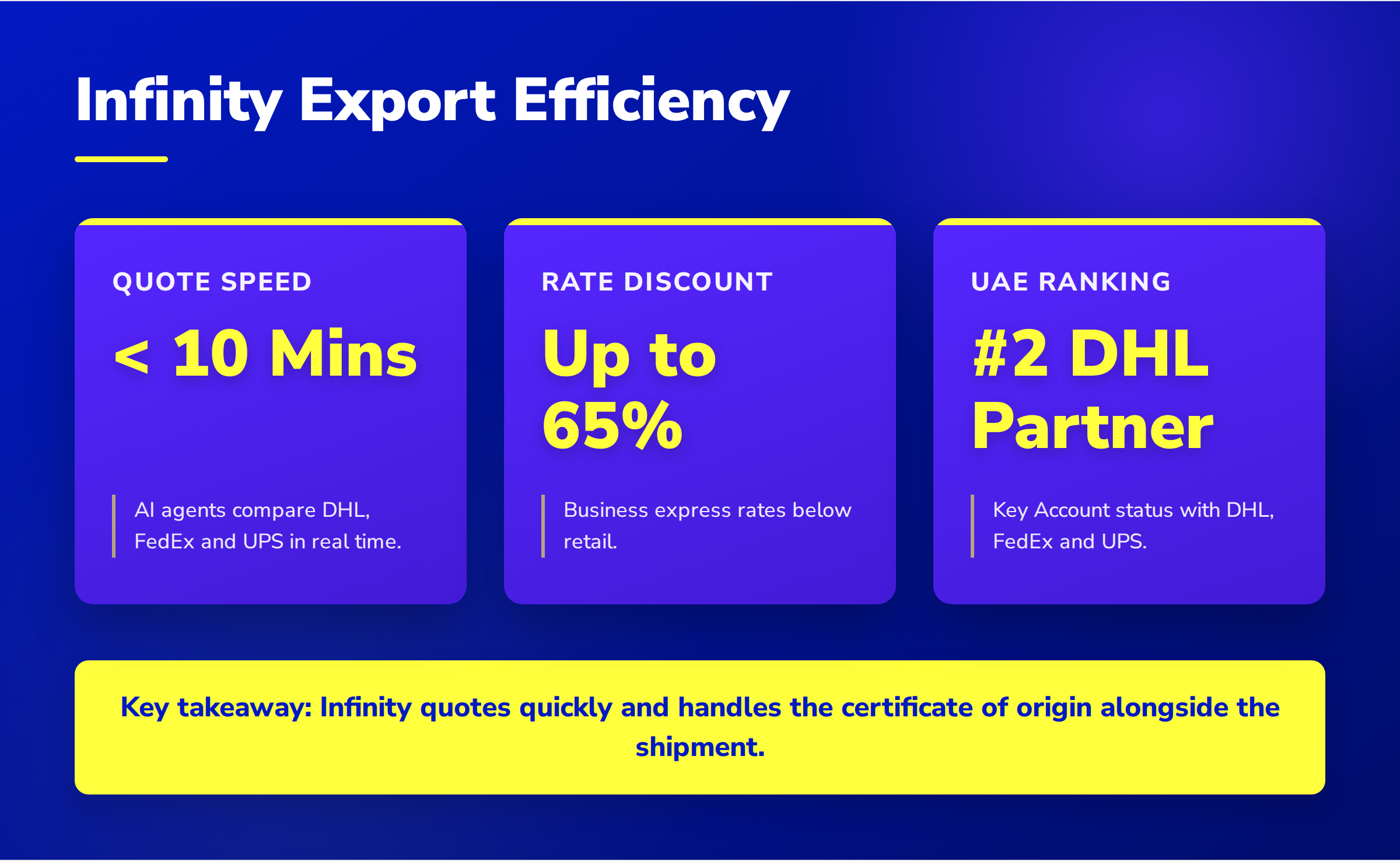
While carriers like DHL, FedEx, and UPS handle the transport, they expect you to provide the certificate of origin. Infinity sorts the certificate out before your shipment is handed to the carrier. Because Infinity holds Key Account status with DHL, FedEx, and UPS at the same time (and is the #2 DHL partner in the UAE), we offer business express rates up to 65% below retail alongside the export paperwork.
Speed and efficiency
Our AI agents compare DHL, FedEx, and UPS in real time, so most enquiries get a quote in under 10 minutes. Tell us early that you need a certificate of origin and we will build it into the shipment plan.
Ready to ship without the paperwork headaches? Infinity Logistics handles your certificate of origin in Dubai as part of a complete export solution. Get an export quote in under 10 minutes.
Frequently Asked Questions
Who issues a certificate of origin in Dubai?
In Dubai, certificates of origin are primarily issued by two bodies. Dubai Chambers issues non-preferential certificates for its members, which includes certificates for UAE-made goods and, crucially, for foreign goods being re-exported. The UAE Ministry of Economy and Tourism (MoET) issues preferential certificates for UAE-made goods that qualify for tariff reductions under free trade agreements. The right authority depends on your shipment type.
Can a free zone company get a certificate of origin for re-exported goods?
Yes. If you are a member of Dubai Chambers, you can apply through its portal with the commercial invoice and the supporting documents Dubai Chambers asks for, such as the Dubai Customs transit bill for goods in transit. Many trading companies in UAE free zones do this routinely.
How long does a certificate of origin take?
The processing time depends on the issuing authority. A Dubai Chamber certificate of origin is typically issued within two hours online, provided all documents are correct. A certificate from the UAE Ministry of Economy and Tourism generally takes one working day. It is always best to apply before the goods are scheduled to ship to avoid any last-minute delays.
What is the difference between preferential and non-preferential?
The key difference is customs duty. A preferential certificate of origin allows your buyer to pay lower or zero import duties under a specific trade agreement the UAE is part of. A non-preferential certificate of origin only proves the country where the goods were made and does not grant any tariff benefits. You must use a preferential certificate to take advantage of trade agreements.
Does every export need a certificate of origin?
No, not every export requires one. A certificate of origin is only necessary when the customs authority in the destination country demands it, when it's required by a bank under a Letter of Credit, or when you want to claim tariff benefits through a preferential certificate. For many routine, low-value shipments, a clear country of origin statement on the commercial invoice may be sufficient. Always confirm the requirements with your buyer before shipping.
Sources & References
Official and industry sources referenced in this guide:
- [PDF] Dubai Chambers Board of Directors Resolution No. (7) of 2024
- Issue a Certificate Of Origin | Ministry of Economy & Tourism
- Certificates Of Origin - Sharjah Chamber of Commerce & ...
- United Arab Emirates Legislations
- [PDF] DUBAI CUSTOMS SERVICE GUIDE
- Proof Of Origin
- Issue a Certificate Of Origin - Ministry Of Foreign Trade
- United Arab Emirates - Import Requirements and Documentation
Tags
Related Articles
Ready to optimize your logistics?
Whether you need express shipping, freight forwarding, or warehousing — our AI finds the best rates and routes for your business.