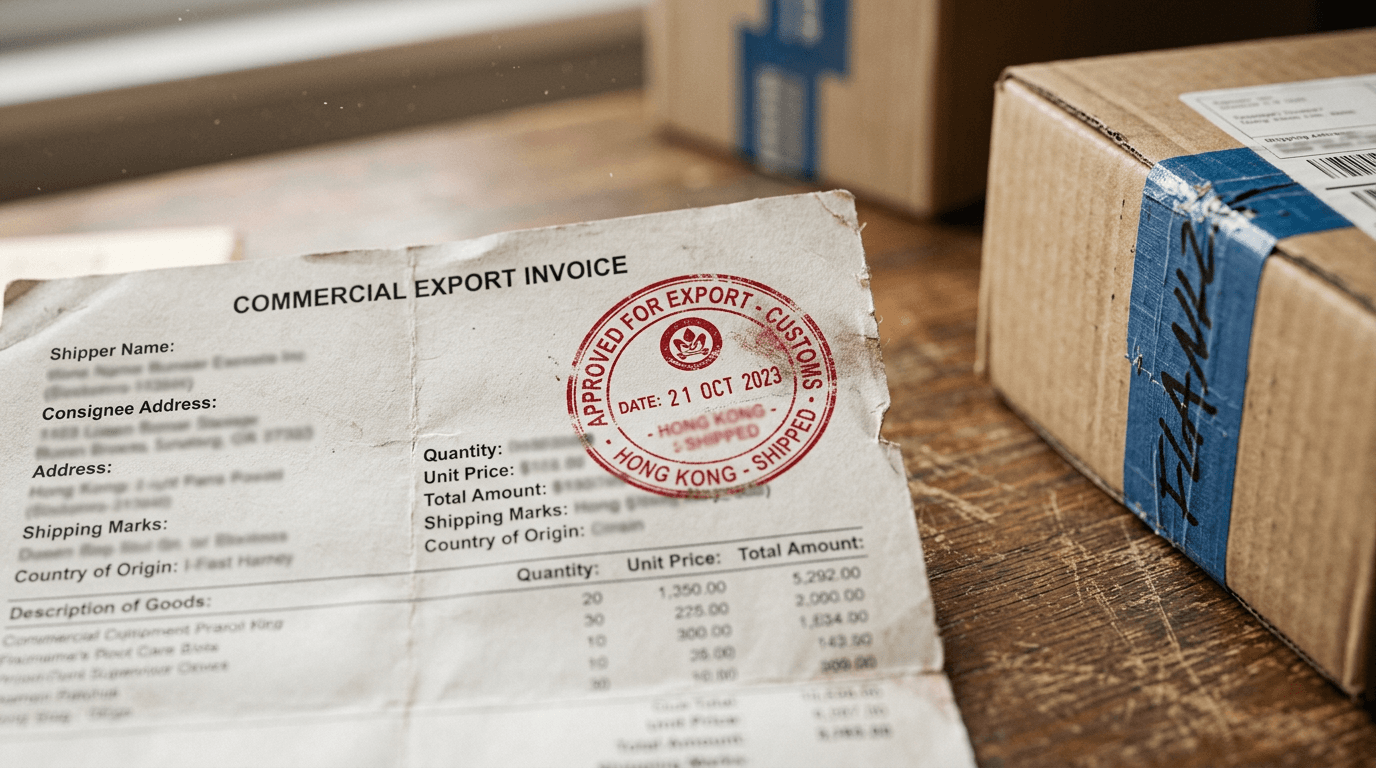
A commercial invoice is the final bill of sale that customs authorities use to assess duties and taxes on your exported goods. For any non-document shipment leaving the UAE, a complete and accurate commercial invoice is non-negotiable; many customs holds are caused by vague descriptions or missing codes on this document, not by the goods themselves.
Getting this single document right is the most important step you can take to ensure your shipment clears customs quickly at both ends of its journey. This guide provides a field-by-field checklist for creating a compliant commercial invoice for export from the UAE, helping you avoid the common mistakes that delay cargo and frustrate customers.
What is a Commercial Invoice?
A commercial invoice is a legally binding document issued by the exporter (seller) to the importer (buyer). It serves as the primary record of the transaction for customs authorities worldwide. According to the International Trade Administration, governments use this document to determine the true value of goods when assessing customs duties.
The Final Bill of Sale
Unlike a proforma invoice, which is a preliminary quote, the commercial invoice represents the final, agreed-upon details of the sale. It confirms the exact quantities, descriptions, and values of the goods being shipped. For customs in Dubai and the destination country, this document is the single source of truth for valuation.
Needed for Every Non-Document Shipment
Every international shipment containing goods with a commercial value requires this document. Whether you are sending a single sample via courier or a full container load via sea freight, a commercial invoice must accompany the shipment. Express carriers like DHL, FedEx, and UPS will not accept a non-document parcel without one, as it's essential for their electronic customs filing processes.
What a UAE Export Commercial Invoice Must Include
To ensure compliance with Dubai Customs and destination authorities, your invoice should be clear, comprehensive, and accurate. The following table outlines the essential fields for a commercial invoice for export from the UAE.
| Field | Description |
|---|---|
| Exporter/Shipper Details | Your full company name, address, contact details, and UAE Tax Registration Number (TRN) if applicable. |
| Consignee/Importer Details | The buyer's full legal name, address, and contact information. Complete details prevent delivery issues. |
| Invoice Number & Date | A unique invoice number for your records and the date of issue. |
| Reason for Export | State the purpose, e.g., "Commercial Sale," "Sample," "Warranty Repair," or "Temporary Export." |
| Incoterms® 2020 Rule | The agreed trade term (e.g., FOB Jebel Ali, DAP London, DDP New York). This defines who pays for what. |
| Detailed Description of Goods | A specific description for each item, including material, purpose, and model number. (See next section). |
| HS Code | The Harmonized System code for each item, with at least the six internationally agreed digits. This is critical for duty calculation. |
| Country of Origin | The country where each product was manufactured (e.g., "Made in UAE"). |
| Quantity & Unit of Measure | The number of units for each item (e.g., 100 pieces, 50 kgs). |
| Unit Price & Total Value | The price per unit and the total value for each line item, along with the overall invoice total and currency (e.g., USD, AED). |
| Number of Packages & Weight | The total number of cartons/pallets, plus the total gross and net weight of the shipment. |
| Signature & Company Stamp | An authorized signature and company stamp to validate the document. |
Describing Goods So Customs Does Not Hold Them
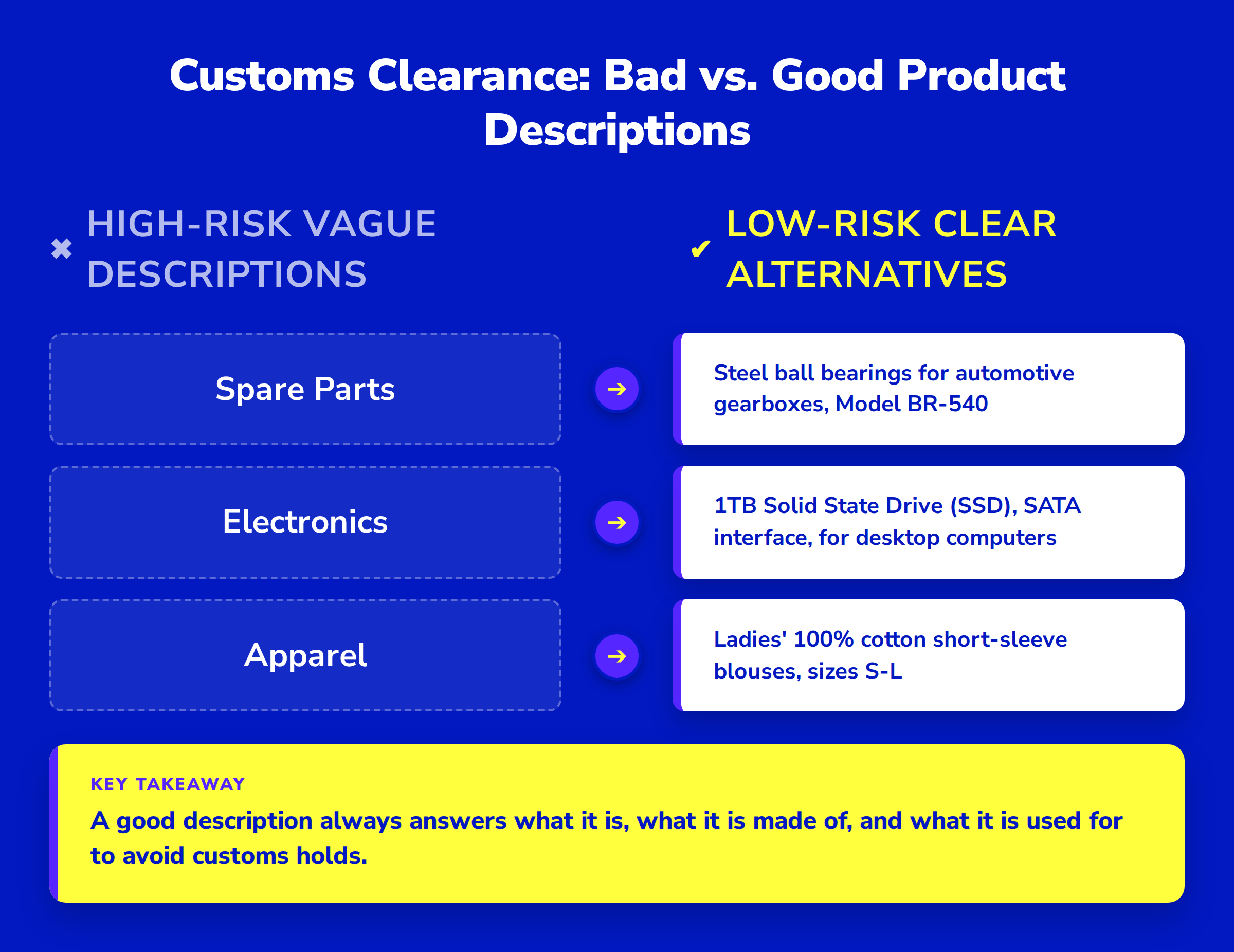
Vague descriptions are one of the most common causes of customs holds. A customs officer must be able to identify your product and verify its HS code from your description alone. A good description answers three questions: What is it? What is it made of? What is it used for?
Bad vs. Good Descriptions
Here’s how to turn a high-risk, vague description into a low-risk, clear one that speeds up clearance.
| Bad Description (High Risk) | Good Description (Low Risk) |
|---|---|
| Spare Parts | Steel ball bearings for automotive gearboxes, Model BR-540 |
| Electronics | 1TB Solid State Drive (SSD), SATA interface, for desktop computers |
| Apparel | Ladies' 100% cotton short-sleeve blouses, sizes S-L |
| Samples | Fabric swatches (65% polyester, 35% cotton), 10cm x 10cm, not for resale |
The Material, Use, and Model Rule
For every item on your commercial invoice format, aim to include:
- Material/Composition: e.g., "stainless steel," "polypropylene plastic," "100% leather."
- Intended Use: e.g., "for water filtration," "for office furniture," "for personal skincare."
- Model/Type: Include part numbers, model numbers, or specific names that identify the exact product.
Getting this right streamlines the entire process of customs clearance in the UAE and abroad. Infinity Logistics' customs team can review your product descriptions before booking to catch vague terms early.
HS Codes, Incoterms, and Country of Origin
These three elements on the commercial invoice are critical because they tell customs how to classify your goods, who is responsible for duties, and what trade rules apply.
Harmonized System (HS) Codes
The HS code is a universal language for classifying products. Administered by the World Customs Organization (WCO), this code determines the duty and tax rates for your goods. A missing or incorrect HS code is a major red flag for customs and a common reason for delays. Always include the specific code for each item on your invoice.
Incoterms® 2020: Who Pays for What?
Incoterms define the responsibilities of the seller and buyer. The two most common for e-commerce and general exports are DAP and DDP.
- DAP (Delivered at Place): The seller pays for transport to the destination country. The buyer is responsible for import clearance, duties, and taxes.
- DDP (Delivered Duty Paid): The seller pays for everything, including transport, import clearance, duties, and taxes. This provides a "landed cost" price for the buyer.
Clearly stating the Incoterm on the invoice prevents disputes and ensures customs bills the correct party for any charges.
Need a shipping quote?
Get AI-optimized rates from DHL, FedEx & UPS — up to 65% below retail. Quote in under 10 minutes.
Country of Origin
The country of origin (the country of manufacture) is used to determine eligibility for free trade agreements and to enforce import restrictions. This must be accurately stated for each product and should match the information on the Certificate of Origin if one is required.
Proforma Invoice vs. Commercial Invoice
While they look similar, these two documents serve very different purposes. Understanding the difference is key to smooth international trade.
What is a Proforma Invoice?
A proforma invoice is a preliminary bill of sale or a quote sent to the buyer before the shipment is prepared. It is not a final or legally binding financial document. Buyers often use it to arrange financing, open a letter of credit, or apply for an import license. It confirms the seller's commitment to provide the goods at a specific price.
What is a Commercial Invoice?
The commercial invoice is the final, official bill of sale issued after the goods are ready to ship. As confirmed by UPS UAE, this is the primary document used by customs to assess duties and taxes. It reflects the actual details of the shipment and is used for accounting and customs clearance. You cannot clear customs with a proforma invoice.
Invoices for Express Shipments
When shipping via courier, the accuracy of your commercial invoice for courier shipments is paramount for speed.
Carrier Requirements
Express carriers like DHL, FedEx, and UPS have strict requirements. The invoice data is transmitted electronically to customs authorities before the plane even takes off. Any errors can stop the shipment in its tracks. Infinity Logistics holds Key Account status with DHL, FedEx, and UPS simultaneously, allowing us to offer business express rates up to 65% below retail while ensuring your documentation meets carrier standards.
Match Weights and Piece Counts to the Air Waybill
A critical check is ensuring the total number of packages and the gross weight on your commercial invoice match the air waybill (AWB) exactly. A mismatch in weight or piece count can trigger a hold and a physical inspection. This is one of the most common and easily avoidable mistakes in worldwide express shipping.
Common Mistakes That Delay Shipments
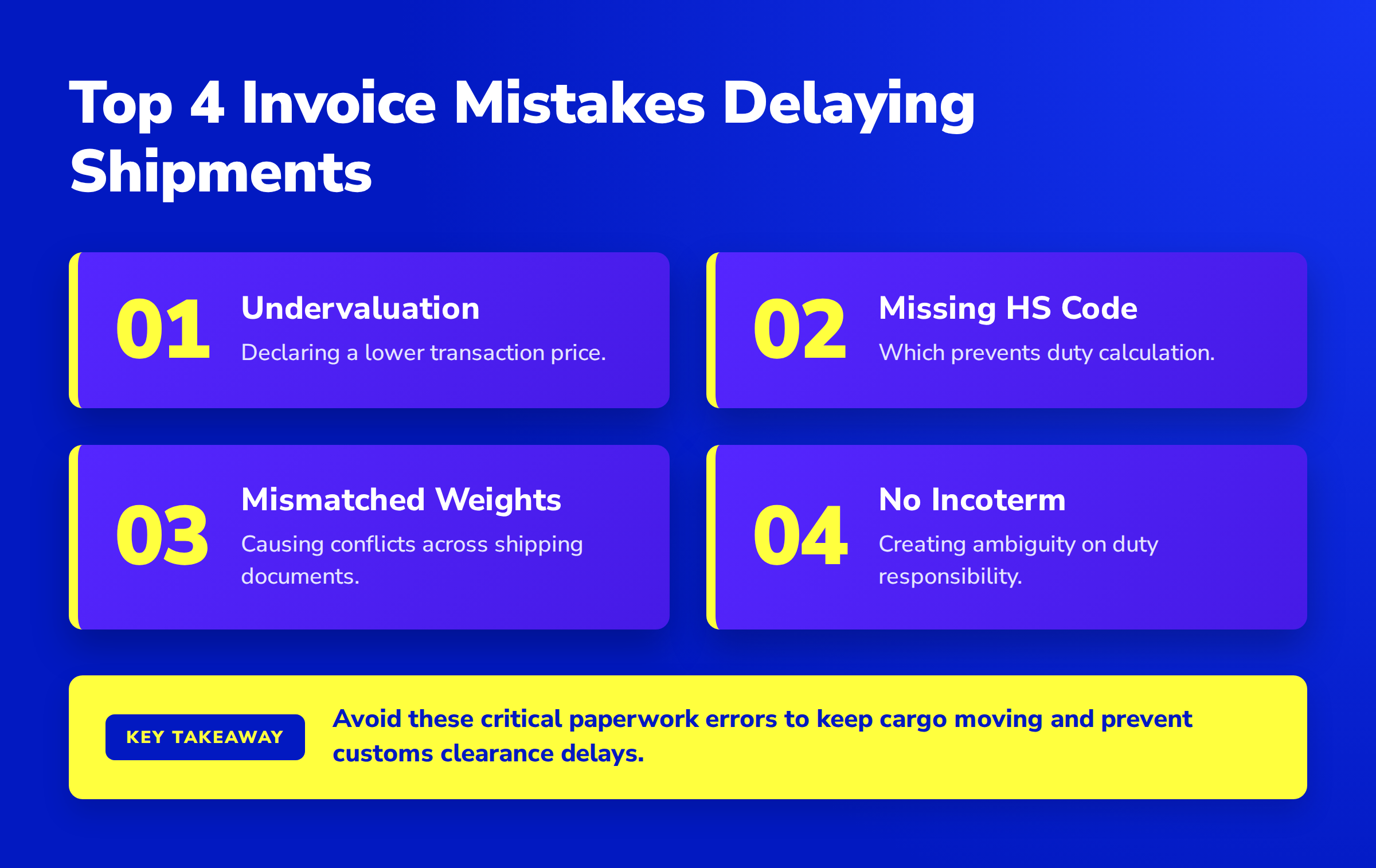
Many customs delays start with simple paperwork errors. Avoid these five common mistakes to keep your cargo moving.
- Undervaluation: Declaring a value lower than the true transaction price to avoid duties is illegal and easily detected by customs valuation systems. This leads to fines, audits, and severe delays.
- Missing HS Code: Without an HS code, customs cannot classify the product or calculate duties, forcing a manual review.
- Mismatched Weights: If the weight on the invoice, packing list, and AWB don't align, the shipment will be flagged for inspection.
- No Incoterm: Forgetting the Incoterm creates ambiguity about who is responsible for duties and taxes, halting the clearance process.
- Incomplete Consignee Details: Missing phone numbers or incorrect addresses for the receiver can delay final delivery even after the shipment has cleared customs.
To avoid these pitfalls, Infinity Logistics' customs team can check your export documents before booking. We are the #2 DHL partner in the UAE and a WCA Inter Global member.
Get the invoice right once, and every border moves faster. Let our team check your documents and provide a competitive shipping rate. You can get a quote in under 10 minutes with our AI-powered platform that compares DHL, FedEx, and UPS in real time.
Frequently Asked Questions
Who issues the commercial invoice?
The commercial invoice is always issued by the exporter (the seller or shipper). It is their declaration to the buyer and to customs authorities about the contents and value of the shipment. The exporter is legally responsible for the accuracy of the information provided on the document.
Does a sample shipment need a commercial invoice?
Yes. Every non-document shipment, including samples, gifts, or warranty replacements, requires a commercial invoice. For non-commercial items, you must still declare a realistic value for customs purposes (e.g., the manufacturing cost). You can state "Value for customs purposes only. Not for resale." on the invoice.
Do I also need a Certificate of Origin?
It depends on the destination country and the products being shipped. A Certificate of Origin (COO) is a separate document, typically issued by a Chamber of Commerce in the UAE, that certifies the country where the goods were manufactured. Some countries require a COO to apply preferential tariff rates under a free trade agreement. Always check the import requirements of the destination country.
Can I sign the commercial invoice electronically?
While many customs authorities and carriers now accept electronic signatures, some countries still require a "wet ink" signature and a physical company stamp. It is best practice to check the specific requirements of the destination country. For maximum compatibility, many UAE exporters continue to print, sign, and stamp their invoices.
What is the difference between net weight and gross weight?
Net weight is the weight of the products themselves, without any packaging. Gross weight is the total weight of the products plus all packaging, including boxes, pallets, and wrapping materials. Both are required on the commercial invoice and packing list, as they are used for logistics planning, safety calculations, and customs verification.
How can I find the correct HS code for my product?
You can find HS codes using online search tools provided by your country's customs authority or international trade bodies. You can also consult with a customs broker or a logistics provider like Infinity Logistics. Providing a detailed product description is the first step, as the classification depends on the item's material, form, and function.
Sources & References
Official and industry sources referenced in this guide:
- Commercial Invoice - International Trade Administration
- How to Create a Commercial Invoice | UPS - United Arab Emirates
- DISPLAYING ITEMS BY TAG: Declaration
- What is a commercial invoice and how do I fill it in? - FedEx
- [PDF] Customer Guide
- UAE-eInvoicing-Public-Consultation-document.pdf
- HS Codes in Shipping: What They Are and How to Use Them
Tags
Related Articles
Ready to optimize your logistics?
Whether you need express shipping, freight forwarding, or warehousing — our AI finds the best rates and routes for your business.