Moving goods from a UAE free zone into the mainland customs territory normally requires an import procedure. Duty and VAT depend on the goods, their customs status and the type of movement. Re-export and controlled transit follow different procedures, so plan the declaration before stock moves.
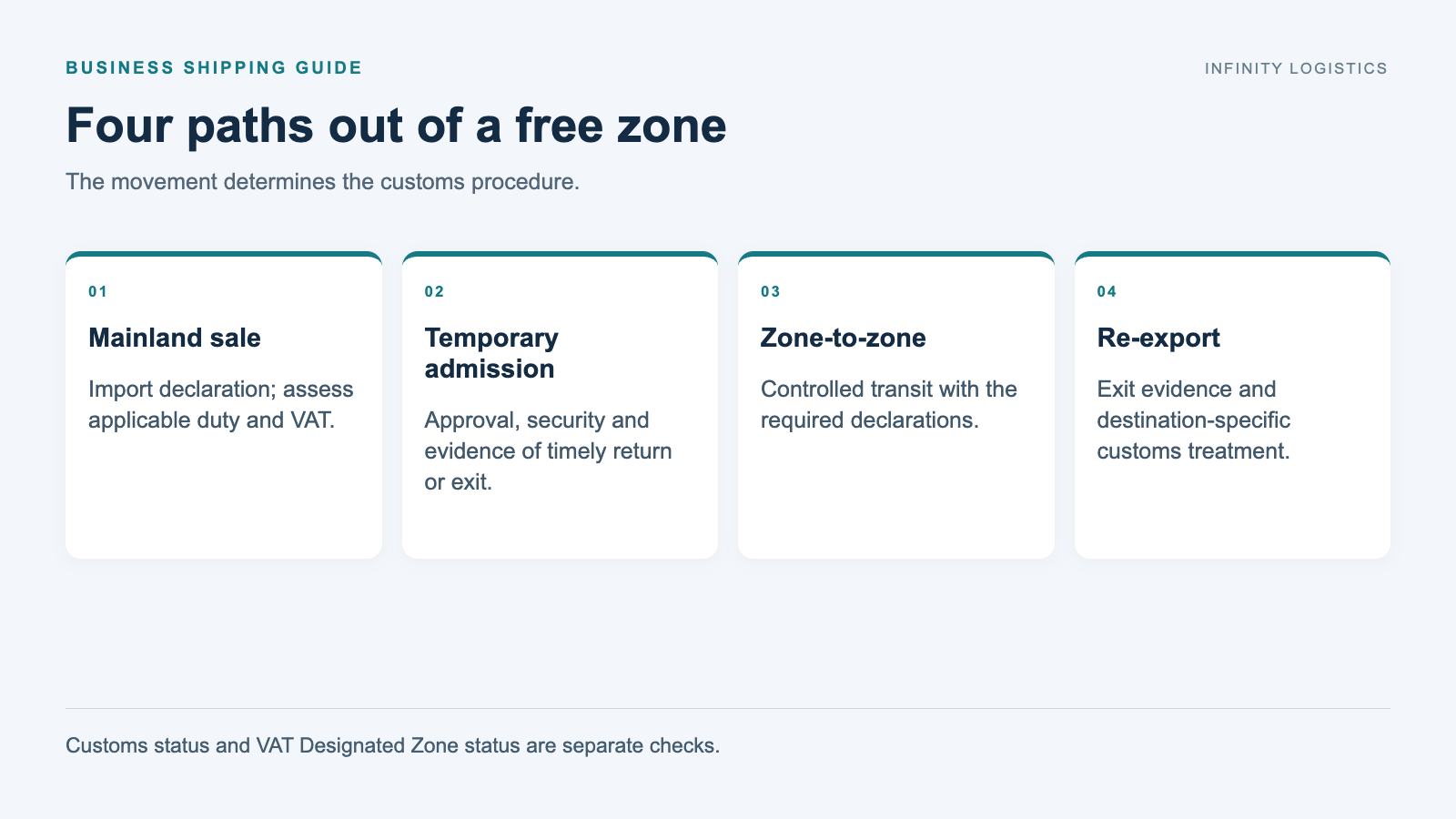
Every shipment leaving a free zone follows one of four paths, each with distinct rules for customs duty, VAT, and paperwork. Here is a summary of what to expect for each movement in 2026:
| Movement Type | Customs Duty | VAT | Key Declaration Type (Dubai Customs) |
|---|---|---|---|
| To Mainland (Sale) | Payable (typically 5% of CIF value) | Generally 5% for standard-rated imports from a Designated Zone; assess the actual movement | Import to Local from FZ |
| Temporary Admission | Refundable deposit equal to duty | Confirm with the FTA or a tax adviser | Temporary Admission from FZ to Local |
| Zone to Zone | Suspended (under customs control) | Confirm with the FTA or a tax adviser | FZ Transit Out |
| Re-Export Outside the GCC | Normally no UAE import duty if the customs-control and exit conditions are met | Confirm with the FTA or a tax adviser | Free zone exit or re-export declaration (your broker confirms the type) |
Why goods in a free zone are duty-suspended
A UAE free zone is a special economic area that, for customs purposes, is treated as being outside the UAE customs territory. This status is the foundation of the UAE's role as a global logistics hub, allowing businesses to import, store, and consolidate goods without immediately paying customs duties.
Free Zones: Inside the UAE, Outside the Customs Territory
While physically located within the UAE, free zones operate under a duty-suspended regime. This means that when goods arrive from overseas into a free zone like Jebel Ali Free Zone (JAFZA), the standard import duties are not collected. The obligation to pay is deferred, or suspended, as long as the goods remain within the zone's boundaries or are moved under customs control.
The GCC Common External Tariff: The 5% Rule
The UAE is part of the Gulf Cooperation Council (GCC) customs union. Under this agreement, a GCC common external tariff applies to most foreign goods entering the union's market. According to the UAE Government portal, this duty is typically set at 5% of the goods' CIF value (Cost, Insurance, and Freight).
When goods enter mainland circulation, the applicable duty becomes assessable. Five per cent is a common rate, but the HS classification, origin, exemptions and customs procedure determine the actual treatment.
Duty Suspension vs. Duty Exemption
It is critical to understand that goods in a free zone are duty-suspended, not duty-exempt. The duty obligation is latent, not cancelled. If the goods are later sold into the mainland, the duty crystallises. However, if the goods are re-exported from the free zone to a country outside the GCC, they never enter the local market, and therefore no UAE customs duty is ever paid.
Selling into the mainland: duty and VAT
A sale involving goods moving from a free zone into the mainland customs territory requires the appropriate import procedure. Customs duty and VAT must be assessed separately, including whether the zone is a Designated Zone for VAT.
The Customs Declaration: 'Import to Local from FZ'
To move goods from a free zone to mainland, a specific customs declaration must be filed. According to the Dubai Customs Services Guide, this is done using the ‘Import to Local from FZ’ declaration type in the Mirsal 2 electronic system. This declaration officially brings the goods into the UAE customs territory for "home consumption" and is the trigger for duty and tax assessment.
Calculating Customs Duty: The 5% CIF Rule
For most commercial goods, Dubai Customs levies a duty of 5% on the CIF value. For example, if a shipment has a CIF value of AED 100,000, the customs duty payable upon moving it from JAFZA to mainland Dubai would be AED 5,000. Certain goods, like alcohol (50%) and tobacco (100%), attract significantly higher rates.
VAT on Mainland Sales: Designated Zones and Import VAT
VAT treatment depends on whether the free zone is a Designated Zone. The UAE's Federal Tax Authority (FTA) maintains a list of Designated Zones, which are fenced free zones with specific customs controls. According to the FTA's Designated Zones VAT Guide, moving goods from a Designated Zone to the mainland is treated as an import of goods into the UAE.
Standard-rated imports from a Designated Zone generally attract 5% import VAT, subject to applicable exemptions and reliefs. Free zones that are not Designated Zones are generally within the UAE VAT territory, so ordinary domestic VAT rules may apply instead.
The Reverse Charge Mechanism (RCM) Explained
For B2B transactions, the mainland buyer, if VAT-registered, typically accounts for the 5% import VAT using the Reverse Charge Mechanism (RCM). Instead of paying the VAT at the border, the buyer declares it as both output tax (payable) and input tax (recoverable) on their regular VAT return. This creates a cash-flow neutral transaction for fully taxable businesses. Always confirm the correct VAT treatment with a qualified tax advisor.
Temporary admission to the mainland
Sometimes goods need to enter the mainland from a free zone for a short period, for an exhibition, a repair or a project, before being returned or re-exported. This is handled through temporary admission.
What is Temporary Admission?
Temporary admission allows goods to enter the mainland market with customs duties suspended, provided they are intended for re-export within a specific timeframe. Instead of paying the duty, the importer provides a security deposit.
The Duty Deposit: A Refundable Guarantee
According to Dubai Customs, a deposit equal to the customs duty that would have been payable is collected. For a shipment with a potential duty of AED 10,000, a deposit of AED 10,000 is lodged with customs.
Time Limits and Re-Export Requirements
The goods must be re-exported or returned to the free zone within the period customs allows; confirm that period for your goods when you apply. If they are not, the deposit can be kept as the duty.
Claiming Your Deposit Refund
The deposit is refunded once customs has proof that the goods were re-exported or returned to the zone within the allowed period. Infinity's customs team can prepare the declarations involved.
Moving goods between free zones
Transferring goods between two different UAE free zones, such as from JAFZA to DAFZA, is a common logistics requirement. These movements can generally be made without paying duty, provided the goods stay under customs control.
Transfer Within the Same Free Zone
Moving goods between two warehouses within the same free zone (for example, within JAFZA) is the simplest transfer. Dubai Customs has a 'Transfer within a FZ' declaration for this, and the goods stay duty-suspended.
FZ Transit Out: Moving Between Different Free Zones
Between two different free zones, the goods move as a customs transit. In Dubai, an 'FZ Transit Out' declaration moves them out of the origin zone, and they travel under customs control to the destination zone. Duty stays suspended throughout.
Need a shipping quote?
Get AI-optimized rates from DHL, FedEx & UPS — up to 65% below retail. Quote in under 10 minutes.
The Importance of Customs Control During Transit
For a zone-to-zone transfer to stay duty-free, the goods must not enter local circulation. The route must be direct and the shipment documented as a customs transit. A deviation can be treated as an import into the mainland, triggering duty and VAT.
Always Check Each Zone's Specific Rules
Procedures and documents vary between free zones and emirates. Infinity confirms the requirements for the origin zone, destination and customs status before arranging a zone-to-zone transfer.
Re-exporting from a free zone
Many businesses use UAE free zones as a hub for regional distribution: goods come into the zone and are re-exported to other countries.
The Re-Export Declaration Process
A free zone exit or re-export requires the correct customs declaration and evidence of onward transport. Where foreign goods remain under the appropriate customs control and leave directly for a country outside the GCC, UAE import duty is normally not collected. GCC destinations require a separate assessment; your broker selects the declaration for the goods’ entry history and destination.
Certificate of Origin for Re-Exported Goods
Even though the goods are foreign, the destination's customs may ask for a Certificate of Origin (COO). Dubai Chambers issues certificates of origin for goods being re-exported to its members, stating where the goods were originally made.
Arranging the Onward Shipment: Express and Freight
Once customs clearance for re-export from Dubai is complete, the goods are ready for the final leg. Infinity arranges the onward freight or express from the UAE. With Key Account status on DHL, FedEx and UPS, and as the #2 DHL partner in the UAE, we offer business express rates up to 65% below retail.
Who can file the declarations
Customs declarations in the UAE are filed electronically through systems like Dubai's Mirsal 2. Not just anyone can submit them; filers must be registered and authorised.
Customs Business Code Holders (The Goods Owner)
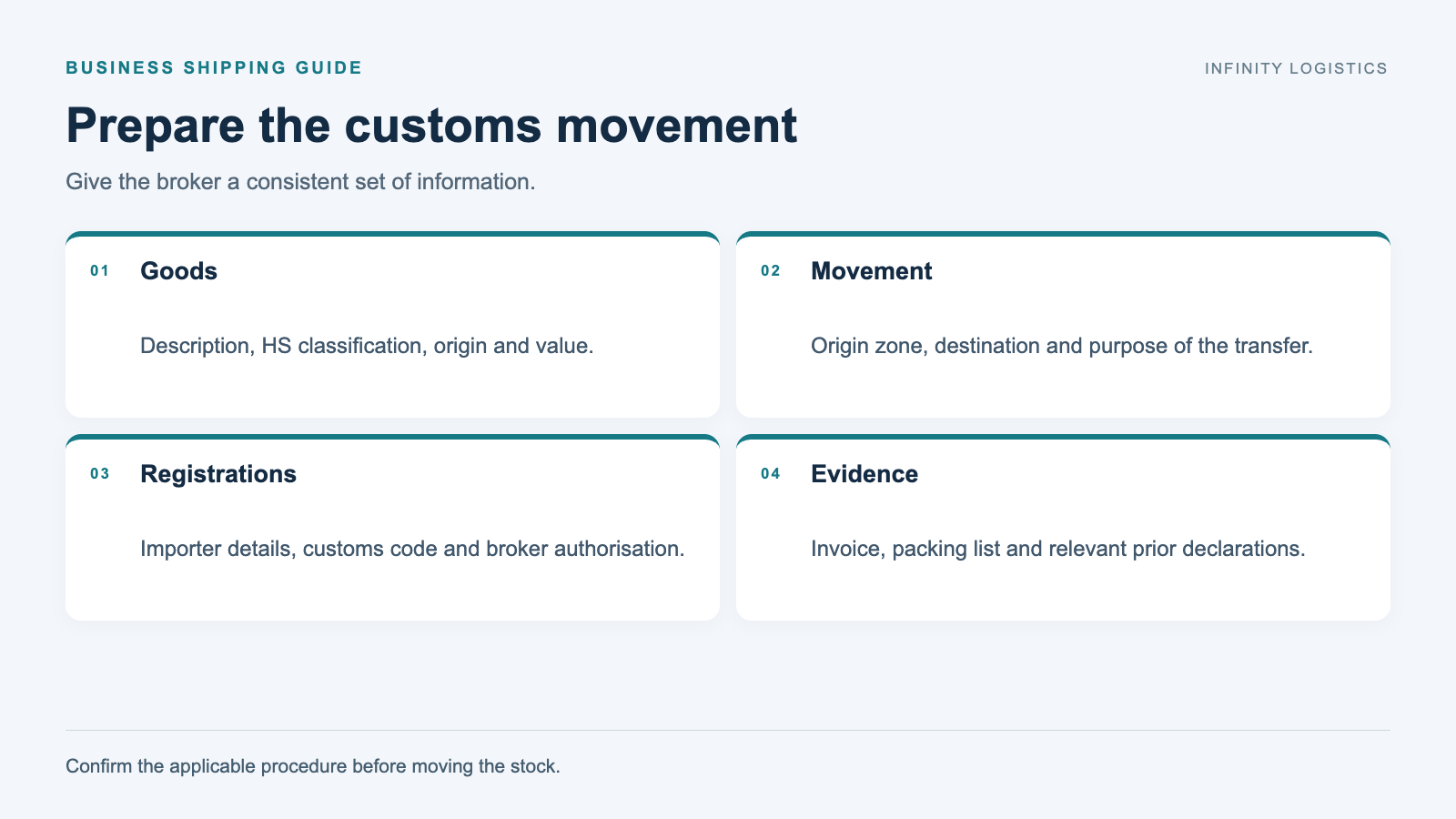
Any company that wants to import or export goods, including a free zone company, must first register with the relevant customs authority and get a customs business code. The code identifies the company in all customs transactions, and a company holding it can file its own declarations.
Authorised Customs Brokers and Clearing Agents
Many businesses authorise a customs broker or forwarder to file declarations for them; Dubai Customs allows licence holders to do this. A good broker makes sure goods carry the right HS codes and that the free zone procedure fits the movement.
How to Authorise a Broker in Dubai
In Dubai, the licence holder authorises the broker with Dubai Customs, and the broker then files declarations on the company's behalf.
How Infinity handles free zone movements
Infinity Logistics was founded in 2017, with an office in Ajman Free Zone and warehousing in JAFZA, DIP and Al Quoz. The key to free zone stock movements is planning the paperwork before the stock moves.
One Partner for Storage, Clearance, and Onward Shipping
Goods can be stored in our JAFZA warehousing while they are duty-suspended. Our customs clearance covers the declarations for all four movements: sale to the mainland, temporary admission, zone-to-zone transfer and re-export. One partner for storage, clearance and shipping means fewer hand-offs.
Free zone procedures we cover
Infinity handles sale to mainland, temporary admission, zone-to-zone transfers and re-export, subject to the relevant customs procedure. Our warehousing network includes JAFZA, Dubai Investment Park and Al Quoz; the customs and VAT status of each location must be checked separately.
Key Account express rates for re-exports
For re-exports, the last step is the onward shipment. Infinity's Key Account status with DHL, FedEx and UPS brings business express rates up to 65% below retail, and our AI agents compare all three carriers in real time, so most enquiries get a quote in under 10 minutes.
Whether you are moving goods from a free zone to mainland or re-exporting to a global customer, having the right logistics partner is crucial. Get a quote from Infinity Logistics today to streamline your free zone operations.
Frequently Asked Questions
Do I pay customs duty when goods leave a free zone for the mainland?
Yes. Moving goods from a UAE free zone into the mainland is treated as an import into the UAE customs territory. For most goods, this triggers the standard GCC customs duty of 5% calculated on the CIF (Cost, Insurance, and Freight) value of the shipment. The duty is payable at the time of customs clearance into the mainland.
Is VAT due on goods moved from a free zone to the mainland?
For standard-rated goods imported from a Designated Zone, 5% import VAT generally applies. A registered importer may account for it on its VAT return where the conditions are met; input recovery depends on eligibility. Non-designated free zones follow ordinary UAE VAT treatment. Confirm the treatment of the actual movement with the FTA or a tax adviser.
Do re-exported goods pay UAE duty?
No. If goods are imported into a UAE free zone and then re-exported directly to a country outside the GCC without ever entering the UAE mainland, no UAE customs duty is payable. The goods remain under a duty-suspended status from arrival to departure. This is a primary benefit of using UAE free zones as a distribution hub.
Can a mainland company buy directly from a free zone company?
Yes. The parties must agree who acts as importer, holds the required registrations and arranges clearance. Applicable duty and VAT depend on the goods and zone status; the common 5% rates are not universal.
Who files the declaration for free zone to mainland?
The customs declaration can be filed by the owner of the goods (the importer) or by a customs broker it has authorised. The filer must hold a valid customs business code with the relevant UAE customs authority. Many businesses authorise a broker or forwarder, such as Infinity Logistics, to file it for them.
Sources & References
Official and industry sources referenced in this guide:
- [PDF] DUBAI CUSTOMS SERVICE GUIDE
- FTA Designated Zones VAT Guide - الهيئة الاتحادية للضرائب
- Frequently Asked Questions
- Customs duty | The Official Platform of the UAE Government
- dubai customs
- United Arab Emirates - Temporary Entry - export.gov
- Sharjah Customs-Free Zone
- السياسات و االجراءات الخاصة بإيداع واخراج البضائع من والى ...
- United Arab Emirates - Customs Regulations
- Technical Guidelines for Consumer Products Import and Re-export
Tags
Related Articles
Ready to optimize your logistics?
Whether you need express shipping, freight forwarding, or warehousing — our AI finds the best rates and routes for your business.