
How AI Agents Handle Express Logistics: Real-Time Multi-Carrier Rate Comparison in Under 10 Minutes
The AI Revolution in Express Logistics: From Hours to Minutes
The express logistics industry in Dubai and the UAE has undergone a dramatic transformation, evolving from manual, time-consuming processes to AI-powered operations that deliver results in minutes. Traditional express logistics has long been plagued by manual quoting processes, frequent carrier switching, and rate opacity that create operational bottlenecks and inflate costs. According to Mordor Intelligence's 2026 UAE Freight & Logistics Market Report, the UAE freight and logistics market reached USD 23.05 billion in 2026, yet many businesses still struggle with administrative friction from non-digitized paperwork and manual quote generation.
The impact of these traditional pain points is substantial. In the UAE's air freight forwarding sector, which holds 44.33% of forwarding revenue, manual capacity management exacerbates dwell times for high-value goods at major hubs like Jebel Ali and Dubai International Airport. Small and medium enterprises often find themselves waiting in brokerage queues for hours just to receive quotes, with error rates exceeding 20% in non-integrated systems.
How AI agents handle express logistics: real-time multi-carrier rate comparison in under 10 minutes represents a paradigm shift in the industry. These intelligent systems transform the entire process from initial request to final booking, eliminating the friction that has historically plagued international shipping. AI agents enable instant multi-carrier rate comparisons, predictive routing, and automated booking workflows that compress what once took hours into mere minutes.
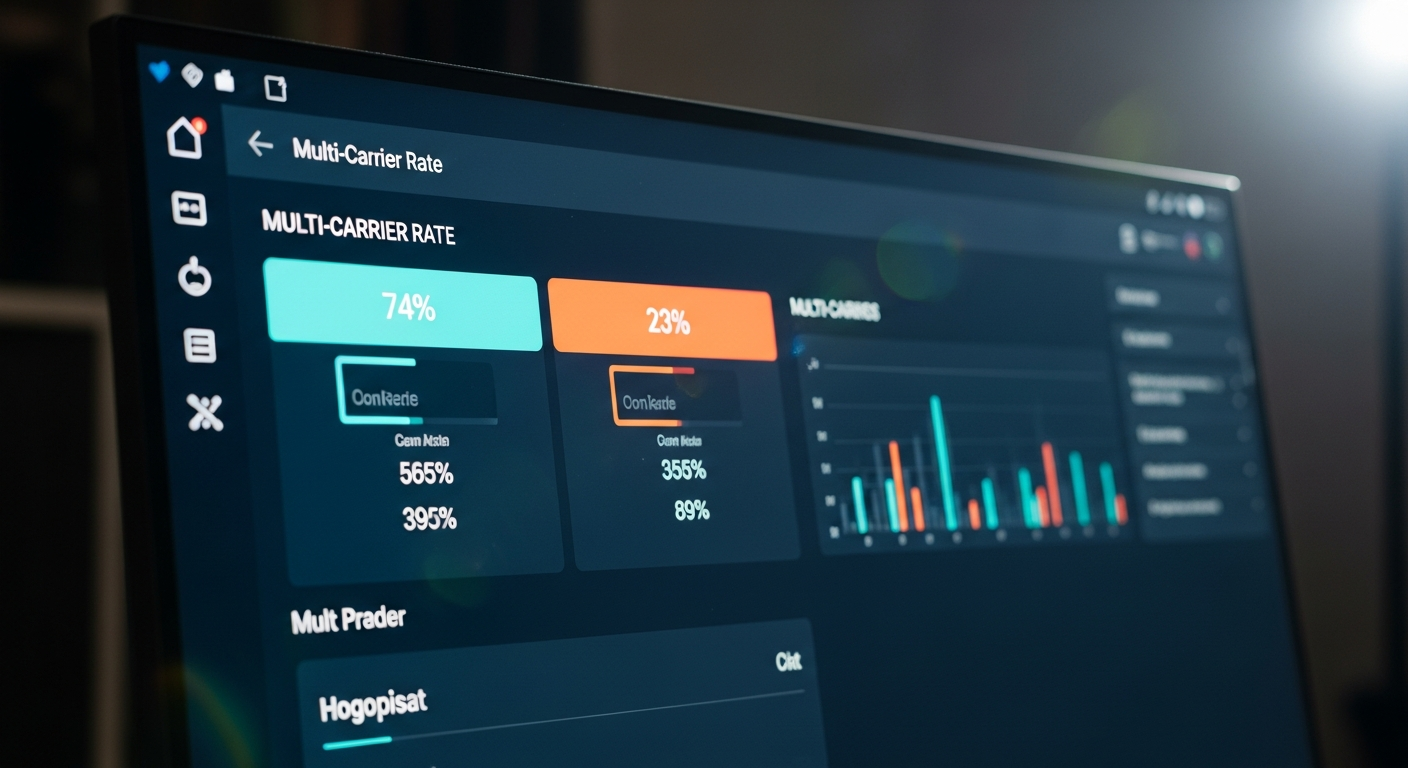
The real-world impact is measurable and significant. Traditional multi-carrier quoting processes typically require 2-4 hours of manual work, involving phone calls to different carriers, spreadsheet comparisons, and back-and-forth negotiations. In contrast, AI-powered systems deliver comprehensive quotes in under 10 minutes. According to Grand View Research, the UAE logistics automation market, valued at USD 349.4 million in 2025, is growing at 16.9% CAGR to reach USD 1,186.8 million by 2033, driven by businesses seeking these efficiency gains.
This shift from reactive to predictive logistics operations is reshaping how businesses approach express shipping. Instead of responding to shipping needs as they arise, AI agents anticipate requirements, optimize routes proactively, and select carriers based on real-time performance data. The UAE government's 2023 mandate requiring AI-driven forecasting tools for all logistics firms has accelerated this transition, pushing the industry toward a future where intelligent automation is the standard, not the exception.
What Are AI Agents in Express Logistics?
AI agents in express logistics are autonomous software systems that use real-time data, machine learning, and reasoning models to monitor conditions, make decisions, and execute actions without constant human intervention. According to IBM's research on AI agents in supply chain, these systems function as intelligent decision-makers that gather real-time data from multiple sources, evaluate constraints, and recommend or execute actions to optimize shipping operations.
Unlike traditional logistics software that operates reactively and requires human input at each decision point, AI agents work proactively. They combine real-time data from enterprise systems, sensors, and IoT devices with machine learning, predictive analytics, and optimization models to evaluate tradeoffs and make decisions closer to the point of impact. This fundamental difference enables them to handle the complexity of modern express logistics with unprecedented speed and accuracy.
The key capabilities that enable how AI agents handle express logistics: real-time multi-carrier rate comparison in under 10 minutes include sophisticated API integration and data aggregation. These agents automatically identify and connect to the right data sources—including ERP systems, Transportation Management Systems (TMS), Warehouse Management Systems (WMS), and external APIs from carriers like DHL, FedEx, and UPS. This seamless connectivity allows them to pull rate information, service levels, and availability data from multiple carriers simultaneously without manual intervention.
Real-time decision-making represents another critical capability. AI agents analyze both structured and unstructured data—including weather reports, traffic alerts, and carrier performance metrics—to make instantaneous decisions about optimal routing and carrier selection. They process complex variables such as weight, dimensions, destination, service level requirements, and cost constraints in parallel across multiple carriers, delivering results that would take human operators hours to compile.
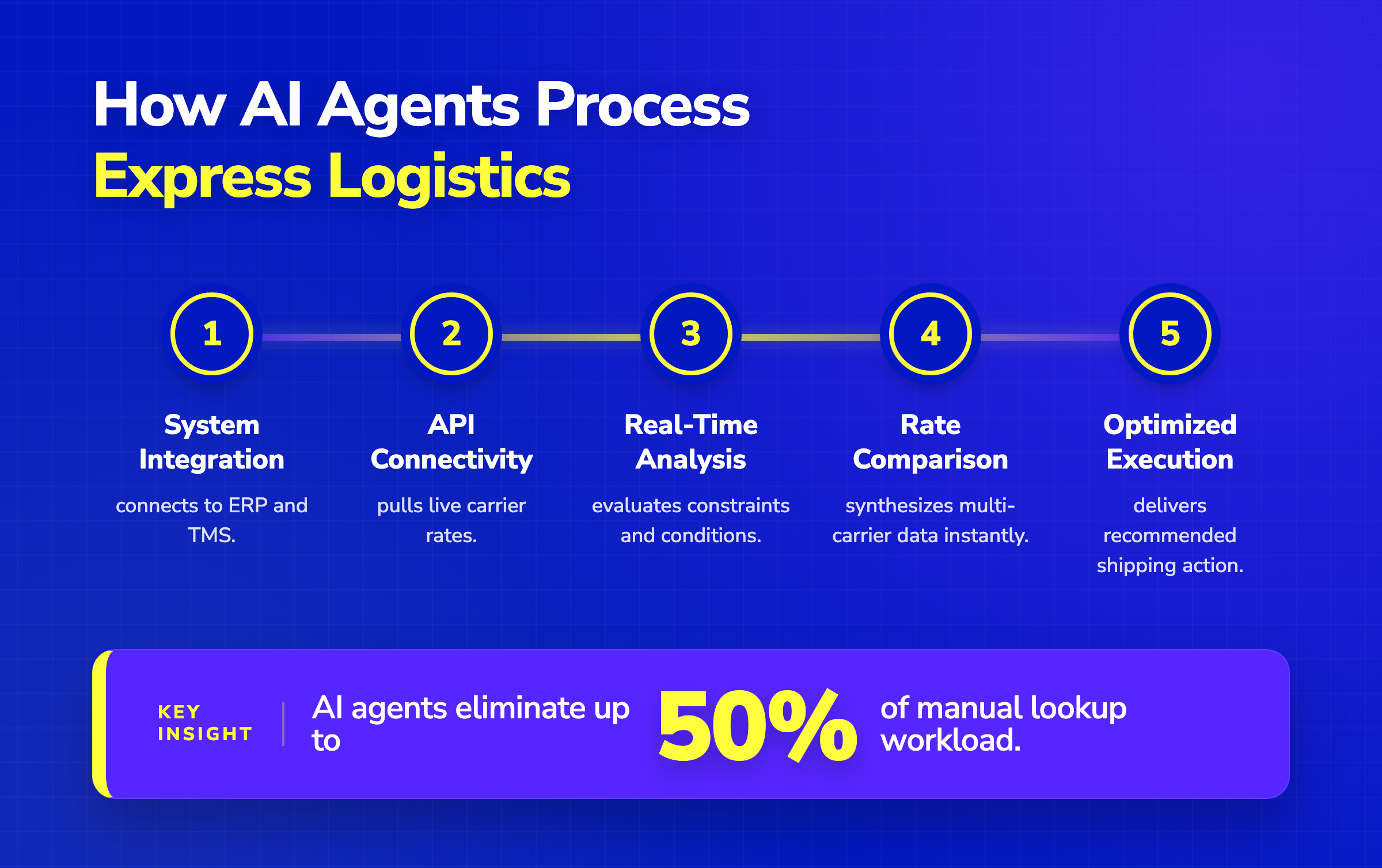
In distributed logistics networks, AI agents excel at multi-carrier coordination. As explained in AWS's guide to agentic AI in supply chain, one agent looks up order status, another checks inventory, another accesses expedite tables and costs, and a final agent synthesizes all information to deliver the recommended next action. This multi-agent approach eliminates data silos and ensures consistent decision-making across carriers.
Natural language processing capabilities allow AI agents to understand shipping requirements expressed in everyday language and automatically translate them into structured queries. They can interpret complex shipping parameters—such as hazmat restrictions, temperature control needs, customs requirements, and delivery timeframes—and compare these across different carrier offerings to find the optimal match.
The performance impact of AI agents in express logistics is substantial. According to Virtual Workforce AI, AI has delivered approximately 12% efficiency uplift in last-mile processes, reducing wasted driver hours and operational friction. For broader logistics operations, AI-powered agents can reduce expedite costs by 3–5% of total logistics spend while shortening order-to-delivery cycles. Additionally, AI agents can eliminate up to 50% of manual lookup and reconciliation workload, freeing logistics professionals to focus on strategic optimization rather than transactional tasks.
Real-Time Multi-Carrier Rate Comparison: The Technical Foundation
The technical foundation that enables how AI agents handle express logistics: real-time multi-carrier rate comparison in under 10 minutes rests on sophisticated API integration with global carriers. According to ERP Software Blog's 2025 analysis, carriers like DHL, FedEx, and UPS provide RESTful APIs for seamless integration into logistics platforms, ERP systems, and TMS software. These APIs enable real-time rate quotes, label generation, and cross-border tracking capabilities that form the backbone of AI-powered logistics operations.
The real-time data flow begins when AI agents transmit package specifications through carrier APIs. Essential data points include weight, dimensions, origin and destination (such as Dubai to Europe), and required service levels (priority overnight versus economy). Carriers respond with zoned rates, applicable surcharges, and estimated transit times in milliseconds. FedEx calculates smart shipping zones, UPS factors in carbon-neutral options, and DHL assigns harmonized codes for customs clearance—all happening simultaneously through AI-powered logistics operations.
The complexity of comparing different carrier pricing structures cannot be overstated. Each carrier employs unique pricing models: FedEx uses zone-based surcharges, UPS applies dimensional weight multipliers, and DHL factors in fuel, peak, and accessorial fees like residential delivery charges. According to TwinCore's integration guide, AI agents normalize these disparate structures through multi-carrier logic, comparing costs, service level agreements, and capabilities in real-time. In the UAE freight forwarding market, where 2024 data shows average rate variances of 18-25% across carriers for Middle East-Europe routes, this complexity demands sophisticated API aggregation.
The distinction between Key Account Centre rates and retail pricing represents a crucial advantage in AI-powered logistics. Key Account Centre status—the top volume partner tier offered by global carriers—grants access to wholesale rates that can be 40-65% below retail pricing. These deeply discounted contracts are reserved for partners processing millions of parcels annually, leveraging the scale of UAE's air freight market, which captured 46.62% of market revenue in 2025.
Individual businesses cannot access these preferential rates directly due to insufficient standalone volume. Carriers prioritize partnerships with aggregators who can commit to massive scales—a threshold impossible for most individual shippers to meet. This is where AI-powered logistics platforms create value by democratizing access to enterprise-level pricing. Through aggregated volume across hundreds of clients, these platforms unlock DHL Key Account Centre partnership benefits, FedEx Key Account Centre rates, and UPS volume partner benefits for businesses of all sizes.
Why are static rate cards obsolete in this new paradigm? Traditional rate cards represent point-in-time snapshots that quickly become outdated as fuel costs fluctuate, seasonal demands shift, and carrier capacity changes. In contrast, AI agents access live pricing through APIs, ensuring every quote reflects current market conditions. This real-time accuracy is essential in Dubai's dynamic logistics environment, where the market reached USD 23.05 billion in 2026 and continues growing at 6.55% CAGR.
How It Works: The 10-Minute Express Logistics Process
Understanding how AI agents handle express logistics: real-time multi-carrier rate comparison in under 10 minutes requires examining each step of the automated workflow. The process leverages Dubai's advanced digital infrastructure and the UAE's USD 1.30 billion express delivery market, which is projected to reach USD 2.58 billion by 2034 according to The Report Cubes' market analysis.
Step 1: Customer Inquiry Capture begins when AI agents ingest shipping requests through multiple channels—email, phone transcription, or web forms. This omnichannel approach aligns with the UAE's e-commerce-driven CEP sector, where domestic flows hold 64.72% revenue share in 2025. Dubai's government-backed blockchain customs initiatives enable instant capture of shipping requirements, supporting same-day delivery promises in high-density zones where 70% of the nation's retail sales occur.
Step 2: AI Requirement Extraction employs natural language processing to parse critical details from customer inquiries. The system extracts commodity type, package dimensions, urgency levels (such as same-day or express), and destination information. In the UAE's freight forwarding ecosystem, where air modes dominate at 46.62% revenue share, AI agents excel at identifying requirements for urgent high-value goods like pharmaceuticals that require Emirates SkyCargo's specialized handling across 140 destinations.
Step 3: Simultaneous API Queries represent the technical core of the 10-minute process. AI agents fire parallel API calls to DHL, FedEx, and UPS to access Key Account rates in real-time. This capability is enhanced by major carrier investments in the region: DHL's USD 570 million regional commitment, FedEx's World Central hub operations, and UPS's USD 100 million Dubai South automation project launched in March 2025. These infrastructure investments ensure reliable API connectivity and data access.
Step 4: Intelligent Comparison Algorithm evaluates the returned quotes across multiple dimensions. The AI weighs price differentials, transit times (including air-sea transshipment options via Jebel Ali), and reliability metrics such as on-time delivery performance. With international parcels growing at 7.85% CAGR from 2026-2031, the algorithm must factor in destination-specific carrier strengths and service capabilities. According to IMARC Group, this intelligent selection process is crucial as the UAE's overall logistics market expands from USD 54.5 billion in 2024 to USD 95.2 billion by 2033.
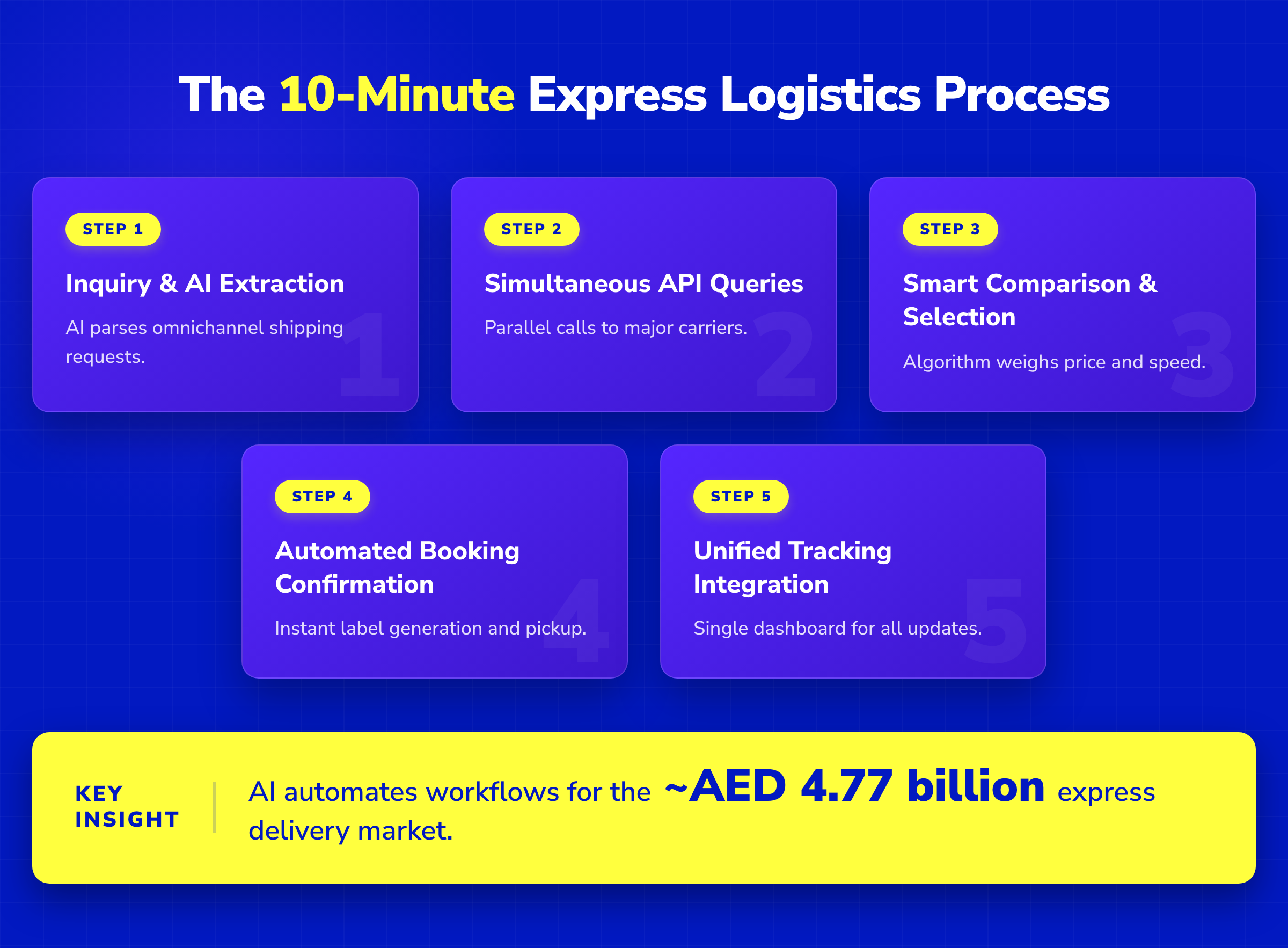
Step 5: Best Carrier Auto-Selection and Quote Generation happens within seconds of receiving all carrier responses. The AI agent selects the optimal carrier based on the weighted criteria and generates a transparent quote that clearly shows all costs, transit times, and service inclusions. Customers can get your real-time quote with full visibility into why a particular carrier was selected.
Step 6: 20-Minute Booking Confirmation follows quote acceptance. The AI agent automatically books with the selected carrier, generates shipping labels, and schedules same-day pickup—all without manual intervention. This speed is critical in Dubai's fast-paced business environment, where Kuehne+Nagel's autonomous Dubai South center exemplifies how AI-driven operations reduce processing time.
Step 7: Unified Tracking Integration completes the process by providing unified real-time tracking regardless of which carrier was selected. Customers receive a single tracking interface that aggregates updates from DHL, FedEx, or UPS, eliminating the need to navigate multiple carrier websites.
Need a shipping quote?
Get AI-optimized rates from DHL, FedEx & UPS — up to 65% below retail. Quote in under 10 minutes.
The Intelligence Behind Carrier Selection: Beyond Just Price
The sophistication of how AI agents handle express logistics: real-time multi-carrier rate comparison in under 10 minutes extends far beyond simple price comparison. AI systems employ a multi-factor decision matrix that evaluates carriers based on cost, transit time, reliability, and destination coverage, enabling optimized selection that aligns with business priorities.
According to Trax Technologies' analysis of UAE's National AI Strategy, AI systems in logistics integrate multiple factors into weighted scoring models. These models draw from freight audit data and normalized shipment metrics common in UAE operations. For urgent express shipments, transit time is often weighted 25-35% higher than cost, reflecting the premium businesses place on speed in time-sensitive deliveries.
The AI's ability to weigh trade-offs between faster, cheaper, and more reliable options represents a quantum leap from traditional decision-making. Algorithms dynamically balance these factors using predictive analytics. For instance, they may recommend a carrier that costs 10-15% more if it reduces transit time by 20% or improves on-time delivery performance from 85% to 95%. This nuanced decision-making mirrors the "why before how" principle from the UAE's National AI Strategy, where logistics managers can validate AI suggestions against operational constraints.
Destination-specific carrier strengths play a crucial role in the selection algorithm. AI agents leverage regional performance data to match carriers to geographic routes:
- DHL excels in Europe, with superior coverage for intra-continental express deliveries and 98% on-time rates on EU lanes
- FedEx dominates Americas routes, handling over 40% of UAE-U.S. volume with integrated air and ground networks
- UPS leads in Asia-Pacific, capturing 35% market share in Pacific routes from Dubai hubs
These geographic preferences stem from each carrier's infrastructure investments and operational focus areas. With the UAE logistics market projected to surpass USD 30 billion by 2026, AI-driven routing that leverages these strengths becomes increasingly critical for competitive advantage.
Service level optimization represents another layer of intelligent decision-making. AI agents automatically adjust between express and economy services based on shipment urgency. For time-sensitive shipments requiring delivery within 48 hours, the system shifts to premium services that may increase costs by 20-30% but reduce transit time by 1-2 days. Conversely, for non-urgent cargo, economy options are selected to achieve 15-25% cost savings without compromising delivery reliability.
The learning component of AI agents continuously improves carrier selection over time. By analyzing historical performance data—including actual versus promised delivery times, damage rates, and customer satisfaction scores—the system refines its selection criteria. This is particularly valuable in the UAE market, where air freight transport grows by approximately 3 million ton-kilometers annually through 2028, creating dynamic conditions that require adaptive decision-making.
Key Account Centre Advantage: Why AI Agents Access Better Rates
Key Account Centre status represents the pinnacle of carrier partnerships in express logistics. According to Globe Newswire's 2025 UAE Logistics Market Outlook, this top-tier status is offered by global carriers like DHL, FedEx, UPS, and Aramex exclusively to high-volume shippers who can guarantee substantial shipping volumes. In the UAE's express logistics sector, these partnerships unlock wholesale rates that are completely inaccessible to standard business customers.
The power of aggregated shipping volumes cannot be understated in securing these preferential rates. When logistics platforms pool shipments from multiple businesses, they achieve the scale necessary to negotiate rates up to 65% below market pricing. This aggregation model leverages the UAE's massive freight market scale—valued at USD 23.05 billion in 2026 with courier, express, and parcel (CEP) revenue growing at 7.52% CAGR through 2031. Dubai's dominance in this sector, handling 64.72% of domestic CEP flows in 2025 through hubs like Jebel Ali Free Zone, creates the volume concentration that carriers value.
The distinction between retail and wholesale Key Account rates is stark. Retail rates represent public list prices charged to individual or low-volume shippers, often inflated by 30-65% to cover carrier margins and operational costs. In contrast, wholesale Key Account rates are deeply discounted contracts reserved for top-10 volume partners based on annual throughput thresholds—typically millions of parcels processed through the UAE's air freight network, which captured 46.62% of market revenue in 2025.
Why can't individual businesses access these rates directly? The answer lies in volume commitments. Carriers prioritize partnerships with entities that can guarantee massive shipping scales—the kind of volume that only comes from aggregating hundreds or thousands of individual shippers. With the UAE logistics market at USD 30 billion in 2023 and growing to USD 40 billion by 2028, carriers reserve their best rates for partners who can deliver consistent, high-volume business. Small and medium enterprises simply cannot meet these thresholds independently.
This is where AI agents democratize access to enterprise-level pricing. By aggregating shipments across their entire client base, AI-powered logistics platforms achieve the volume tiers required for Key Account Centre status. A single platform processing shipments for 500+ active clients and handling 10,000+ monthly shipments can negotiate rates that would be impossible for any individual client to obtain. This collective bargaining power translates directly into cost savings for every business using the platform.
The impact is particularly pronounced in Dubai's competitive logistics landscape. Major infrastructure investments—such as UPS's USD 100 million in Dubai South automation and DHL's USD 570 million regional commitment—are predicated on partnerships with high-volume aggregators. These carriers invest in dedicated facilities, specialized handling equipment, and priority processing lanes for Key Account partners, creating a virtuous cycle where volume drives investment, which in turn enables better service and lower rates.
Industry Applications: Where AI-Powered Express Logistics Delivers Maximum Impact
The transformative power of how AI agents handle express logistics: real-time multi-carrier rate comparison in under 10 minutes manifests differently across industries, each leveraging AI capabilities to solve unique challenges. In the UAE's diverse economy, these applications drive measurable improvements in efficiency, cost, and customer satisfaction.
E-commerce: Managing Peak Season Volumes with Dynamic Carrier Selection
The UAE's e-commerce sector exemplifies the critical need for AI-powered logistics. According to Mordor Intelligence, the courier, express, and parcel segment drives 7.52% CAGR from 2026-2031, fueled by online shopping surges and same-day delivery expectations in Dubai-Abu Dhabi clusters that account for 52% of the population and over 70% of retail sales.
During peak seasons like Ramadan and White Friday, order volumes can spike 300-400% above normal levels. AI agents manage this surge by dynamically selecting carriers based on real-time capacity and performance metrics. UPS's USD 100 million Dubai South investment in March 2025 specifically targeted automation for high-volume omnichannel flows, enabling e-commerce logistics solutions that scale seamlessly. The express delivery market, valued at USD 1.30 billion in 2025 and projected to reach USD 2.58 billion by 2034, depends on this intelligent routing to meet customer expectations.
Healthcare & Pharma: Temperature-Sensitive Shipments with Optimal Carrier Routing
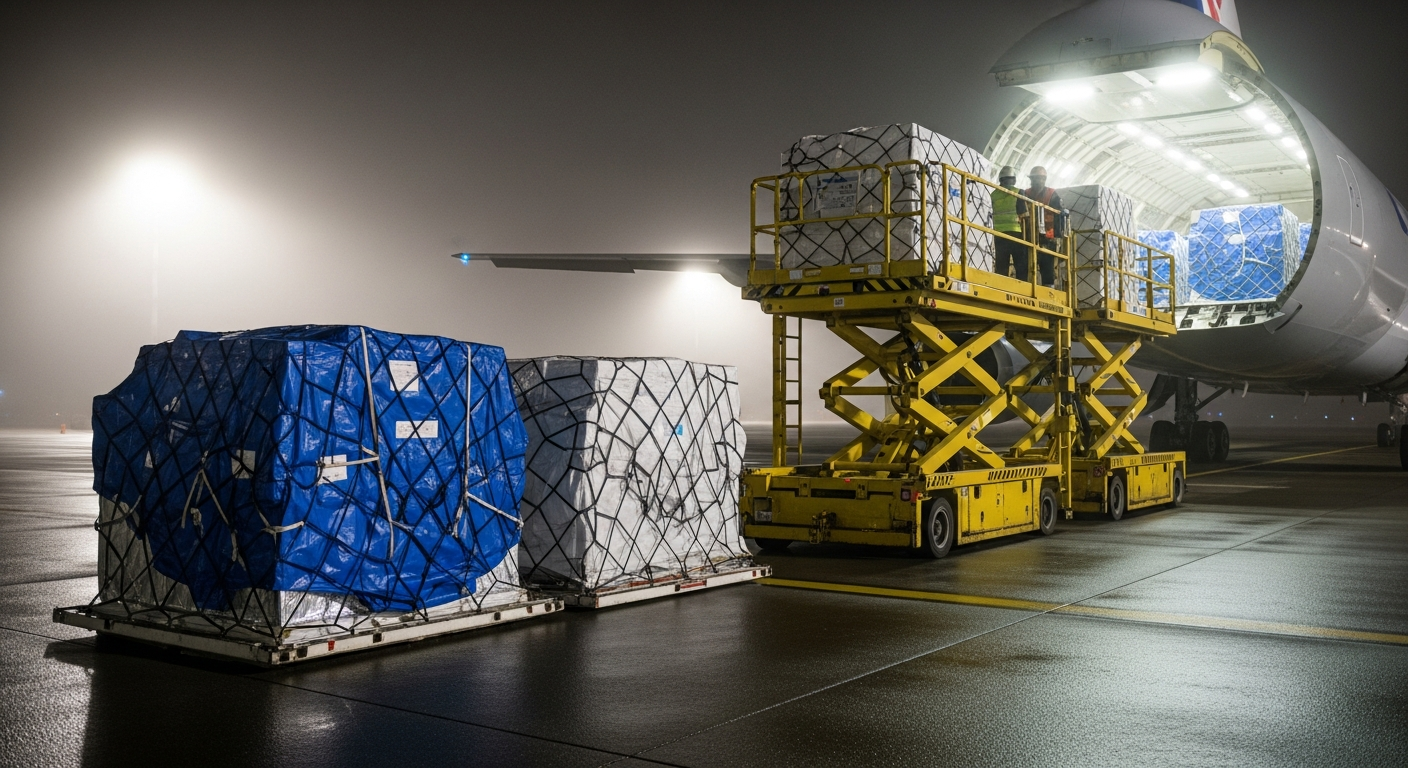
The pharmaceutical industry presents unique logistics challenges that AI agents are uniquely equipped to handle. Air freight, capturing 46.62% of UAE logistics revenue in 2025, supports pharma shipments via specialized cool-chain infrastructure at Dubai International Airport and Emirates SkyCargo's 140-destination network. AI agents evaluate carrier capabilities for temperature control, selecting only those with validated cold chain certifications for sensitive medications.
The stakes are high—a single temperature excursion can render millions of dirhams worth of vaccines or biologics unusable. AI-driven routing leverages Jebel Ali's pharma-certified facilities and real-time temperature monitoring to ensure product integrity. With logistics automation growing at 16.9% CAGR to USD 1,186.8 million by 2033, pharmaceutical companies increasingly rely on AI to navigate complex regulatory requirements while maintaining product quality.
Manufacturing: Just-in-Time Delivery with Predictive Rate Optimization
Manufacturing operations in the UAE depend on precise timing to maintain lean inventory levels. AI-driven predictive analytics enable true just-in-time delivery, supporting a freight logistics market that reached USD 23.05 billion in 2026 with projected growth to USD 31.63 billion by 2031. Sea forwarding, growing at 8.12% CAGR, benefits from AI optimization for factory-to-market movements of electronics and fast fashion.
DP World's USD 2.5 billion investment to achieve 100 million TEU throughput in 2025 creates the infrastructure foundation for AI-optimized manufacturing logistics. Agents analyze production schedules, shipping lanes, and carrier performance to recommend optimal routing that minimizes inventory holding costs while ensuring materials arrive precisely when needed.
Trading Companies: Multi-Destination Shipments with Consolidated Quoting
Dubai's position as a global trading hub, with 45 free zones attracting USD 5 billion in logistics capital in 2024, creates complex multi-destination shipping requirements. Trading companies often need to split shipments across multiple countries while maintaining cost efficiency. AI agents excel at consolidated quoting, evaluating split-shipment options across carriers to find the optimal combination of routes and rates.
Digital platforms provide instant multi-carrier quotes that would traditionally require hours of manual calculation. For re-export operations through Jebel Ali, AI enhances visibility and cost optimization. With the UAE shipping and logistics sector valued at USD 4.14 billion and rising to USD 4.761 billion, trading companies leverage AI to maintain competitive margins in global markets.
Comparing AI-Powered vs Traditional Express Logistics
The contrast between AI-powered and traditional express logistics becomes stark when examining operational metrics. Understanding these differences helps businesses appreciate why how AI agents handle express logistics: real-time multi-carrier rate comparison in under 10 minutes represents such a fundamental advancement in the industry.
Speed Comparison: Minutes vs Hours
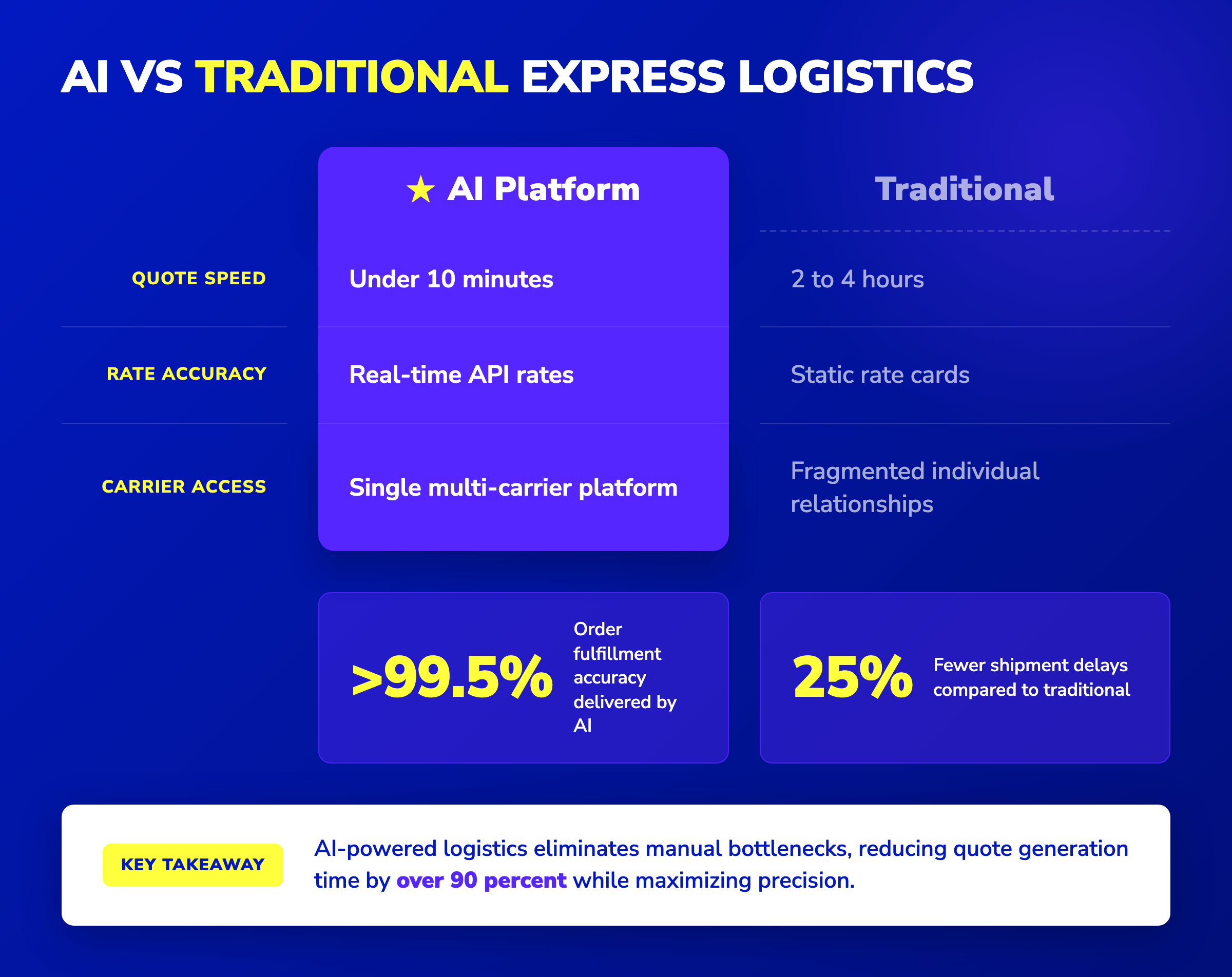
The most immediately visible difference lies in processing speed. According to Technavio's UAE Logistics Market Analysis, AI-powered platforms deliver real-time multi-carrier quotes in under 10 minutes, while traditional methods require 2+ hours for manual comparisons. This 90%+ reduction in quote generation time stems from parallel API processing and automated decision-making.
In Dubai South's autonomous fulfillment centers, advanced robotics enhance order processing speed by 40% over manual methods. Supply chain visibility platforms reduce shipment delays by up to 25%, creating compound benefits that extend beyond initial quoting. When every minute counts in express logistics, these time savings translate directly to competitive advantage.
Accuracy: Real-Time Precision vs Outdated Information
Traditional logistics often relies on static rate cards that become outdated within days as fuel surcharges change and carrier capacity fluctuates. AI systems deliver real-time rates through continuous API connectivity, ensuring every quote reflects current market conditions. Firms using AI report inventory holding cost reductions more than twice as effective compared to traditional forecasting, while achieving order fulfillment accuracy exceeding 99.5%.
The UAE's 2023 regulation mandating AI-driven forecasting tools for all logistics firms recognizes this accuracy advantage. In a market where the CEP segment grows at 7.52% CAGR through 2031, precision in pricing and routing becomes essential for maintaining margins.
Transparency: Full Visibility vs Hidden Costs
AI platforms provide complete cost breakdowns with itemized charges for base rates, fuel surcharges, customs fees, and any additional services. This contrasts sharply with traditional carrier relationships where hidden fees often emerge after shipment completion. Aramex's January 2025 blockchain platform partnership exemplifies the industry's move toward radical transparency, improving freight tracking and data security across UAE supply chains.
Convenience: Unified Interface vs Fragmented Relationships
Perhaps the greatest operational improvement comes from consolidation. AI provides a single point of contact for multi-carrier management, eliminating the need to maintain relationships with multiple carrier representatives. Multimodal transport strategies reduce transit times by up to 15% on key UAE trade lanes, while unified tracking eliminates the frustration of checking multiple carrier websites for updates.
| Aspect | AI-Powered Logistics | Traditional Logistics | Impact in UAE Market |
|---|---|---|---|
| Quote Speed | <10 minutes | 2-4 hours | 40% faster processing, 25% fewer delays |
| Rate Accuracy | Real-time API rates | Static rate cards | 2x cost reduction effectiveness |
| Price Transparency | Full cost breakdown | Hidden fees common | Blockchain-verified pricing |
| Carrier Access | Multi-carrier from one platform | Individual relationships | 15% transit time reduction |
| Tracking | Unified dashboard | Multiple websites | Single interface for all shipments |
The logistics automation market in the UAE, valued at USD 349.4 million in 2025 and growing at 16.9% CAGR to 2033, reflects businesses' recognition of these advantages. As the overall logistics market expands from USD 41.14 billion in 2025, the gap between AI-powered and traditional operations will only widen.
Have a quick question? Get answers instantly on WhatsApp.
Choosing the Right AI-Powered Express Logistics Partner
Selecting an AI-powered express logistics partner requires careful evaluation of capabilities that directly impact your shipping operations. With the UAE express delivery market projected to grow from USD 1.30 billion in 2025 to USD 2.58 billion by 2034, choosing the right partner becomes critical for capturing efficiency gains and cost savings.
Essential Criteria: Key Account Centre Status
The foundation of any effective AI logistics partner is Key Account Centre status with multiple carriers. According to OpenPR's market analysis, partners must demonstrate this status across DHL, FedEx, UPS, and regional carriers like Aramex to enable seamless multi-carrier rate comparisons. This status unlocks wholesale rates up to 65% below retail pricing—savings that directly impact your bottom line.
Look for partners who can document their volume tier status with each carrier. Top 10 volume partner classification indicates the scale necessary to negotiate and maintain preferential rates. With the UAE freight logistics market reaching USD 23.05 billion in 2026, only partners with significant aggregate volume can access and pass along these wholesale rates.
Technology Integration: Beyond Basic Connectivity
API connectivity and real-time processing capabilities separate true AI-powered platforms from basic rate comparison tools. Leading examples include DP World's September 2025 AI-powered Jebel Ali hub, which processes 1 million shipments monthly with 15% faster delivery times, and DHL's May 2025 Dubai cold chain facility achieving 30% faster perishables delivery through AI optimization.
Evaluate potential partners' technology stack for:
- Real-time API integration with all major carriers
- Predictive analytics for route optimization
- Machine learning capabilities that improve over time
- Automated booking and documentation systems
- Unified tracking platforms across all carriers
Geographic Coverage: Global Reach with Local Expertise
Partners must offer coverage exceeding 220 countries while maintaining deep expertise in UAE logistics. Dubai International Airport's position as the top global hub for international tonnage, combined with Jebel Ali Port's 100 million TEU throughput capacity, demands partners who can leverage these assets effectively. Emirates SkyCargo's 140-destination network should be fully accessible through your chosen partner.
Support Infrastructure: Beyond Technology
While AI handles routine operations, robust human support remains essential for complex shipments and relationship management. Look for partners offering dedicated account management and 24/7 customer service. This is particularly critical given the UAE's e-commerce surge, with CEP segments growing at 7.52% CAGR through 2031 and domestic CEP holding 64.72% revenue share.
Compliance and Certifications: Non-Negotiable Standards
Verify essential certifications including:
- ISO 9001:2015 for quality management systems
- AEO (Authorized Economic Operator) status for customs efficiency
- IATA certification for air freight handling
- Local licensing from UAE authorities
These certifications ensure your partner can handle international shipments smoothly while maintaining compliance with evolving regulations.
Red Flags to Avoid
Be wary of providers who:
- Cannot demonstrate actual Key Account status with carriers
- Lack transparent pricing models or hide fees
- Offer limited geographic coverage despite claiming global reach
- Have no physical presence in the UAE despite serving the market
- Cannot provide real-time tracking across all carriers
- Lack proper certifications and compliance documentation
With the UAE logistics market projected to reach USD 95.2 billion by 2033, growing at 5.7% CAGR from 2025-2033, the stakes for choosing the right partner have never been higher. Partners leveraging Dubai's 70%+ retail sales share and free zones like JAFZA for tax-efficient operations will deliver the greatest value as your business scales.
Frequently Asked Questions
What is an AI agent in express logistics?
An AI agent in express logistics is an autonomous software system that uses real-time data, machine learning, and reasoning models to handle shipping operations without constant human intervention. These intelligent systems connect to multiple carrier APIs (DHL, FedEx, UPS), analyze shipping requirements, compare rates across carriers, and make optimal routing decisions in real-time. Unlike traditional logistics software that requires manual input at each step, AI agents work proactively to gather data from Transportation Management Systems, Warehouse Management Systems, and external carrier APIs to deliver instant, accurate shipping solutions. In the UAE's USD 23.05 billion freight logistics market, AI agents have become essential for managing the complexity of international express shipping while reducing processing time from hours to minutes.
How do AI agents compare rates across DHL, FedEx, and UPS simultaneously?
AI agents achieve simultaneous rate comparison through parallel API integration with each carrier's systems. When a shipping request is received, the AI agent extracts key parameters—weight, dimensions, origin, destination, and service level—then fires concurrent API calls to DHL, FedEx, and UPS. Each carrier's API returns real-time pricing that includes base rates, fuel surcharges, and any applicable fees within milliseconds. The AI agent then normalizes these different pricing structures (FedEx's zone-based surcharges, UPS's dimensional weight multipliers, DHL's accessorial fees) into a standardized format for accurate comparison. This entire process, which would take a human operator 2-4 hours of phone calls and spreadsheet work, completes in under 10 minutes. The system also factors in each carrier's performance metrics, transit times, and destination-specific strengths to recommend the optimal choice beyond just price.
What is Key Account Centre status and why does it matter?
Key Account Centre status represents the highest partnership tier offered by global carriers like DHL, FedEx, and UPS to their largest volume shippers. This exclusive status is reserved for partners who ship millions of parcels annually and can guarantee consistent high-volume business. The primary benefit is access to wholesale rates that are typically 40-65% below the retail prices available to standard business customers. In Dubai's competitive logistics market, where the freight sector reached USD 23.05 billion in 2026, Key Account Centre status provides a massive competitive advantage. Only aggregators who combine shipments from hundreds of businesses can achieve the volume thresholds required for this status. Individual businesses, regardless of size, cannot access these rates directly because they lack the aggregate volume that carriers demand for their best pricing tiers.
Can small businesses access the same rates as large enterprises through AI aggregators?
Yes, AI-powered logistics aggregators democratize access to enterprise-level shipping rates for businesses of all sizes. By pooling shipments from hundreds or thousands of clients, these platforms achieve the volume thresholds required for Key Account Centre status with major carriers. A small business shipping 50 packages per month can access the same wholesale rates as a large enterprise because their shipments are aggregated with others on the platform. This collective bargaining power translates to rates up to 65% below retail pricing—savings that would be impossible for small businesses to negotiate independently. In the UAE's growing e-commerce sector, where domestic courier and parcel services hold 64.72% revenue share, this rate democratization enables small businesses to compete effectively with larger competitors while maintaining healthy margins.
How accurate are 10-minute quotes compared to detailed manual quotes?
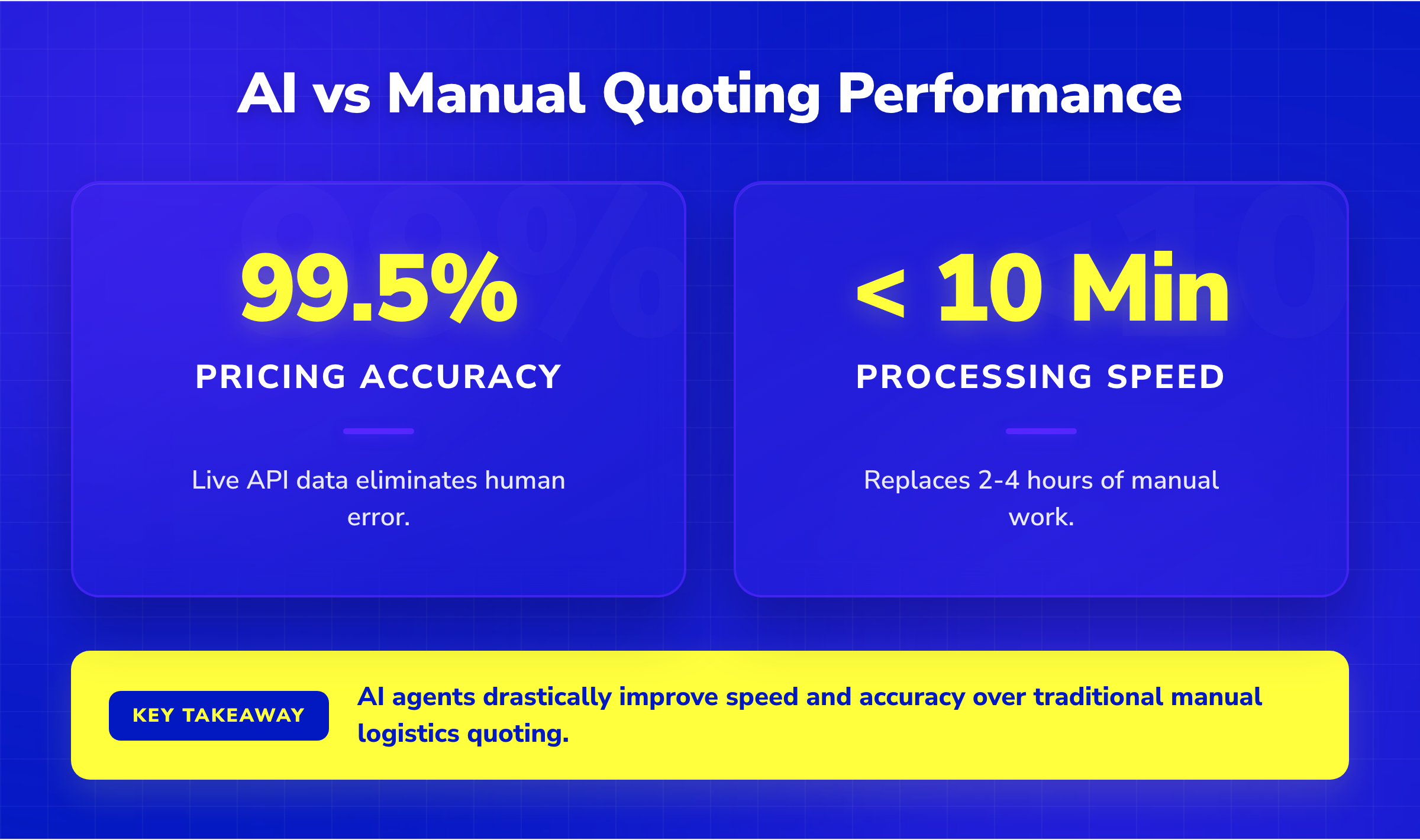
AI-generated 10-minute quotes are actually more accurate than traditional manual quotes due to real-time data access and elimination of human error. While manual quoting relies on static rate cards that quickly become outdated and often miss applicable surcharges, AI agents pull live pricing directly from carrier APIs, ensuring every quote reflects current fuel surcharges, seasonal adjustments, and capacity constraints. Studies show error rates exceed 20% in non-integrated manual systems, while AI-powered platforms achieve over 99.5% accuracy in pricing and fulfillment. The AI also factors in hidden costs that manual quotes often miss, such as residential delivery fees, dimensional weight adjustments, and customs charges. Additionally, because AI agents analyze historical shipping data and carrier performance metrics, they can predict and include potential additional charges that might arise during transit, providing a more comprehensive and reliable quote than traditional methods.
What happens if the AI selects the wrong carrier for my shipment?
AI carrier selection is based on sophisticated algorithms that analyze multiple factors including cost, transit time, reliability scores, and destination-specific performance data, making "wrong" selections extremely rare. However, quality AI-powered logistics platforms include safeguards and flexibility. First, the AI provides transparency in its selection logic, showing why a particular carrier was chosen based on your shipment parameters. Users can review these recommendations and override them if they have specific preferences or requirements the AI hasn't considered. Additionally, leading platforms maintain dedicated account management teams who monitor AI decisions and can intervene if unusual circumstances require human judgment. The AI continuously learns from outcomes, so if a carrier underperforms on a particular route, this data feeds back into the algorithm to improve future selections. Most importantly, unified tracking across all carriers means that regardless of which carrier is selected, you maintain full visibility and control throughout the shipping process.
Sources & References
This article draws on research and data from the following verified sources:
- Mordor Intelligence - UAE Freight & Logistics Market
- Grand View Research - UAE Logistics Automation Market
- Ken Research - GCC AI-Powered Logistics Forecasting Market
- Virtualworkforce.ai - AI agents for last-mile delivery and logistics
- IBM - AI Agents in Supply Chain
- AWS for Industries - Transform Supply Chain Logistics with Agentic AI
- Rapid Innovation - AI Logistics Optimization with Agents (2025)
- Locate2u - What is AI Logistics Agents
- Oracle - AI in Logistics: Potential Benefits and Applications
- ERP Software Blog: Optimize Shipping with FedEx, UPS, DHL Integration
- TwinCore: How to Integrate DHL API into Your Logistics Software
- ShipEngine: Shipping APIs
- Acropolium: Logistics & Shipping APIs Integration Guide 2025
- FedEx Developer Portal
- OSKI Solutions: Best Shipping API Integration Companies in 2026
- DHL API Developer Portal
- The Report Cubes - UAE Express Delivery Market Report and Forecast 2026-2034
- IMARC Group - UAE Logistics Market
- UAE's National AI Strategy - Trax Technologies
- UAE Logistics Market Outlook to 2028 with Aramex, Emirates Post, DHL Express, FedEx and UPS Leading the 30 Billion Industry
- Competenza - AI in Logistics UAE
- Nexdigm - UAE Logistics Market
- Digital Dubai - State of AI Report
- Cognitive Market Research - Middle East Shipping and Logistics
- Data Insights Market - UAE CEP Market Analysis
- OpenPR - UAE Logistics Market Size to Hit USD 95.2 Billion by 2033
- The UAE Courier, Express, and Parcel Market Size & Outlook, 2033
Tags
Related Articles
Ready to optimize your logistics?
Whether you need express shipping, freight forwarding, or warehousing — our AI finds the best rates and routes for your business.