
How to Evaluate Transport & Logistics Companies in Dubai: Selection Criteria for International Shippers
Why Choosing the Right Transport Company in Dubai Matters for Your Business
Dubai's strategic position as a global logistics hub makes selecting the right transport partner critical for international business success. With infrastructure enabling connectivity to over 220 countries through its airports and ports, Dubai serves as a pivotal gateway connecting Europe, Asia, Africa, and beyond. According to KGRN Shipping's analysis, Dubai International Airport handled 2.2 million metric tonnes of cargo in 2024, reflecting 20.5% year-on-year growth and ranking it 11th globally.
The financial impact of choosing the wrong carrier can be devastating for businesses. Cost disparities between retail rates and Key Account rates can reach up to 65%, directly impacting profit margins for shippers in express shipping and freight forwarding. The Nexdigm market report values the UAE logistics market at USD 38.6 billion in 2024, amplifying these stakes amid high-volume operations like DP World's handling of over 70 million containers annually at Jebel Ali.
Service reliability directly affects customer satisfaction and repeat business in this competitive landscape. Dubai's World Bank Logistics Performance Index ranking of 11th in 2023 highlights the need for consistent performance in a sector projected to reach USD 31.4 billion by 2026. Delays or failures in this high-connectivity hub can disrupt supply chains serving emerging markets in EMEA and Asia, eroding trust and competitiveness.
For businesses operating from UAE free zones like Dubai South and Jebel Ali, compliance with regulations becomes paramount. International shippers must prioritize adherence to customs clearance requirements, blockchain-enabled transparency standards, and multimodal transfer regulations. Non-compliance risks supply chain disruptions in a market where digital innovations like AI routing and Etihad Rail integrations set global standards, as noted by Freyt World's industry analysis.
Essential Evaluation Criteria for Dubai Transport Companies
When evaluating transport companies in Dubai, several critical criteria determine which partners can deliver optimal value for international shipping operations. Understanding these factors helps businesses make informed decisions that impact both costs and service quality.
Carrier Partnerships and Volume Status
The most crucial evaluation factor is a transport company's established partnerships with global carriers like DHL, FedEx, and UPS. Specifically, Key Account partnerships unlock significant advantages for high-volume shippers, including discounted rates, priority handling, and dedicated support. According to Mordor Intelligence, the UAE's freight market was valued at USD 21.63 billion in 2025 and is projected to reach USD 23.05 billion in 2026, underscoring the importance of such alliances for scale.
International shippers should verify whether potential partners hold direct contracts or authorized agent status with major carriers. Transport companies in Dubai handling express shipping often leverage these relationships to gain competitive advantages in high-volume freight forwarding. Key Account Centre status, in particular, provides access to rates up to 65% below retail pricing while maintaining the same service quality.
Geographic Coverage and Transit Time Commitments
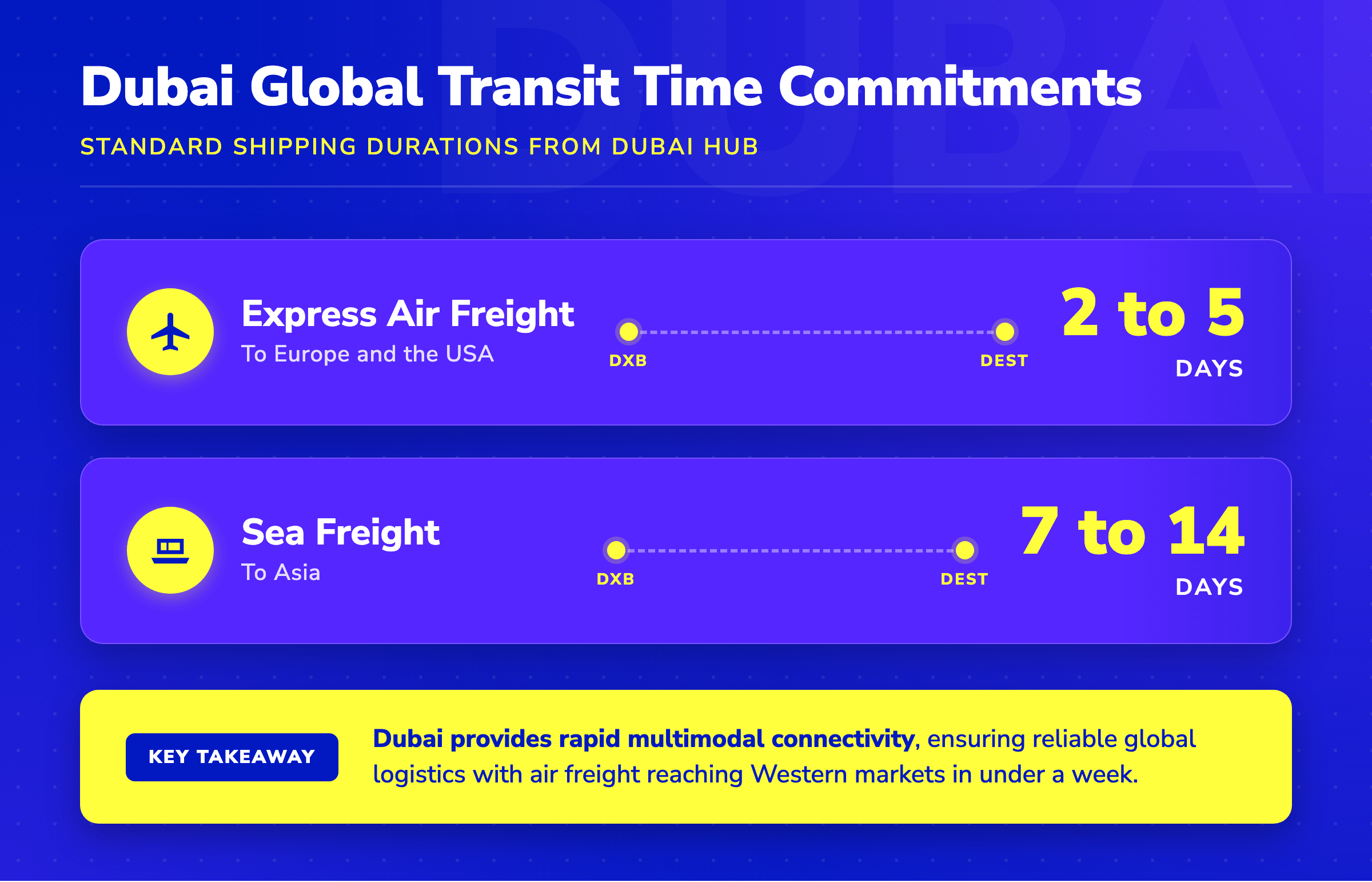
Comprehensive geographic coverage across air, sea, and road networks is essential for international logistics success. Dubai firms need strong connectivity via Jebel Ali Port—one of the world's busiest container terminals handling Full Container Load (FCL), Less than Container Load (LCL), and out-of-gauge cargo for global routes. As reported by Dahla's logistics guide, prioritize providers committing to reliable transit times, such as 2-5 days for express air freight to Europe/USA and 7-14 days for sea freight to Asia.
The UAE industrial logistics market showed strong Q3 2023 demand from e-commerce and automotive sectors, driving the need for robust coverage. Transport companies must demonstrate multimodal coordination capabilities and proven track records in managing GCC cross-border road transport alongside Jebel Ali's global shipping lanes.
Technology Integration Capabilities
Modern logistics demands sophisticated technology integration, including real-time tracking, API connectivity for seamless ERP/WMS integration, and automated quoting platforms. Top Dubai companies leverage AI-powered logistics operations to enhance supply chain visibility and efficiency. Seek providers with digital systems for shipment updates, exception handling, and proactive bottleneck detection.
According to Alma Cargo Dubai, inventory control via tracking systems reduces excess stock costs, while API integration enables seamless data sharing with international shippers. These capabilities have become standard requirements for competitive firms operating in UAE's USD 23+ billion freight market.
Service Portfolio Breadth
Comprehensive service portfolios should cover express logistics solutions, freight forwarding services (air/sea/road), warehousing/distribution, and customs clearance with in-house expertise. Key services include multimodal freight options, 3PL/4PL supply chain management, inventory/pick-and-pack services, and compliance handling for restricted goods under UAE laws.
Verify that potential partners operate Dubai Municipality-approved warehouses (costs range from AED 35,000-100,000) and maintain RTA compliance for comprehensive service delivery. In-house customs handling consistently outperforms outsourcing, proving critical for managing UAE's substantial trade volume via Jebel Ali. Additionally, ESG-focused green logistics solutions, such as route optimization, have gained prominence since 2023.
Industry Certifications and Compliance
Professional certifications validate a transport company's operational standards and regulatory compliance. Essential certifications include ISO 9001:2015 for quality management systems, AEO (Authorized Economic Operator) status for customs facilitation, and IATA licensing for air freight operations. These credentials demonstrate commitment to international best practices and regulatory adherence.
Transport companies in Dubai with these certifications typically maintain higher service standards and face fewer operational disruptions. The Kayrouza and Associates guide emphasizes that certified operators better navigate UAE's complex regulatory environment, ensuring smoother international shipping operations.
Comparing Service Capabilities: Express vs Freight vs Integrated Solutions
Understanding the distinctions between express logistics, freight forwarding, and integrated solutions helps businesses select the most appropriate service model for their specific shipping needs from Dubai.
Express Logistics for Documents and Parcels: Speed vs Cost Analysis
Express services in Dubai prioritize speed for time-sensitive documents and parcels, often achieving 95-98%+ OTIF (On-Time In-Full) rates, though at premium pricing compared to standard freight. According to Svarna Institute's comprehensive comparison, Aramex maintains 95%+ OTIF rates through robust tracking systems, while FedEx achieves 98%+ OTIF in premium express segments through optimized MEA hubs.
DHL delivers 96-98% OTIF in express segments, supported by €80B+ global revenue and digital dashboards for cost transparency. In Dubai's dense urban clusters, same-day delivery promises have become feasible at scale, with UPS investing USD 100M in Dubai South automation (March 2025) to reduce last-mile costs amid rising e-commerce volumes.
Freight Forwarding for Commercial Shipments: Air, Sea, Road Options
Freight forwarding handles bulk commercial shipments via air, sea, and road networks, leveraging Dubai's world-class infrastructure. Jebel Ali Port's throughput exceeded 100 million TEU in January 2025 (up 8.3% year-on-year), while Dubai International Airport maintains its position as a global cargo hub. The Mordor Intelligence report projects the UAE freight market to reach USD 23.05 billion in 2026, growing at 6.55% CAGR.
Leading providers demonstrate distinct strengths across transport modes:

- Air Freight: DHL, FedEx, and Kuehne + Nagel achieve 96-98%+ OTIF rates, excelling in pharmaceutical and aerospace shipments with fast transshipment capabilities
- Sea Freight: DP World and DSV/DB Schenker maintain 99%+ OTIF rates, leveraging Jebel Ali's massive scale for high-volume TEU operations
- Road Freight: Aramex and Emirates Logistics deliver 95%+ OTIF rates, specializing in GCC last-mile delivery and FMCG corridors
Integrated One-Stop Solutions: Combining Express, Freight, and Warehousing
Integrated providers offer comprehensive solutions merging express, freight, and integrated warehousing solutions. The Nexdigm market analysis values the UAE logistics market at USD 41.14 billion in 2025, growing at 8.2% CAGR through 2030.
DP World exemplifies end-to-end integration, managing operations from Jebel Ali Free Zone ports through to final warehousing. Al-Futtaim Logistics spans 1.2M+ m² of warehousing for automotive and cold chain operations with high sector OTIF rates. These integrated approaches reduce handoffs and enhance transparency through blockchain implementations, according to industry reports.
Cross-Trade Capabilities for Multi-Country Supply Chains
Cross-trade services support multi-country supply chains via Dubai's strategic hub position, enabling efficient GCC/Africa/Europe routing with resilient networks. Emirates Logistics excels in GCC-Africa corridors for FMCG and project cargo, while DB Schenker (now part of DSV following a EUR 14.3 billion acquisition in May 2025) covers 33 MEA sites for technology and automotive sectors.
DHL's global scale aids regulatory compliance in pharmaceutical and aerospace cross-trade operations. National throughput gains of 8.3% in 2025 and ongoing Dubai South investments position UAE transport companies for enhanced omnichannel cross-border efficiency.
Technology and Automation: What Modern Shippers Need
Modern shippers evaluating transport and logistics companies in Dubai must prioritize technology and automation capabilities. The Grand View Research report reveals that the UAE logistics automation market reached USD 349.4 million in 2025 and is projected to hit USD 1,186.8 million by 2033, growing at 16.9% CAGR from 2026-2033.
AI-Powered Rate Comparison Across Multiple Carriers
AI technology enables dynamic rate comparisons by analyzing carrier data and optimizing costs for international shippers. In the UAE logistics sector, AI agents have reduced manual work by 40 hours weekly per company, with one Dubai firm achieving 70% error reduction and 60% faster processing in invoice and payment tasks—capabilities extendable to rate benchmarking. According to Beam AI's 2025 analysis, 64% of UAE firms plan increased automation investments, fueling AI adoption for multi-carrier freight optimization in express shipping.
Transport companies in Dubai leveraging AI-powered systems can compare rates across DHL, FedEx, and UPS simultaneously, delivering optimal pricing recommendations within minutes. This capability proves essential for businesses managing complex international shipping requirements across multiple carriers.
Need a shipping quote?
Get AI-optimized rates from DHL, FedEx & UPS — up to 65% below retail. Quote in under 10 minutes.
Real-Time Tracking Integration and Unified Dashboards
Real-time visibility through sensors, IoT devices, and analytics has become standard for leading logistics providers. Unified dashboards consolidate tracking data across carriers, providing international shippers with comprehensive shipment oversight. Grand View Research highlights how Dubai firms deploy these technologies amid rising e-commerce demands, exemplified by Hellmann Worldwide Logistics' May 2025 robotics system deployment at Dubai CommerCity.
The UAE Logistics Strategy 2030 and AED 1.8 billion in smart initiatives drive IoT-integrated dashboard adoption, enhancing port and warehouse oversight in freight forwarding operations. These systems enable real-time goods movement visibility, significantly reducing delays in express shipping operations.

Automated Quoting Systems: 10-Minute Quote Capability
Automation delivers quotes in under 10 minutes through AI-driven platforms, accelerating international bidding processes. While specific benchmarks tie to advanced TMS/WMS software in UAE's hardware portfolio (representing 74.73% market share), Aramex's January 2025 Jeddah facility demonstrates these capabilities at scale—handling 96,000 shipments daily with 120 robotic vehicles.
The services segment grows fastest at 16.9% CAGR, supporting rapid quoting integration for shippers. Dubai's automation push optimizes for short delivery windows, enabling sub-10-minute quotes in competitive freight markets. Transport companies offering get real-time quotes capabilities provide significant competitive advantages.
API Integration for Seamless Workflow Integration
APIs ensure ERP, TMS, and carrier systems interconnect for end-to-end international workflows. UAE firms integrate robotics with legacy systems via services (the fastest-growing segment), as demonstrated in Hellmann's CommerCity deployment. The Research and Markets report indicates that smart logistics investments under UAE Logistics Strategy 2030 promote API-driven digital transformation, with port automation growing at 18% CAGR (2023-2028) in Dubai/Abu Dhabi.
These API integrations facilitate seamless sea-air freight connections and enable real-time synchronization across supply chain partners. Inventory management automation with AI tracking further embeds APIs for comprehensive visibility and control.
Digital Documentation and Customs Clearance Automation
Advanced transport companies in Dubai implement digital documentation systems that streamline customs clearance processes. Automated document processing reduces errors, accelerates clearance times, and ensures compliance with UAE regulations. These systems integrate with government portals for seamless submission and tracking of customs declarations.
The combination of these technological capabilities positions Dubai providers as leaders in the global logistics landscape, backed by USD 5 billion in smart logistics and port automation investments as of 2023, alongside substantial government technology allocations supporting continued innovation.
How the Evaluation Process Works: From RFQ to Partner Selection
Selecting the right transport company in Dubai requires a systematic evaluation process that ensures alignment with your business needs and international shipping requirements.
Step 1: Define Shipping Requirements and Volume Projections
The foundation of selecting a transport partner begins with clearly articulating your logistics needs. According to Dahla's practical guide, businesses must assess cargo type—whether general goods, high-value items, regulated materials, or oversized freight—along with required transport modes (air, sea, road, or multimodal combinations).
Critical factors include shipment frequency, volume projections, destination markets, and delivery timeline sensitivity for each shipment category. Industry experience demonstrates that cargo-specific expertise significantly outweighs provider size. A mid-sized company with deep specialization in your cargo category will have developed superior customs contacts, regulatory knowledge, and problem-solving processes compared to larger generalist providers.
For businesses operating through Dubai's major infrastructure hubs, understanding port and airport capabilities is essential. Jebel Ali Port ranks as the world's 9th largest container terminal and handles the bulk of UAE trade volume, while Al Maktoum International Airport is designed for 12 million tons of annual cargo capacity.
Step 2: Request Quotes from Multiple Transport Companies
When issuing Requests for Quote (RFQs), evaluate providers across standardized criteria. Customs expertise deserves particular weight during the evaluation phase—specifically whether customs clearance is managed in-house or outsourced to external agents. In-house handling typically delivers faster problem resolution and clearer accountability lines.
Key operational questions to include in RFQs address fleet management and vehicle maintenance protocols, route disruption handling procedures, cross-border documentation management capabilities, and permit handling for restricted goods and GCC trade regulation compliance. According to Quiqup's industry analysis, pricing models vary significantly by service type and shipper profile.
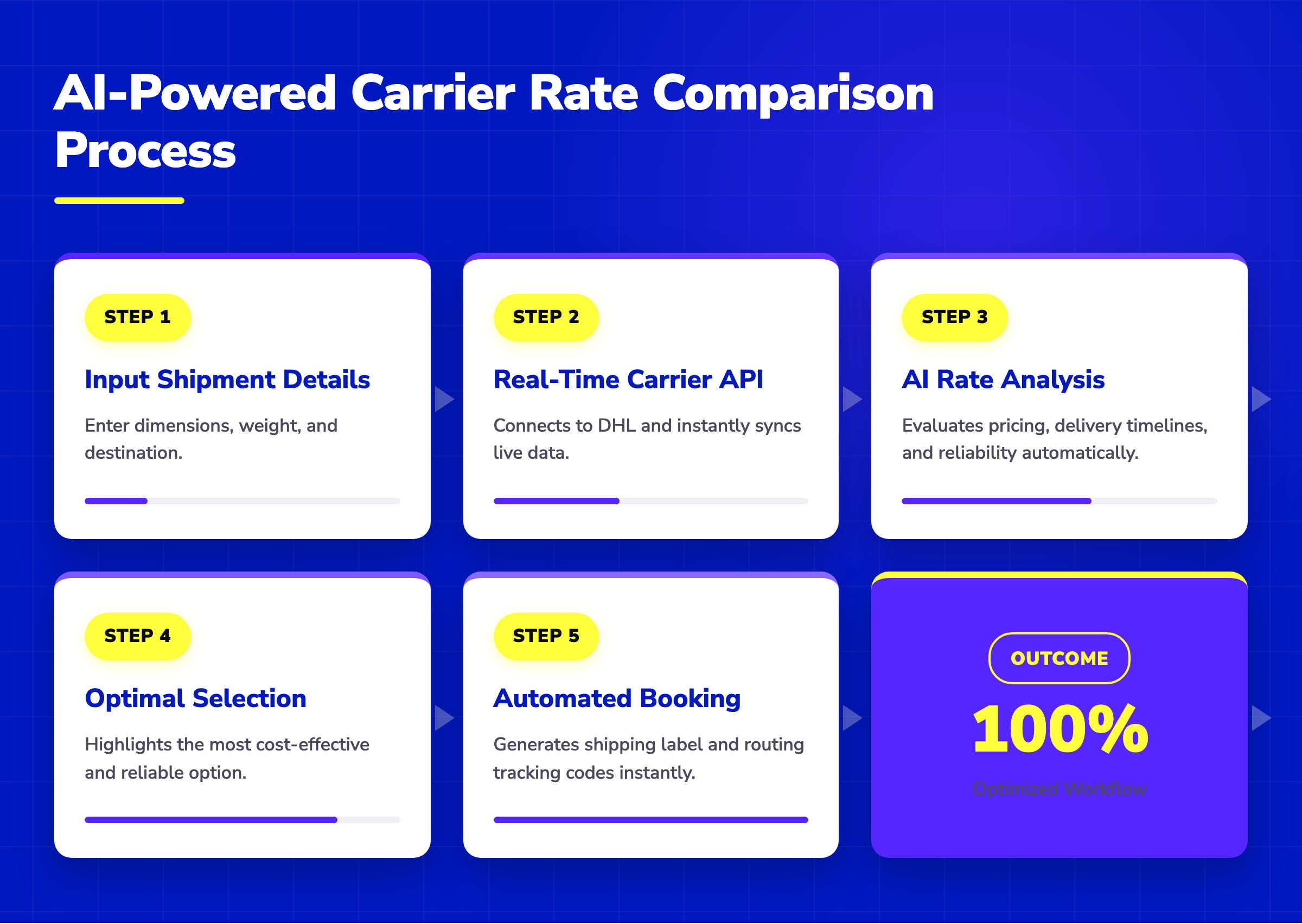
Step 3: AI Systems Compare DHL, FedEx, UPS Rates Simultaneously
Modern transport companies in Dubai employ AI-powered systems to compare rates across major carriers instantaneously. These systems analyze real-time pricing from DHL, FedEx, and UPS, considering factors such as service levels, transit times, dimensional weight calculations, and applicable surcharges.
DHL operates a global logistics network spanning 220+ countries with advanced infrastructure suited for businesses requiring international reach. However, customer satisfaction varies—DHL's Trustpilot rating stands at 1.2/5 from 21,000+ reviews, though customers highlight professionalism of specific delivery agents when shipments proceed smoothly.
For effective rate comparison, businesses should request quotes specifying service level options (express, standard, economy), transit time guarantees, dimensional weight pricing structures, fuel surcharges and accessorial fees, and volume discount tiers available through Key Account partnerships.
Step 4: Evaluate Service Levels, Transit Times, and Technology Integration
Service level evaluation should prioritize reliability over attractive pricing promises, as unreliable transport significantly increases overall project costs. According to BVM Transport's analysis, businesses increasingly weight reliability higher than cost when comparing transport providers.
Technology integration capabilities now represent a core selection criterion. Top-tier providers offer real-time shipment tracking and visibility, e-commerce platform integrations, API connectivity for automated workflows, mobile applications with delivery confirmation, and estimation tools with comprehensive tracking dashboards.
Step 5: Test Booking Process and Customer Support Responsiveness
Before committing to a transport partner, test their booking process and customer support systems. Submit a test shipment request to evaluate response times, system usability, and support quality. Leading providers should demonstrate 10-minute quote capabilities and 20-minute booking processes with minimal workflow disruption.
Assess customer support availability across time zones, especially critical for international shipping operations. Evaluate their problem resolution processes and escalation procedures for handling shipment issues or delays.
Step 6: Review Contract Terms and Key Account Rate Access
Carefully review contract terms, focusing on rate structures, volume commitments, and Key Account benefits. Transport companies with established Key Account Centre status can offer rates up to 65% below retail pricing, but these benefits often require minimum volume commitments.
Examine service level agreements (SLAs) for performance guarantees, liability limits, and dispute resolution procedures. Ensure contracts include provisions for rate reviews and adjustments based on changing market conditions.
Step 7: Implement Unified Tracking and Reporting Systems
The final step involves implementing unified tracking and reporting systems that integrate with your existing operations. Modern transport companies in Dubai should provide comprehensive dashboards that consolidate shipment data across all carriers and service types.
These systems should offer customizable reporting capabilities, automated alerts for shipment milestones or exceptions, and integration with your internal systems via APIs. The evaluation process ultimately prioritizes operational capability, genuine customs expertise, transparent pricing, and consistent communication as factors with the longest-term implications for costs, delivery performance, and customer satisfaction.
Red Flags to Avoid When Selecting Transport Partners
When evaluating transport companies in Dubai, several warning signs should prompt immediate caution and deeper investigation of potential partners.
Static Rate Cards Without Real-Time Pricing
Transport providers relying on outdated, static pricing models fail to reflect the volatile cost environment affecting the UAE logistics sector. According to Nexdigm's market research, fuel costs constitute approximately 30% of total operational expenses for logistics companies, and these fluctuate significantly based on global oil prices.
The Mordor Intelligence report notes that fuel price swings lifted trucking outlays by up to 20% in 2024, demonstrating the inadequacy of fixed-rate structures. Current geopolitical disruptions underscore this vulnerability further, with shipping lines implementing multiple emergency surcharges—including Emergency Conflict Surcharge (ECS), War Risk Surcharge (WRS), and Emergency Fuel Surcharge (EFS)—that vary by carrier and route.
Limited Carrier Options or Single-Carrier Dependency
Reliance on a single carrier or limited carrier network creates dangerous vulnerability in the current operating environment. According to Metro Global's supply chain analysis, a total of 124 liner services include at least one Arabian Gulf port in their scheduled rotations, representing 520 container vessels and 3.6 million TEU of deployed capacity.
Recent events illustrate this risk acutely. The Scan Global Logistics security update reports that all ocean carriers have suspended shipping through the Strait of Hormuz, with MSC suspending all bookings for worldwide cargo to the Middle East until further notice. Partners without diversified carrier relationships cannot pivot when primary routing options close.
Lack of Technology Integration or Manual Processes
Manual, non-integrated logistics operations create operational friction that compounds during supply chain disruptions. The UAE logistics market is experiencing increased lead times and notable imbalances between supply and demand. Geopolitical instability and port congestion have increased average lead times by nearly 20% in some sectors.
Technology integration becomes essential for managing this complexity. Kuehne + Nagel launched a fully autonomous fulfillment center in Dubai South in August 2024, leveraging advanced robotics to enhance order processing speed and accuracy. UPS committed USD 100 million for Dubai South investment in March 2025 to automate last-mile sorting. Partners relying on manual processes cannot match the visibility, speed, and accuracy that modern supply chains demand.

Have a quick question? Get answers instantly on WhatsApp.
No Volume Discount Access or Key Account Partnerships
Transport partners without established volume discount structures or Key Account relationships with major carriers cannot deliver cost efficiency at scale. Rising fuel, labor, and warehouse rental expenses have collectively pushed operational costs up by approximately 10% year-over-year, squeezing margins for service providers.
Partners without volume leverage cannot absorb these cost pressures and will pass them directly to shippers. Conversely, integrated providers like DP World, whose USD 2.5 billion program pushed national throughput capacity past 100 million TEU in January 2025 (an 8.3% jump over 2024 volumes), can leverage scale to negotiate better terms.
Poor Tracking Visibility or Delayed Status Updates
Transport companies offering limited tracking visibility or experiencing frequent delays in status updates pose significant risks for international shippers. Modern logistics demands real-time visibility across the entire supply chain, from pickup through final delivery. Partners unable to provide comprehensive tracking capabilities leave shippers blind to potential issues until they become critical problems.
Hidden Fees and Non-Transparent Pricing Structures
Beware of transport companies in Dubai that present attractive base rates but layer on numerous hidden fees. Common hidden charges include documentation fees, fuel surcharges not clearly defined, handling fees for specific cargo types, peak season surcharges without advance notice, and administrative fees for basic services. Transparent partners provide comprehensive rate cards that clearly outline all potential charges upfront.
Frequently Asked Questions About Dubai Transport Companies
What is Key Account Centre status and how does it benefit shippers?
Key Account Centre status represents a volume partnership tier offered by major global carriers like DHL, FedEx, and UPS to high-volume shippers and their logistics partners. This status provides access to significantly discounted rates—typically 30-65% below standard retail pricing—along with priority handling during peak seasons, dedicated account management teams, and enhanced service level agreements. For businesses shipping internationally from Dubai, working with a transport company that holds Key Account Centre status across multiple carriers ensures access to these preferential rates without needing to meet individual carrier volume requirements independently. The status also typically includes benefits such as extended credit terms, customized billing solutions, and priority customer service access during shipment issues.
How do AI-powered logistics systems compare rates across carriers?
AI-powered logistics systems utilize machine learning algorithms to analyze real-time pricing data from multiple carriers simultaneously, considering factors such as shipment dimensions, weight, destination, service level requirements, and current market conditions. These systems access carrier APIs to pull live rates from DHL, FedEx, UPS, and other providers, then apply predictive analytics to identify optimal routing options based on cost, transit time, and reliability metrics. The AI continuously learns from historical shipping data to improve recommendations, factoring in seasonal variations, carrier performance patterns, and route-specific considerations. Modern systems can generate comprehensive rate comparisons across 10+ carriers within seconds, presenting options ranked by total landed cost including all surcharges, customs duties, and handling fees.
What's the difference between express logistics and freight forwarding?
Express logistics refers to time-critical shipments typically delivered within 1-5 business days, focusing on documents, parcels, and smaller packages under 70kg per piece. Express services prioritize speed and reliability, offering door-to-door delivery with comprehensive tracking and guaranteed transit times. Freight forwarding, conversely, handles larger commercial shipments via air, sea, or road transport, typically for cargo exceeding 100kg or requiring palletization. Freight forwarding involves more complex logistics coordination including customs brokerage, cargo consolidation, multimodal transport arrangements, and often takes 7-30 days depending on the route and mode. While express logistics suits urgent, smaller shipments with premium pricing, freight forwarding offers cost-effective solutions for bulk commercial cargo with longer lead times.
How quickly can I get quotes from Dubai transport companies?
Leading transport companies in Dubai equipped with AI-powered quoting systems can provide comprehensive rate quotes within 10 minutes for standard shipments. This rapid turnaround is achieved through automated systems that instantly access pre-negotiated carrier rates, calculate dimensional weight pricing, apply relevant surcharges, and factor in customs duties for international destinations. For complex shipments requiring special handling, dangerous goods certification, or project cargo coordination, quotes may take 2-4 hours as they require manual review by specialists. Traditional logistics providers without automated systems typically require 24-48 hours for quote generation, as they must manually contact individual carriers and compile pricing. Companies with Key Account partnerships and integrated technology platforms consistently deliver the fastest quote turnaround times.
What certifications should I look for in a logistics partner?
Essential certifications for Dubai logistics partners include ISO 9001:2015 for quality management systems, demonstrating standardized processes and continuous improvement protocols. AEO (Authorized Economic Operator) certification indicates trusted trader status with customs authorities, enabling faster clearance and reduced inspections. IATA (International Air Transport Association) accreditation is crucial for air freight operations, ensuring compliance with dangerous goods handling and aviation security requirements. Additional valuable certifications include ISO 14001 for environmental management, TAPA (Transported Asset Protection Association) for high-value cargo security, GDP (Good Distribution Practice) for pharmaceutical logistics, and OHSAS 18001/ISO 45001 for occupational health and safety. Free zone-specific licenses from JAFZA, DAFZA, or DMCC indicate authorized operations within these key trade zones.
What's the minimum volume requirement for accessing Key Account rates?
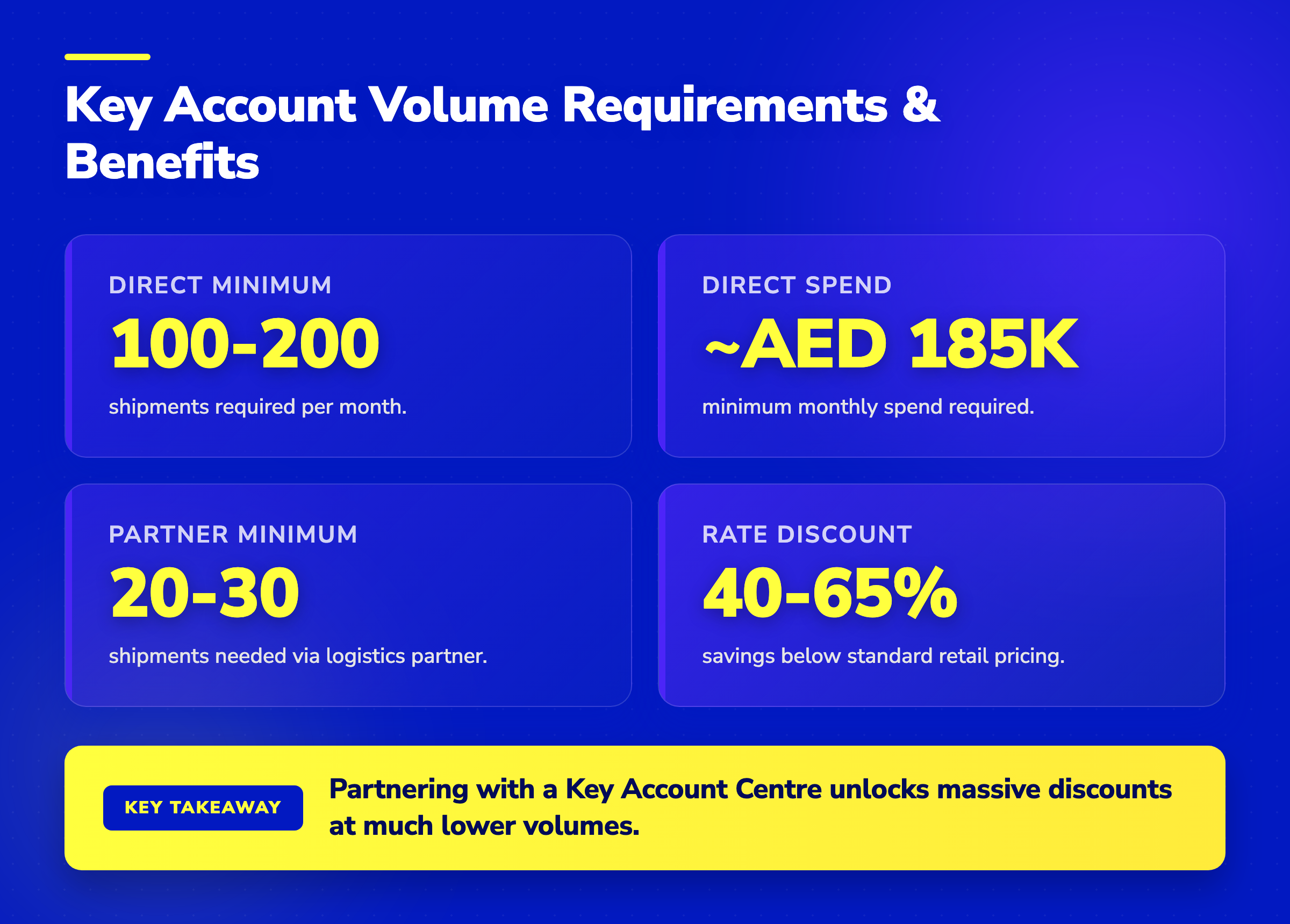
Minimum volume requirements for Key Account rates vary by carrier and service type, but typically start at 100-200 shipments per month or USD 50,000-100,000 in monthly shipping spend for direct carrier agreements. However, businesses can access these preferential rates without meeting individual carrier minimums by partnering with logistics companies that have achieved Key Account Centre status through aggregated volumes. These partners combine shipments from multiple clients to maintain Top 10 volume partner status across carriers, passing on rate benefits to smaller shippers. For example, a company shipping only 20-30 parcels monthly can still access rates 40-65% below retail when working with a Key Account Centre partner. The key is selecting a transport company in Dubai with established high-volume partnerships across multiple carriers, ensuring rate benefits regardless of your individual shipping volume.
Sources & References
This article draws on research and data from the following verified sources:
- How Dubai Dominates as A Top Global Logistics Hub With Its Warehouse Services
- Dubai's Logistics Revolution: Pioneering the Next Era of Global Trade
- UAE Logistics: Power, Progress, and the New Global Standard
- GCC Logistics Hub: Dubai vs. Riyadh vs. Doha; Where Should You Really Invest?
- UAE Logistics and Warehousing Market Outlook to 2030 - Nexdigm
- Empowering Logistics with Advanced Infrastructure in the Region (Grant Thornton PDF)
- Trends Transforming Logistics and Supply Chains In the MENA Region in 2023
- How to Choose Right Logistics Company in Dubai
- How to Choose the Right Logistics Company in UAE | Practical 2026 Guide
- Logistics Company Setup Dubai 2026: Complete Guide
- How to Evaluate a Logistics Partner's Safety and Compliance Record
- Dubai and Abu Dhabi Industrial Markets Review - Q3 2023
- Transport and Logistics Industry Management in the UAE
- UAE Freight & Logistics Market Share & Size 2031 Outlook
- Top 10 Logistics Companies in Dubai, Complete 2026 Comparison
- Logistics Market in the UAE 2026-2030 - Research and Markets
- Middle East Logistics Automation Market Size Report, 2033
- AI Agents UAE Reduce Manual Work in 2026 - Beam AI
- UAE Port Automation Market Research Report: Forecast (2023-2028)
- Quiqup - Best Logistics Companies in UAE (2026) | Top 10 Ranked
- BVM Transport - Comparing Transport Companies in Dubai: Price vs. Reliability (2026)
- Middle East: Disruption ripples through global supply chains
- Middle East Security Situation: Immediate impact on the global transportation and logistics industry
- UAE Express Delivery Market Report and Forecast 2026-2034
- UAE Logistics Market Size is Expected to Reach USD 95.2 Billion
- United Arab Emirates (UAE) CEP Market Analysis 2026
- Middle East Third-Party Logistics Market Size, Forecasts 2035
- The UAE Courier, Express, and Parcel Market Size & Outlook, 2033
- Middle East Shipping and Logistics Market Analysis 2026
Tags
Related Articles
Ready to optimize your logistics?
Whether you need express shipping, freight forwarding, or warehousing — our AI finds the best rates and routes for your business.