
Express quotations depend on each packed piece’s weight, longest side and length plus girth. Surcharge thresholds and absolute acceptance limits are different: paying an additional charge does not guarantee that a carrier will accept an oversized piece.
This guide explains measurement and the handling thresholds described in Infinity’s published UAE account terms. Carrier, service and account rules can change; confirm the current limits and charge basis in your written quote before dispatch.
How to measure: length, girth and volumetric weight
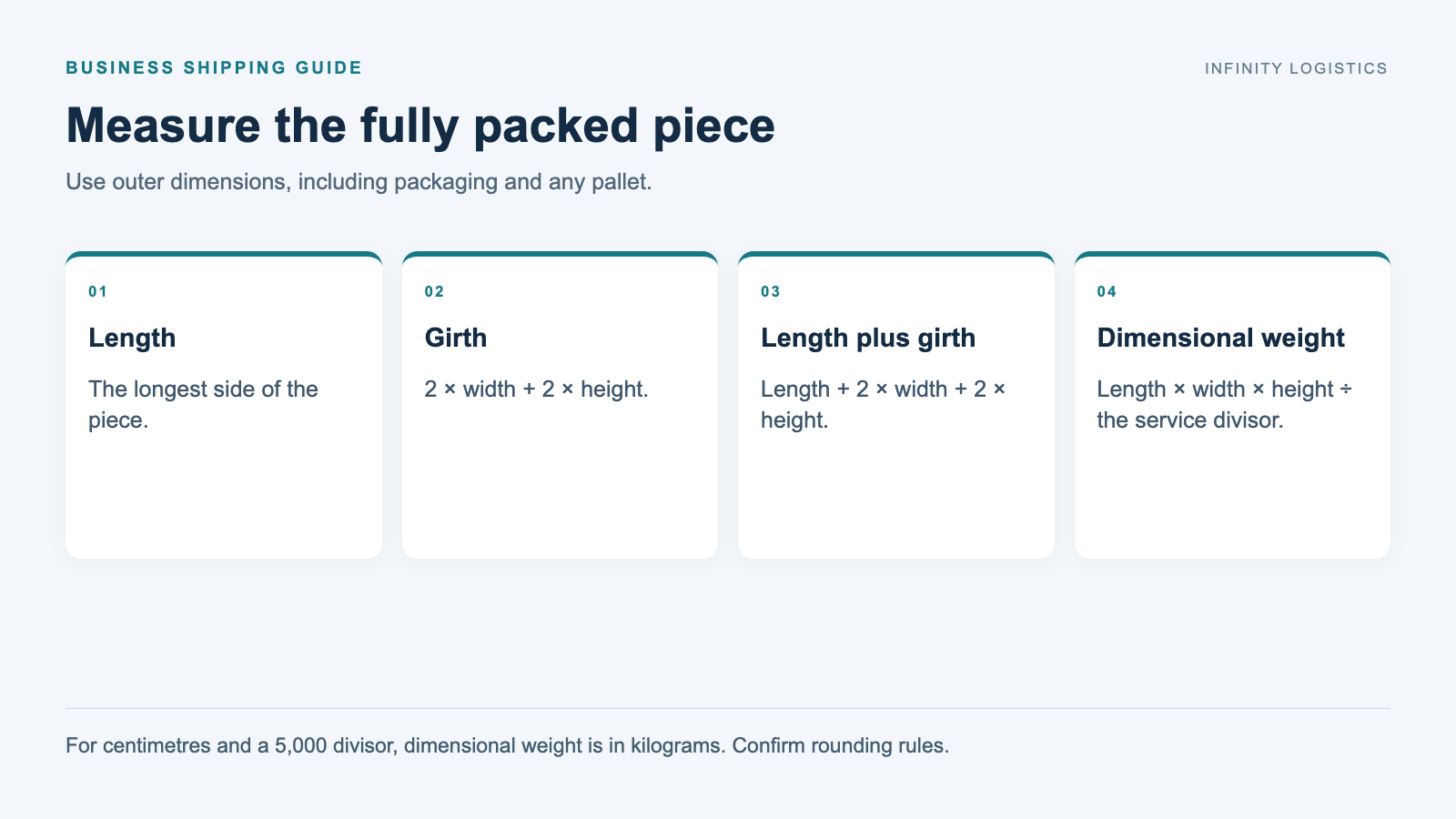
Before you can compare carrier limits, you must measure your shipment correctly. Carriers use three key metrics: length, girth, and volumetric weight. All measurements must be taken after the item is fully packed and sealed.
Length and Girth
The dimensions of your package determine whether it can move through automated sorting systems or if it requires special handling.
- Length: Always the longest side of the packed carton or pallet.
- Girth: The distance around the package's two shorter sides (2 x width + 2 x height). Carriers often add the length to it: Infinity's UPS terms measure girth as length + (2 x width) + (2 x height). Check which version a threshold uses, because it decides whether a large-package or oversize charge applies.
Volumetric Weight
Volumetric weight reflects the space a package occupies. A common international express divisor is 5,000, while 6,000 is common for general air freight. Use the divisor and rounding rules on the selected service’s quote.
Volumetric Weight (kg) = (Length x Width x Height in cm) / 5,000
This is the express divisor. Standard air freight uses a divisor of 6,000 instead. If your package is light but bulky, its volumetric weight will likely be higher than its actual weight, and that is what you will be billed on. Work it out before you book with our chargeable weight calculator.
DHL Express thresholds
Infinity is the #2 DHL partner in the UAE. DHL has specific triggers for overweight, oversize, and non-conveyable pieces, each handled and charged separately.
Overweight and Oversize Pieces
Infinity's DHL terms for express from the UAE set these triggers:
- Overweight Piece: Any single piece, including a pallet, with a scale or volumetric weight over 70 kg.
- Oversize Piece: Any single piece, including a pallet, with any one dimension longer than 120 cm.
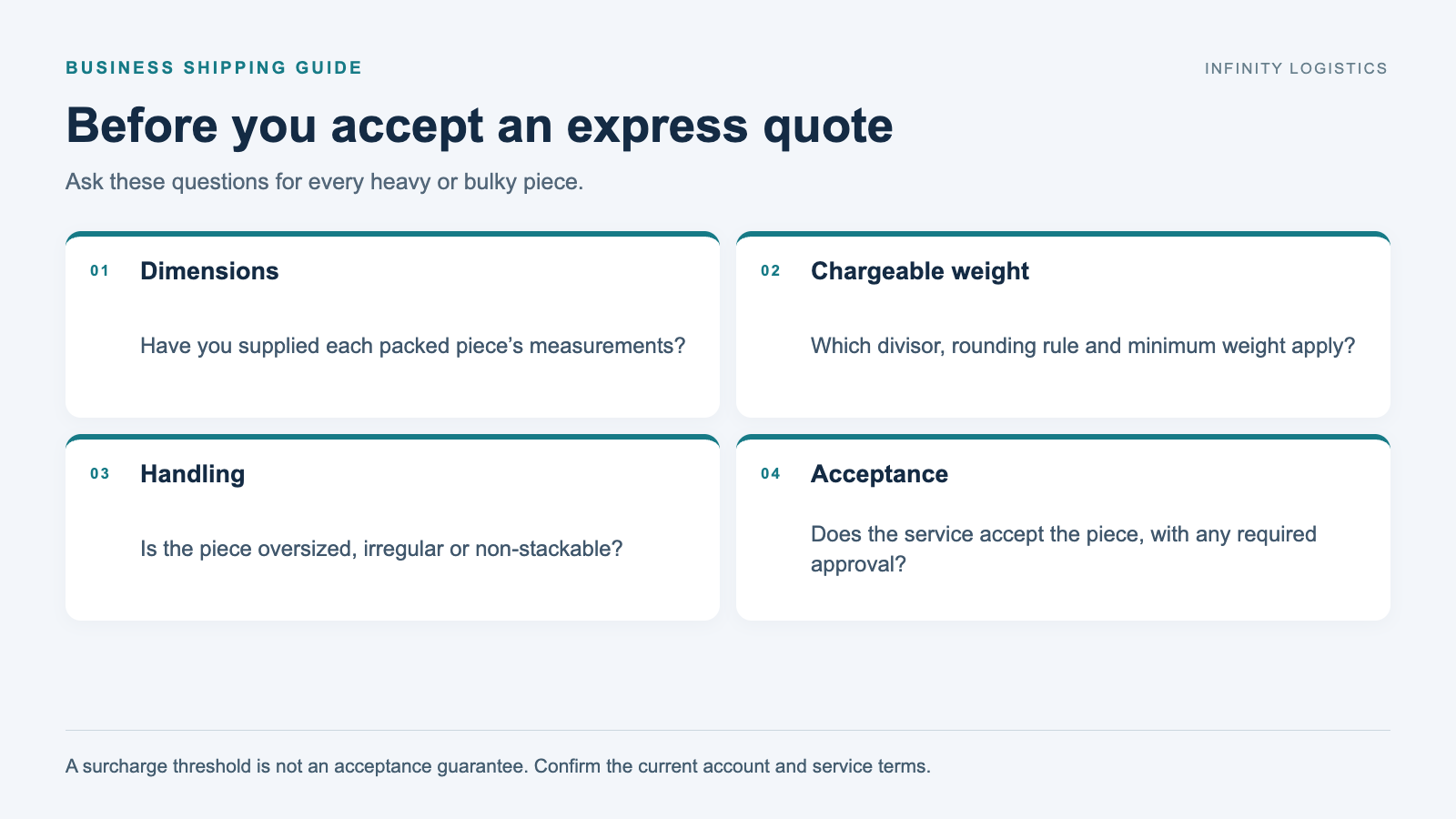
An overweight surcharge is a pricing threshold, not the maximum accepted piece weight. Ask Infinity to confirm the selected DHL service’s hard limits and any approval needed for a heavy or oversized piece.
Non-Conveyable and Irregular Pieces
A piece doesn't have to be huge to attract surcharges. If it can't run on automated conveyor belts, it's considered non-conveyable.
- In Infinity's DHL terms, any piece with an actual weight between 25 kg and 70 kg counts as non-conveyable.
- An irregular piece is an item within 120 x 80 x 80 cm and 30 kg that is unusually shaped, unstable, or packed in a way that could get caught in or damage other packages or the sorting system. Examples include cylindrical items, packages in wooden or metal outer containers, and shrink-wrapped items not in a carton.
FedEx thresholds
FedEx applies extra charges to packages that need manual handling. The triggers relate to length, the second-longest side, and length plus girth.
Additional Handling Surcharge
Infinity's FedEx terms for express from the UAE apply an Additional Handling charge if a package meets any of these criteria:
- Longest side is greater than 121 cm.
- Second-longest side is greater than 76 cm.
- Length plus girth (L + 2W + 2H) is greater than 243 cm.
These thresholds separate standard, conveyable parcels from those that need manual handling.
Oversize and Freight-Level Pieces
When a package goes well past the standard dimensions, further charges apply.
- Over 330 cm: Packages exceeding 330 cm in girth are billed at a minimum chargeable weight of 71 kg, on top of the charges above.
- Freight Handling Units: An over-maximum-dimensions freight charge applies to any freight handling unit longer than 157 cm on its longest side.
UPS thresholds
UPS separates standard packages, "Large Packages" and packages over its maximum dimensions. These are the thresholds Infinity's UPS terms publish for express from the UAE.
Additional Handling Charge
For UPS, the weight trigger for extra handling is simple: any package with an actual weight over 30 kg attracts an Additional Handling charge.
Large Package Surcharge
A package is classified as a "Large Package" if its length plus girth (L + 2W + 2H) is over 300 cm but not more than 400 cm. Large packages attract a large package charge and are billed at a minimum of 40 kg each.
Over Maximum Limits
An over-maximum-dimensions charge applies, on top of the large package charge, to packages that exceed either of these limits:
- Length greater than 274 cm.
- Length plus girth greater than 400 cm.
DHL, FedEx, and UPS side by side
To simplify your decision-making, here is a direct comparison of the key triggers for additional charges across the three major carriers. These are the thresholds that turn a standard parcel into an oversize, overweight, or freight-level shipment.
| Carrier | Weight Trigger (Surcharge/Freight) | Length Trigger (Surcharge/Freight) | Girth Trigger (Surcharge/Freight) |
|---|---|---|---|
| DHL Express | > 70 kg (Overweight) > 25 kg (Non-Conveyable) |
> 120 cm (Oversize) | Based on L x W x H (120x80x80 cm standard) |
| FedEx | Min. 71 kg billed if over 330 cm girth | > 121 cm (Additional Handling) > 157 cm (freight handling unit) |
> 243 cm (Additional Handling) > 330 cm (min. 71 kg billed) |
| UPS | > 30 kg (Additional Handling) | > 274 cm (Over Maximum) | > 300 cm (Large Package) > 400 cm (Over Maximum) |
Need a shipping quote?
Get AI-optimized rates from DHL, FedEx & UPS — up to 65% below retail. Quote in under 10 minutes.
Irregular and non-stackable pieces
Beyond simple size and weight, the shape and stability of your shipment can also lead to extra charges. These pieces disrupt the highly automated sorting processes at express hubs.
What Makes a Piece Irregular?
An irregular piece is one that cannot be handled by standard machinery. This includes:
These items often incur an additional handling or DHL irregular piece charge because they require manual sorting.
Pallets That Cannot Be Stacked
If a pallet cannot safely take another pallet on top of it, carriers treat it as non-stackable and charge it differently, because it wastes space in a truck or aircraft. What counts as non-stackable, and how to avoid it, is set out on our non-stackable pallets page.
Packing tips to stay under the thresholds
The best way to control costs is to avoid surcharges altogether. Smart packing is your first line of defense against unexpected fees related to express package size and weight limits.
Split Heavy Shipments
A single 100 kg piece is overweight for DHL (over 70 kg). Splitting it into smaller pieces avoids that trigger, but pieces over 25 kg can still count as non-conveyable with DHL, and pieces over 30 kg attract UPS's Additional Handling charge. Ask for the quote both ways.
Fit the Box to the Goods
Using a box that is too large not only increases your volumetric weight but also pushes you closer to oversize dimension limits. Choose a sturdy, double-walled carton that leaves just enough room for adequate cushioning. This minimizes your L x W x H and, consequently, your chargeable weight.
Keep It Square and Stable
Carriers want regular, box-shaped pieces. Avoid bulges, protrusions, and loose strapping. Odd-shaped items are worth asking about before you pack: a corrugated carton can keep a piece conveyable, while wooden or metal outer containers can count as irregular pieces with DHL.
Provide Exact Dimensions When Booking
Send exact dimensions and weights for every piece when you ask for a quote. Carriers re-measure, and if a piece turns out bigger or heavier than declared, the charges change. Accurate figures up front mean no surprises on the invoice.
How Infinity quotes oversize and heavy pieces
The best carrier for a heavy or bulky piece depends on its dimensions and destination, so it pays to compare.
Comparative Quoting at Key Account Rates
Infinity Logistics holds Key Account status with DHL, FedEx, and UPS at the same time, with business express rates up to 65% below retail. Our AI agents compare all three in real time, so you can see which network suits a heavy or bulky piece.
Send Dimensions With Your Request
Send the dimensions and weight of each piece with your request, so the quote for worldwide express from the UAE can account for oversize, overweight or non-conveyable pieces before you book.
Quotes in Under 10 Minutes
Our AI agents compare DHL, FedEx, and UPS in real time, so most enquiries get a quote in under 10 minutes.
Check your cartons before you book, then get a quote from Infinity.
Frequently Asked Questions
What is the maximum weight for a DHL express piece?
Infinity’s published DHL terms identify pieces above 70 kg actual or volumetric weight as overweight. This is a surcharge trigger. The maximum accepted weight depends on the service and any required approval, so confirm it before booking.
What is girth in shipping?
Girth is the distance around a package's two shorter sides: 2 x width + 2 x height. Carriers often add the length to it and compare the total with their limit. Infinity's UPS terms call that total (length + 2 x width + 2 x height) the girth, so check which version a threshold uses.
What is a non-conveyable piece?
A non-conveyable piece cannot run on a carrier's automated sorting belts and needs manual handling. That can be because of its weight (for DHL, pieces between 25 kg and 70 kg), its shape (cylindrical, unstable or irregular) or its packaging (wooden or metal containers, or shrink-wrap instead of a carton). These pieces usually attract a handling charge.
Why was my package charged as a large package?
Your package was likely charged as a "Large Package" because it exceeded a specific size threshold, most commonly the carrier's limit for length plus girth. For example, UPS applies a Large Package Surcharge if a shipment's length plus girth is over 300 cm. When this happens, the package is also billed at a minimum chargeable weight (e.g., 40 kg for UPS), even if its actual weight is much lower.
Is volumetric weight the same for DHL, FedEx, and UPS?
A divisor of 5,000 is commonly used for international express by these carriers, but service and account rules should be checked. With dimensions in centimetres, multiply length × width × height and divide by the applicable divisor; compare the result with actual weight.
Sources & References
Official and industry sources referenced in this guide:
- Shipping Dimensions and Weight | UPS - United Arab Emirates
- 2025 UPS® Tariff Guide
- FedEx Surcharge Announcement 2025 - FedEx Developer
- SERVICE GUIDE
- Dimensional Weight Calculator - FedEx
- [PDF] 2026 UPS® Rate and Service Guide
- About Weight
- FedEx Express Rates
- Parcel Weight, Size & Packaging | FAQs
- [PDF] 2024 UPS® Rate & Service Guide Daily Rates
- UPS Worldwide Express Freight® Services
Tags
Related Articles
Ready to optimize your logistics?
Whether you need express shipping, freight forwarding, or warehousing — our AI finds the best rates and routes for your business.