
Complete Guide to Customs Clearance & Trade Compliance in UAE
Understanding Customs Clearance in the UAE: Your Gateway to Global Trade
Customs clearance in the UAE is the official process of obtaining approval from authorities to import, export, or re-export goods through ports and airports, ensuring compliance with regulations, documentation, duties, and inspections to facilitate seamless international trade. It serves as a critical gateway for UAE's global trade hub status, protecting the economy by controlling prohibited items, verifying safety standards, and enabling efficient logistics across Dubai's bustling ports and airports.
The UAE's strategic position at the crossroads of Europe, Asia, and Africa has transformed it into a global logistics powerhouse. According to Mordor Intelligence, the UAE freight and logistics market is projected to reach USD 31.63 billion by 2031, growing at a 6.55% CAGR. This growth is underpinned by sophisticated customs clearance services that streamline international trade operations.
UAE Customs Authority Structure and Digital Transformation
The Federal Customs Authority (FCA) oversees national customs enforcement, smuggling prevention, and policy alignment with GCC Common Customs Law. The FCA collaborates with emirate-level bodies like Dubai Customs for local operations, creating a unified yet flexible system that supports both mainland and free zone trade.
Digital transformation has revolutionized UAE customs operations. Dubai's Mirsal2 platform enables online submission of declarations, bills of lading, certificates of origin, invoices, and packing lists, dramatically reducing paperwork and supporting faster duty calculations. The transition to 12-digit HS codes in UAE/GCC by 2025 further enhances digital accuracy in tariff classification, as reported by TFI World.
Key Statistics: UAE Trade Volumes and Clearance Processing Times
The scale of UAE's trade operations is impressive. Dubai Customs processed 22 million declarations in 2023, handling goods worth AED 820 billion according to the Dubai Customs AlFurdah Q1 Magazine. Pre-registered Customs Codes enable quicker turnaround, often achieving same-day clearance for compliant shipments via digital systems.
The efficiency of UAE customs is particularly evident in its 45 Free Trade Zones (FTZs), which exempt goods from duties on imports and re-exports outside GCC, significantly boosting re-export efficiency and supporting Dubai's position as a global logistics hub.
Free Zones vs Mainland Customs Procedures
Understanding the distinction between mainland and free zone customs procedures is crucial for businesses operating in the UAE:
- Mainland Procedures: Subject to 5% GCC Common Customs Law tariffs plus VAT on imports for local sale or re-export to GCC. Full documentation, inspections, and duty payments are required via FCA/Dubai Customs systems.
- Free Zone Procedures: Duty-exempt for imports and re-exports to non-GCC markets. Simplified clearance process with no import duties or taxes for storage and re-export, though a Customs Code is still required.
This dual system allows businesses to optimize their supply chains based on their target markets, with mainland procedures ideal for domestic sales and free zones perfect for international trade and re-exports.
Essential Documentation for UAE Customs Clearance
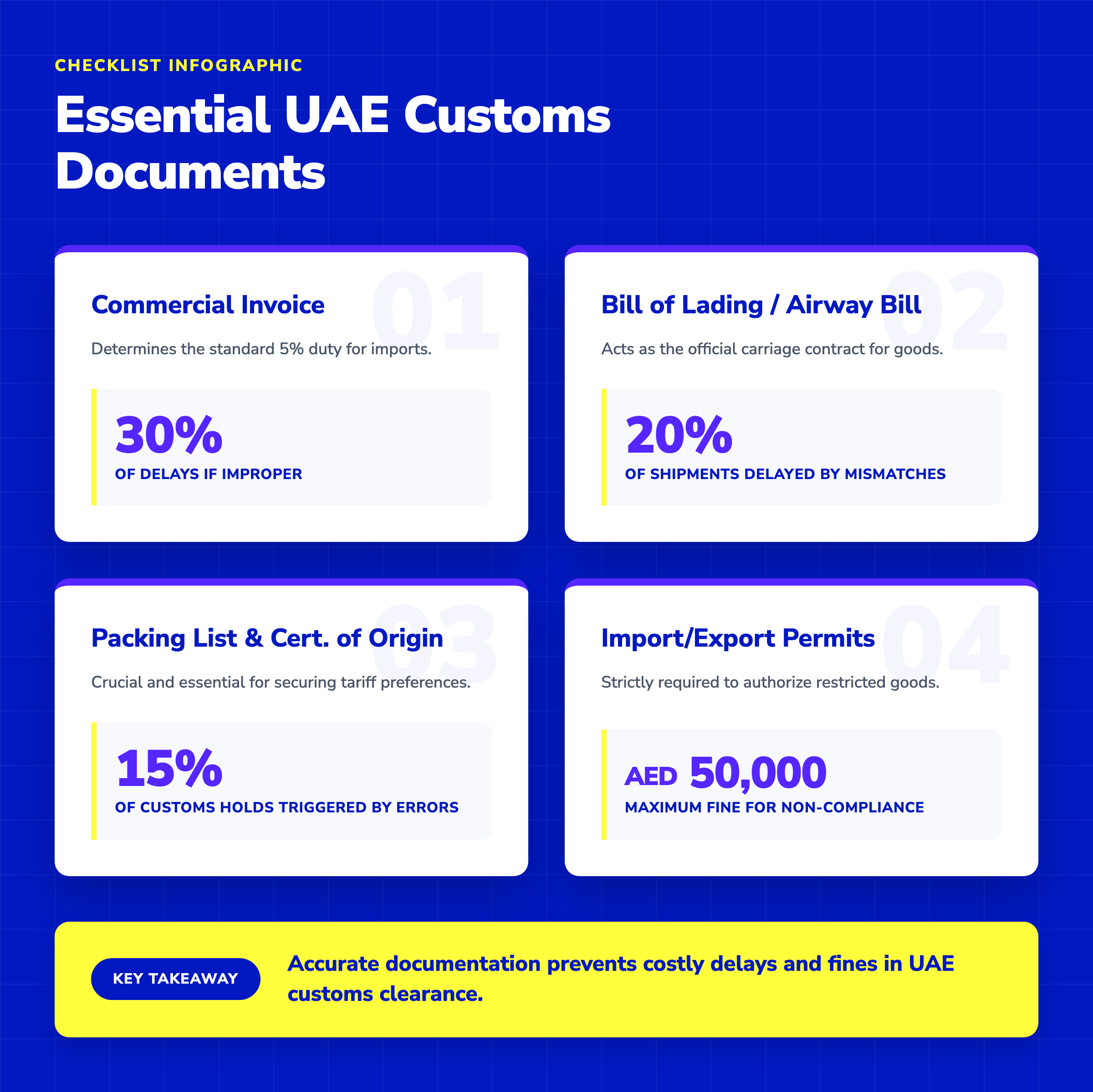
Proper documentation is the foundation of smooth customs clearance in the UAE. According to Interlink Gulf, improper invoices cause 30% of delays in express shipping through logistics hubs like Jebel Ali Port, which handled 15.3 million TEUs in 2023.
Commercial Invoice Requirements and Valuation Rules
The commercial invoice is the cornerstone document for customs documentation requirements. It must include comprehensive details: seller and buyer information (full name, address, contact), invoice number, issue date, goods description (including unit price, weight, quantity), total value with currency, Incoterms (e.g., CIF, FOB), shipping method and date, country of origin, payment terms, and exporter's signature.
This document forms the basis for customs valuation under UAE's Harmonized System (HS) codes, determining duties—typically 5% on CIF value for most goods as of 2023-2025, with exemptions for GCC-origin items under trade agreements. Records must be archived for 5 years per Customs Notice No. (04/2023), as noted by Premier Brains.
Bill of Lading/Airway Bill Specifications
The Bill of Lading (BOL) for sea freight acts as a contract of carriage, receipt for goods, and document of title. For air freight services, the Airway Bill (AWB) confirms carrier receipt and carriage conditions. These documents must specify consignor/consignee details, goods description, shipping details, and terms.
According to FedEx, these are core requirements for UAE clearance, especially critical in Dubai's international logistics where air cargo via DXB airport reached 1.4 million tonnes in 2023, up 12% year-over-year. Documents must align with invoice and packing list details to avoid inspections that delay 20% of shipments in UAE freight forwarding.
Packing List and Certificate of Origin Essentials
The packing list provides crucial shipment details: number of packages, dimensions, weights, and product descriptions. This document aids inspections and duty calculations, ensuring customs officers can verify shipment contents efficiently.
The Certificate of Origin (COO), issued by chambers of commerce, certifies origin for tariff preferences under UAE's 100+ Free Trade Agreements (FTAs) by 2025. According to Locad, COO and packing list mismatches trigger 15% of holds at Dubai customs in the UAE e-commerce logistics sector, projected to be an $8 billion market by 2026.
Import/Export Permits and Restricted Goods Documentation
A valid import/export license from the Department of Economic Development (DED) is mandatory for trade. Restricted goods—including food, electronics, and pharmaceuticals—require permits from competent agencies, plus HS code classification, customs declaration, and specific certificates like health or Halal certificates for food products.
Dubai's 2024 data shows permits are vital for 40% of restricted imports via freight forwarders, with non-compliance fines reaching up to AED 50,000. In Dubai/UAE's logistics industry, valued at $20 billion in 2023 and growing 7% annually to 2026, digital submission via Mirsal2 cuts clearance to 1-2 hours for 85% of express logistics services, emphasizing the importance of pre-checks by brokers.
Digital Documentation Trends and E-clearance Systems
The shift to digital documentation has transformed customs clearance efficiency. The Mirsal2 system's integration with other government portals enables seamless data sharing, reducing redundancy and errors. This digital ecosystem supports the UAE's vision of becoming a paperless trade environment, with electronic certificates of origin, digital signatures, and blockchain-verified documents becoming increasingly common.
UAE Duty Calculations and Tariff Classifications
Understanding duty calculations and tariff classifications is essential for accurate cost planning and compliance in international trade. The UAE's adoption of advanced classification systems reflects its commitment to trade facilitation and transparency.
HS Code Classification System in UAE
The UAE employs the Harmonized System (HS) code, a global standard where the first 6 digits classify goods internationally, followed by additional digits for regional and national specificity. As reported by Kuehne + Nagel, as of August 1, 2025, Dubai Customs and the GCC adopted a 12-digit HS code system, expanding from the prior 8-digit format. This nearly doubles tariff codes from 7,809 to over 13,450 for finer product distinctions.
The structure breaks down as follows: first 6 digits (international HS), next 2 (GCC extensions), and final 4 (UAE-specific). Implementation is phased—Phase 1 (August 2025–January 2026) allows parallel use for GCC shipments, with full mandatory use beginning February 2026, extending to free zones, imports, and re-exports by 2027.
Duty Rates Structure and Calculation Methods
UAE customs duties are calculated using the GCC Common Customs Tariff, applied ad valorem on CIF (Cost, Insurance, Freight) value of imports. According to the Federal Authority for Identity, rates typically range from 0-5% based on HS classification via the Central Customs Tariff System.
The 12-digit expansion enhances precision for duty assessment, directly impacting freight forwarders in Dubai by standardizing valuations across 13,450+ codes. For businesses engaged in express shipping, declaring full tariff codes on manifests is crucial for automated clearance and avoiding costly delays.
VAT Implications for Imported Goods (5% Standard Rate)
Imported goods in UAE attract 5% VAT on the CIF value plus any customs duties, calculated post-duty and remitted via the Federal Tax Authority. This applies universally unless zero-rated for certain exports. In Dubai logistics, VAT adds approximately 5% to landed costs for most freight, with HS codes determining if duties precede VAT.
For example, a 5% duty item incurs VAT on CIF plus duty, inflating totals by up to 10% combined. The Abu Dhabi Customs Foreign Trade Indicators 2023-2024 shows VAT compliance is vital for over 80% of non-oil imports processed via HS-classified shipments.
Duty Exemptions and Preferential Trade Agreements
The UAE offers extensive duty exemptions to facilitate trade. GCC-origin goods enjoy 0% duty under the Common Tariff, while free zone transfers, personal effects, and specific HS categories like essentials are also exempt. The country has signed over 170 preferential trade agreements (PTAs) as of 2025, providing 0-5% reduced rates for partners including India, EU, US, and China.
The Comprehensive Economic Partnership Agreement (CEPA) with India, implemented in 2022, cut duties on over 90% of goods, boosting Dubai imports by 20% in electronics and textiles according to 2023 statistics. GCC-wide alignment via 12-digit HS ensures seamless PTA claims in freight forwarding, with tools verifying eligibility to avoid penalties.
Common Classification Errors and How to Avoid Them
Misclassification can result in significant penalties and delays. Common errors include using outdated HS codes, misinterpreting product descriptions, and failing to account for material composition or end-use. To avoid these issues, businesses should utilize Dubai Customs' AI-powered Al Munasiq platform, which predicts HS codes accurately and details duties, restrictions, and clearance requirements for express shipping and imports.
How Customs Clearance Works: The Complete Process
The UAE customs clearance process is a streamlined, digital workflow that exemplifies the country's commitment to trade facilitation. According to Golden Topaz, Dubai Customs processed over 18 million import declarations in 2023, with an average clearance time of 1-2 hours for low-risk shipments.
Step 1: Pre-Arrival Documentation Submission via Mirsal2 System
The customs clearance journey begins before goods even arrive in the UAE. Importers or freight forwarders submit key documents electronically via the Mirsal2 system or integrated portals like dubaitrade.ae. Required documents include commercial invoice, packing list, bill of lading/airway bill, certificate of origin, HS codes, and import permits.
Accurate pre-clearance filing via Mirsal2 triggers automated HS code validation and initial risk profiling. According to industry data, incomplete submissions cause 70% of delays in Dubai's express shipping sector, where 15 million pre-arrival declarations are processed annually. Businesses must hold a Customs Importer/Exporter Code, linked to a valid trade license and VAT TRN, for system access.
Step 2: Goods Arrival and Inspection Scheduling
Upon arrival at Dubai ports like Jebel Ali or airports like DXB, cargo is scanned into Mirsal2, triggering automated risk assessment. The 7 Seas Matrix UAE Customs Guide notes that low-risk shipments—comprising 85% of total volume—bypass physical checks via the green channel.
In 2025, UAE ports handled 16.5 million TEUs in container traffic, with express couriers like DHL and FedEx clearing 2.8 million air shipments monthly. AI-driven scheduling has reduced wait times by 40%, demonstrating how technology enhances efficiency in sea freight clearance and air cargo operations.
Step 3: Duty Assessment and Payment Processing
Mirsal2 automatically calculates duties (0-5% on CIF value, averaging 4.95% in 2023), VAT (5%), and fees based on HS classification, origin, and applicable exemptions. Payments occur online via CDR account, credit card, or debit, ensuring swift processing.
The UAE collected AED 12.4 billion in customs duties in 2024 from over 20 million transactions, with 95% of freight forwarding payments processed digitally in under 30 minutes. This efficiency boosts Dubai's trade compliance reputation and supports its position as a global logistics hub.
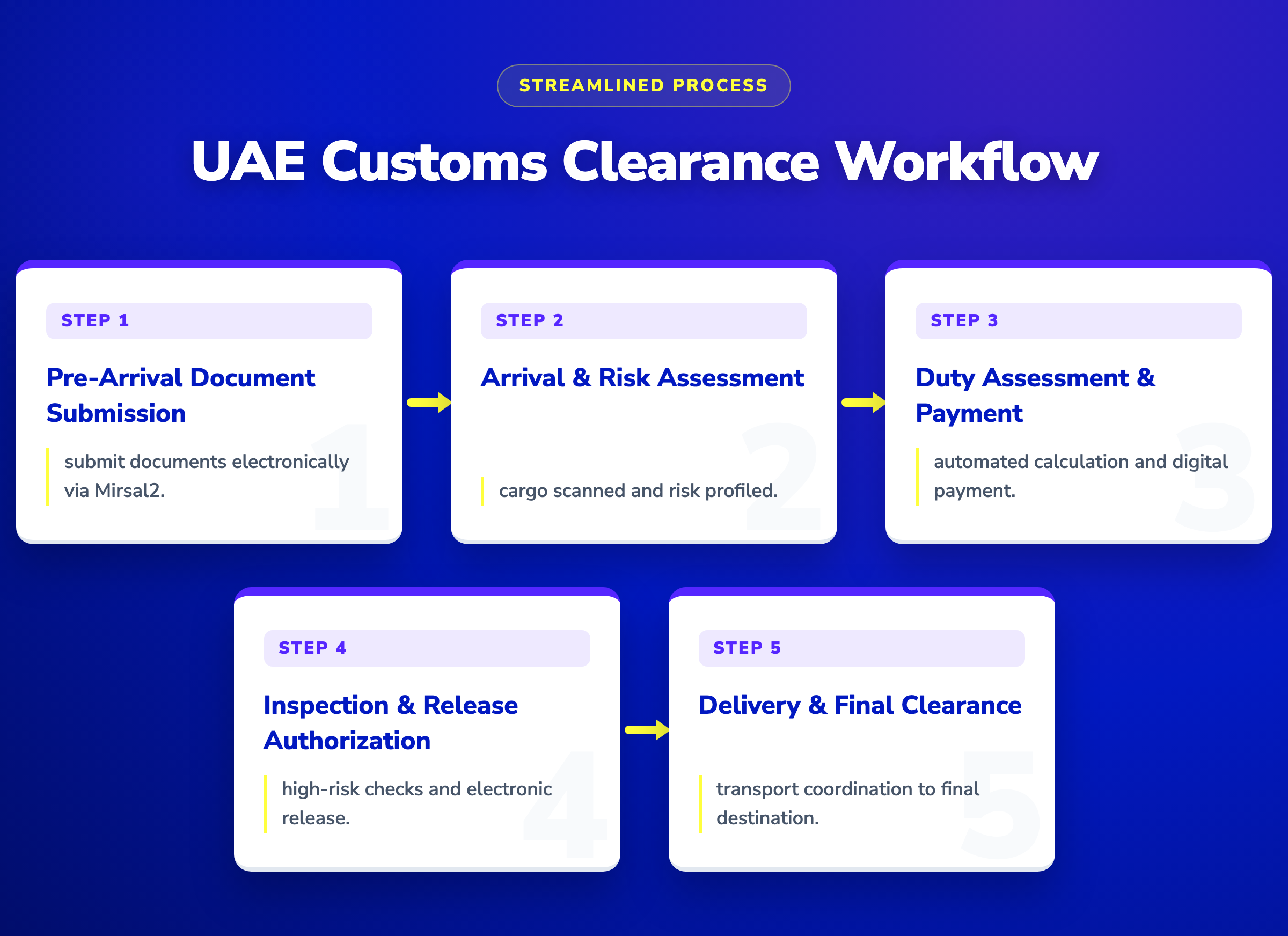
Step 4: Physical Examination (When Required) and Release Authorization
High-risk cargo, representing 15% of arrivals, undergoes document verification, X-ray scanning, or physical inspection. Seals are broken only under supervision to maintain cargo integrity. According to TFI World, 2023 statistics show a 98% release rate within 24 hours for inspected goods in Dubai's logistics sector.
Once compliant, clearance is granted via electronic release order, enabling gate pass issuance and cargo pickup. For free zone transits, facilities like JAFZA issue 'Free Zone Transit In' permits. Partnering with experienced Dubai customs agents cuts re-inspection rates by 50% in international freight operations.
Step 5: Delivery Coordination and Final Clearance
The final step involves coordinating delivery from the port or airport to the final destination. This may include arranging transportation, managing bonded warehouse facilities for temporary storage, and ensuring all documentation is complete for final delivery. The integration of customs clearance with logistics services ensures seamless movement of goods from port to door.
Infinity's AEO-certified clearance process leverages these digital systems to achieve 24-hour turnaround times for most shipments, combining customs expertise with integrated logistics capabilities to minimize delays and optimize supply chain efficiency.
Authorized Economic Operator (AEO) Certification Benefits
Authorized Economic Operator (AEO) certification in the UAE represents a gold standard for trusted trade partners, offering unprecedented advantages in customs clearance efficiency and international trade facilitation. According to the World Customs Organization, UAE AEO enjoys mutual recognition agreements covering 35% of UAE trade volume.
What is AEO Certification and Eligibility Requirements
AEO status designates reliable economic operators with robust compliance, financial stability, and security measures. The certification enables streamlined customs processes for businesses in logistics, freight forwarding, and express shipping throughout Dubai and the UAE.
Eligibility requirements include:
- Clean compliance history with customs and tax rules over several years
- Proven financial solvency and stability
- Sophisticated accounting and record-keeping systems for audit trails
- Documented security procedures for facilities, personnel, and supply chains
- Professional competence in customs matters
Both mainland and free zone businesses qualify upon meeting these stringent criteria, positioning them as trusted partners in the global supply chain.
Need a shipping quote?
Get AI-optimized rates from DHL, FedEx & UPS — up to 65% below retail. Quote in under 10 minutes.
Fast-Track Clearance Privileges and Reduced Inspections
The benefits of AEO certification are substantial and measurable. According to PwC's AEO Offering UAE report, AEO-certified firms receive 85% faster customs clearance times, with 53% overall speedup and 36% operational cost reductions.
Key privileges include:
- No supporting document submission requirements
- Elimination of post-filing paper documents
- Reduced declarations selected for control
- Low or zero risk scores for imports
- Fewer physical and documentary inspections
- Priority clearance and VIP terminal treatment
- Flexible inspection locations and grace periods for amendments
Mutual Recognition Agreements with International Partners
UAE's AEO program extends benefits beyond national borders through Mutual Recognition Agreements (MRAs) with major global customs administrations. These agreements provide:
- Expedited clearances in MRA partner countries
- Reduced inspections internationally
- Exclusion from targeted risk profiles
- Access to non-intrusive inspection methods
- GCC-wide status adding regional privileges
This international recognition significantly boosts competitiveness for UAE importers and exporters engaged in global trade, making AEO certification a strategic investment for businesses with international operations.
Cost Savings and Supply Chain Security Advantages
The financial benefits of AEO certification are compelling. Interlink Gulf reports that AEO certification cuts operational costs by 36% through various mechanisms:
- Fewer controls and inspections reducing delay costs
- Self-guarantee privileges eliminating bank guarantee requirements
- Automatic refunds accelerating cash flow
- Dedicated account managers providing personalized support
- Enhanced security standards improving risk management
- Marketing advantages through use of UAEO logo
How Infinity's AEO Status Benefits Client Shipments
As an AEO-certified customs broker, Infinity Logistics extends these benefits to all client shipments. Our AEO status means your goods receive priority treatment at every checkpoint, from initial risk assessment to final release. This translates to faster clearance times, reduced inspection rates, and lower overall logistics costs.
With 107 certified operators in the UAE as of recent data, AEO certification remains an exclusive advantage that sets leading logistics providers apart. Infinity's combination of AEO certification with Key Account Centre status across major carriers creates a unique value proposition for businesses seeking reliable, efficient customs clearance services.
Choosing the Right Customs Broker in Dubai
Selecting the right clearing agent in Dubai is crucial for efficient international trade operations. According to Emergen Research, the global customs brokerage market is projected to reach USD 50.2 billion by 2034 at a 6.8% CAGR, with Dubai playing a pivotal role in this growth.
Licensed Customs Broker Requirements and IATA Certification
A legitimate custom clearance agent Dubai must hold a valid trade license and register with Dubai Customs via the Dubai Trade Portal, obtaining a Customs Client Code for transactions at a fee of AED 100-500. This registration requires submission of trade license, Emirates ID, and office lease documentation.
IATA certification is particularly critical for air freight brokers handling express shipping. It ensures adherence to international air cargo standards, essential given Dubai's role as a global aviation hub. The Dubai Customs News reported a 17% surge in transactions to 30 million in 2023, with a 98% customer happiness rate, underscoring the importance of working with properly licensed brokers.
Technology Capabilities: API Integration and Real-Time Tracking
Leading customs brokers offer advanced technology capabilities aligned with Dubai's 2026-2030 strategic plan prioritizing AI-driven risk management. Top brokers provide:
- API integration with Dubai Customs' systems
- Real-time shipment tracking and status updates
- Digital document management platforms
- Automated compliance checking
- Predictive analytics for clearance times
Dubai's modernization initiatives, including the EU-inspired Single Window Environment, facilitate broker integrations that reduce dwell times. In 2023, Dubai Customs' digital enhancements enabled processing of 84,000 transactions daily, demonstrating the scale at which modern brokers must operate.
Free Zone Expertise Across JAFZA, DAFZA, and DMCC
Experienced Dubai customs brokers must demonstrate expertise across major free zones. According to the Dubai Customs AlFurdah Q1 Magazine, these zones handled 1.5 million containers and AED 820 billion in goods value in 2023.
Key free zone competencies include:
- JAFZA (Jebel Ali Free Zone): Handling re-exports and maritime cargo
- DAFZA (Dubai Airport Free Zone): Managing air freight and express shipments
- DMCC: Specializing in commodities and precious metals
Free zone setups for import-export firms cost AED 21,100-41,500 initially, including customs registration. Brokers must navigate VAT compliance for turnovers exceeding AED 375,000 while maximizing free zone benefits.
Carrier Relationships and Consolidated Clearance Services
Brokers with strong relationships with carriers like DHL, FedEx, and UPS provide consolidated clearance services that significantly improve efficiency. These partnerships enable processing of high volumes—DHL alone handles 1.2 million daily transactions globally, while FedEx and DHL combined process 350 million global entries annually.
In Dubai's logistics hubs, such partnerships enable:
- Consolidated clearance reducing per-shipment costs
- Priority handling during peak seasons (17% YoY growth in holiday peaks)
- Streamlined compliance amid regulatory shifts
- Reduced inspection rates through trusted trader programs
Comparison Framework: In-house vs Outsourced Clearance
When evaluating customs clearance options, businesses must weigh the benefits of in-house operations versus outsourcing to a professional broker:
In-house Clearance:
- Direct control over processes
- Higher fixed costs for licensing and staff
- Limited expertise across multiple regulations
- Suitable for high-volume, single-product importers
Outsourced to Professional Broker:
- Access to specialized expertise and technology
- Variable costs based on shipment volume
- Established relationships with customs authorities
- Ideal for businesses with diverse product lines or irregular shipments
According to Inlex Partners, Middle East brokers support FTZ logistics contributing to the region's 4% share of global brokerage revenues, demonstrating the value of professional customs brokerage services in the UAE market.
Common Compliance Challenges and Solutions
Trade compliance in the UAE has become increasingly complex, with heightened enforcement and regulatory reforms following the country's removal from the FATF grey list in 2024. According to Fintech News AE, financial crime compliance costs in UAE and Saudi Arabia reached USD 1.8 billion in 2023, with 98% of businesses reporting cost increases.
Documentation Errors and Incomplete Submissions
Incomplete or erroneous documentation remains a top challenge in free zones and logistics hubs like Dubai. Missing customs declarations, gate passes, or transport logs often trigger audits and penalties during transshipments between designated zones. The Tax Adepts UAE Freezone VAT Rules report notes that in 2026, the Federal Tax Authority (FTA) enforces stricter reconciliation of customs data with VAT returns and Corporate Tax filings, automatically flagging mismatches.
Solution: Implement comprehensive pre-audit VAT health checks with digitally indexed records. Validate all out-of-scope claims to avoid the new 14% annual interest penalties (effective April 14, 2026). Regular staff training on goAML filings and UBO reporting is essential, as non-compliance fines can reach AED 3 million.
Valuation Disputes and Transfer Pricing Issues
Valuation disputes frequently arise from misclassification of imports and transfer pricing in high-risk trades. According to JD Supra, 59% of UAE decision-makers cited trade-based money laundering as a growing concern in 2023. AML/CFT fines have surged dramatically: AED 249 million (USD 67.8 million) imposed January-October 2023, over three times the AED 76 million in 2022.
Solution: Develop robust compliance frameworks with enhanced manager liability training. Reconcile valuations via FTA-monitored Reverse Charge Mechanism (RCM) for monitored categories. Ensure transfer pricing documentation meets international standards and aligns with customs valuations to avoid disputes.
Restricted Goods and Licensing Requirements
Handling restricted goods demands precise licensing amid intensified enforcement. The Ministry of Economy imposed AED 42 million in fines on Designated Non-Financial Businesses and Professions (DNFBPs) from AML inspections in H1 2025, mostly on metal traders. Dubai Customs conducted 206,600 inspections and 236 seizures in 2023, rising from 173,700 inspections and 239 seizures in the first 9 months of 2022.
Solution: Adopt FIU guidance on terrorist financing risks and high-risk indicators. Maintain comprehensive 5-year records for emissions and compliance data (grace period until May 30, 2026). Prioritize licensing audits in freight forwarding operations and ensure all restricted goods have proper permits before importation.

Delayed Clearance Impacts on Supply Chain
Delays from inspections, seizures, or compliance holds significantly disrupt express shipping and freight operations. The Fintech News AE report reveals that 54% of UAE firms noted supply chain disruptions as a 2023 concern. Total financial crime compliance costs hit USD 1.8 billion in UAE/Saudi 2023, with 98% of decision-makers reporting rises driven by over 70% labor and 74% technology costs.
Solution: Leverage Dubai Customs' 2021-2026 Strategic Plan for digital services. Consider outsourcing compliance functions (identified as 75% cost driver) and invest in goAML systems for faster Suspicious Activity Reports (SARs). Early detection via health checks prevents cash-flow erosion from compounding interest and maintains supply chain fluidity.
Best Practices for Compliance Risk Management
Effective compliance risk management requires a proactive, systematic approach:
- Regular Audits: Conduct quarterly internal audits of customs documentation and processes
- Technology Investment: Implement automated compliance checking systems integrated with customs platforms
- Staff Training: Ensure all personnel understand current regulations and penalty structures
- Partner Selection: Work with AEO-certified customs brokers who maintain high compliance standards
- Documentation Management: Maintain organized, accessible records for the mandatory 5-year retention period
By addressing these common challenges proactively, businesses can minimize compliance risks and maintain smooth customs clearance operations in the increasingly regulated UAE trade environment.
Industry-Specific Customs Requirements
Different industries face unique customs challenges in the UAE, requiring specialized knowledge and tailored approaches to ensure compliance and efficiency. Understanding these sector-specific requirements is crucial for businesses operating in Dubai's diverse economy.
E-commerce and Retail: De Minimis Thresholds and Consumer Goods
The e-commerce sector has experienced significant regulatory changes. According to Locad's UAE Import Duties Guide, Dubai reduced its de minimis threshold for customs duties to AED 300 effective January 1, 2023. This means shipments valued above AED 300 now incur a 5% import duty based on CIF value for mainland trade.
Abu Dhabi maintains a higher threshold of AED 1,000, while a uniform UAE-wide de minimis value of $270 (approximately AED 992) applies for certain express shipping contexts. This regulatory shift has prompted e-commerce businesses and freight forwarders to adjust their strategies, as Visa reports that U.S. cross-border low-value purchases grew 25 times faster than other channels from 2021-2024, with similar trends influencing UAE operations.
Healthcare and Pharmaceuticals: MOH Approvals and Temperature Control
Pharmaceutical imports require stringent compliance with Ministry of Health (MOH) regulations. All drugs and medical devices must obtain MOH registration before importation. Temperature-controlled logistics are critical for maintaining product integrity, particularly given Dubai's climate.
Key requirements include:
- Valid MOH product registration certificates
- Temperature monitoring documentation throughout transit
- Specialized cold chain facilities at ports and airports
- Batch certificates and quality assurance documentation
- Compliance with Good Distribution Practice (GDP) guidelines
Automotive: Type Approval Certificates and Safety Standards
Automotive imports must comply with Emirates Authority for Standardization and Metrology (ESMA) requirements and GCC safety standards. Essential documentation includes:
- Type approval certificates from ESMA
- Conformity certificates for GCC standards
- Vehicle identification number (VIN) documentation
- Emission compliance certificates
- Safety feature verification documents
These requirements apply to both complete vehicles and automotive parts, making compliance crucial for Dubai's thriving automotive re-export sector.
FMCG: Shelf Life Documentation and Labeling Requirements
Fast-moving consumer goods face specific requirements to ensure product safety and consumer protection. General requirements include:
- Proof of minimum shelf life (typically 50-70% remaining upon arrival)
- Arabic and English labeling per ESMA standards
- Ingredient lists and nutritional information for food products
- Halal certification for applicable products
- Country of origin marking
These requirements significantly impact high-volume express shipping and logistics operations in Dubai, where FMCG represents a substantial portion of import volumes.
Oil & Gas Equipment: ADNOC Specifications and Hazardous Materials
The oil and gas sector requires specialized handling for equipment and hazardous materials:
- ADNOC approval for equipment used in UAE oil and gas operations
- Hazardous materials documentation and UN classification
- Safety data sheets (SDS) for all chemical products
- Pressure vessel and lifting equipment certifications
- Third-party inspection certificates where required
Given the strategic importance of the energy sector to the UAE economy, compliance with these requirements is strictly enforced, requiring experienced customs brokers familiar with industry-specific regulations.
Digital Transformation in UAE Customs
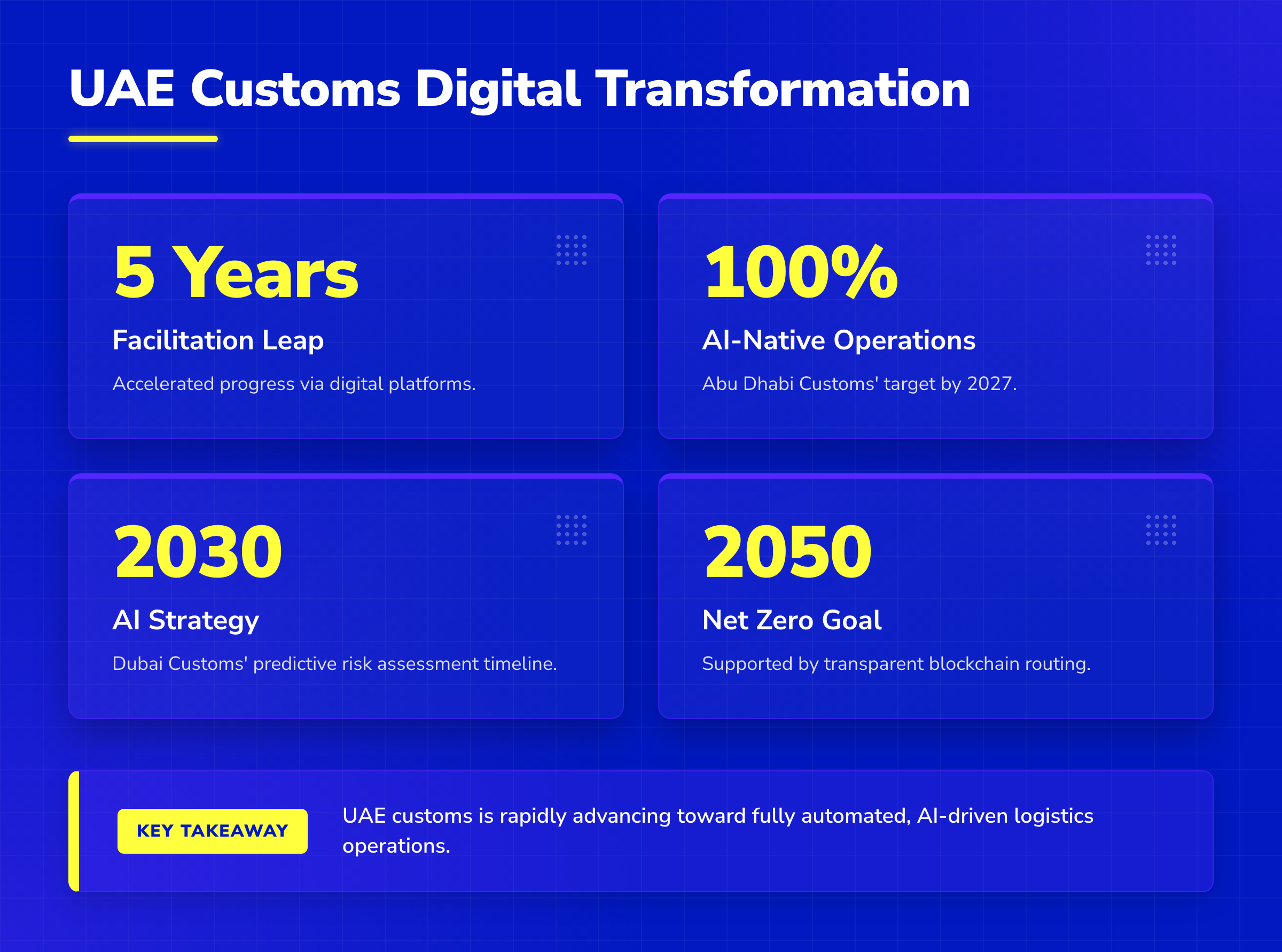
The UAE has positioned itself at the forefront of customs digitalization, leveraging cutting-edge technology to enhance trade facilitation. According to World Customs Organization, Dubai Customs reported a "five-year leap" in facilitation since implementing digital platforms, earning the Hamdan Flag for Government Innovation.
Mirsal2 Platform Features and Digital Submission Benefits
The Mirsal2 system represents the cornerstone of UAE's digital customs infrastructure. This sophisticated platform enables fully digital submissions for declarations, dramatically reducing paperwork and processing times in Dubai's logistics hubs. Key features include:
- Automated data extraction from invoices and documents via OCR and AI parsing
- Direct API integration with government portals
- Real-time validation against HS codes for compliance
- Instant duty and tax calculations
- Electronic payment processing
The platform's benefits are substantial—mainland courier and broker firms report cutting clearance times through predictive routing, with the system enabling pre-arrival processing that allows goods to clear customs before physical arrival at ports.
Have a quick question? Get answers instantly on WhatsApp.
AI-Powered Risk Assessment and Automated Clearance
Dubai Customs' 2030 AI strategy deploys predictive risk assessment, smart inspection, and post-transaction auditing to revolutionize clearance processes. According to Dubai Customs, their AI systems feature automated audits, real-time parcel/trader profiling, and compliance checks.
Abu Dhabi Customs' Clearance.AI, launched at GITEX Global 2025, takes automation further by enabling:
- Self-clearance for non-restricted goods via smart device scans
- Smart valuation against global price databases
- Registration verification with automated fraud detection
- Real-time audit analysis reducing human error
The Abu Dhabi Customs reports that these AI implementations align with the Abu Dhabi Digital Strategy 2025-2027 for 100% AI-native operations, significantly improving processing times and compliance rates.
Blockchain Integration for Supply Chain Transparency
While specific blockchain implementations in UAE customs are still emerging, Beam.ai reports that AI logistics platforms in UAE freight forwarding leverage blockchain-like structured data pipelines for trade document transparency. These systems convert PDFs to validated data objects and flag potential fraud through advanced pattern recognition.
This technology supports the UAE's Net Zero 2050 goals by enabling optimized, transparent routing through major hubs like Jebel Ali and along the Etihad Rail network, while maintaining comprehensive audit trails for compliance purposes.
Mobile Customs Applications and Real-Time Notifications
Mobile technology has transformed how businesses interact with customs authorities. Clearance.AI provides real-time notifications throughout the clearance process, alerting stakeholders via mobile devices for seamless logistics tracking. Key mobile features include:
- Push notifications for clearance status updates
- Mobile document upload capabilities
- Real-time duty calculations
- Digital payment processing
- Shipment tracking integration
Dubai Customs' AI-powered channels offer mobile-enabled services with predictive alerts for potential delays or compliance issues, significantly reducing "where is my shipment" queries and enhancing transparency in trade operations.
Future Developments: IoT Integration and Predictive Analytics
The future of UAE customs technology looks increasingly sophisticated. According to PwC's report on Revolutionising Customs with AI, emerging technologies will further transform customs operations:
- IoT Integration: Smart containers with GPS and sensor technology providing real-time location and condition monitoring
- Predictive Analytics: AI algorithms predicting clearance times and identifying potential compliance issues before they occur
- Digital Twins: Virtual representations of supply chains enabling scenario planning and optimization
- Quantum Computing: Enhanced encryption and processing capabilities for secure, instantaneous global trade documentation
The Dubai State of AI Report indicates that these technologies will be progressively integrated into customs operations, further cementing the UAE's position as a global leader in trade facilitation technology.
Frequently Asked Questions About UAE Customs Clearance
How long does customs clearance take in UAE?
Customs clearance times in the UAE vary based on several factors, but the country's digital infrastructure enables remarkably fast processing. For low-risk shipments with complete documentation submitted via the Mirsal2 system, clearance can be completed in as little as 1-2 hours. According to industry data, 85% of express shipments achieve same-day clearance when all documentation is properly prepared and submitted electronically before arrival. However, shipments requiring physical inspection or those with incomplete documentation may take 24-48 hours or longer. Free zone shipments typically process faster than mainland clearances due to simplified procedures. Working with an AEO-certified customs broker like Infinity can significantly reduce clearance times through priority processing privileges.
What documents are required for import clearance?
Import clearance in the UAE requires a comprehensive set of documents to ensure compliance with customs regulations. The essential documents include: a commercial invoice detailing the transaction value and terms; a packing list specifying contents, weights, and dimensions; the bill of lading (for sea freight) or airway bill (for air freight) serving as the transport document; a certificate of origin to determine applicable duty rates under trade agreements; and any specific permits required for restricted goods. Additional documents may include import licenses from the Department of Economic Development, product-specific certificates (such as health certificates for food products or conformity certificates for electronics), and insurance documents if applicable. All documents must be submitted electronically via the Mirsal2 system, and accuracy is crucial—documentation errors cause 30% of clearance delays in Dubai's logistics sector.
How are customs duties calculated?
Customs duties in the UAE are calculated using the GCC Common Customs Tariff system, typically applying a 5% ad valorem rate on the CIF (Cost, Insurance, and Freight) value of imported goods. The calculation process involves first determining the correct HS (Harmonized System) code for your product, which identifies the applicable duty rate. The CIF value includes the invoice value of goods, plus insurance costs and freight charges to the UAE port of entry. After calculating the duty amount, a 5% VAT is applied to the total of CIF value plus customs duty. For example, goods with a CIF value of AED 10,000 would incur AED 500 in customs duty (5%), then AED 525 in VAT (5% of AED 10,500), totaling AED 11,025. However, many goods qualify for exemptions or reduced rates under the UAE's 170+ preferential trade agreements, making proper classification essential for cost optimization.
What are the benefits of using an AEO-certified customs broker?
Using an AEO-certified customs broker provides substantial advantages for businesses engaged in international trade. AEO (Authorized Economic Operator) certification indicates the highest level of customs compliance and security standards, translating to tangible benefits for clients. These include 85% faster clearance times compared to standard processing, with priority treatment at all checkpoints and significantly reduced inspection rates. AEO brokers can submit simplified declarations without supporting documents, access flexible inspection locations, and receive grace periods for documentation amendments. The certification also extends internationally through Mutual Recognition Agreements, providing expedited clearance in partner countries covering 35% of UAE trade volume. Additionally, AEO status results in 36% average operational cost reductions through fewer delays, automatic refunds, and streamlined processes. When combined with other credentials like IATA licensing and Key Account partnerships with major carriers, as offered by Infinity Logistics, AEO certification ensures the most efficient and cost-effective customs clearance possible.
Can I track my shipment during customs clearance?
Yes, modern customs clearance in the UAE offers comprehensive tracking capabilities throughout the entire process. The Mirsal2 system provides real-time status updates accessible through web portals and mobile applications. Leading customs brokers integrate their systems with customs platforms to offer enhanced tracking features, including push notifications for status changes, predictive analytics for estimated clearance times, and detailed milestone tracking from pre-arrival documentation through final release. Advanced brokers like Infinity Logistics provide integrated tracking that combines customs status with transportation updates, giving you visibility from origin to destination. The tracking system typically shows key stages including: document submission confirmation, customs declaration acceptance, duty assessment completion, inspection scheduling (if required), clearance approval, and gate pass issuance for collection. This transparency helps businesses plan their operations more effectively and reduces uncertainty in supply chain management.
What happens if my goods are selected for physical inspection?
When goods are selected for physical inspection—which occurs for approximately 15% of shipments based on risk assessment—the process follows a structured protocol designed to maintain security while minimizing delays. First, you'll receive notification through the Mirsal2 system or your customs broker about the inspection requirement. The shipment is then moved to a designated inspection area where customs officers verify the contents against declared documentation. Seals are broken only under official supervision, and the inspection may include document verification, X-ray scanning, physical examination of goods, and sampling if required for testing. For AEO-certified importers or those using AEO brokers, inspections are often expedited with flexible location options. The inspection process typically adds 24-48 hours to clearance time, though 98% of inspected goods are released within 24 hours in Dubai. To minimize inspection likelihood, ensure accurate documentation, maintain consistent import patterns, work with reputable suppliers, and consider pursuing AEO certification for your business. If discrepancies are found, you may need to provide additional documentation or pay adjusted duties, making accuracy in initial declarations crucial.
Sources & References
This article draws on research and data from the following verified sources:
- Unlock Global Trade: The Hidden Power of a UAE Customs Code
- Customs Clearance Of Imported Goods In The UAE Explained
- Best Guide to know Customs Clearance in UAE - Clarion Shipping
- What is a Customs Clearance Agent? Role, Benefits & Process
- Customs Clearance in Dubai: Process, Rules & Services
- United Arab Emirates - Customs Regulations
- A Complete Guide to Customs Clearance Procedures in Dubai
- Customs clearance | The Official Platform of the UAE Government
- TFI World - Documents Required for Customs Clearance in Dubai
- Locad - UAE Import Duties and Customs Clearance Guide (2025)
- TTL - Documents Required for Customs Clearance in Dubai
- Quiqup - Customs Clearance in the UAE
- Premier Brains - Customs Notice No. (04/2023)
- All you need to know about the UAE 12-digit Integrated Customs Tariff
- Central Customs Tariff System | Federal Authority for Identity
- DUBAI CUSTOMS SERVICES HS Code Search
- Harmonized System (HS) Codes | Abu Dhabi Single Window for Trade
- Foreign Trade Indicators 2023-2024 - Abu Dhabi Customs
- Customs Clearance UAE: A Complete Guide for Importers & Exporters
- UAE Customs Clearance Guide: Documents, Process & Tips for Faster Approval
- Importing into the UAE: An Overview of the Customs Clearance Process
- AEO Benefits – Authorized Economic Operator
- What is AEO Certification, origins and benefits | Savino Del Bene
- Benefits of AEO (Authorized Economic Operator) I Cargo Flores
- 8 benefits of AEO certification for importers/exporters - AbroadLink
- United Arab Emirates ARTICLE 7 - World Customs Organization
- Emergen Research - Customs Brokerage Market Size, Share, Industry Forecast by 2034
- Inlex Partners - Dubai Import Export Business Setup: Complete 2026 Licensing Guide
- Fintech News AE: Financial Crime Compliance Costs
- JD Supra: UAE Tightens Monitoring
- Tax Adepts: UAE Freezone VAT Rules
- AMCA: UAE Compliance 2026
- Chambers Practice Guides: Investing in 2026 UAE
- Dubai reduces threshold for imposing customs duties on imports of ... - EY
- De minimis: not a trifle anymore for global e-commerce - Visa
- AI in UAE Logistic Companies: Automating Customs, SLAs, and Trade Documents
- Revolutionising Customs with AI - PwC
- Dubai Customs' five-year leap in e-commerce facilitation - WCO
- State of AI Report - Digital Dubai
- 15 AI Use Cases in Government - Dubai Future Foundation
- The Report Cubes - UAE Express Delivery Market Report and Forecast 2026-2034
- OpenPR - UAE Logistics Market Size is Expected to Reach USD 95.2 Billion
- Data Insights Market - United Arab Emirates (UAE) CEP Market Analysis 2026
- Mordor Intelligence - UAE Freight & Logistics Market Share & Size 2031 Outlook
- Grand View Research - UAE Courier, Express, and Parcel Market Size & Outlook, 2033
Tags
Related Articles
Ready to optimize your logistics?
Whether you need express shipping, freight forwarding, or warehousing — our AI finds the best rates and routes for your business.