
Ultimate Guide to Warehousing & 3PL Services in Dubai: Storage to Fulfillment
Dubai has emerged as the Middle East's premier logistics hub, with the UAE logistics and warehousing market valued at USD 54.65 billion in 2025 and projected to grow at a CAGR of 8.15% through 2032, according to Nexdigm's market analysis. This explosive growth is fueled by e-commerce expansion, which reached AED 27.5 billion in retail value in 2023, and the movement of 20.3 million TEU containers through UAE ports in 2022.
For businesses seeking a storage facility Dubai can rely on, understanding the landscape of warehousing options, 3PL services, and distribution networks is crucial for success in this dynamic market. Whether you're an e-commerce startup needing fulfillment services or an established manufacturer requiring bonded storage, this comprehensive guide covers everything from facility selection to integrated logistics solutions.
Dubai Storage Facility Landscape: Free Zones, Locations & Capacity Overview
Dubai's strategic position bridging Asia, Africa, and Europe has transformed it into a global logistics powerhouse. The emirate's world-class infrastructure includes Jebel Ali Port, which handles over 70 million containers annually via DP World, and Dubai International Airport (DXB), managing 2.2 million tonnes of cargo in 2024, as reported by Chestertons' warehouse investment analysis.
Free Zone Advantages: JAFZA, DAFZA, DMCC Storage Benefits
Dubai's free zones offer unparalleled advantages for international businesses seeking storage solutions. These zones provide tax exemptions, 100% foreign ownership, and streamlined customs procedures that are essential for efficient logistics operations.
- Jebel Ali Free Zone (JAFZA): The crown jewel of Dubai's logistics infrastructure, JAFZA hosts over 650 logistics companies from 60+ countries across 3.85 million square meters of facilities. Its direct connectivity to Jebel Ali Port makes it ideal for businesses requiring seamless sea freight integration.
- Dubai Airport Free Zone (DAFZA): Strategically positioned for air cargo operations, DAFZA provides proximity advantages to DXB's high-volume freight operations, making it perfect for express logistics and time-sensitive shipments.
- Dubai Multi Commodities Centre (DMCC): Specializing in commodity trading, DMCC offers bonded storage benefits for hazardous materials and secure logistics, particularly for precious metals and jewelry sectors.
The appeal of these free zones is evident in Dubai's e-commerce surge, which is projected to hit USD 9.2 billion by 2026, representing a 92% growth from 2021, according to The Report Cubes' market forecast.
Warehouse Capacity Across Dubai
Dubai's warehouse landscape offers diverse capacity options, ranging from 1,000 square feet to over 100,000 square feet facilities. According to Knight Frank's Q3 2023 industrial markets review, demand hit 9.9 million square feet in Q1-Q3 2023, with logistics accounting for 44% of this demand.
The market is experiencing significant growth, with developers planning 9-10 million square feet of Grade A logistics build-to-rent facilities. In Q3 2025, approximately 4,200 rental transactions occurred, with renewals up 62.2% and rents rising 16.8% year-over-year, as noted by Cavendish Maxwell's market performance report.
Storage Facility Types
Dubai offers various storage facility types to meet diverse business needs:
- Ambient Storage: Standard facilities for general freight, dominating industrial and retail segments
- Temperature-Controlled (Cold-Chain): Experiencing surge in demand for e-commerce perishables, with 3.3 million users averaging USD 1,590 spend in 2023
- Hazmat-Certified: Bonded zones in JAFZA and KEZAD for dangerous goods in freight forwarding operations
Automation is enhancing all facility types, with robots deployed at Amazon and Emirates facilities to improve fulfillment efficiency. When searching for a storage facility Dubai businesses trust, it's essential to consider these specialized options based on your product requirements.
Location Factors: Proximity to Ports, Airports, and Distribution Networks
Strategic location selection significantly impacts operational efficiency and costs. Key industrial districts and their characteristics include:
| District/Free Zone | Key Features | Rental Rates (2023-2025) |
|---|---|---|
| JAFZA | 3.85M sqm logistics space, port-linked | Competitive rates with customs benefits |
| Dubai Industrial City | High demand, central location | AED 32 psf (Q3 2023) |
| Jebel Ali Industrial | Grade B facilities, established infrastructure | AED 26 psf (Q3 2023) |
For businesses looking to explore our warehouse solutions, understanding these location dynamics is crucial for optimizing supply chain efficiency and managing costs effectively.
Types of Storage Solutions Available in Dubai
Dubai's diverse storage ecosystem caters to the emirate's role as a global logistics hub. The UAE warehousing market, valued at USD 3.02 billion in 2024 and growing at a 4.6% CAGR through 2030, offers specialized solutions for every business need, as reported by Mobility Foresights.
Ambient Storage for General Merchandise and Retail Goods
Ambient storage facilities accommodate non-perishable retail and general merchandise in standard warehouse environments. These facilities are experiencing unprecedented demand, with Dubai recording 9.9 million square feet of new industrial space requirements in Q1-Q3 2023, where logistics accounted for the largest share at 44%, followed by manufacturing at 16% and technology at 13%.
JAFZA exemplifies the scale of ambient storage available, providing 3.85 million square meters of logistics facilities and hosting over 650 companies from 60+ countries. This makes it ideal for retail trading, which represented 15% of leased space in 2023. The high demand for Grade A ambient facilities near ports and airports has driven rents in prime areas like Dubai Industrial City to AED 32 per square foot in Q3 2023, representing a 52% increase from January 2020 levels.
Temperature-Controlled Facilities for Pharmaceuticals and Perishables
The cold chain storage sector is expanding rapidly to meet the needs of pharmaceutical, food, and perishable goods industries. According to Nexdigm's warehousing market report, demand for temperature-controlled storage is rising 30% annually due to sector growth.
In 2023, a new Dubai facility added capacity for 1,000 tons of product, addressing critical needs in free zones like Dubai South and JAFZA. These facilities support advanced monitoring technology essential for maintaining product integrity. The UAE warehousing market's 7.8% CAGR from 2023-2028 highlights significant opportunities in cold storage, particularly amid growing pharmaceutical and food imports through upgraded Jebel Ali Port facilities.
Bonded Warehouse Storage for Customs-Free Inventory Holding
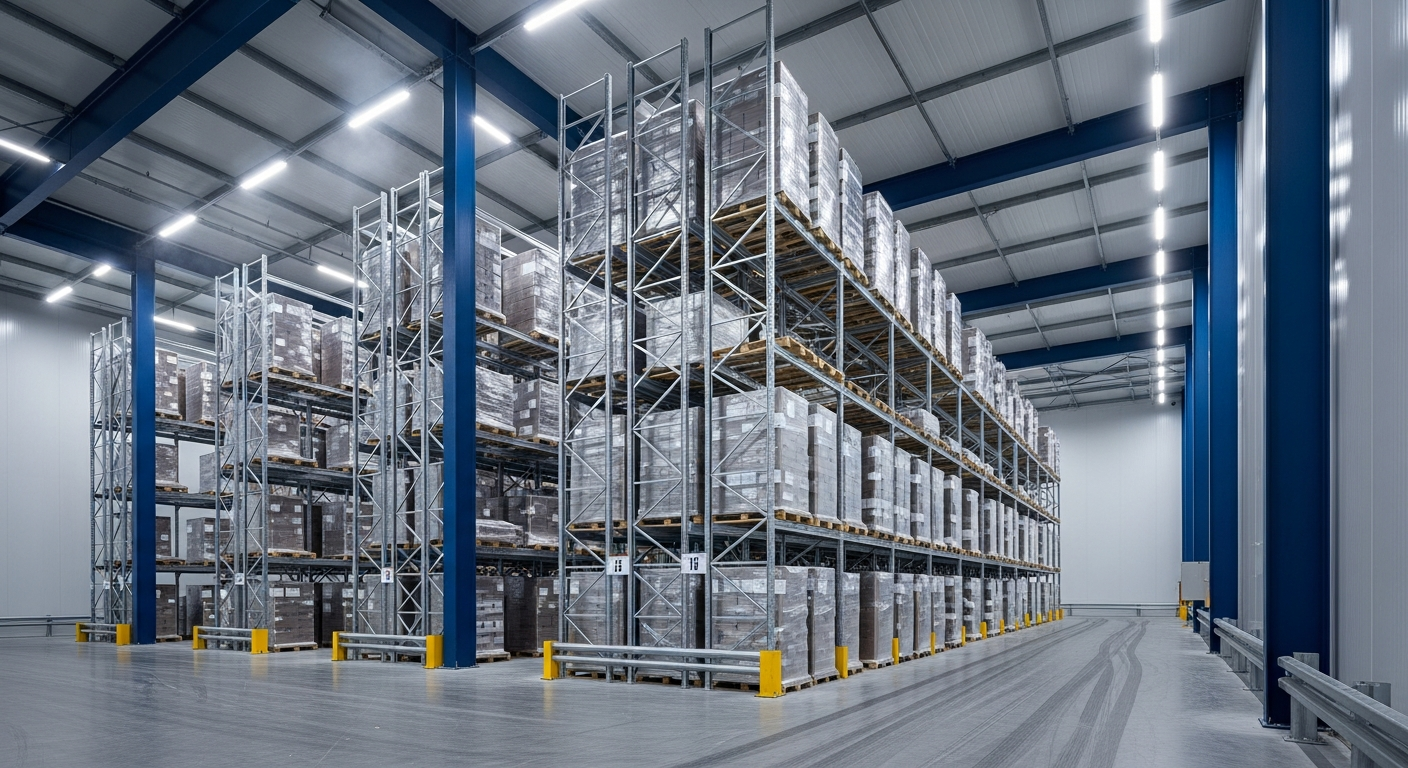
Bonded warehouses enable duty-free holding of imports and exports, proving crucial for freight forwarding operations in free zones. JAFZA and Dubai South offer sophisticated bonded facilities with direct port and airport links, serving international trade requirements. These facilities are particularly valuable for luxury goods and transshipment operations between Asia, Europe, and Africa.
The demand for bonded storage solutions remains strong, with logistics occupying 44% of leased industrial space in 2023, up from previous years. However, Grade A bonded warehouses remain in short supply, prompting plans for 9-10 million square feet of new build-to-rent developments to address this gap.
E-Commerce Fulfillment Centers with Pick-Pack-Ship Capabilities
E-commerce fulfillment centers represent the fastest-growing segment of Dubai's storage landscape. These facilities integrate sophisticated pick-pack-ship operations to support same-day and next-day delivery requirements. The UAE e-commerce market reached USD 27 billion in 2023, supported by 99% internet penetration, driving unprecedented demand for automated fulfillment capabilities.
The e-commerce sector drove 44% of Q1-Q3 2023 warehouse demand, totaling 9.9 million square feet. Modern facilities in JAFZA and Dubai Industrial City feature advanced robotics and warehouse management systems (WMS), with rental rates ranging from AED 26-32 per square foot. These facilities support major international players like Amazon, which has established significant operations in the region.
For businesses seeking e-commerce fulfillment solutions, Dubai's infrastructure offers world-class capabilities for rapid order processing and delivery.
Bulk Storage for Raw Materials and Industrial Components
Industrial bulk storage facilities cater to manufacturers and traders dealing with raw materials and components. These warehouses typically feature high ceilings, heavy-duty flooring, and specialized handling equipment. The manufacturing sector accounted for 16% of Dubai's industrial space demand in 2023, reflecting the emirate's growing industrial base.
Specialized Storage: Dangerous Goods, Automotive Parts, Fashion
Dubai offers specialized storage solutions for unique requirements:
- Dangerous Goods Storage: Certified facilities in JAFZA and KEZAD with proper safety systems and regulatory compliance
- Automotive Parts Storage: Climate-controlled environments with specialized racking systems for delicate components
- Fashion and Apparel Storage: Hanging garment systems, humidity control, and quality inspection areas
When selecting a storage facility Dubai operations require, businesses must consider these specialized options to ensure proper handling and compliance with industry-specific regulations.
3PL Services Integration: Beyond Storage to Full Fulfillment
Third-party logistics (3PL) services in Dubai extend far beyond basic storage, encompassing comprehensive fulfillment operations that drive business growth. The UAE 3PL market, valued at USD 5.78 billion in 2024 and projected to reach USD 9.46 billion by 2032 at a CAGR of 7.23%, reflects the increasing sophistication of logistics services, according to Verified Market Research.
What 3PL Services Include: Receiving, Storage, Picking, Packing, Shipping
Modern 3PL providers offer end-to-end logistics solutions that transform how businesses manage their supply chains. These comprehensive 3PL services form the foundation of efficient operations, particularly in free zones like JAFZA, where bonded corridors enable rapid customs clearance for re-export to Africa and South Asia.
Dubai's logistics zones process 76% of UAE value-added logistics services, contributing USD 6.5 billion annually to the economy. The 3PL operations sector has grown 28% since 2022 and achieves 42% faster cargo processing than regional competitors. Dubai dominates national 3PL activity, accounting for 66.12% of shipments and contract revenue in 2025, as reported by Mordor Intelligence.
Inventory Management Systems and Real-Time Stock Visibility
Advanced inventory management systems leverage cutting-edge technology to provide unprecedented transparency and control. According to the UAE Federal Competitiveness and Statistics Centre, 78% of UAE logistics companies invested at least USD 1.5 million in IoT and AI technologies in 2023.
Key technological advancements include:
- Blockchain solutions that reduced documentation times by 56% and costs by 23%
- IoT sensors providing real-time temperature and location tracking
- AI-powered demand forecasting and inventory optimization
- Cloud-based WMS platforms enabling 24/7 visibility from anywhere
By the end of 2026, over 65% of UAE 3PL contracts will prioritize digital visibility capabilities, according to Rankpy's 3PL logistics trends analysis. DP World's platform exemplifies this trend, integrating IoT sensors and blockchain for chain-of-custody tracking in value-added warehousing.
Order Fulfillment Automation and Same-Day Processing
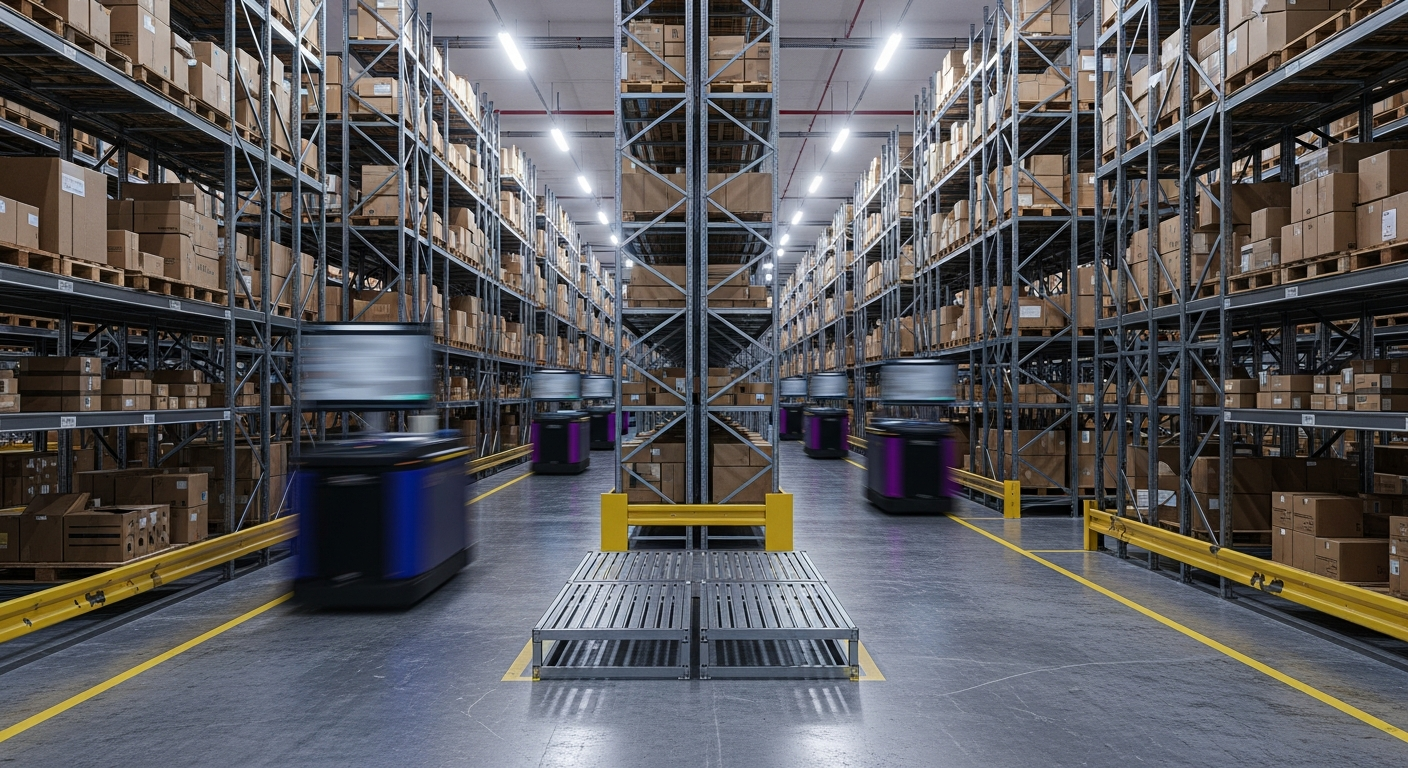
Automation is revolutionizing order fulfillment in Dubai's warehouses. UAE e-commerce transactions rose 38% in 2023 to USD 7.8 billion, with 3PL providers handling 65% of these shipments. Cross-border logistics has grown 42% annually since 2021, driving demand for sophisticated fulfillment capabilities.
The digital retail share of transactions will rise from 8.2% in 2021 to 26.5% in 2026, boosting last-mile delivery volumes from 185 million to 665 million parcels annually. To meet this demand, providers are deploying:
- Micro-fulfillment centers in urban areas for rapid delivery
- Automated sortation systems reducing processing time by up to 70%
- Crowd-sourced delivery networks for flexible last-mile solutions
- Robotic picking systems improving accuracy to over 99.9%
In Abu Dhabi alone, last-mile volumes grew from 28 million to 47 million packages annually, with 3PL providers managing 72% of this volume. The value-added warehousing segment, including kitting and assembly services, is growing at the fastest rate of 10.03% CAGR through 2031.
Returns Management and Reverse Logistics
Effective returns management has become crucial for e-commerce success. Dubai's free zones facilitate integrated reverse logistics flows with zero import duties and on-site customs clearance. This capability is essential as e-commerce return rates typically range from 15-30% depending on the product category.
Investments in logistics free zones have reached USD 3.2 billion since 2023, expanding warehouse capacity by 1.8 million square meters to accommodate growing reverse logistics needs. These facilities position Dubai as a global hub, supporting UAE's total trade value of AED 2.2 trillion (USD 600 billion).
Value-Added Services: Kitting, Labeling, Quality Control
Modern 3PL providers offer extensive value-added services that go beyond traditional warehousing:
- Kitting and Assembly: Creating product bundles, gift sets, and promotional packages
- Custom Labeling: Country-specific labeling, regulatory compliance stickers, and brand customization
- Quality Control: Pre-shipment inspections, product testing, and damage assessment
- Product Customization: Engraving, embroidery, and personalization services
- Repackaging: Bulk breaking, retail-ready packaging, and display preparation
Integration with E-Commerce Platforms and Marketplaces
Seamless integration with e-commerce platforms is essential for modern fulfillment operations. Leading 3PL providers in Dubai offer direct API connections with major platforms including:
- Amazon Seller Central and FBA integration
- Shopify, WooCommerce, and Magento synchronization
- Local marketplace connections (Noon, Namshi, etc.)
- Multi-channel inventory management across all platforms
- Automated order routing and fulfillment triggers
This integration enables real-time inventory updates, automatic order processing, and synchronized tracking information across all sales channels, ensuring customers receive accurate information regardless of where they shop.
Free Zone Storage Advantages: JAFZA, DAFZA & DMCC Comparison
Dubai's free zones offer distinct advantages for businesses seeking storage and logistics solutions. Each zone provides unique benefits tailored to specific industries and operational requirements, making the selection of the right storage facility Dubai free zone crucial for business success.
JAFZA: Largest Free Zone, Port Connectivity, 100% Foreign Ownership
Jebel Ali Free Zone (JAFZA) stands as Dubai's logistics crown jewel, hosting over 650 logistics companies from more than 60 countries and offering 3.85 million square meters of combined logistics facilities with direct connectivity to Jebel Ali Port, according to Chestertons' warehouse investment analysis.
JAFZA's key advantages include:
- 100% foreign ownership with no local sponsor requirement
- Direct access to Jebel Ali Port, handling over 70 million containers annually
- Integrated logistics infrastructure supporting manufacturing, trading, and distribution
- Advanced automation and real-time tracking capabilities
- Bonded warehouse facilities for duty-free storage
The zone accommodates diverse activities including logistics, industrial manufacturing, and trading, all integrated with world-class port infrastructure. This makes JAFZA ideal for businesses requiring seamless maritime freight operations and global distribution capabilities.
DAFZA: Airport Proximity, Express Logistics Integration, Cargo Handling
Dubai Airport Free Zone (DAFZA), strategically located in Dubai South near Al Maktoum International Airport, excels in express logistics and air cargo operations. Its proximity to the airport expansion project enhances air freight capacity, positioning it as a key cluster for freight forwarding and e-commerce distribution.
DAFZA's strategic benefits include:
- Direct access to air cargo facilities and express courier hubs
- Ideal for time-sensitive shipments and express logistics integration
- Purpose-built infrastructure for e-commerce fulfillment
- 24/7 operations supporting global supply chains
- Specialized facilities for high-value and temperature-sensitive cargo
With UAE e-commerce projected to reach USD 9.2 billion by 2026, DAFZA's location and infrastructure make it perfect for businesses prioritizing speed and efficiency in their distribution networks.
DMCC: Commodities Focus, Precious Metals Storage, Business Hub Access
Dubai Multi Commodities Centre (DMCC) specializes in commodities trading, including precious metals storage, jewelry, and general trading services. As reported by HenryClub's free zone comparison, DMCC functions as a comprehensive business hub with extensive support services.
DMCC's unique offerings include:
- Specialized vaults and secure storage for precious metals and stones
- Dedicated facilities for commodity trading and storage
- Integration with Dubai's financial and trading ecosystem
- Business center facilities with meeting rooms and support services
- Strategic location in the heart of Dubai's business district
Need a shipping quote?
Get AI-optimized rates from DHL, FedEx & UPS — up to 65% below retail. Quote in under 10 minutes.
Tax Benefits and Customs Advantages Across All Free Zones
All three free zones—JAFZA, DAFZA, and DMCC—offer shared benefits that make them attractive for international businesses:
- 0% corporate and personal income tax
- 100% foreign ownership without local partner requirements
- 100% repatriation of capital and profits
- Customs duty exemptions on imports and re-exports
- Simplified customs procedures for efficient freight forwarding
- No currency restrictions
These benefits are driving the UAE warehousing market, valued at USD 3.02 billion in 2024 with a 4.6% CAGR through 2030, according to Mobility Foresights.
Re-Export Capabilities and Trade Facilitation
Dubai's free zones excel in facilitating re-export trade, with the emirate handling 15% of global re-export trade. The zones offer:
- Streamlined documentation for re-export transactions
- Bonded corridors for seamless cargo movement
- Multi-modal connectivity (sea, air, and road)
- Preferential trade agreements access through UAE's network
- Specialized handling for transit cargo
Licensing Requirements and Operational Flexibility
Each free zone offers different licensing options tailored to business needs:
| Free Zone | License Types | Key Requirements | Setup Timeline |
|---|---|---|---|
| JAFZA | Trading, Industrial, Service, Logistics | Minimum office/warehouse space | 7-10 business days |
| DAFZA | Trading, Service, Industrial | Activity-specific approvals | 5-7 business days |
| DMCC | Trading, Service, Commodities | Flexi-desk or office options | 3-5 business days |
The operational flexibility extends to workforce management, with free zones offering easy visa processing, no restrictions on hiring expatriates, and simplified labor law compliance. This makes it easier for businesses to scale operations based on demand fluctuations.
For companies looking to establish or expand their presence in Dubai, understanding these free zone advantages is crucial. Each zone's unique benefits align with different business models, from high-volume maritime logistics in JAFZA to time-critical air freight operations in DAFZA and specialized commodity trading in DMCC.
How Storage & 3PL Operations Work: From Inquiry to Fulfillment
Understanding the operational workflow of storage and 3PL services is essential for businesses entering Dubai's logistics ecosystem. The process from initial inquiry to successful fulfillment involves multiple stages, each designed to ensure efficiency and alignment with business objectives.
Initial Assessment: Storage Requirements, Volume Projections, Service Needs
The journey begins with a comprehensive evaluation of your logistics requirements. During this phase, 3PL providers conduct detailed analysis to determine optimal solutions for your business. The UAE warehousing market, valued at USD 3.02 billion in 2024 with a projected CAGR of 4.6% through 2030, offers diverse options for businesses of all sizes, according to Nexdigm's market research.
The assessment process includes:
- Current inventory volume analysis and seasonal fluctuation mapping
- Growth projections and scalability requirements
- Product characteristics (dimensions, weight, special handling needs)
- Service requirements beyond basic storage (kitting, labeling, returns)
- Technology integration needs and system compatibility
- Budget parameters and cost optimization goals
Small and medium-sized enterprises (SMEs) are increasingly adopting 3PL solutions to leverage specialized logistics expertise while minimizing operational overheads. Value-added warehousing and distribution services are experiencing particularly strong growth, with a forecasted 8.99% CAGR, as omnichannel retailers pay premiums for specialized services.
Facility Tour and Space Allocation Planning
Once requirements are established, prospective clients tour facilities to assess infrastructure capabilities. Modern Dubai storage facilities showcase state-of-the-art infrastructure, as demonstrated by DahNAY Logistics' December 2025 launch of a 250,000 sq. ft. advanced 3PL warehouse in Dubai's Jebel Ali, according to GM Insights.
During facility tours, key evaluation points include:
- Storage infrastructure (racking systems, floor loading capacity, ceiling heights)
- Technology capabilities (WMS, automation, tracking systems)
- Security measures (CCTV, access control, fire suppression)
- Specialized zones (temperature-controlled areas, hazmat storage, bonded sections)
- Loading dock efficiency and cross-docking capabilities
- Office space and meeting facilities for operational coordination
Space allocation planning considers both current needs and future scalability. Maersk's Cold Store facility in Dubai, inaugurated in July 2023, exemplifies strategic positioning with connections to Jebel Ali Port, Al Maktoum International Airport, direct road access across the UAE, and an Etihad Rail freight terminal. With warehousing expenses averaging AED 200 per square meter annually, efficient space utilization is crucial for cost management.
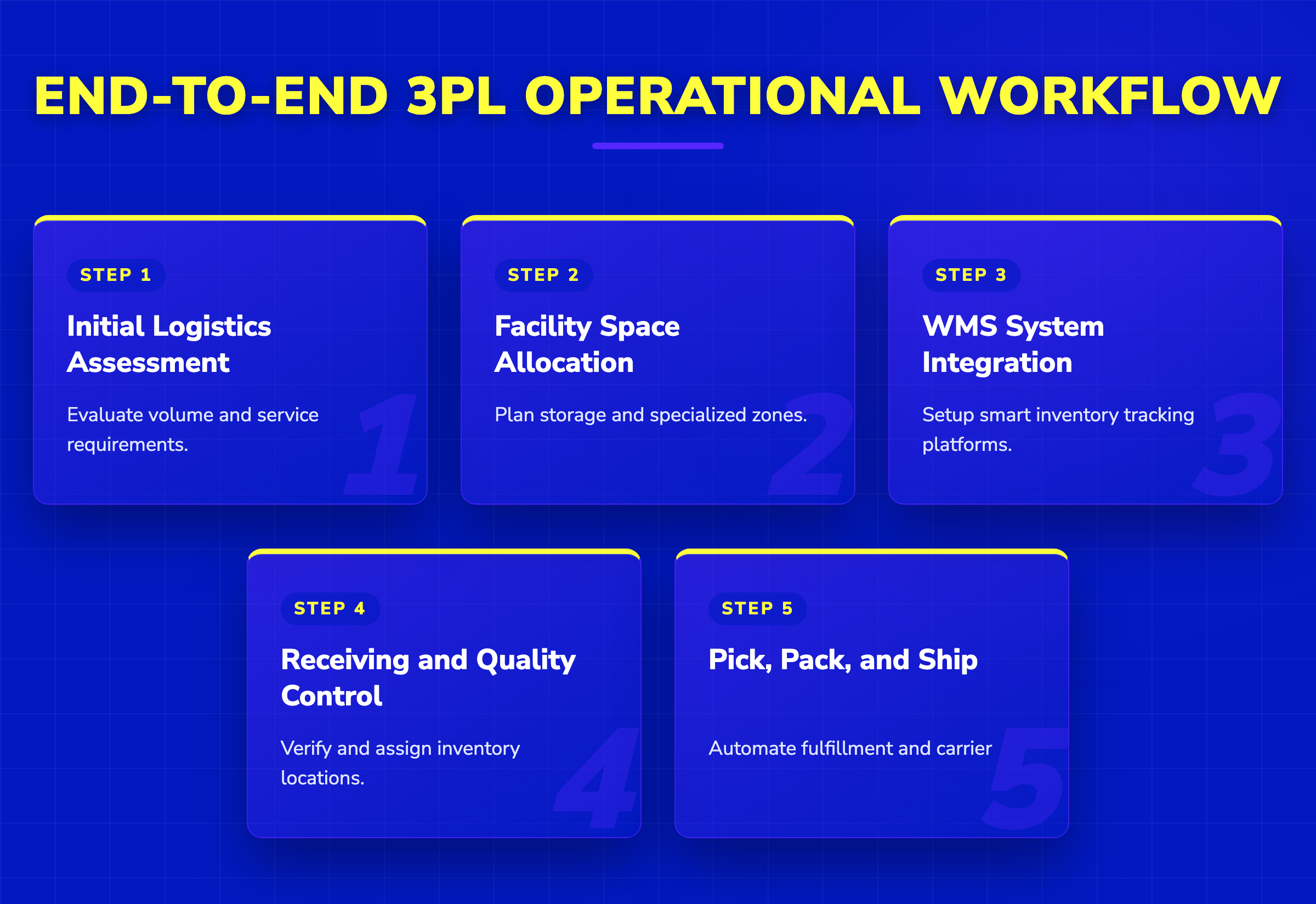
WMS Integration and Inventory Setup Procedures
Warehouse Management System (WMS) integration forms the technological backbone of modern 3PL operations. The UAE 3PL sector's digital transformation is accelerating, with investments in logistics technology projected to reach AED 5 billion (approximately USD 1.36 billion), as reported by Research and Markets.
The WMS integration process involves:
- System compatibility assessment and API configuration
- Data migration from existing systems
- SKU setup and categorization
- Barcode/RFID tag assignment and printing
- User access configuration and training
- Testing and validation procedures
Leading providers like DHL, Aramex, and Kuehne + Nagel have implemented smart warehouses in the UAE featuring automated sorting, robotic picking, and real-time inventory monitoring. These systems integrate customs clearance APIs with warehouse management platforms, supporting import-to-shelf workflows that enhance operational efficiency. Robotics deployments in Dubai reduce order-cycle times by up to 30%, validating capital investments in automated storage and retrieval systems.
Receiving Protocols and Quality Control Processes
Receiving and quality control procedures ensure inventory accuracy and regulatory compliance. The UAE government's "National Logistics Strategy" implemented in 2023 has elevated receiving standards across the industry, aiming to enhance logistics capabilities through improved infrastructure and digital transformation.
Standard receiving protocols include:
- Advanced shipping notice (ASN) verification
- Physical inspection and damage assessment
- Quantity verification against purchase orders
- Quality control sampling based on agreed parameters
- Documentation review and customs clearance (for international shipments)
- System entry and location assignment
Compliance costs for logistics companies were estimated at AED 1 billion (approximately USD 272 million), reflecting the complexity of maintaining operational efficiency while adhering to regulatory requirements. DHL Global Forwarding became the first logistics company to offer expedited sea freight clearance services at the Eastern Gateway Bonded Zone (EGBZ) in September 2022, demonstrating innovation in streamlining customs processes.
Pick-Pack-Ship Operations and Carrier Integration
The pick-pack-ship process represents the core of fulfillment operations, where efficiency directly impacts customer satisfaction. Modern facilities leverage AI-powered warehouse operations to optimize these processes.
Key operational elements include:
- Order Processing: Automated order routing based on inventory location and shipping requirements
- Picking Optimization: Wave picking, batch picking, or zone picking based on order profiles
- Packing Efficiency: Right-sized packaging selection and automated packing stations
- Carrier Integration: Multi-carrier shipping platforms for rate optimization
- Label Generation: Automated shipping label creation with customs documentation
- Sortation: Automated sorting systems directing packages to appropriate shipping lanes
Integration with major carriers enables competitive shipping rates and service options. Facilities maintain relationships with express carriers (DHL, FedEx, UPS) and regional delivery services to offer flexible shipping solutions.
Real-Time Reporting and Inventory Visibility
Transparency and visibility are paramount in modern 3PL operations. Advanced reporting systems provide:
- Dashboard Analytics: Real-time KPIs including order status, inventory levels, and shipping performance
- Inventory Reports: Stock levels, aging analysis, and movement history
- Order Tracking: End-to-end visibility from receipt to delivery
- Performance Metrics: Pick accuracy, shipping accuracy, and on-time delivery rates
- Custom Reports: Tailored analytics based on specific business requirements
- Alert Systems: Automated notifications for low stock, delays, or exceptions
By 2026, over 65% of UAE 3PL contracts will prioritize digital visibility capabilities, ensuring businesses have complete control and insight into their supply chain operations.
Billing Transparency and Performance Metrics
Clear billing structures and performance measurement ensure accountability and value delivery. Modern 3PL providers offer:
- Transparent Pricing: Detailed breakdown of storage, handling, and value-added service costs
- Activity-Based Billing: Charges based on actual usage rather than fixed fees
- Performance SLAs: Guaranteed service levels with penalty clauses for non-compliance
- Regular Reviews: Monthly or quarterly business reviews analyzing performance and optimization opportunities
- Cost Optimization: Recommendations for reducing expenses through process improvements
The combination of advanced technology, efficient processes, and transparent operations makes Dubai's 3PL sector attractive for businesses seeking reliable logistics partners. With the market's continued growth and technological advancement, these operational standards will continue to evolve, offering even greater efficiency and value to businesses operating in the region.
Distribution Network Integration: Connecting Storage to Global Markets
Dubai's storage and fulfillment infrastructure operates within a USD 23.05 billion UAE freight and logistics market that is expanding at a 6.55% CAGR through 2031, creating a highly integrated distribution ecosystem, according to Mordor Intelligence. This robust network connects regional warehousing to global supply chains through multiple transportation modes and advanced logistics infrastructure.
Express Logistics Integration: DHL, FedEx, UPS Connectivity
Major express carriers have made substantial investments in Dubai's logistics infrastructure, positioning the emirate as a critical hub for international express operations. DHL committed €120 million for a 38-year leasehold agreement on a 96,000-square-meter plot in Dubai South, constructing a 55,000-square-meter multi-user warehouse targeting carbon-neutral operations and set to complete in summer 2027.
UPS invested USD 100 million in March 2025 to develop automated sortation and regional distribution infrastructure within Dubai South's logistics district. FedEx operates its automated World Central hub as part of broader capital investments in air-express infrastructure across the region. These integrations leverage Emirates SkyCargo's 140-destination network, which contributed 46.62% of market revenue in 2025.
For businesses seeking to optimize their shipping costs, express logistics integration with these major carriers provides access to competitive rates and extensive global networks. The tight capacity management and specialized cool-chain chambers capture pharmaceutical and high-tech yields critical for temperature-sensitive shipments.
Freight Forwarding Coordination: Air, Sea, Road Distribution
The UAE's freight forwarding ecosystem spans three primary modes with distinct growth trajectories and capabilities:
Air Freight dominates revenue generation at 46.62% of market revenue in 2025, supported by Dubai International Airport's retention of top global ranking for international tonnage. The airport's strategic location and extensive connectivity make it ideal for time-sensitive and high-value cargo.
Sea Freight posted the fastest tonnage growth at 8.55% CAGR between 2026-2031. DP World's USD 2.5 billion program pushed national throughput capacity past 100 million TEU in January 2025, representing an 8.3% jump over 2024 volumes. Jebel Ali's fourth container terminal, combined with revamped cargo aprons at Dubai International Airport, reduces air-sea transshipment dwell times for high-value goods.
Road Freight remains vital for final-mile coverage, though stricter weight rules and congestion fees encourage modal shift for inter-emirate hauls exceeding 200 kilometers. The nascent rail freight network will open bulk and container corridors linking western oil fields to eastern seaports, reducing highway wear and greenhouse gas emissions.
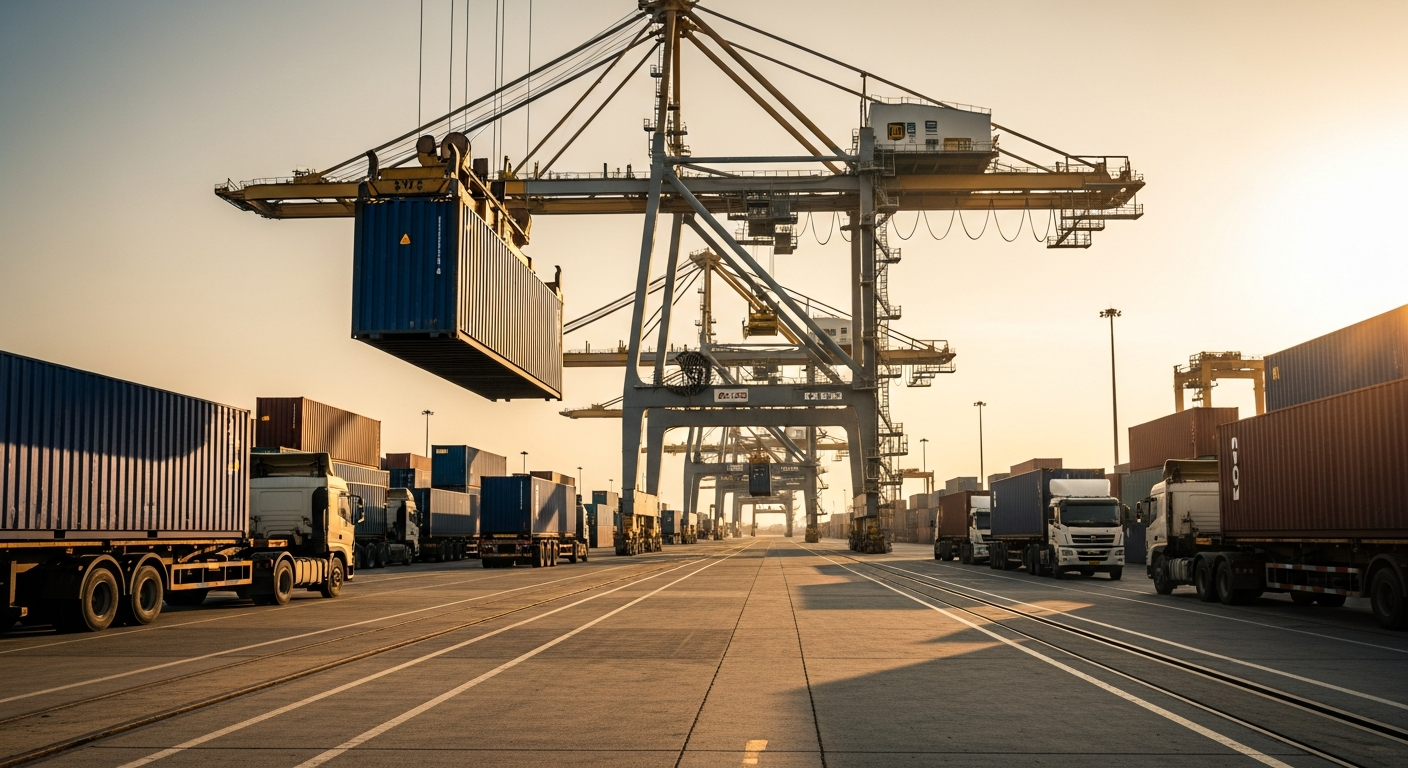
Businesses can leverage comprehensive freight forwarding services to optimize their distribution strategies across all transportation modes.
Last-Mile Delivery Options Across UAE and GCC
Dense population clusters in Dubai and Abu Dhabi enable same-day service delivery at scale. These two emirates jointly housed 52% of the population and generated more than 70% of retail sales in 2024, concentrating parcel densities that make rapid delivery economically viable.
Micro-fulfillment and locker networks are emerging as critical infrastructure. Courier, Express and Parcel (CEP) firms are refining micro-fulfillment nodes and locker networks that lower failed-delivery rates. The October 2024 RAKEZ-Emirates Post partnership illustrates how public-private tie-ups bundle licensing, warehousing, and last-mile delivery for 25,000 resident firms, shortening setup timelines and reducing administrative costs.
Amazon's upcoming 175,000 m² Abu Dhabi site will reinforce the emirate's stature as the fastest-growing e-commerce node, further expanding last-mile delivery capacity across the region.
Cross-Docking Capabilities for Time-Sensitive Shipments
Dubai South Logistics Corridor has emerged as the primary infrastructure engine for time-sensitive operations. According to CASTTIO's analysis, the corridor welcomed 653 new companies in 2025 alone, reaching a total of over 4,200 operational businesses with a 65% year-on-year increase in new business licenses issued.
EZDubai, a 920,000-square-meter free zone within Dubai South created exclusively for e-commerce logistics, specializes in:
- High-velocity fulfillment operations
- Last-mile delivery integration
- Returns processing optimization
- Cross-border customs simplification for B2C parcels
The Contract Logistics Zone within Dubai South accommodates large-scale 3PL operations with multi-user warehouse infrastructure and cold storage for temperature-sensitive supply chains. Recent commitments include Expeditors International's 23,200-square-meter 3PL facility and Toll Group's facility completing in August 2026.
Multi-Carrier Shipping Optimization and Rate Comparison
Modern logistics operations require sophisticated multi-carrier management to optimize costs and service levels. Kuehne+Nagel launched a fully autonomous fulfillment center in Dubai South in August 2024, leveraging advanced robotics to enhance order processing speed and accuracy. Automated sorting systems demonstrate a 40% improvement in order processing speeds compared to manual methods, while supply chain visibility platforms reduce shipment delays by up to 25%.
Key optimization strategies include:
- Real-time rate shopping across multiple carriers
- Service level matching based on delivery requirements
- Zone skipping for cost reduction on long-distance shipments
- Consolidation opportunities for volume discounts
- Dynamic routing based on carrier performance metrics
Regional Distribution to Saudi Arabia, Kuwait, Qatar, Oman
Dubai's strategic location makes it an ideal hub for regional distribution across the GCC. The emirate's connectivity enables efficient distribution to:
- Saudi Arabia: Road freight corridors and daily air connections to major cities
- Kuwait: Express delivery within 24-48 hours via integrated logistics networks
- Qatar: Normalized trade relations enabling seamless cross-border logistics
- Oman: Direct road connections and coastal shipping options
- Bahrain: Air and sea freight connectivity through established routes
The UAE logistics market is projected to reach USD 31.63 billion by 2031, with the broader Middle East and Africa shipping and logistics market expanding at a 10.7% CAGR from 2024, according to Cognitive Market Research. Dubai and Abu Dhabi's concentration of over 120 Fortune Global 500 enterprises within the broader corridor ecosystem underscores the region's role as a critical distribution nexus.
For businesses seeking a comprehensive storage facility Dubai can provide, the integration with this extensive distribution network ensures seamless connectivity from warehouse to final destination, whether locally or globally.
Storage Cost Factors & Pricing Models in Dubai
Understanding storage costs and pricing models is crucial for businesses planning their logistics operations in Dubai. The market offers various pricing structures influenced by location, facility type, and service requirements, with costs varying significantly based on specific business needs.
Factors Affecting Storage Costs: Location, Facility Type, Services Included
Storage costs in Dubai's warehousing sector are primarily influenced by three key factors. According to eShipper UAE's analysis, proximity to trade hubs like Jebel Ali Port or Dubai South increases rates due to high demand and superior logistics efficiency.
Facility types significantly impact pricing, with specialized facilities commanding premium rates:
- Standard dry warehouses: AED 4-7 per sq. ft. monthly for non-AC facilities
- Temperature-controlled storage: 20-40% premium over standard rates
- Bonded warehouses: Additional 10-15% for customs advantages
- Hazmat-certified facilities: 30-50% premium due to specialized requirements
Included services drive costs beyond base storage rates. Pick-and-pack, custom packaging, inventory management, and expedited handling often add value-added fees. The 3PL sector is projected to expand at a 9.7% CAGR, reaching $3,040 million in revenue by 2031, reflecting growing demand for comprehensive services.
Have a quick question? Get answers instantly on WhatsApp.
Pricing Models: Per Pallet, Per Sqft, Per Cubic Meter, Handling Fees
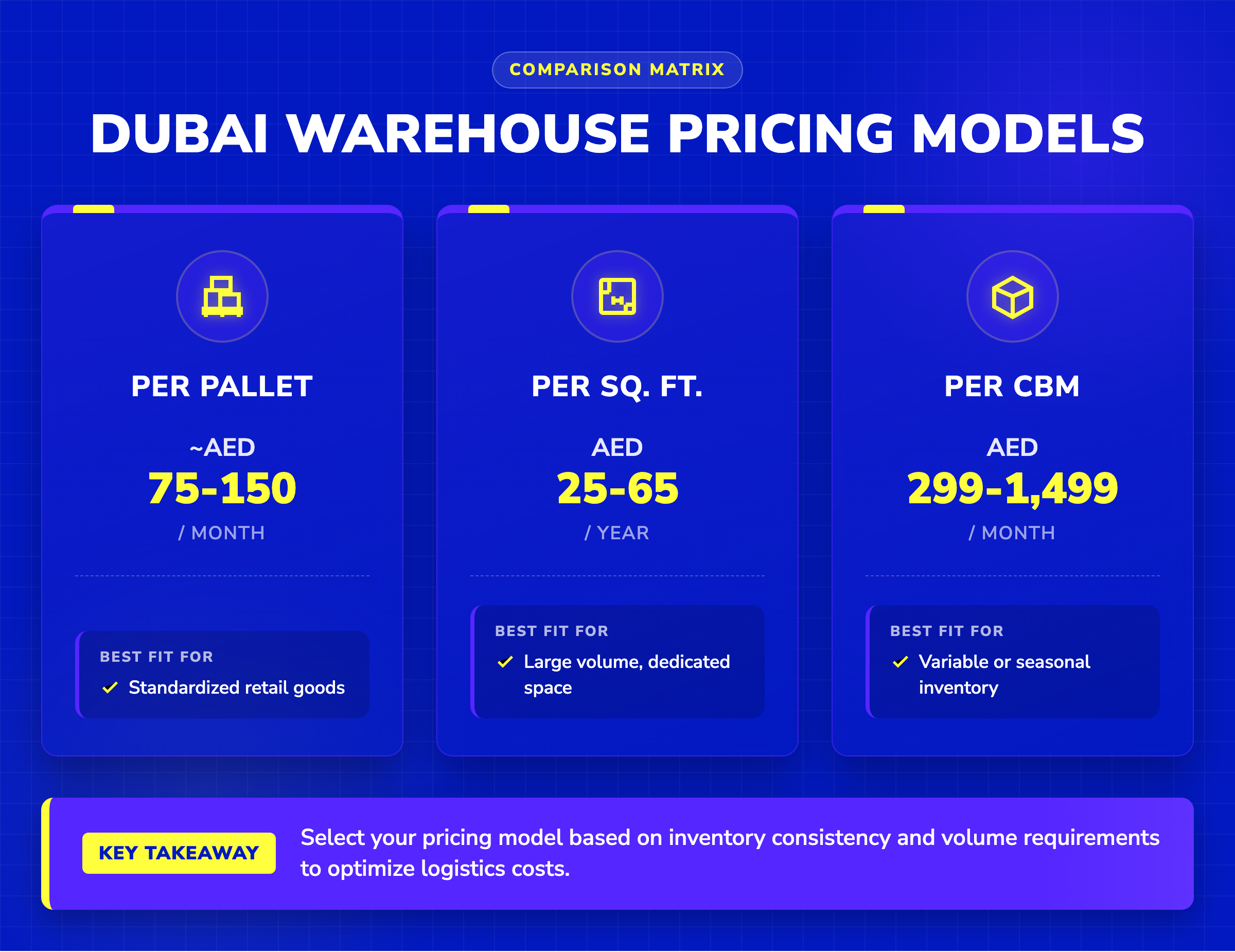
Dubai's warehousing market offers multiple pricing models to accommodate different business needs. According to Customs Clearance Dubai, common pricing structures include:
| Pricing Model | Typical Rates (2023-2026) | Best For |
|---|---|---|
| Per Pallet | $20-40/month | Standardized inventory, retail goods |
| Per Sq. Ft. | AED 25-65/year (varies by grade) | Large volume, dedicated space users |
| Per CBM | AED 299-1,499/month (volume-based) | Variable inventory, seasonal businesses |
| Handling Fees | Variable add-ons | High-touch operations, e-commerce |
Recent market data from Knight Frank shows Grade A facilities in Al Quoz reached AED 58 psf in Q3 2023, surging approximately 45% to AED 65 psf in 2024. Prime Dubai locations command $20.48 psf, while KEZAD offers AED 400-500 psf for Grade A facilities.
Free Zone vs Mainland Storage Cost Differences
Free zones typically command 10-20% premiums over mainland facilities due to their strategic advantages. According to Royal Gulf Shipping, mainland areas like Al Quoz and Dubai Industrial City offer rates of AED 25-45 psf annually, while free zones provide:
- Customs advantages and bonded storage capabilities
- 100% foreign ownership without local sponsorship
- Superior connectivity to ports and airports
- Streamlined import/export procedures
Free zones suit international freight forwarding operations, while mainland facilities offer lower base rents for domestic-focused businesses. The choice between free zone and mainland storage depends on your business model and international trade requirements.
Volume Discounts and Long-Term Contract Benefits
Larger volumes trigger significant cost savings through tiered pricing structures. As noted by Customs Clearance Dubai, CBM pricing demonstrates clear economies of scale:
- 1-5 CBM: AED 299/CBM per month
- 5-10 CBM: AED 499 total (lower per-unit cost)
- 20-25 CBM: AED 1,399 total (significant per-unit savings)
Long-term contracts yield 10-20% savings through stable tenancy agreements, reduced service charges, and guaranteed scalability. Multinational 3PL users often lock in rates to hedge against rising demand, particularly important given the market's projected growth.
Additional Service Costs: Pick-Pack, Labeling, Special Handling
Beyond base storage, additional services significantly impact total logistics costs. Cubes Logistics reports typical service charges include:
- Pick-Pack Operations: AED 2-5 per order depending on complexity
- Custom Labeling: AED 0.50-2 per unit for compliance labeling
- Special Handling: 15-25% premium for fragile or high-value items
- Returns Processing: AED 5-10 per item including inspection
- Kitting/Assembly: Project-based pricing, typically 20-30% above standard handling
Hidden Costs to Avoid: Setup Fees, Minimum Commitments, Exit Clauses
When evaluating storage options, businesses must consider potential hidden costs that can significantly impact total expenses. According to UAE Shelving's 2026 analysis, common hidden costs include:
- Setup Fees: One-time charges ranging from AED 5,000-50,000 for system integration and space preparation
- Minimum Commitments: Required minimum monthly spend or space allocation, regardless of actual usage
- Exit Clauses: Penalties for early contract termination, often 2-3 months' fees
- Insurance Requirements: Mandatory coverage adding 2-5% to monthly costs
- Peak Season Surcharges: 15-30% premiums during high-demand periods
- Documentation Fees: Charges for reports, customs paperwork, and special documentation
To avoid unexpected costs, businesses should request comprehensive pricing breakdowns and carefully review contract terms. Transparent providers will clearly outline all potential charges upfront, enabling accurate budget planning.
Understanding these cost factors helps businesses make informed decisions when selecting a storage facility Dubai operations require. By carefully evaluating pricing models and potential hidden costs, companies can optimize their logistics expenses while ensuring they receive the services necessary for efficient operations.
Choosing the Right Storage Partner: Evaluation Criteria
Selecting the right storage partner in Dubai requires careful evaluation of multiple criteria to ensure compliance, efficiency, and scalability. With the implementation of the Dubai Logistics Policy 2026, which mandates higher safety and sustainability benchmarks, choosing a compliant partner has become even more critical, according to Safety Shelves' policy analysis.
Facility Certifications: ISO, HACCP, GDP for Pharmaceuticals
Certifications serve as the foundation for evaluating storage partners. Facilities must meet stringent standards, particularly under Dubai's evolving regulations. Key certifications to prioritize include:
ISO Certifications: Heavy-duty racks must meet ISO 3457:2025 and Dubai Civil Defense standards, with verified load-bearing capacity at 120% of maximum load. For example, racks rated for 1,000kg must safely support 1,200kg. Non-certified equipment faces fines up to AED 50,000 or facility shutdowns.
GDP (Good Distribution Practice): For pharmaceutical storage, FDA and MOHAP require controlled room temperature (CRT: 15°C-25°C) with consistent monitoring records. According to UAE Shelving's pharmaceutical storage guide, medical warehouses need digital tracking systems to avoid regulatory red flags.
General Compliance Requirements: As outlined by IR Interior's warehouse approval guidelines, facilities must maintain:
- 2-hour fire resistance ratings
- 5-10 tons/sq.m floor loading capacity
- Skylights covering 5% of floor area
- Compliance with Dubai Municipality and Civil Defense rules
Under the 2026 policy, at least 60% of storage equipment must use recyclable materials, reflecting sustainability requirements.
Technology Capabilities: WMS, Real-Time Tracking, API Integration
Modern storage partners must offer advanced technology infrastructure. According to Royal Gulf Shipping, essential technology capabilities include:
- Warehouse Management Systems (WMS) with real-time inventory tracking
- RFID/barcode integration for accurate product identification
- API compatibility for seamless system integration
- QR-coded traceability for product tracking
- AI-powered logistics optimization
- Digital maintenance records for compliance audits
Facilities should provide standardized infrastructure such as rack dimensions of 1.2m depth and 2.4m height for automation compatibility, along with high ceilings (8-12m) and flexible racking systems.
Carrier Partnerships and Shipping Rate Advantages
Strong carrier relationships translate to competitive shipping rates and service reliability. While specific rate data varies, facilities in strategic locations offer distinct advantages. JAFZA Grade B warehouse rents stabilized at AED 25/sq.ft in Q3 2023, offering duty deferral via bonded storage and efficient container turnaround with dock levelers.
Evaluate partners based on:
- Established relationships with major carriers (DHL, FedEx, UPS)
- Multi-carrier options for rate optimization
- Integration with regional delivery networks
- Access to express and economy shipping options
- Preferential rates through volume agreements
Scalability: Ability to Grow with Business Needs
Choose providers offering flexible growth options aligned with business expansion. Key scalability features include:
- On-demand space allocation without long-term commitments
- Variable racking and zoning to accommodate changing inventory
- Flexible contract terms allowing upsizing or downsizing
- Digital usage reports with cost-per-pallet metrics
- Multi-site support across free zones for expansion
Dubai's market supports diverse options including 20ft/40ft container storage, cold storage zones, and pick-and-pack areas. Infrastructure features like 24-30m column spacing provide operational flexibility. A case study showed an FMCG firm achieving 20% efficiency gains after 2026 compliance upgrades across three JAFZA warehouses.
Service Level Agreements and Performance Guarantees
Robust SLAs ensure accountability and service quality. Essential SLA components include:
- Order accuracy rates: Typically 99.5% or higher
- On-time shipping performance: 95-98% depending on service level
- Inventory accuracy: 99.9% through cycle counting
- Receiving turnaround: Same-day or 24-hour processing
- Claims processing: Resolution within 48-72 hours
- System uptime: 99.9% availability for WMS access
Performance guarantees should include penalty clauses for non-compliance and regular review mechanisms.
Financial Stability and Insurance Coverage
Partner financial stability ensures long-term reliability. Evaluation criteria include:
- Financial statements demonstrating consistent profitability
- Insurance coverage including general liability, cargo, and errors & omissions
- Bank guarantees or performance bonds for high-value inventory
- Trade credit insurance for international transactions
- Business continuity plans with disaster recovery procedures
Customer References and Industry Experience
Proven track record provides confidence in partner capabilities. Request:
- Client references from similar industries or business models
- Case studies demonstrating successful implementations
- Industry certifications and association memberships
- Years of operation in Dubai market
- Management team experience in logistics and warehousing
For businesses seeking reliable storage solutions, learn more about our facilities and how our extensive experience can support your growth in Dubai's dynamic market.
These evaluation criteria position businesses to leverage Dubai's logistics growth while ensuring compliance with evolving regulations. Partners meeting these standards provide the foundation for efficient, scalable operations in one of the world's most dynamic logistics markets.
Industry-Specific Storage Solutions
Dubai's warehousing sector offers specialized storage solutions tailored to meet the unique requirements of different industries. Each sector demands specific infrastructure, compliance standards, and operational capabilities to ensure efficient supply chain management.
E-commerce: Fast Fulfillment, Returns Processing, Marketplace Integration
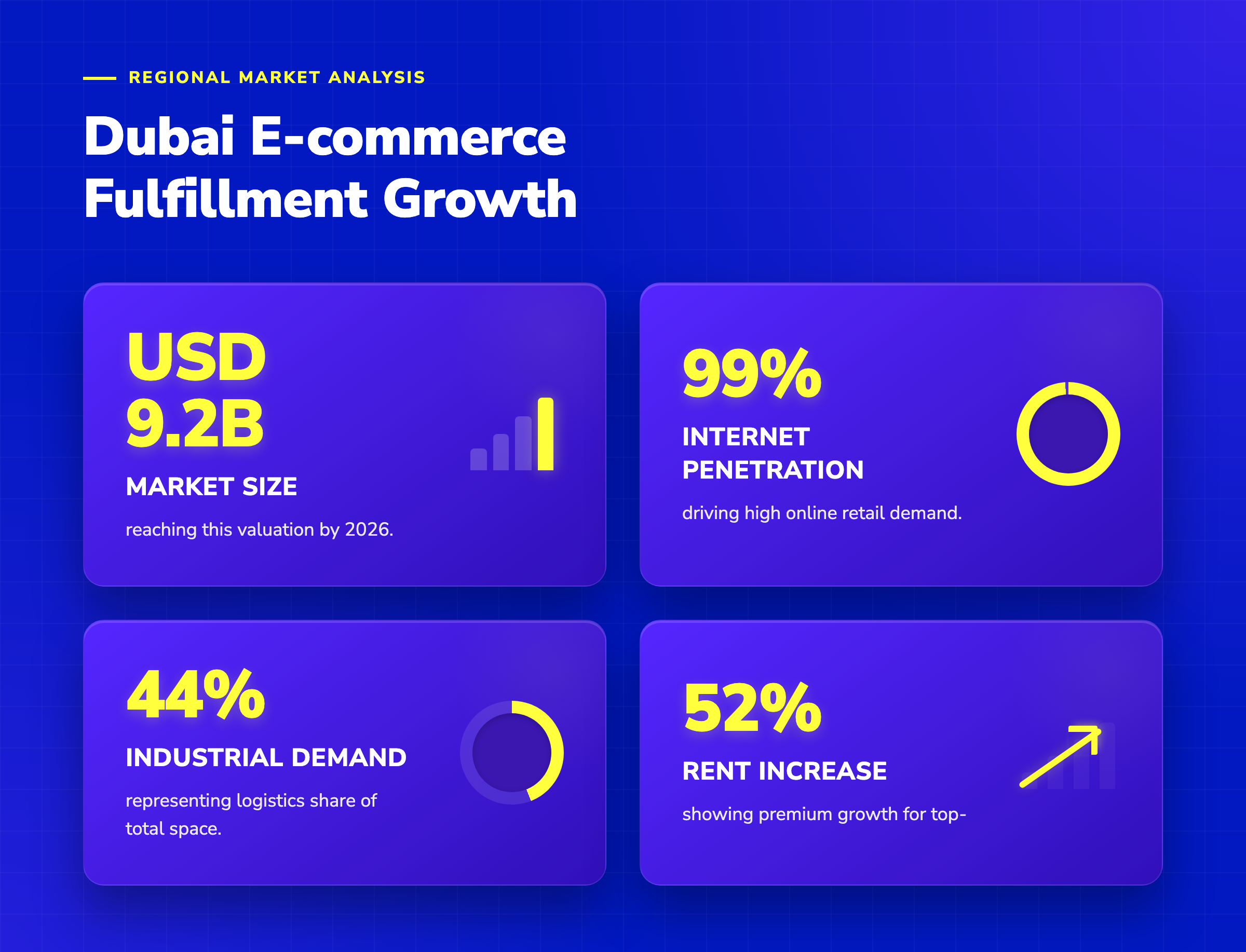
Dubai's e-commerce sector has transformed warehousing requirements, with the market reaching USD 27 billion in 2023 supported by 99% internet penetration, according to Nexdigm's market analysis. The sector is projected to hit USD 9.2 billion by 2026, representing a 92% rise from 2021.
E-commerce warehousing demands include:
- Same-day and next-day delivery capabilities
- Automated returns processing systems
- Multi-marketplace integration (Amazon, Noon, etc.)
- High-velocity pick-pack operations
- Real-time inventory synchronization across channels
In Q1-Q3 2023, logistics operations including e-commerce drove 44% of Dubai's 9.9 million sq ft industrial demand, with e-commerce specifically boosting warehouse rents 52% above 2020 levels amid scarce top-tier spaces near hubs like Dubai South. Recent investments include DHL's December 2025 commitment of EUR 120 million (USD 138.70 million) for a 55,000 m² multi-user warehouse in Dubai South, enhancing fulfillment capabilities near Al Maktoum Airport.
For comprehensive e-commerce logistics solutions, businesses require integrated systems that seamlessly connect storage, fulfillment, and last-mile delivery.
Healthcare & Pharmaceuticals: GDP Compliance, Temperature Monitoring
Pharmaceutical storage in Dubai adheres to strict Good Distribution Practice (GDP) standards with advanced temperature-controlled systems. The sector experiences 30% annual demand growth for specialized storage, driven by expanding healthcare infrastructure and pharmaceutical trade.
Critical requirements include:
- GDP-compliant facilities with validated processes
- Controlled room temperature (CRT: 15°C-25°C) maintenance
- Real-time temperature monitoring and alerting
- Segregated storage for different product categories
- Complete chain-of-custody documentation
A new 1,000-ton cold storage facility opened in Dubai in 2023, integrating real-time monitoring technology for compliance and efficiency. High demand in zones like Dubai Industrial City, where rents reached AED 32 psf in 2023, caters to pharmaceutical storage needs within the overall UAE warehousing market valued at USD 3.02 billion in 2024.
FMCG: High-Volume Storage, Rapid Turnover, Distribution Efficiency
Fast-Moving Consumer Goods (FMCG) operations leverage Dubai's high-volume Grade A warehouses for quick inventory turnover and efficient distribution. According to Sources & References
This article draws on research and data from the following verified sources:
Tags
Related Articles
Ready to optimize your logistics?
Whether you need express shipping, freight forwarding, or warehousing — our AI finds the best rates and routes for your business.