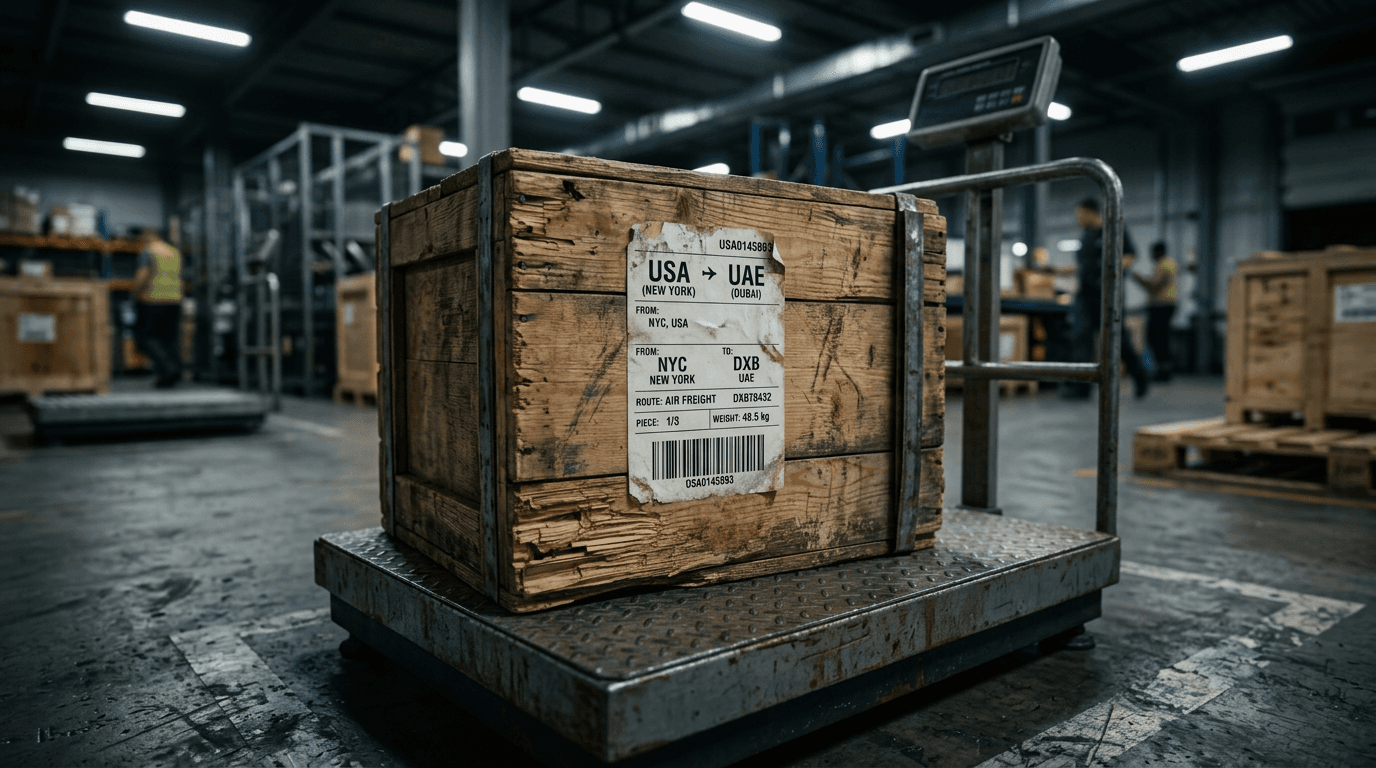
For businesses importing goods, the core of shipping from the USA to the UAE is a choice between speed and cost, with paperwork determining your timeline. Express couriers deliver in 3-4 days for urgent, small shipments, while consolidated air freight takes 5-8 days for cargo over 100 kg, and sea freight offers the lowest per-kilo cost over a 30-40 day transit. This guide provides the rules, documents, and cost calculations your business needs for smooth USA to UAE shipping.
Express, Air Freight or Sea Freight: Which Fits Your Shipment
Choosing the right shipping mode from the USA to the UAE depends on your shipment's weight, volume, and deadline. A miscalculation on chargeable weight can turn a profitable shipment into a loss, making this the most critical decision for your procurement team.
| Mode | Best For | Typical Weight | Transit Time (Door-to-Door) |
|---|---|---|---|
| Express Courier (DHL, FedEx, UPS) | Urgent samples, documents, high-value electronics, e-commerce orders | Up to ~100 kg | 3-4 days (Priority) / 4-6 days (Standard) |
| Air Freight | Time-sensitive cargo, palletized goods, machinery parts | From about 100 kg | 5-8 days |
| Sea Freight to Jebel Ali (FCL/LCL) | Bulk inventory, heavy machinery, non-urgent goods, large volumes | Part container (LCL) or full container (FCL) | 30-40 days |
Understanding Chargeable Weight
Carriers price international freight based on chargeable weight, which is the greater of the actual (gross) weight and the volumetric (dimensional) weight. This prevents light, bulky items from taking up valuable space at a low price.
- Express Courier Standard: For couriers like DHL, FedEx, and UPS, the volumetric weight in kg is calculated as (L x W x H in cm) / 5000. This equates to a density of 200 kg per cubic meter. With Key Account status on all three, Infinity Logistics offers business express rates up to 65% below retail.
- Air Freight Standard: For general air freight, the IATA standard formula is (L x W x H in cm) / 6000. This equates to a density of approximately 167 kg per cubic meter. According to IATA guidelines, if your cargo is less dense than this, you pay for the volume it occupies, not its actual weight.
This difference means that a light but large one-cubic-meter box weighing 50 kg would be charged as 200 kg by an express courier but only 167 kg by standard air freight. When Infinity quotes, we work out the chargeable weight for each option so you can compare them. Try the numbers yourself with our chargeable weight calculator.
Transit Times from Major US Cities
Transit times are a key factor in managing inventory and meeting customer expectations. The times below represent typical door-to-door estimates for business shipments from major US export hubs to Dubai, UAE. Note that these are transport times and do not include potential delays from customs inspections or documentation issues.
| US Origin City | Express Courier | Air Freight | Sea Freight |
|---|---|---|---|
| New York, NY | 3-4 days | 5-7 days | 30-35 days |
| Los Angeles, CA | 3-4 days | 6-8 days | 32-38 days |
| Chicago, IL | 3-4 days | 5-7 days | 32-36 days |
| Houston, TX | 3-4 days | 5-8 days | 30-35 days |
| Miami, FL | 3-4 days | 5-7 days | 30-34 days |
| Seattle, WA | 4-5 days | 6-8 days | 34-40 days |
Infinity can assess air freight from major US gateways, including New York, Chicago and Los Angeles, to Dubai. Confirm the origin collection, gateway, flight schedule and destination delivery scope when quoting.
US Export Paperwork: When EEI Filing is Needed
One of the most common sources of delay for shipments leaving the US is incorrect or missing export paperwork. The primary requirement that trips up new exporters is the Electronic Export Information (EEI) filing.
What is Electronic Export Information (EEI)?
Electronic Export Information (EEI) is the data filed electronically with the U.S. Census Bureau to control exports and compile trade statistics. It replaces the old paper-based Shipper's Export Declaration (SED). According to the U.S. International Trade Administration, this filing is mandatory for certain exports and is submitted through the Automated Export System (AESDirect).
When is EEI Filing Required?
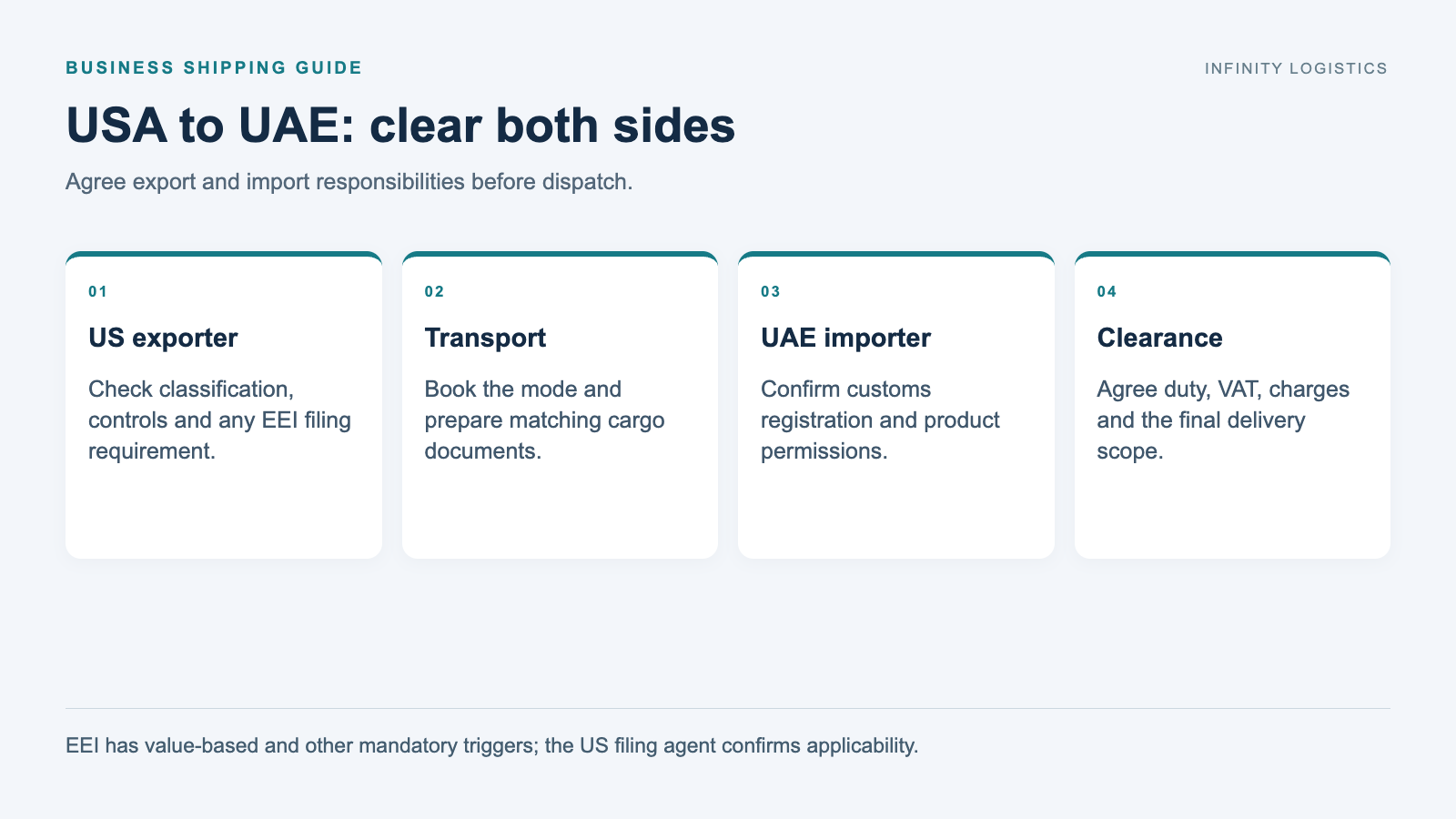
For a commercial export from the USA to the UAE, two common EEI filing triggers are listed below. Other mandatory filing requirements or exemptions may apply, so the US exporter or authorised filing agent must check the actual shipment.
- Value Threshold: When the value of goods classified under a single Schedule B number is over $2,500. This applies per commodity type, not the total invoice value.
- License Requirement: If the shipment requires an export license from a U.S. government agency (like the Bureau of Industry and Security), an EEI must be filed regardless of its value.
The filing must be completed by the U.S. seller (the USPPI) or their authorized agent (like a freight forwarder) before the cargo is exported. Upon successful filing, an Internal Transaction Number (ITN) is issued, which must be provided to the carrier.
What is a Schedule B Number?
A Schedule B number is a 10-digit U.S.-specific classification code used for exporting goods from the United States. Maintained by the U.S. Census Bureau, it is the American export equivalent of the globally recognized Harmonized System (HS) code. While the first six digits of a Schedule B number align with the HS code, the last four provide specific U.S. statistical detail. Correctly classifying your goods with a Schedule B number is essential for a compliant EEI filing.
UAE Import Duty and VAT on US Goods
Knowing your landed cost before the goods leave the US is critical. This requires understanding how the UAE calculates import duties and taxes. The process is straightforward but depends on getting the valuation correct.
Understanding CIF Value for Customs
The UAE calculates customs duty based on the CIF value of the shipment. CIF stands for Cost, Insurance, and Freight. This is the total value of the goods plus the cost of international insurance and transportation to the UAE port or airport. According to the official UAE Government portal, this valuation method is part of the Common Customs Law of the GCC States.
Calculating the 5% Customs Duty
Certain goods, like alcohol (50%) and tobacco (100%), are subject to much higher rates. For most commercial products, the 5% rate applies. Infinity's UAE customs clearance team classifies your goods and prepares the declaration, so the duty is worked out on the right basis.
Need a shipping quote?
Get AI-optimized rates from DHL, FedEx & UPS — up to 65% below retail. Quote in under 10 minutes.
Applying the 5% Import VAT
For standard-rated imports, UAE VAT is generally 5%. The taxable import value includes the customs value and applicable duty; excise and other legally included amounts can also affect the base. Exemptions and zero-rating must be checked for the goods.
VAT = (CIF Value + Customs Duty) x 5%
A Worked Example of Landed Cost Calculation
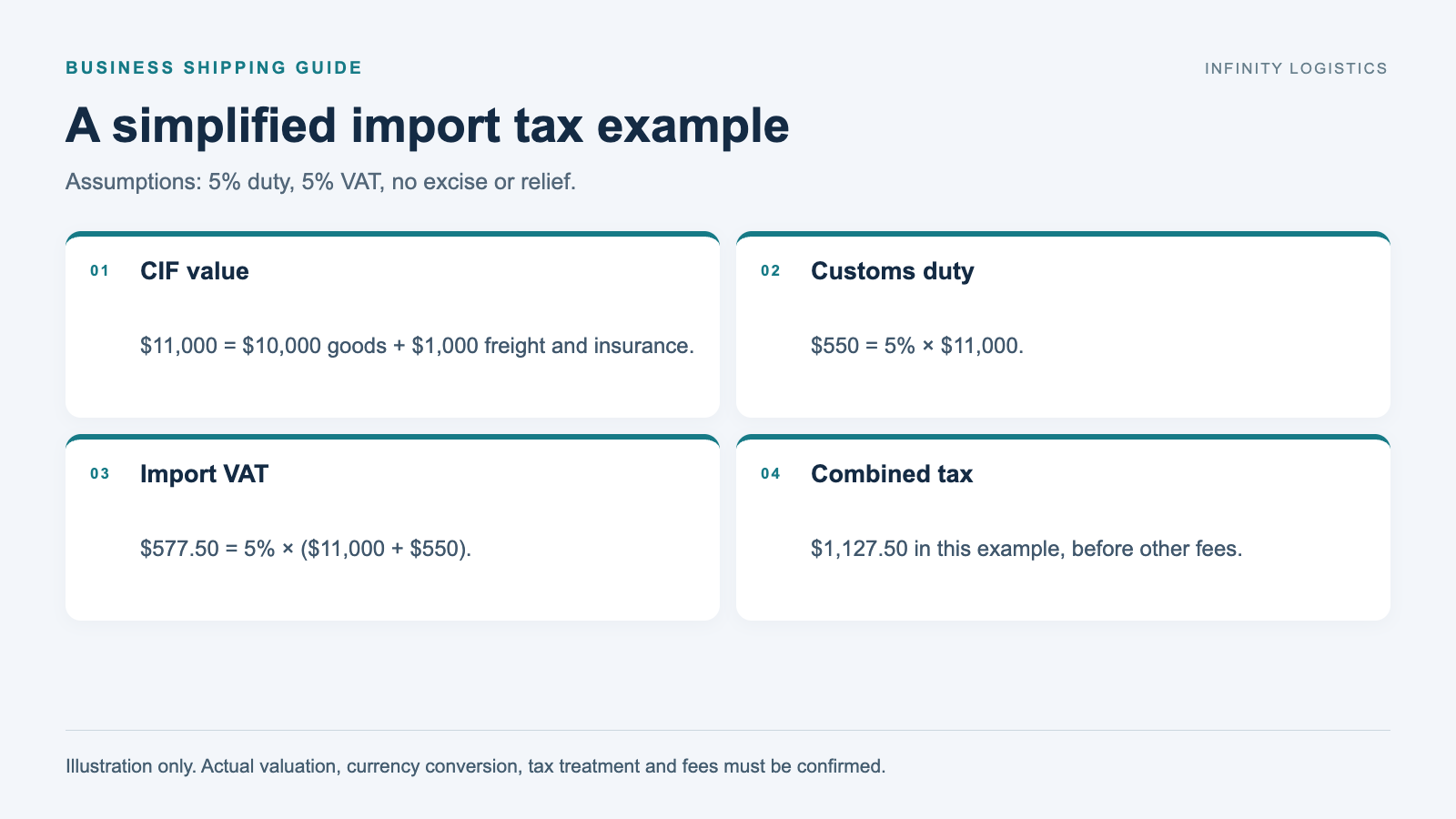
This simplified example assumes standard 5% customs duty and 5% VAT, no excise or relief, and excludes clearance, handling and delivery fees. Actual declarations use the applicable customs valuation and currency conversion.
- Cost of Goods (FOB Value): $10,000
- International Freight & Insurance: $1,000
- CIF Value: $10,000 + $1,000 = $11,000
- Customs Duty Calculation:
$11,000 (CIF) x 5% = $550 - VAT Calculation:
($11,000 (CIF) + $550 (Duty)) x 5% = $11,550 x 5% = $577.50 - Total Import Taxes:
$550 (Duty) + $577.50 (VAT) = $1,127.50
In this example, the total tax burden is approximately 10.25% of the CIF value. This calculation is essential for any business looking to import from USA to UAE.
Documents That Clear US Goods into the UAE
Smooth customs clearance depends on having a complete and accurate set of documents. Delays often start with missing or inconsistent paperwork. According to Dubai Customs, the following documents are required for commercial imports:
Core Transport and Commercial Documents
- Commercial Invoice: Must detail the shipper, consignee, description of goods, HS codes, value of each item, and Incoterms.
- Air Waybill (AWB) or Bill of Lading (B/L): The contract of carriage for air or sea freight, respectively. The details must match the commercial invoice.
Proving Origin and Packing Details
- Certificate of Origin (COO): A document, typically certified by a Chamber of Commerce in the USA, that attests to the country where the goods were manufactured.
- Packing List: A detailed list of the contents of each package, including weights and dimensions. This is used by customs to verify the shipment's contents without necessarily opening every box.
Importer Registration and Permits
- Importer's Trade License & Customs Code: The importing business in the UAE must be registered with Dubai Customs and hold a valid trade license.
- Delivery Order (for sea freight): Issued by the shipping line's agent in the UAE, authorizing the release of cargo to the consignee.
- Permits for Restricted Goods: Shipments of restricted items (e.g., certain electronics, medical devices, foodstuffs) require pre-approval permits from the relevant UAE government ministry.
DDP or DAP: Who Pays the UAE Duty
Understanding Incoterms is vital for clarifying who is responsible for paying the import duties and taxes. For shipping from USA to Dubai, the most common terms are DAP and DDP.
DAP (Delivered At Place)
Under DAP terms, the seller is responsible for delivering the goods to a named place in the UAE, but the buyer is responsible for import clearance and paying all customs duties and VAT. The courier or freight forwarder will typically bill the consignee for these charges before releasing the shipment.
DDP (Delivered Duty Paid)
Under DDP terms, the seller is responsible for everything, including import clearance and paying all UAE customs duties and VAT. This provides the buyer with a clear, all-inclusive landed cost. The seller's price includes all costs to get the goods to the buyer's door.
Know Your Landed Cost with Infinity's DDP Service
For US exporters selling to the UAE, offering DDP terms can be a significant competitive advantage. Infinity Logistics facilitates this by offering a comprehensive DDP service for USA to UAE shipping. We estimate all UAE duties and VAT upfront, allowing the US shipper to provide a single, landed price to their UAE customer. Infinity then handles the payment of these charges during clearance, ensuring a seamless delivery experience for the buyer.
How Infinity Handles USA to UAE Imports
As a WCA Inter Global member and the Highly Commended Express Logistics Company of the Year at the Logistics Middle East Awards 2022, Infinity Logistics provides a single, reliable point of contact for all your import needs.
Key Account Rates on DHL, FedEx, and UPS
Infinity Logistics holds Key Account status with DHL, FedEx, and UPS simultaneously. As the #2 DHL partner in the UAE, we offer business express rates up to 65% below retail. Our AI agents compare all three networks in real time to find the right service for your shipment.
A Single Partner for Air, Sea, and Express
Whether you need express for a small sample, consolidated air freight for a time-sensitive pallet, or full container sea freight USA to UAE, Infinity provides a unified solution. Our operations, based in our Ajman Free Zone office and Dubai Investment Park warehouse, manage everything from US-side pickup to final UAE delivery.
DDP with Upfront Duty Estimates
Infinity offers DDP arrangements on this lane, subject to the agreed importer, service and commodity requirements. Duties and VAT can be estimated before dispatch; the final assessment and any excluded fees should be clear in the quote.
Quotes in Under 10 Minutes
Infinity's AI agents compare DHL, FedEx, and UPS rates in real time, so most enquiries get a quote in under 10 minutes. Get a USA to UAE quote and we will also price air and sea freight where they fit better.
Frequently Asked Questions
How long does shipping from the USA to Dubai take?
The transit time for shipping from USA to Dubai depends on the mode. Express courier services are the fastest, typically taking 3-4 business days. Consolidated air freight takes approximately 5-8 days. Sea freight is the most economical for large volumes but also the slowest, with transit times of 30-40 days from US ports to Jebel Ali.
How much import duty does the UAE charge on goods from the USA?
The UAE typically charges a standard customs duty of 5% on the CIF (Cost, Insurance, and Freight) value for most goods imported from the USA. In addition, a 5% VAT is applied to the sum of the CIF value and the customs duty. Some goods, like alcohol and tobacco, have much higher duty rates, while certain essential items may be exempt.
When does a US export need EEI filing?
EEI is generally required when goods under one Schedule B classification exceed $2,500, or an export licence requires filing regardless of value. Other mandatory filing provisions and exemptions can apply. The US exporter or authorised agent must confirm the rule and file before export where required.
Which documents do I need to import from the USA into the UAE?
To clear customs in the UAE, you will need a standard set of documents: a Commercial Invoice, a Packing List, a Certificate of Origin, and the transport document (an Air Waybill for air freight or a Bill of Lading for sea freight). The importing company in the UAE must also have a valid trade license and be registered with Dubai Customs.
Can the UAE duty be prepaid (DDP)?
Yes, Infinity can arrange DDP on eligible USA-to-UAE shipments. Agree the importer, duty payer, estimated taxes and any exclusions before booking. Customs makes the final assessment, so an estimate should not be treated as a guarantee of no additional charges.
Sources & References
Official and industry sources referenced in this guide:
- Customs duty | The Official Platform of the UAE Government
- Electronic Export Information (EEI) - International Trade Administration
- Schedule B - Census.gov
- [PDF] Customer Guide
- E-Commerce VAT Guide | VATGEC1
- EAR | Bureau of Industry and Security
- dubai customs
- Entry, transit and departure of cargo - gcaa.gov.ae
Tags
Related Articles
Ready to optimize your logistics?
Whether you need express shipping, freight forwarding, or warehousing — our AI finds the best rates and routes for your business.