
For businesses, shipping from the UK to the UAE is a question of speed versus cost. The short answer is to use express services for urgent parcels, air freight for shipments over 100 kg, and sea freight for bulk volume. Getting the customs paperwork right is the single most important factor in avoiding costly delays.
This guide provides a step-by-step breakdown for UK exporters and UAE importers. We cover the modes, transit times, documentation, and the taxes you'll face at the UAE border. This is the essential information for planning your UK to UAE shipping strategy for 2026.
How to ship from the UK to the UAE: the short answer
Every shipment has a deadline and a budget. The choice between express, air, and sea freight depends entirely on your shipment's weight, volume, and urgency. For most commercial goods, you can expect to pay 5% customs duty on the CIF value plus 5% VAT on top of that.
Key Decision Factors
- Express Courier: Best for documents, samples, and small, urgent parcels typically under 70 kg. It's the fastest but most expensive per kilogram.
- Air Freight: The optimal balance for time-sensitive commercial cargo from around 100 kg. Faster than sea, cheaper than express for larger weights.
- Sea Freight: The most cost-effective option for large, heavy, or non-urgent goods. Ideal for stock replenishment and bulk items where transit time is not the primary concern.
Standard Import Costs
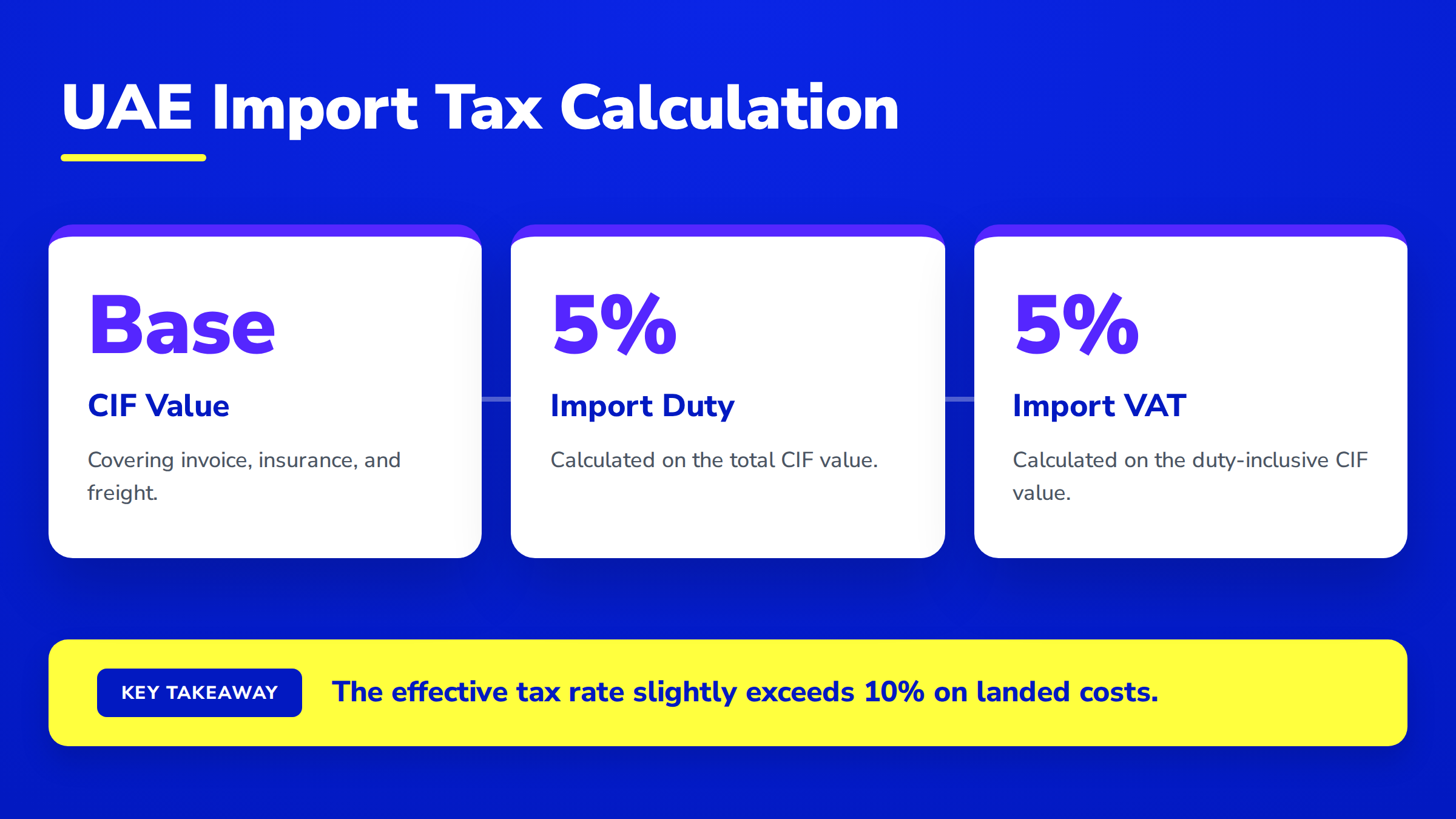
According to the official UAE Government platform, most goods imported into the UAE are subject to a 5% customs duty based on their CIF value (Cost, Insurance, and Freight). On top of this, a 5% Value Added Tax (VAT) is applied to the duty-inclusive value of the goods.
Express, air freight or sea freight: which fits your shipment
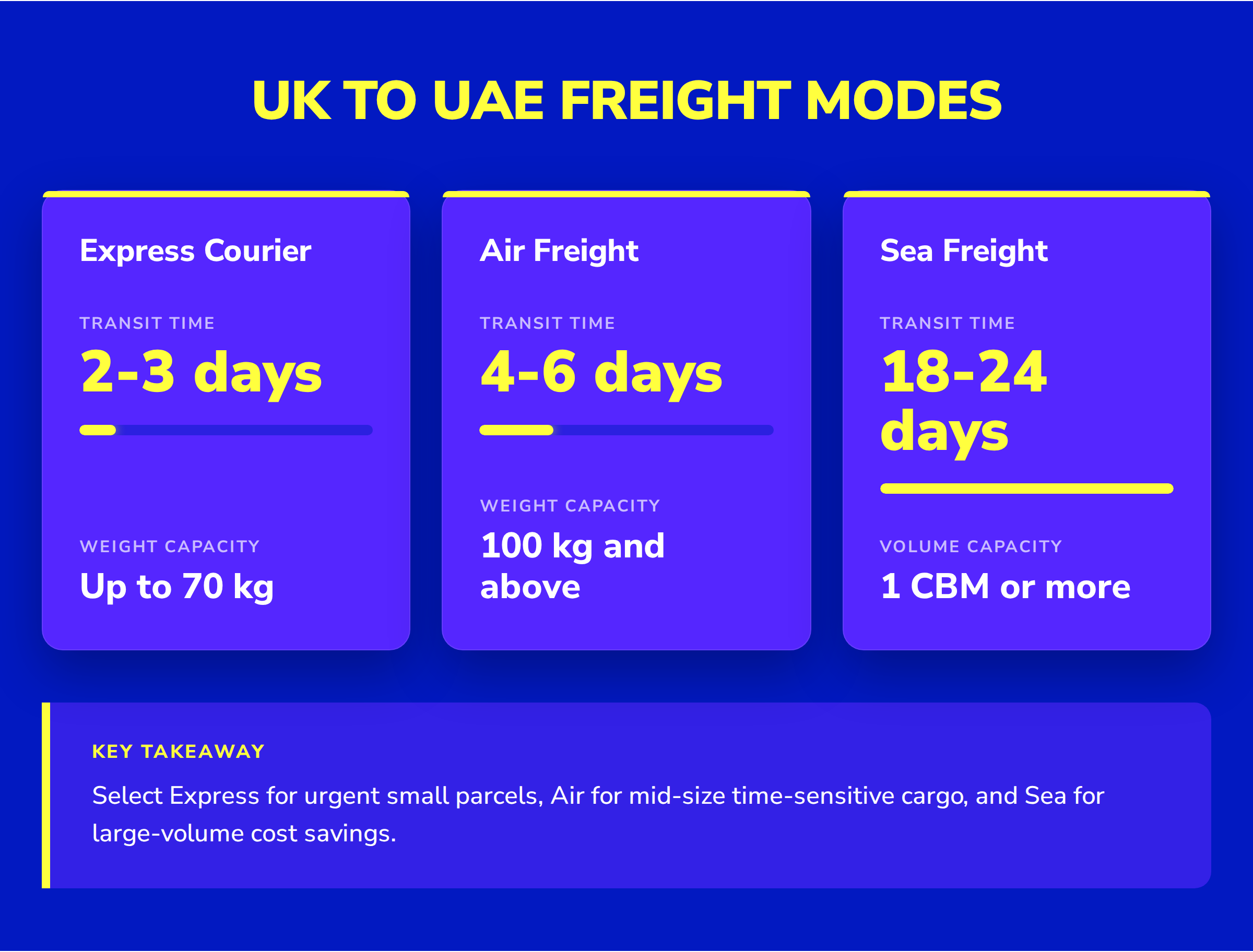
Choosing the right mode for shipping from the UK to the UAE comes down to weight, volume and deadline.
The following table breaks down the best use case for each mode.
| Shipping Mode | Best For | Typical Weight / Volume | Typical Transit Time (Door-to-Door) |
|---|---|---|---|
| Express Courier (e.g., DHL, FedEx, UPS) | Urgent documents, samples, e-commerce orders, high-value small items | Up to 70 kg | 2-3 days |
| Air Freight | Time-sensitive commercial cargo, electronics, fashion, spare parts | 100 kg+ | 4-6 days |
| Sea freight (LCL/FCL) | Bulk goods, stock replenishment, machinery, non-urgent cargo | 1 CBM+ or full containers | 18-24 days |
When to Use Express Courier
Express courier is the default for speed and convenience. If you are sending urgent documents from London to a client in Dubai or fulfilling a high-value e-commerce order, express is the answer. The service is door-to-door, and customs clearance is integrated. While the per-kilogram cost is highest, it's often the most economical choice for shipments under 70 kg, as it avoids the minimum charges associated with general air freight.
When to Use Air Freight
Air freight UK to UAE becomes the logical choice when your shipment is too large for a courier but still time-sensitive. For cargo starting around 100 kg, the per-kilogram rate for air freight is significantly lower than express. This mode is ideal for commercial goods like electronics, apparel, or critical machinery parts that need to reach the UAE market quickly. The UAE's air freight market is robust, with Dubai International (DXB) handling over 517,000 tonnes of cargo in Q1 2025 alone, as reported by STAT Times, ensuring frequent and reliable capacity from UK hubs like Heathrow.
When to Use Sea Freight
For large-volume, heavy, or non-urgent shipments, sea freight UK to UAE offers the lowest cost per unit. This is the standard for businesses replenishing stock, shipping raw materials, or moving large capital goods. You can ship via Less-than-Container Load (LCL), where your goods share a container, or Full-Container Load (FCL) for larger volumes. The main trade-off is time. With major UK ports connecting to Dubai's Jebel Ali port, one of the world's busiest, it's a reliable but slower option.
Transit times by city pair
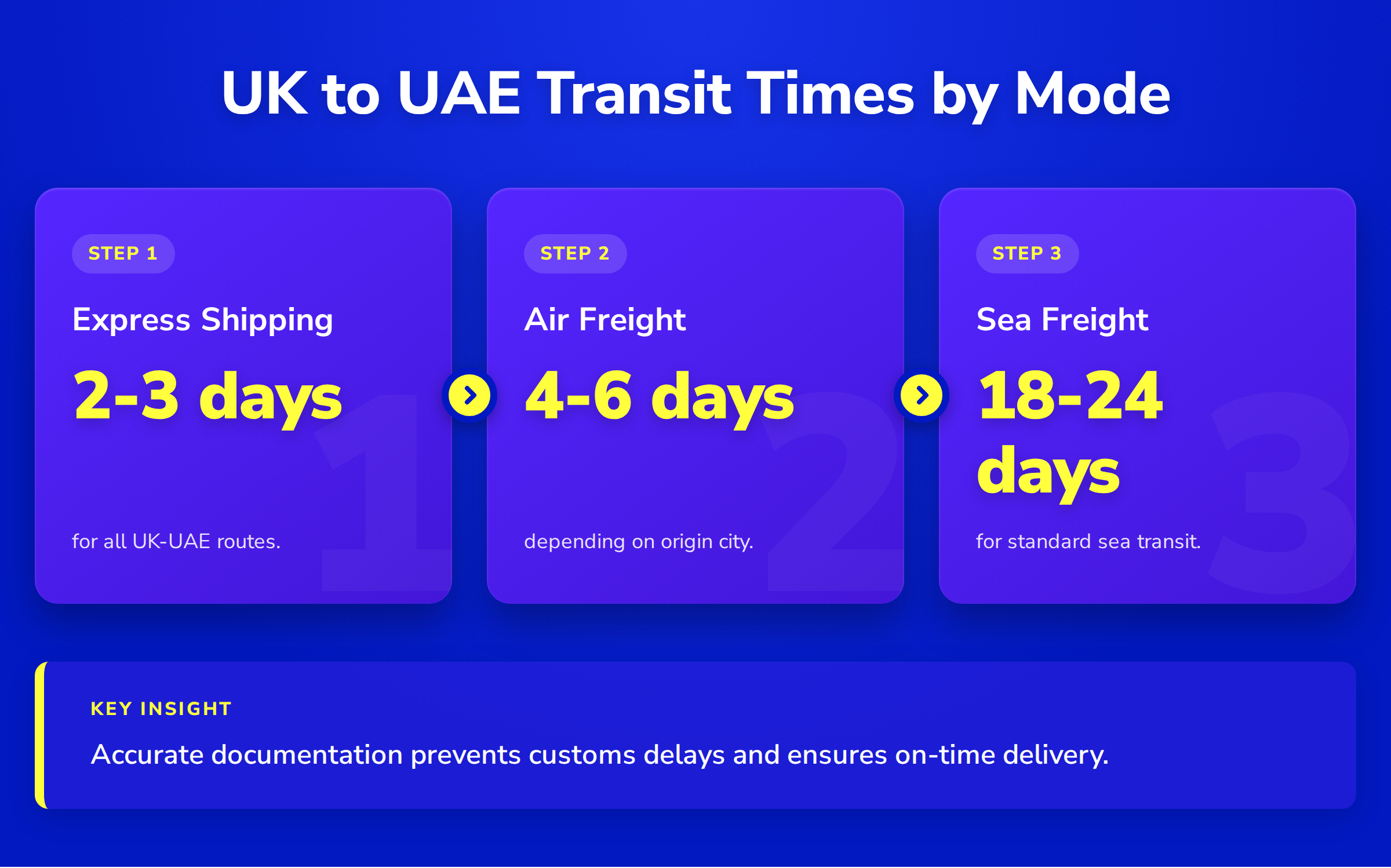
Transit times are a critical planning factor. While schedules can vary by carrier and service level, the following are typical door-to-door estimates for business shipments handled by Infinity Logistics.
- London to Dubai:
- Express: 2-3 days
- Air Freight: 4-5 days
- Sea Freight: 18-22 days
- Manchester or Birmingham to Abu Dhabi or Sharjah:
- Express: 2-3 days
- Air Freight: 4-6 days
- Sea Freight: 20-24 days
These timelines include standard customs clearance. As a U.S. International Trade Administration guide notes for the UAE, accurate documentation is key to achieving these standard times. Delays are almost always caused by paperwork errors, not the physical transit itself.
UAE import duty and VAT on UK goods
Understanding the costs at the UAE border is essential for pricing and profitability. For most goods, the calculation is straightforward, but the details matter. The total landed cost is determined by the duty and VAT applied to your shipment's value.
CIF Value Explained
CIF Value is the basis for calculating customs duty in the UAE. It is a definitional term that stands for Cost, Insurance, and Freight.
CIF = Commercial Invoice Value + Cost of Insurance + Cost of Freight
This means the duty is not just on the price of your goods, but on the total cost to get them to the UAE border. Your commercial invoice must clearly state these components.
UAE Import Duty from UK: Typically 5%
The UAE, as part of the GCC, applies a common external tariff. For most goods arriving from the UK, the UAE import duty from UK is 5% of the CIF value. Some goods, like certain essential foods and medicines, are exempt (0% duty), while others like alcohol and tobacco face much higher rates. However, for general commercial cargo, 5% is the standard you should plan for.
VAT on Imports: A Further 5%
In addition to customs duty, the UAE applies a Value Added Tax (VAT) at a standard rate of 5% on most imports. Crucially, VAT is calculated on the duty-inclusive value.
VAT Base = CIF Value + Customs Duty
This means the effective tax rate is slightly more than 10%. For a VAT-registered business in the UAE, this import VAT is typically recoverable, but the customs duty is a sunk cost.
DDP vs. DAP: Who Pays the Charges?
When you get a quote for shipping to UAE from UK, you'll encounter Incoterms like DDP and DAP.
- DDP (Delivered Duty Paid): The seller (the UK exporter) is responsible for all costs, including transport, customs clearance, duty, and VAT in the UAE. This offers the UAE buyer a clear, all-inclusive price. Infinity Logistics can manage the entire DDP process, calculating and paying all charges on your behalf.
- DAP (Delivered at Place): The seller is responsible for transport to an agreed-upon point in the UAE, but the buyer (the UAE importer) is responsible for handling UAE customs clearance and paying all duties and taxes. This is common in B2B transactions where the importer prefers to manage their own tax affairs.
Documents for UK to UAE shipments
Incorrect or incomplete paperwork is the number one cause of delays and fines when shipping to the UAE. To ensure smooth passage, your shipment must be accompanied by precise documentation.
Need a shipping quote?
Get AI-optimized rates from DHL, FedEx & UPS — up to 65% below retail. Quote in under 10 minutes.
Commercial Invoice
This is the most critical document. It must be an original, signed, and stamped document containing:
- Full details of the shipper (UK) and consignee (UAE).
- A detailed, specific description of each item (no generic terms like "parts" or "samples").
- Quantity, unit price, and total value for each item.
- The currency of the sale.
- The country of origin.
- The correct HS code for each item.
Packing List
A detailed packing list must accompany the commercial invoice, detailing the contents of each box or pallet. It should include the net and gross weight and dimensions of each package. The information must match the commercial invoice exactly.
HS Codes
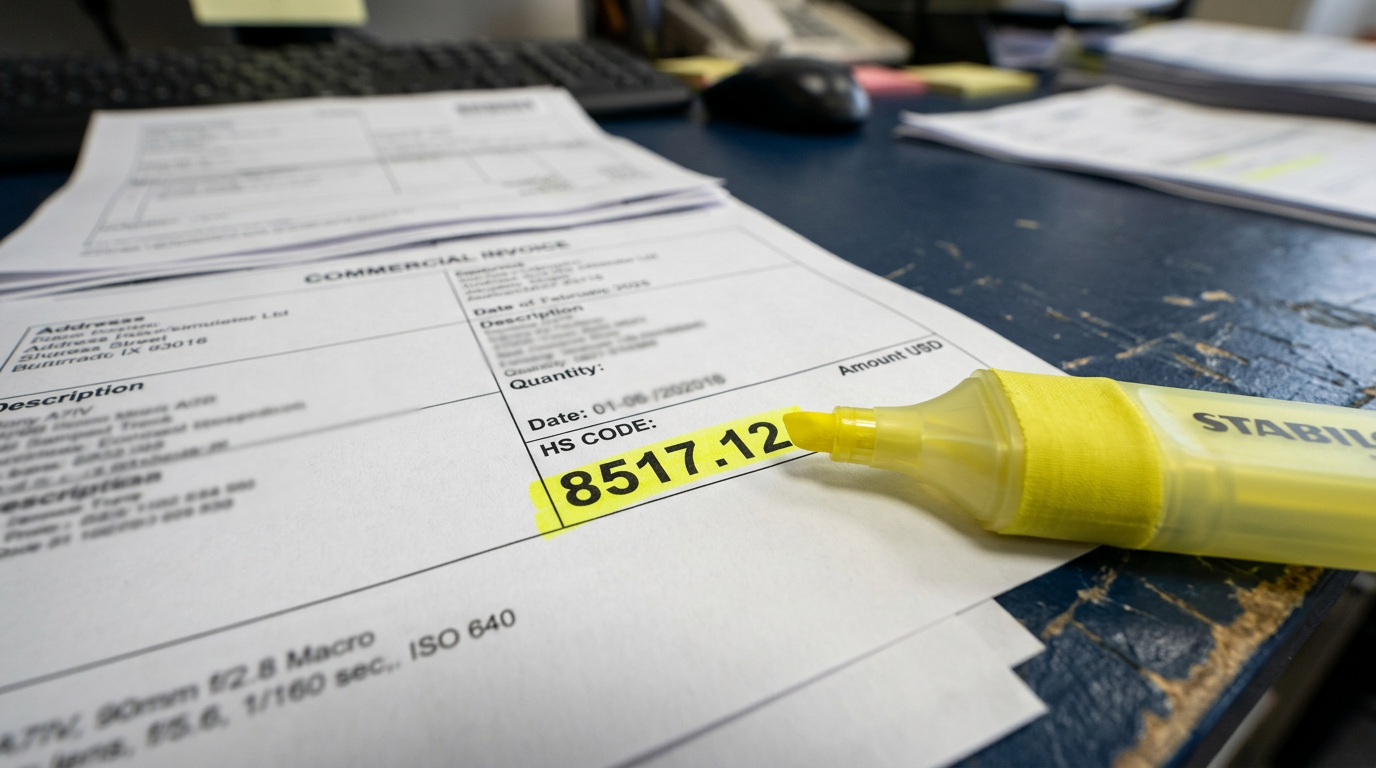
An HS Code (Harmonized System Code) is a global standard for classifying traded products. A valid, minimum 6-digit HS code is mandatory for every item on your commercial invoice. As of early 2024, UAE authorities require HS codes to be included on air waybills for all shipments. Failure to provide a correct HS code can result in delays, re-classification fees, and incorrect duty assessments.
Certificates for Regulated Goods
Certain goods require additional certification to enter the UAE. This includes, but is not limited to, cosmetics, foodstuffs, pharmaceuticals, and electronics. These goods may require a Certificate of Origin, health certificates, or conformity assessments from approved bodies. Infinity Logistics checks these requirements on a case-by-case basis before shipping to prevent goods from being stopped at the border.
Common delays and how to avoid them
Compliant shipments clear smoothly, but simple mistakes can add days or even weeks to your transit time. Here are the most common pitfalls and how to steer clear of them.
Vague Invoice Descriptions
The Problem: Invoices listing "spare parts" or "electronics" are automatically flagged for manual review. Customs officers cannot classify the goods or assess risk without specific details.
The Solution: Be hyper-specific. Instead of "clothing," write "Men's cotton t-shirts, 100% cotton, blue, SKU 12345."
Missing or Incorrect HS Codes
The Problem: Since the UAE's National Advance Information Center (NAIC) mandated HS codes on air waybills in 2024, this has become a major compliance checkpoint. An incorrect code leads to rejection of the customs declaration.
The Solution: Verify every HS code before shipping. Use the UK government's trade tariff tool and cross-reference with your logistics partner. Infinity Logistics validates HS codes as part of its quoting and booking process.
Undeclared Regulated Goods
The Problem: Shipping items like cosmetics, supplements, or battery-powered devices without the required pre-approvals or certifications will result in the shipment being detained.
The Solution: Always declare the nature of your goods to your freight forwarder. Infinity's team will advise if any special permits from UAE authorities (like the Telecommunications and Digital Government Regulatory Authority or local municipalities) are needed.
Incomplete Consignee Details
The Problem: A missing phone number, an incomplete address, or an incorrect contact person for the consignee in the UAE can prevent customs or the carrier from making contact to resolve issues or arrange final delivery.
The Solution: Double-check that all consignee information is complete and accurate on the bill of lading and commercial invoice. A valid local phone number and email address are essential.
How Infinity handles UK to UAE shipments
Infinity Logistics provides a single point of contact for all your shipping needs, from express parcels to full container loads. Our model is built to provide clarity, control, and cost-efficiency for businesses.
One Quote, Three Express Networks
For urgent courier UK to Dubai shipments, finding the best rate can be time-consuming. Infinity Logistics is a Key Account partner with DHL, FedEx, and UPS. Our AI-powered quoting platform, which delivers quotes in under 10 minutes, compares all three networks in real-time to find the optimal balance of speed and price for your specific shipment. This status as the #2 DHL partner in the UAE and our high volume allows us to offer business express rates up to 65% below retail.
Integrated Air and Sea Freight
For larger shipments, Infinity manages both air freight UK to UAE and ocean freight. We handle everything from UK-side collection to final delivery in the UAE. Whether you need the speed of a direct flight from Heathrow to Dubai or the economy of sea freight into Jebel Ali, we provide a seamless door-to-door solution.
Expert UAE Customs Clearance and DDP
Infinity Logistics works out the duty and VAT before your goods leave the UK. We offer a full DDP (Delivered Duty Paid) service, meaning we handle the payment of the 5% duty and 5% VAT, so your customer in the UAE receives their goods without any surprise charges.
Strategic Warehousing in the UAE
Founded in 2017, Infinity Logistics operates from our office in Ajman Free Zone and warehouse in Dubai Investment Park. For clients needing storage and distribution, we provide flexible warehousing solutions in key logistics hubs, including JAFZA (Jebel Ali Free Zone), DIP (Dubai Investment Park), and Al Quoz. This allows UK businesses to hold stock in the UAE for faster fulfillment to local and regional customers, and also manage any reverse logistics for UAE to UK shipping.
Ready to plan your next UK to UAE shipment? Get a quote from Infinity today.

Frequently Asked Questions
How long does shipping from the UK to Dubai take?
The transit time for shipping from UK to Dubai depends entirely on the mode of transport. For urgent shipments, express courier services typically take 2-3 business days. Air freight is slightly longer, with door-to-door transit times around 4-5 days. For larger, less urgent shipments, sea freight is the most economical option, with a transit time of approximately 18-22 days.
What duty do I pay on goods from the UK?
For most commercial goods imported into the UAE from the UK, you will pay a customs duty of 5% on the CIF value (Cost, Insurance, and Freight). In addition, a 5% Value Added Tax (VAT) is levied on the total of the CIF value plus the duty paid. Some specific goods like alcohol and tobacco have higher rates, while certain essential items may be exempt from duty.
Can you ship DDP from the UK?
Yes, it is possible to ship DDP (Delivered Duty Paid) from the UK to the UAE. Under DDP terms, the seller is responsible for all costs, including transportation, customs clearance, and payment of any duties and taxes in the UAE. Infinity Logistics handles DDP shipments, providing UK exporters with a clear, all-inclusive cost and ensuring a smooth, charge-free delivery experience for their UAE-based customers.
Which documents do I need?
To ship goods from the UK to the UAE, you will need a minimum of three core documents: a Commercial Invoice with a detailed description of the goods, value, and HS codes; a Packing List detailing the contents, weight, and dimensions of each package; and a Bill of Lading (for sea) or Air Waybill (for air). For certain regulated products, you may also need a Certificate of Origin or other special permits.
Is sea freight worth it for small shipments?
Generally, sea freight is not cost-effective for very small shipments. Ocean freight carriers and forwarders have minimum charges based on volume (typically 1 cubic meter) or weight. If your shipment is significantly smaller than this, the cost of an express courier or consolidated air freight will likely be more economical and much faster. Sea freight becomes the most viable option when shipping several pallets or larger, bulkier items where cost per kilogram is more important than speed.
Sources & References
Official and industry sources referenced in this guide:
Tags
Related Articles
Ready to optimize your logistics?
Whether you need express shipping, freight forwarding, or warehousing — our AI finds the best rates and routes for your business.