
Shipping from Dubai to Japan goes smoothly when the paperwork is accurate. Japan Customs checks documents closely, so a clean commercial invoice, packing list and HS codes matter as much as speed.
The short answer is this: express shipments arrive in 2-3 days, air freight in 4-6 days, and sea freight in 20-25 days. On arrival, Japan charges a consumption tax of 10% (or a reduced 8%) on the customs value of the goods plus any applicable duty. This guide provides the detailed breakdown your business needs for smooth UAE to Japan shipping.
How to Ship from Dubai to Japan: The Short Answer
Choosing the right shipping mode and understanding the costs upfront are the first steps. Japan's import system is efficient but requires precise documentation. Here are the core facts for planning your shipment.
Transit Time Benchmarks
- Express Courier: 2-3 business days for door-to-door delivery of documents and parcels.
- Air Freight: 4-6 days from Dubai (DXB) to Narita or Kansai, for shipments over about 100 kg.
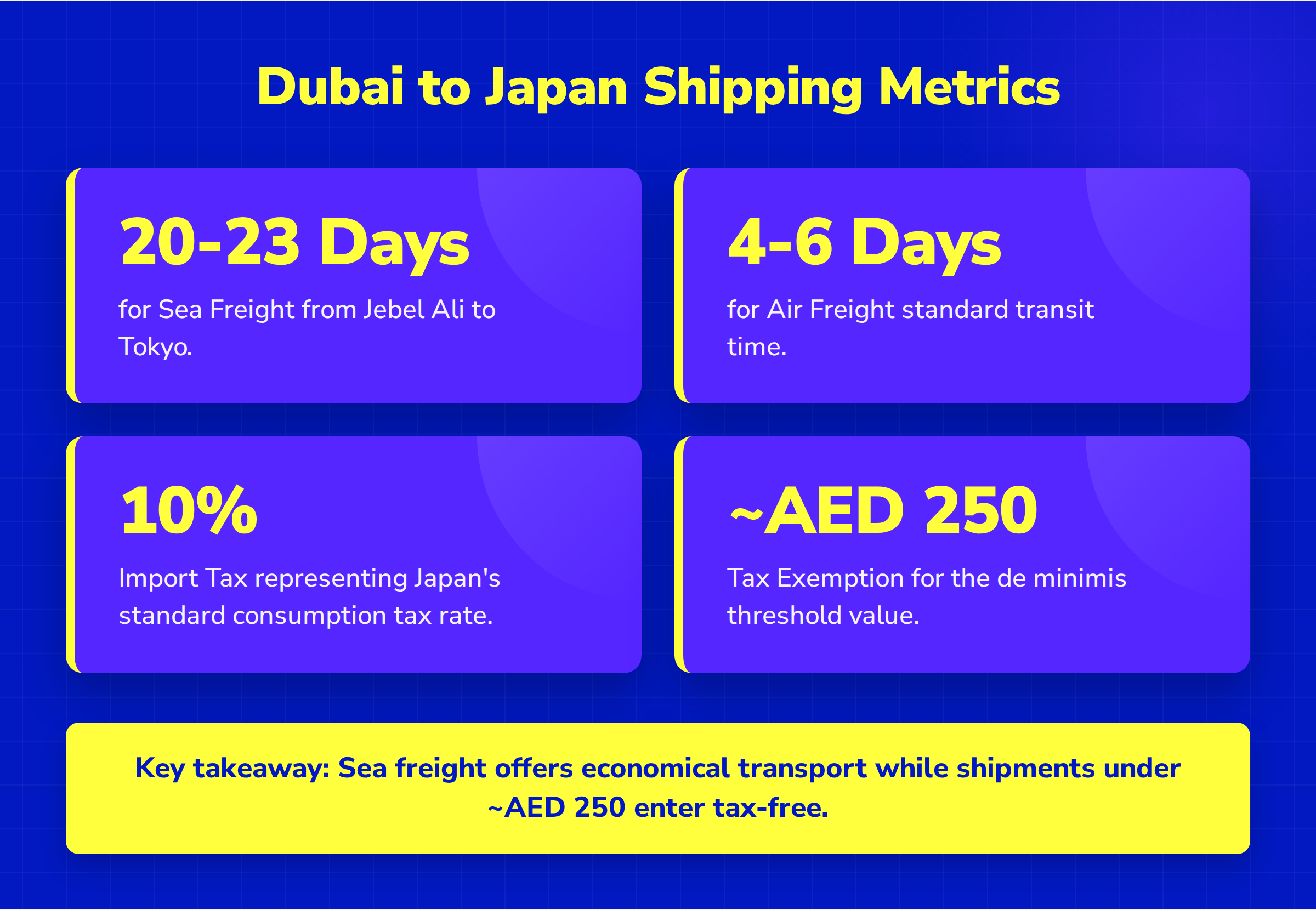
- Sea Freight: 20-25 days for port-to-port transit from Jebel Ali to major Japanese ports like Yokohama or Kobe.
Japan's Import Taxes
According to Japan Customs, a consumption tax is levied on almost all imported goods. This is calculated on the customs value (the cost of goods, insurance, and freight, or CIF value) plus the customs duty amount. The standard rate is 10%, with a reduced rate of 8% for certain foods and beverages.
Express, Air Freight or Sea Freight to Japan
The optimal mode for shipping from UAE to Japan depends on your shipment's urgency, size, and budget. Each option serves a distinct business need, from urgent samples to bulk stock replenishment.
Comparison of Shipping Modes: Dubai to Japan
| Mode | Typical Transit Time | Best For | Cost Per KG |
|---|---|---|---|
| Express Courier | 2-3 Days (Door-to-Door) | Urgent documents, samples, high-value parts, e-commerce orders | Highest |
| Air Freight | 4-6 days (DXB to Narita or Kansai) | Shipments >100 kg, time-sensitive stock, electronics | High |
| Sea Freight | 20-25 Days (Port-to-Port) | Bulk goods, non-urgent stock, heavy machinery, vehicles | Lowest |
When to Use Express Courier
For time-critical deliveries, use worldwide express. Infinity holds Key Account status with DHL, FedEx and UPS, with business rates up to 65% below retail. Express suits prototypes, legal documents and replacement parts, where speed justifies the higher cost.
When to Use Air Freight
When you need to move palletized goods or larger consignments faster than sea, use air freight. Infinity publishes 4-6 days from Dubai (DXB) to Narita (NRT) or Kansai (KIX), for shipments over about 100 kg. It balances speed and cost for stock such as electronics or fashion.
When to Use Sea Freight
For large-volume, cost-sensitive goods, sea freight is the most economical choice. Full container (FCL) or part container (LCL) both suit bulk materials, furniture and stock. Infinity publishes 20-25 days from Jebel Ali to Yokohama and Kobe. Infinity is a WCA Inter Global member.
Transit Times to Japanese Cities
Delivery times depend on the destination within Japan: Tokyo is faster than Sapporo, for example. The times below are the estimates Infinity publishes for each city.
Infinity Logistics publishes the following transit time estimates for cargo from Dubai to Japan:
| Destination City | Express Priority | Air Freight | Sea Freight |
|---|---|---|---|
| Tokyo | 2-3 Days | 4-6 Days | 20-23 Days |
| Osaka | 2-3 Days | 4-6 Days | 20-24 Days |
| Yokohama | 2-3 Days | 4-6 Days | 20-23 Days |
| Nagoya | 2-3 Days | 4-6 Days | 21-25 Days |
| Fukuoka | 2-3 Days | 5-6 Days | 22-25 Days |
| Sapporo | 3 Days | 5-7 Days | 23-26 Days |
Note: These are estimates and can be affected by customs clearance, weather, and final delivery location.
UAE Export Paperwork
Japan’s customs authorities are meticulous. Any discrepancy between your documents can lead to delays. Clean, consistent paperwork is the fast lane for your shipment.
Core Export Documents
According to the Dubai Customs Customer Guide, any commercial export from the UAE to a country outside the GCC requires several key documents:
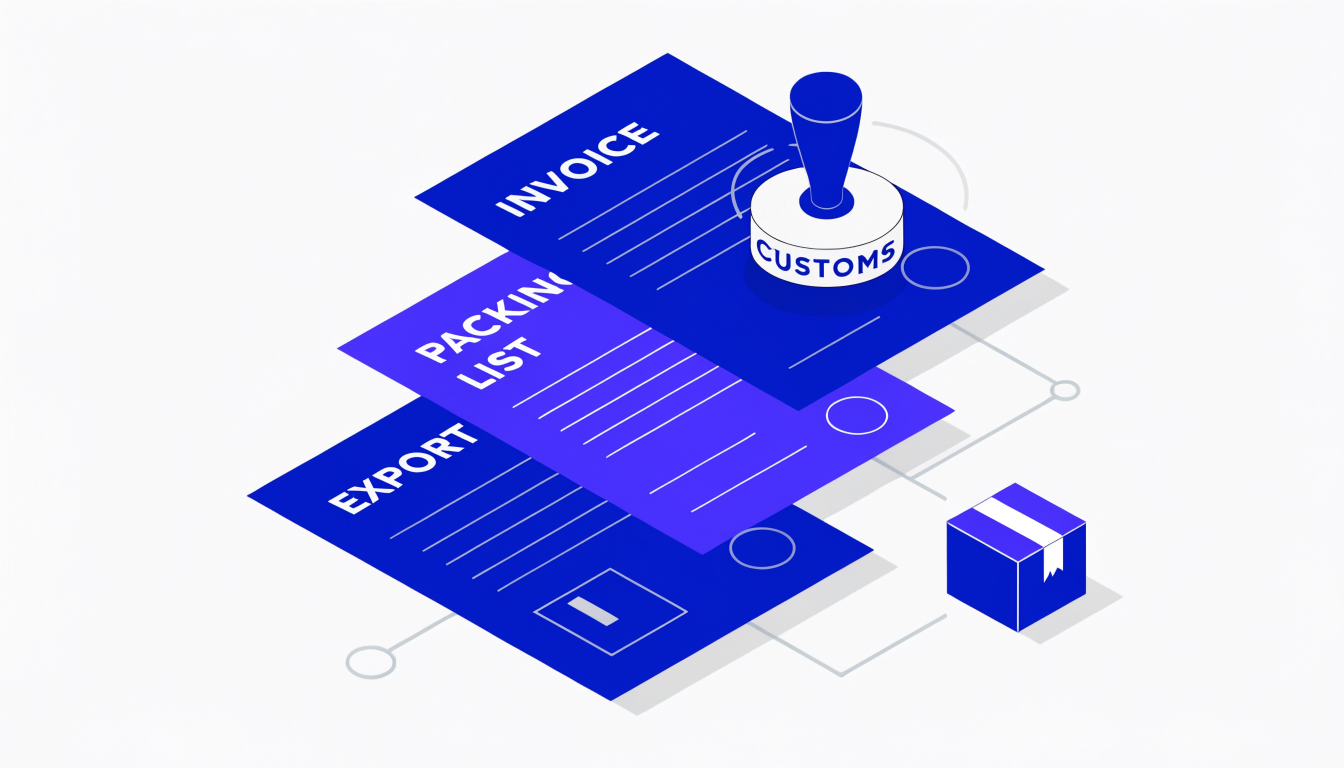
- Export Declaration: Filed electronically with customs for commercial exports. Your freight forwarder typically handles this.
- Commercial Invoice: Details the buyer, seller, goods description, value, currency, and Incoterms.
- Packing List: An itemized list of the shipment's contents, including weights and dimensions for each package.
Harmonized System (HS) Codes
An HS code is a standard number for classifying traded products, maintained by the World Customs Organization. Give an accurate HS code for every item on your commercial invoice. Japan builds its own longer national codes on the HS to set duty and identify controlled goods, and an incorrect code can delay clearance.
Export Permits for Restricted Goods
Most general goods do not need a special permit, but the UAE restricts the export of certain items. If your products are restricted, get an export permit from the relevant controlling authority before shipping.
Japan's Consumption Tax and the 10,000 Yen Exemption
Understanding Japan's tax system is crucial for pricing and managing costs. Unlike a simple sales tax, Japan's import consumption tax is levied on the value of the goods *plus* the duty paid.
Need a shipping quote?
Get AI-optimized rates from DHL, FedEx & UPS — up to 65% below retail. Quote in under 10 minutes.
Consumption Tax Rates: 10% and 8%
Japan's consumption tax is applied to nearly all goods imported for commercial purposes.
- Standard Rate (10%): Applies to most goods, including electronics, machinery, apparel, and general merchandise.
- Reduced Rate (8%): Applies to specific items, primarily food and non-alcoholic beverages.
The tax base is the customs value (CIF) plus any customs duty and other applicable excise taxes, so consumption tax is also charged on the duty.
Worked Example: Calculating Consumption Tax
Take a shipment from Dubai to a buyer in Osaka. Duty depends on the HS code; 3% is used here only to show the arithmetic.
- Customs Value (CIF): ¥150,000
- Customs Duty Rate (Illustrative): 3% (¥4,500)
- Taxable Base: ¥150,000 (CIF) + ¥4,500 (Duty) = ¥154,500
- Consumption Tax (10%): ¥154,500 x 10% = ¥15,450
- Total Import Charges: ¥4,500 (Duty) + ¥15,450 (Tax) = ¥19,950
The 10,000 Yen Small-Value Exemption
However, the exemption does not apply to designated items such as leather bags, gloves, knitted apparel, ski boots and leather-soled shoes. For these, duty and tax are charged regardless of value.
Simplified Tariff for Small Packages
For shipments with a total customs value of 200,000 yen or less, Japan Customs allows a simplified tariff schedule.
DDP or DAP to Japan
The choice between Delivered at Place (DAP) and Delivered Duty Paid (DDP) determines who is responsible for paying the import duties and taxes in Japan.
DAP: Delivered at Place
Under DAP terms, the seller (you) is responsible for arranging and paying for transport to a named destination in Japan. However, the buyer is responsible for import customs clearance and for paying all applicable duties and the 10% consumption tax. This is a common arrangement for B2B shipments where the Japanese buyer prefers to handle their own customs formalities.
DDP: Delivered Duty Paid
Infinity offers DDP on the UAE to Japan lane, so you can prepay Japan's duties and consumption tax and your buyer pays nothing on arrival.
How Infinity Handles Dubai to Japan Shipments
Infinity handles Dubai to Japan shipments across express, air freight and sea freight, with customs paperwork prepared in Dubai.
One Quote, Three Express Networks
As the #2 DHL partner in the UAE and a Key Account holder with FedEx and UPS, Infinity offers business express rates up to 65% below retail. Our AI agents compare all three networks in real time, so most enquiries get a quote in under 10 minutes.
Integrated Air and Sea Freight
For larger shipments, we arrange air freight to Narita and Kansai and LCL or FCL sea freight to Yokohama and Kobe, for example for automotive parts logistics. Infinity has warehousing in JAFZA, DIP and Al Quoz for cargo preparation before export.

DDP and Customs Expertise
With DDP on this lane, Infinity prepays Japan's duties and consumption tax on your behalf. We check that your commercial invoice, packing list and HS codes match before the shipment leaves Dubai. Infinity is a WCA Inter Global member and was Highly Commended as Express Logistics Company of the Year at the Logistics Middle East Awards 2022.
Ready to ship? Get a Japan quote in minutes or explore our complete UAE to Japan shipping services.
Frequently Asked Questions
How long does shipping from Dubai to Tokyo take?
Shipping times to Tokyo depend on the mode. Express takes 2-3 business days door to door. Air freight takes about 4-6 days. Sea freight is the most economical but the slowest: about 20-23 days from Jebel Ali to the Tokyo area.
What is Japan's import consumption tax?
Japan levies an import consumption tax on nearly all goods. The standard rate is 10%, with a reduced rate of 8% for items like food and non-alcoholic beverages. According to Japan Customs, this tax is calculated on the customs value of the goods (cost, insurance, and freight) plus any applicable customs duties. This means the tax is applied to the duty-paid value of the shipment.
Is there a small-value exemption in Japan?
Yes. Japan exempts imported goods with a total customs value of 10,000 yen or less from customs duty and consumption tax. This is often called a "de minimis" threshold. The exemption does not apply to designated items such as leather bags, gloves, knitted apparel, ski boots and leather-soled shoes.
Can duty and tax be prepaid for the buyer?
Yes, by shipping under DDP (Delivered Duty Paid). Under DDP, the seller pays for transport, customs clearance and Japan's duties and taxes. Infinity offers DDP on the UAE to Japan lane, so UAE exporters can quote their Japanese customers one final price.
Which port does sea freight to Japan use?
For sea freight from Dubai (Jebel Ali Port), the most common destination ports in Japan are the Port of Yokohama and the Port of Kobe. The Port of Yokohama serves the greater Tokyo area, while the Port of Kobe serves the Osaka-Kobe-Kyoto metropolitan region. Other major ports include Nagoya and Tokyo itself. The choice of port depends on the final destination of the cargo within Japan.
Sources & References
Official and industry sources referenced in this guide:
Tags
Related Articles
Ready to optimize your logistics?
Whether you need express shipping, freight forwarding, or warehousing — our AI finds the best rates and routes for your business.