
Dubai Cargo & International Shipping Services: Complete Guide for Business Success
Dubai Cargo & Shipping Landscape: Your Gateway to Global Trade
Dubai has emerged as the Middle East's premier logistics hub, strategically positioned at the crossroads of Asia, Europe, and Africa. This unique geographic advantage, combined with world-class infrastructure, has transformed the emirate into a global trade powerhouse. According to Mordor Intelligence's 2026 UAE Freight & Logistics Market Report, the UAE freight and logistics market is projected to reach USD 23.05 billion in 2026, growing at a robust 6.55% CAGR through 2031.
Dubai's strategic position enables seamless connectivity across major trade corridors. The emirate serves as a vital re-export hub, with Dubai and Abu Dhabi generating over 70% of UAE retail sales, creating concentrated parcel densities that enable rapid delivery services. Air freight forwarding alone accounts for 44.33% of forwarding revenue, supported by extensive networks like Emirates SkyCargo's 140 destinations worldwide.
The infrastructure supporting Dubai cargo operations is truly world-class. Dubai International Airport (DXB) maintains its position as a top global hub for international air cargo tonnage, with air cargo demand rising 5.6% in January 2026 compared to the previous year. Meanwhile, Jebel Ali Port has achieved remarkable growth, reaching over 100 million TEU throughput capacity by January 2025 through DP World's USD 2.5 billion investment program – an impressive 8.3% increase from 2024 volumes.
The major trade corridors flowing through Dubai represent the backbone of regional commerce. The UAE-USA, UAE-UK, UAE-Europe, UAE-China, and UAE-GCC routes collectively handle the majority of cargo volume, with the GCC corridor alone comprising over 70% of regional cargo flows. This concentration is driven by the booming e-commerce sector, projected to reach $8 billion by end-2026, further cementing Dubai's role as the region's logistics gateway.
Dubai's business ecosystem reflects this growth trajectory, with over 15,000 trading companies, 8,000+ logistics providers, and 500+ freight forwarders operating within the emirate. The integration of multimodal transport options, including the new Etihad Rail Phase 2 spanning 605 km and lifting capacity to 50 million tonnes by 2050, alongside UPS's USD 100 million investment in Dubai South for automated sorting, demonstrates the continuous evolution of Dubai's logistics infrastructure to meet growing global demand.
Types of Dubai Cargo Services: Express, Freight & Specialized Solutions
Dubai's comprehensive cargo service portfolio spans multiple transportation modes, each designed to meet specific business needs and timelines. Understanding these options is crucial for businesses seeking optimal shipping services from the emirate.
Express logistics services form the fastest tier of Dubai's cargo offerings, handling time-sensitive documents, parcels, and samples with delivery timeframes of 1-5 days globally. Major carriers including DHL, FedEx, and UPS operate extensive networks from Dubai, though recent market conditions have created challenges. According to Mathez Freight's 2026 analysis, 21% of global air freight flows are directly impacted by regional disruptions, affecting transit times and capacity. Despite these challenges, the Middle East air cargo market maintains its value at USD 14 billion as of January 2026, driven by e-commerce growth projected to reach $28.5 billion with a 20% annual growth rate.
Air freight services accommodate commercial cargo and FCL/LCL shipments, typically operating on 3-7 day timelines through carriers like Emirates SkyCargo and Maersk. The sector faces a significant supply-demand imbalance, with global air cargo demand rising 5.6% in January 2026 while capacity increased only 3.6% year-over-year. This constraint has created opportunities for innovative solutions, including Dubai's pioneering "Sea-Air" connectivity model that strengthens Asia-Europe supply chain resilience.
Sea freight services remain the backbone of bulk cargo transportation, offering FCL containers and LCL consolidation with standard transit times of 15-45 days. Jebel Ali Port's strategic importance cannot be overstated – as one of the world's largest container ports, it handles a significant portion of regional maritime trade. Major carriers including Maersk, CMA CGM, and Hapag-Lloyd have adapted their routes to ensure continuity, though some vessels now route via the Cape of Good Hope, adding 10-15 days to transit times.
Road freight services provide crucial connectivity for GCC regional transport and cross-border trucking to Saudi Arabia, Oman, and Kuwait. This mode has gained importance as businesses seek alternatives to air freight for regional distribution. The Middle East and Africa shipping and logistics market continues to expand at a compound annual growth rate of 10.7% from 2024 through 2033, driven by increasing international trade and the GCC's strategic position as a global logistics hub.
Specialized cargo solutions address unique shipping requirements, including project cargo for construction and oil & gas sectors, dangerous goods certified under IATA DGR regulations, temperature-controlled shipments for pharmaceuticals and perishables, and oversized cargo handling. These services leverage Dubai's advanced infrastructure, including specialized warehousing facilities across JAFZA, DAFZA, and DMCC free zones, offering comprehensive solutions for complex logistics needs.
Looking ahead, the UAE's commitment to infrastructure development remains strong, with $1.5 billion allocated for airport expansions expected to increase cargo capacity by 30%. New logistics hubs in Dubai and across the region are projected to enhance connectivity and potentially increase cargo volumes by 20%, ensuring Dubai maintains its position as the Middle East's premier cargo hub.
How Dubai Cargo Shipping Works: The Complete Process
Understanding the complete Dubai cargo shipping process is essential for businesses looking to optimize their international logistics operations. The process leverages Dubai's position as a global re-export hub, with Dubai International Airport handling 2.11 million tons of freight in 2023 and air freight contributing 46.62% of UAE freight market revenue in 2025, according to recent market data.
Step 1: Shipment Inquiry begins when businesses initiate contact via email, phone, or web forms, providing essential cargo details including weight, dimensions, commodity type, origin/destination, and required timeline. Dubai's advanced digital customs infrastructure and government digitization programs have streamlined this initial phase significantly. The surge in e-commerce, with courier, express, and parcel revenue growing at 7.52% CAGR (2026-2031), has driven providers to offer increasingly responsive inquiry systems. In January 2026, global air cargo demand rose 5.6% year-over-year, with UAE capacity up 3.6%, highlighting the importance of rapid response to inquiries.
Step 2: AI-Powered Rate Comparison revolutionizes traditional quotation processes. Modern systems now compare rates across DHL, FedEx, and UPS APIs for express shipments in real-time, while accessing carrier rate sheets for freight options across air, sea, and road transport. With air freight forwarding holding 44.33% of forwarding revenue in 2025, digital platforms provide instant quotes that help businesses navigate complex pricing structures. Sea forwarding, growing at 8.12% CAGR (2026-2031) due to Jebel Ali expansions, benefits from digitized paperwork and transparent pricing models.
Step 3: Real-Time Quote Generation delivers comprehensive pricing in under 10 minutes, including transparent breakdowns of base rates, surcharges, and duties. This speed is crucial in a market where the Middle East & Africa shipping and logistics market expands at 10.7% CAGR from 2024. Advanced providers leverage investments like UPS's USD 100 million Dubai South facility for automated sorting to ensure competitive pricing. Multimodal bundles combining air-rail-sea options can reduce costs by 30-40% on key corridors like Dubai-Abu Dhabi.
Step 4: Service Selection and Booking Confirmation occurs within 20 minutes of quote acceptance. Modern platforms ensure real-time tracking from the moment of booking, supported by infrastructure like Emirates SkyCargo's 140-destination network and DP World's continuous investments. The shift toward lower-emission transport modes, driven by stricter regulations and sustainability goals, has enhanced booking efficiency particularly for SMEs seeking comprehensive freight forwarding solutions.
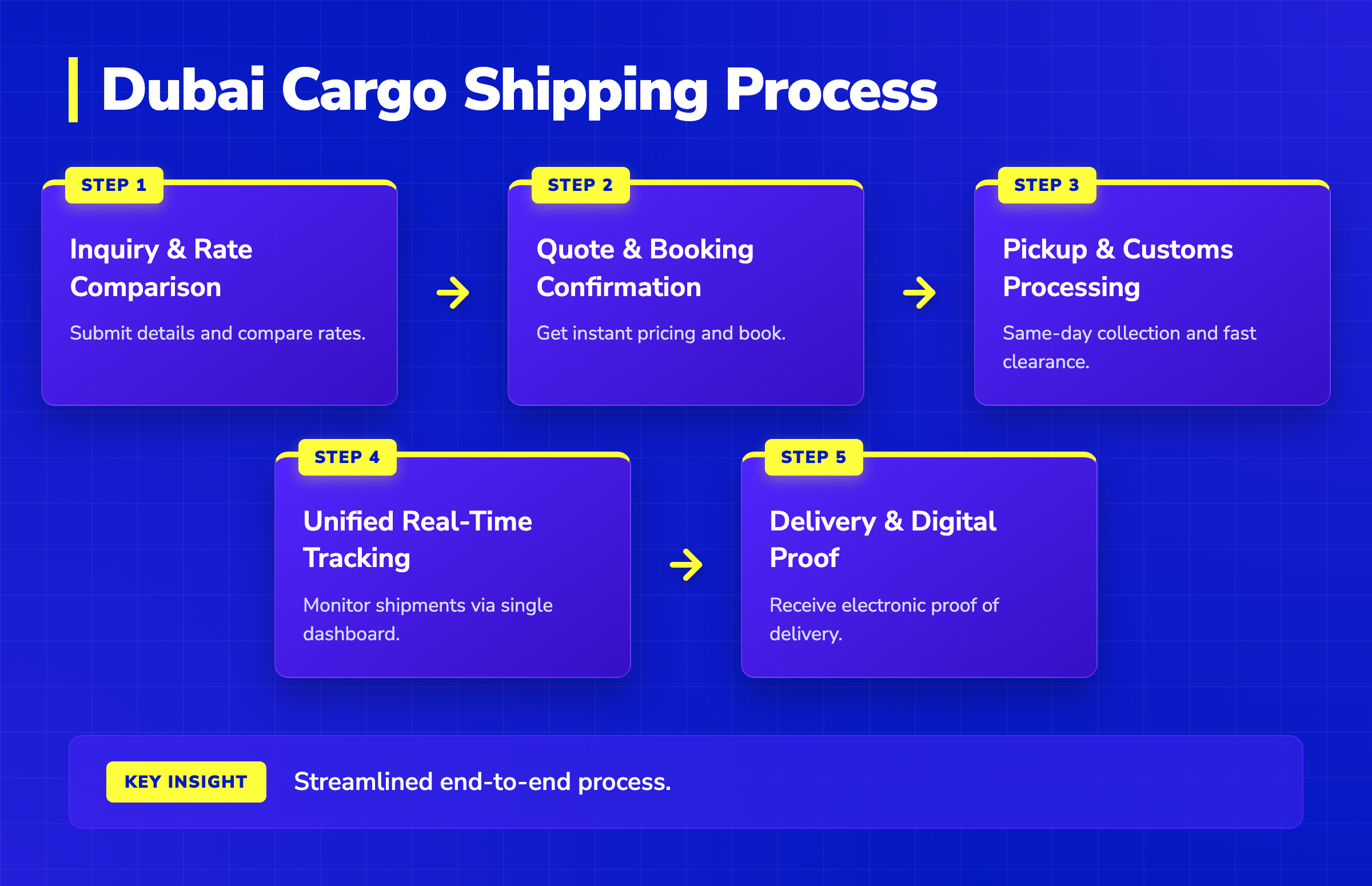
Step 5: Pickup Scheduling offers same-day collection for urgent shipments, with documentation preparation and customs processing handled seamlessly. Dubai's strategic location enables efficient pickup coordination across the emirate, with dense urban clusters facilitating rapid collection services. The integration of digital customs clearance systems reduces paperwork delays and accelerates the pickup-to-departure timeline.
Step 6: Unified Tracking provides visibility across all carriers through a single dashboard, delivering real-time updates throughout the shipment journey. This consolidated approach eliminates the need to check multiple carrier websites, saving time and reducing complexity for businesses managing multiple shipments across different service providers.
Step 7: Delivery Confirmation completes the process with proof of delivery documentation provided electronically. The end-to-end digital trail ensures compliance and provides valuable data for supply chain optimization. For businesses leveraging Key Account Centre advantages, this streamlined process can deliver cost savings of up to 65% below retail rates while maintaining service quality.
The efficiency of this process is enhanced when working with providers offering get your real-time express quote capabilities, enabling businesses to move from inquiry to shipment in record time while accessing the best available rates in the market.
Choosing the Best Cargo Service in Dubai: Key Evaluation Criteria
Selecting the right cargo service provider in Dubai's competitive logistics market requires careful evaluation of multiple factors. With the UAE freight and logistics market valued at USD 23.05 billion in 2026 and growing at 6.55% CAGR through 2031, businesses must choose partners that deliver both value and reliability.
Carrier Partnerships: Direct Relationships vs. Reseller Arrangements represent a fundamental differentiator among cargo companies in Dubai. Direct partnerships with global integrators like DHL, FedEx, and UPS provide superior reliability and priority access compared to reseller models, which often face delays and markups. UPS's recent USD 100 million investment in Dubai South for automated last-mile sorting exemplifies how direct carrier relationships enhance service quality. Companies with DHL Key Account Centre partnership status gain access to preferential rates and priority handling, particularly crucial when air freight represents 46.62% of UAE market revenue.
Volume Advantages through Key Account Centre Status unlock significant cost benefits for businesses. Key Account Centre designation with major carriers enables 40-65% rate reductions compared to retail pricing – a critical advantage in Dubai's express parcel segment growing at 7.52% CAGR (2026-2031). This status is particularly valuable given Dubai's dense population concentration, where 52% of the UAE population enables efficient consolidated shipments. Air freight forwarding, commanding 44.33% of revenue in 2025, becomes significantly more cost-effective through volume partnerships.
Technology Integration separates modern providers from traditional forwarders. Real-time API connections, AI-powered operations, and unified tracking systems reduce administrative burden in Dubai's digitized logistics ecosystem. According to IMARC's GCC Air Freight Transport Market analysis, digital platforms enabling instant quotes and container tracking have become essential, particularly as Dubai International Airport's cargo volume rose 20.4% to 506,018 tons in Q4 2023. Government digitization initiatives and AI-led strategies have boosted supply chain efficiency by 0.8% in the Dubai-Abu Dhabi corridor.
Service Portfolio Breadth determines operational efficiency for businesses. One-stop shops integrating express, freight forwarding, warehousing, and customs brokerage eliminate the complexity of managing multiple vendors. This comprehensive approach is particularly valuable in a market where courier, express, and parcel services command 64.72% domestic revenue share in 2025. Providers offering integrated 3PL and fulfillment services alongside transportation create seamless supply chain solutions.
Geographic Coverage and Specialized Expertise ensure global reach with local excellence. The best cargo service in Dubai combines extensive international networks – ideally covering 220+ countries – with deep expertise in key trade corridors. Specialized knowledge in sectors like e-commerce, pharmaceuticals, automotive, and oil & gas becomes crucial as these industries have unique handling requirements and compliance needs.
Speed and Transparency in quotation and service delivery set leaders apart. While traditional forwarders typically require 24-48 hours for quotes, technology-enabled providers deliver comprehensive quotes in under 10 minutes. This responsiveness is critical in Dubai's fast-paced market where sea freight grows at 8.55% CAGR and multimodal solutions reduce costs by 30-40% on major corridors.
Certifications and Compliance provide assurance of service quality and regulatory adherence. ISO 9001:2015 certification ensures quality management systems, while AEO (Authorized Economic Operator) status accelerates customs clearance. IATA licensing for air freight operations demonstrates technical competence in handling diverse cargo types, from general goods to dangerous materials requiring specialized expertise.
Industry-Specific Capabilities differentiate providers in specialized markets. E-commerce fulfillment requires different capabilities than pharmaceutical cold chain or oil & gas project cargo. Providers with dedicated teams and infrastructure for specific industries deliver superior outcomes through tailored solutions and deep sector knowledge.
When evaluating cargo companies in Dubai, prioritize providers that combine direct carrier relationships, volume-based advantages, and advanced technology with comprehensive service portfolios. The right partner transforms logistics from a cost center into a competitive advantage.
Dubai Cargo Costs & Pricing Factors: Understanding Rate Structures
Dubai cargo pricing operates on dynamic models that respond to real-time market conditions, with rates fluctuating based on weight, dimensions, destination, and commodity type. Understanding these factors is crucial for businesses seeking to optimize their shipping services costs while maintaining service quality.
Dynamic Pricing Model forms the foundation of modern cargo rate structures. According to The Alliance Shipping's 2025-26 Rate Calculation Guide, chargeable weight serves as the core billing metric, calculated as the higher of actual weight or volumetric weight (where 1 CBM equals approximately 1,000 kg). This calculation method ensures fair pricing for both dense and lightweight cargo. Real-time adjustments occur based on destination zones, with shorter GCC routes costing $3-5/kg for express services, while longer routes to the Americas can reach $12-18/kg during peak periods.
Volume Tier Advantages deliver substantial savings for high-volume shippers. Key Account Centre status with major carriers unlocks rate reductions of up to 65% below retail pricing through negotiated contracts. For example, shipping 1,000kg to Europe via air freight costs approximately $4.50/kg for volume shippers versus $6.50/kg for smaller shipments of 100kg. Sea freight offers even greater economies of scale, with costs 50-85% lower than air freight – a 1,000kg LCL shipment to Europe costs $400-600 compared to $3,500 via air.
Cost Factor Breakdown reveals the complexity of international shipping pricing. Fuel surcharges, fluctuating with oil prices, add 15-30% to base rates. The recent Middle East disruptions have driven emergency surcharges of $800-3,800 per container for Arabian Gulf cargo. Service level selection significantly impacts costs, with express services commanding premium rates for guaranteed delivery times. According to Emirates SkyCargo's 2026 tariff schedule, specialized handling for valuable cargo (HUM/VAL classifications) incurs rates of SAR 145-225/kg equivalent.
Hidden Cost Elimination through all-inclusive quotes provides budget certainty. Comprehensive quotes should cover pickup, customs clearance, delivery, and documentation fees, eliminating surprise charges. Traditional forwarders often add these as separate line items, increasing total costs by 20-30%. Modern aggregators provide transparent, all-inclusive pricing that encompasses the entire door-to-door journey.
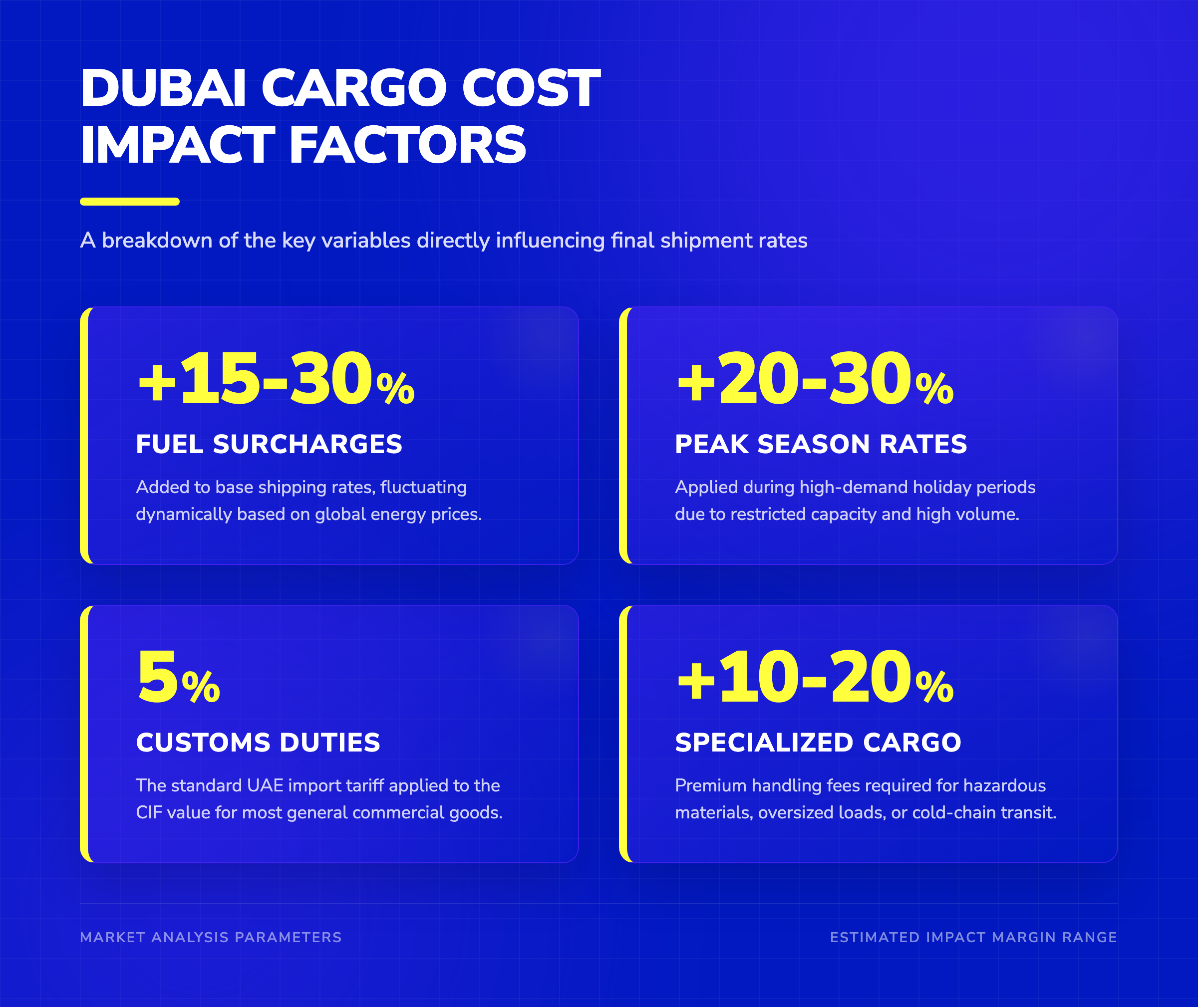
Express Pricing by Zone varies significantly based on distance and service requirements. Zone 1 (GCC countries) offers the most competitive rates at $3-5/kg for express services with 1-2 day delivery. Middle East to Europe routes cost $2.80-4.50/kg for 1-2 day express delivery. The Americas (Zone 8) commands premium pricing, with base rates of $3.80-7.50/kg elevated by up to 70% due to current market conditions, resulting in effective rates of $12-18/kg for 2-5 day delivery.
Freight Pricing Structures differ between air and sea options. Air freight uses per-kilogram rates with minimum charges, while sea freight calculates costs per cubic meter (CBM) for LCL shipments or per container for FCL. Recent market analysis shows Dubai to Singapore LCL at $90 for 500kg/2 CBM ($0.18/kg), while FCL 40-foot containers to Hamburg cost approximately $0.11/kg for 25,000kg loads.
Rate Comparison Importance cannot be overstated in today's volatile market. Carrier rates can vary by 30-50% on identical routes, making comparison essential. The absence of static rate cards reflects market reality – carrier rates change weekly, fuel surcharges adjust monthly, and seasonal factors create additional variability. This dynamic environment makes real-time rate comparison through technology platforms crucial for cost optimization.
Why Static Rate Cards Don't Work in modern logistics becomes clear when examining market volatility. According to Economic Times reporting, air freight rates have soared by up to 70% on some routes due to capacity constraints. Weekly rate adjustments by carriers, monthly fuel surcharge updates, and unpredictable global events make printed rate cards obsolete within days. Successful businesses rely on real-time pricing engines that capture current market conditions.
Understanding cargo transportation costs requires recognizing the interplay between volume advantages, dynamic pricing factors, and market conditions. Businesses that leverage Key Account Centre partnerships and technology-driven rate comparison consistently achieve 40-65% cost savings compared to retail rates.
Need a shipping quote?
Get AI-optimized rates from DHL, FedEx & UPS — up to 65% below retail. Quote in under 10 minutes.
Major Dubai Cargo Routes & Transit Times
Understanding current transit times for Dubai cargo routes is essential for effective supply chain planning. The ongoing regional challenges in early 2026 have significantly impacted traditional shipping timelines across all major corridors. According to Mathez Freight's 2026 analysis, standard transit times have extended due to Strait of Hormuz disruptions, with sea freight adding 10-15 days via Cape of Good Hope rerouting and air freight facing 18% capacity loss.
UAE to USA Shipping represents one of Dubai's most critical trade corridors. Express services, traditionally delivering in 2-3 days, now face extended timelines due to routing adjustments and backlogs affecting up to 50% of traffic. Air freight, normally completing delivery in 5-7 days, is impacted by the 21% of global air flows that transit through the Middle East. Sea freight has seen the most dramatic changes, with pre-crisis timelines of 25-30 days now extended to 35-45 days due to vessels avoiding the Strait of Hormuz. For businesses requiring reliable service to the USA, exploring our UAE to USA shipping guide provides detailed corridor-specific insights.
UAE to UK/Europe Routes maintain their importance for Dubai's trade ecosystem. Express services to these destinations typically complete in 1-2 days, though capacity constraints from suspended Asian airline services to Dubai have created bottlenecks. Air freight services, usually delivering in 3-5 days, suffer from the collapse of passenger flight belly capacity. Sea freight faces significant delays, with baseline 18-22 day transit times now extended to 28-37 days as vessels route around Africa rather than through the Suez Canal.
UAE to China/Far East Corridors serve as vital links for electronics and manufacturing trade. Express shipments normally completing in 2-4 days face disruptions from Dubai and Doha rerouting affecting up to 50% of traffic flows. Air freight, typically 4-6 days, experiences extreme price pressure from capacity scarcity and increased fuel costs. Sea freight services have extended from standard 12-18 days to 22-33 days, with major carriers including MSC, COSCO, and OOCL suspending new bookings according to Business Times reporting.
UAE to GCC Regional Transport remains the most resilient corridor despite regional challenges. Express services maintain 1-2 day delivery times via air, while road freight offers a competitive 1-3 day alternative. This corridor benefits from its overland options, providing crucial flexibility when air and sea routes face constraints. With 170 ships carrying 450,000 TEU currently delayed in the Persian Gulf, road transport has become increasingly important for maintaining regional supply chains.
UAE to Africa Routes continue to grow in importance as trade with the continent expands. Express services typically deliver in 2-5 days depending on the destination country, while air freight requires 5-8 days for most African capitals. Sea freight to major African ports normally takes 15-25 days, though current disruptions have added additional transit time for vessels rerouting around conflict zones.
UAE to Australia Shipping serves the growing trade relationship with Oceania. Express services reach major Australian cities in 3-4 days under normal conditions, while air freight typically requires 6-8 days. Sea freight to Australian ports averages 20-25 days, though current market conditions have created variability in these timelines.
Cross-Trade Capabilities highlight Dubai's role as a global transshipment hub. The ability to coordinate shipments from China to USA or Europe to Africa without touching UAE soil provides flexibility for international traders. However, current disruptions have impacted these services, with many shipments requiring alternative routing through European or Asian hubs.
Peak Season Impact compounds existing challenges during critical periods. Chinese New Year, Ramadan, and Christmas seasons traditionally add 2-5 days to transit times due to increased volumes and reduced operational capacity. The March 2026 Supply Chain Update from Marken indicates that businesses should add substantial buffers to standard transit times and consider air freight or road alternatives for urgent shipments.
Current market conditions require flexible planning for cargo transportation from Dubai. While express and air services maintain relative reliability despite capacity constraints, sea freight users must account for significant delays. Businesses should work with experienced providers who can navigate these challenges and offer alternative routing options when traditional paths face disruption.
Industry-Specific Dubai Cargo Solutions
Dubai's position as a global logistics hub enables specialized cargo companies in Dubai to develop tailored solutions for diverse industry sectors. Each industry presents unique challenges and requirements that demand specific expertise and infrastructure.
E-commerce & Retail sectors drive unprecedented growth in Dubai's express logistics market. According to Mordor Intelligence, courier, express, and parcel (CEP) revenue is climbing at 7.52% CAGR from 2026-2031, with domestic flows representing 64.72% of revenue share in 2025. International parcels advance even faster at 7.85% CAGR, as free-zone exporters leverage duty-free agreements to reach 55 million GCC consumers. Amazon's upcoming 175,000 m² Abu Dhabi facility reinforces the region's e-commerce infrastructure, while UPS's USD 100 million logistics district investment in Dubai South provides automated sortation for peak season scaling. Returns management and 3PL fulfillment have become critical differentiators, with providers offering integrated 3PL and fulfillment services capturing premium market share.
Healthcare & Pharmaceutical logistics has experienced exceptional growth in specialized cargo handling. Healthcare logistics volumes under pharmaceutical services have risen by 54 percent, driven by clinical trials and advanced therapies requiring GDP compliance and temperature-controlled transport. Fresh product volumes in perishables and pharmaceutical logistics increased by 10 percent year-on-year. Emirates SkyCargo leads regional capacity expansion, growing its fleet to at least 21 freighters by end-2026 with up to 10 Boeing 777Fs on order, while adding 20 new freighter destinations. Air freight forwarding's 44.33% share of forwarding revenue reflects the sector's reliance on time-sensitive, temperature-controlled delivery for life-saving medications.
Oil & Gas industries continue to require specialized project cargo and hazardous materials handling despite UAE's economic diversification. The sector procures specialized tubing, rigs, and chemicals via dedicated corridors, benefiting from Dubai's enhanced port infrastructure. DP World's USD 2.5 billion investment program pushed national throughput capacity past 100 million TEU in January 2025, an 8.3% jump over 2024 volumes. Jebel Ali's fourth container terminal, combined with revamped cargo aprons at Dubai International Airport, reduces air-sea transshipment dwell times for high-value oil field equipment and time-critical spare parts.
Automotive spare parts and aftermarket distribution leverage Dubai's multimodal connectivity. While freight transport holds 53.35% revenue share in 2025, the automotive sector benefits from intermodal offerings that combine truck, rail, and barge transport for carbon reduction alongside cost savings. Express delivery for critical spare parts ensures minimal vehicle downtime, while consolidated shipments for aftermarket accessories optimize costs. The sector's just-in-time requirements align perfectly with Dubai's rapid clearance capabilities through free zones.
Fashion & Apparel businesses rely on Dubai's strategic location for sample shipments, seasonal inventory management, and trade show logistics. The fast fashion segment particularly benefits from air freight's speed, with garments moving from Asian factories to European retailers via Dubai in under a week. Seasonal peaks require scalable solutions, with providers offering flexible warehousing and distribution to manage inventory fluctuations. Trade show support includes temporary storage, repackaging, and expedited customs clearance for exhibition materials.

FMCG Distribution capitalizes on Dubai's role as a regional hub for fast-moving consumer goods. The wholesale and retail trade vertical grows at 7.05% CAGR (2026-2031), the fastest among all sectors. FMCG companies benefit from bonded warehousing in free zones, enabling duty-deferred storage and just-in-time distribution to retail outlets across the GCC. Promotional materials and product launches require coordinated multi-country distribution, leveraging Dubai's connectivity to ensure simultaneous market entry.
Technology sector shipping demands secure handling for high-value electronics and sensitive prototypes. The concentration of regional headquarters in Dubai creates steady demand for IT equipment distribution, warranty replacements, and prototype shipping with enhanced security protocols. Free zones like DAFZA and Dubai Internet City provide specialized facilities for technology companies, including secure storage and value-added services like kitting and configuration.
Free Zone Advantages amplify industry-specific benefits across all sectors. JAFZA, DAFZA, and DMCC offer 100% foreign ownership, zero corporate taxes, and streamlined customs procedures. According to Ken Research, the UAE government's AED 35 billion (USD 9.5 billion) investment in logistics infrastructure focuses on expanding these free zone capabilities. Dubai International Airport's projection to handle 4 million tons of cargo annually reinforces the free zones' role in facilitating industry-specific solutions.
Selecting the best cargo service in Dubai requires matching provider capabilities with industry-specific needs. Whether managing temperature-sensitive pharmaceuticals, time-critical automotive parts, or high-volume e-commerce fulfillment, success depends on partnering with providers who understand sector-specific challenges and offer tailored solutions backed by robust infrastructure and technology.
Technology & Innovation in Dubai Cargo Services
Technology transformation drives efficiency gains across Dubai's logistics sector, with the UAE freight and logistics market valued at USD 23.05 billion in 2026 increasingly dependent on digital innovation. Advanced technologies support express parcel growth at 7.52% CAGR (2026-2031), enabling Dubai cargo providers to meet rising e-commerce demands while optimizing operations.
AI-Powered Operations revolutionize traditional logistics processes through automated quote generation, intelligent carrier selection, and shipment optimization. According to Mordor Intelligence, AI-led supply chain strategies boost operational density by 0.8% in the Dubai-Abu Dhabi corridor over 2-4 years. Emirates-grown AI partnerships enable predictive demand forecasting and dynamic route optimization, while warehouse automation demand surges for robotic picking and shuttle systems. These technologies reduce labor intensity while improving accuracy, with some providers achieving order accuracy rates exceeding 99.5%.
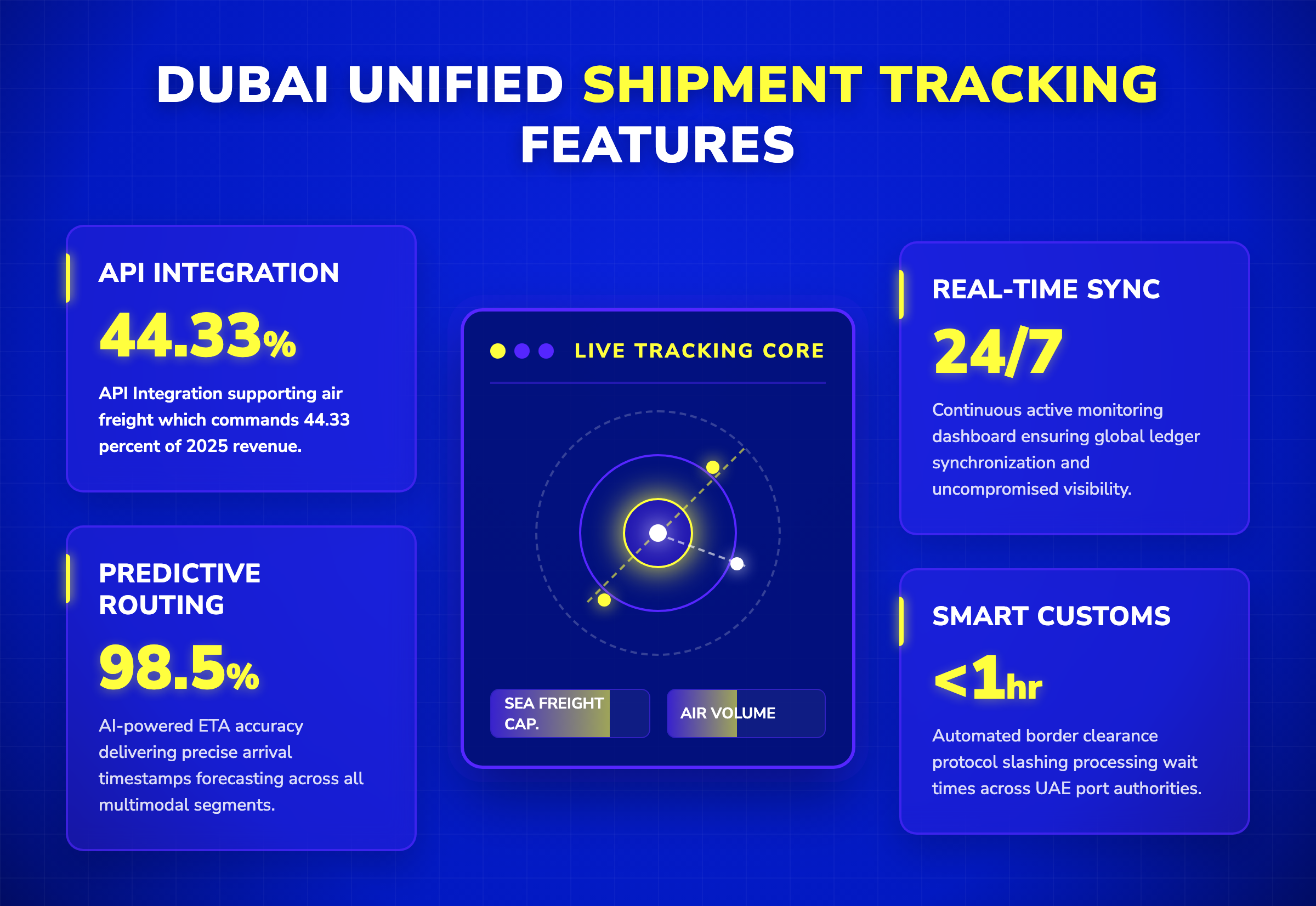
Real-Time API Integration connects shippers directly to carrier systems for instant rate access and booking capabilities. Digital platforms now offer immediate quotes and container tracking, dramatically reducing administrative friction for SMEs. UPS's March 2023 Google Cloud partnership exemplifies this trend, improving package tracking accuracy while supporting their USD 100 million Dubai South investment for automated sorting facilities. With air freight forwarding commanding 44.33% of 2025 revenue, API-driven digitization of documentation and booking processes has become essential for maintaining competitiveness.
Unified Tracking Platforms eliminate the complexity of monitoring shipments across multiple carriers. Modern shipping services provide single dashboard visibility for all shipments, regardless of carrier or service type. This consolidation proves particularly valuable as blockchain integration enhances transparency in courier, express, and parcel operations. The technology supports multimodal bundles combining sea-air options for reduced carbon intensity, aligning with sustainability goals while maintaining service levels. DP World's USD 2.5 billion infrastructure program, which achieved 100 million TEU throughput in January 2025, incorporates advanced tracking systems that reduce transshipment times through real-time visibility.
Predictive Analytics transform planning and execution across the supply chain. AI algorithms optimize routes, predict accurate delivery times, and enable proactive capacity planning using historical data and real-time inputs. For air freight operations, which represent 46.62% of 2025 market revenue, predictive analytics enable tight capacity management particularly crucial for pharmaceutical shipments via Emirates SkyCargo's 140-destination network. Sea forwarding, growing at 8.12% CAGR (2026-2031), benefits from predictive models that optimize container utilization and port selection.
Digital Documentation streamlines customs clearance and reduces processing delays. Electronic air waybills, digital customs declarations, and automated proof of delivery systems eliminate paper-based inefficiencies. The transition to digital documentation particularly benefits express logistics, where speed is paramount. Smart contracts and blockchain verification add additional layers of security and transparency, reducing disputes and accelerating payment cycles.
Customer Portal Integration maintains familiar workflows while adding technological advantages. Rather than forcing businesses to adopt entirely new systems, leading providers offer zero workflow disruption by maintaining existing email and phone processes while adding digital capabilities. This approach has proven particularly successful in the UAE market, where relationship-based business practices remain important alongside technological advancement.
Mobile Accessibility extends system capabilities to smartphones and tablets, enabling real-time tracking, quote requests, and shipment management from anywhere. According to Data Insights Market analysis, mobile-first design has become essential as logistics managers increasingly work remotely or while traveling. Push notifications for shipment status updates and exception alerts ensure proactive issue resolution.
Blockchain Potential promises revolutionary improvements in supply chain transparency and document verification. While still emerging, blockchain applications in Dubai logistics show promise for reducing fraud, accelerating customs clearance, and enabling smart contracts that automatically execute based on shipment milestones. The technology aligns with Dubai's vision as a smart city and positions early adopters for future competitive advantages.
Innovation in Last-Mile Delivery addresses the final and often most challenging segment of the logistics chain. Drone delivery tests by Aramex in September 2023 demonstrate the potential for revolutionary last-mile solutions. Combined with the region's e-commerce market projected to reach $8 billion by 2026, these innovations position Dubai at the forefront of logistics technology adoption. Warehouse automation investments, expected to reach $1.6 billion by 2025, further enhance the technology ecosystem supporting efficient cargo operations.
Technology adoption in Dubai's cargo sector isn't just about efficiency – it's about creating competitive advantages through superior service delivery. Businesses partnering with technology-enabled providers gain access to capabilities that were unimaginable just a few years ago, from 10-minute quotes to AI-optimized routing that reduces costs while improving reliability.
Have a quick question? Get answers instantly on WhatsApp.
Dubai Cargo Regulations & Compliance Requirements
Navigating Dubai's regulatory landscape is essential for successful international trade operations. The emirate's strategic position as a global logistics hub comes with comprehensive compliance requirements designed to facilitate legitimate trade while maintaining security and safety standards.
UAE Customs Procedures require meticulous documentation for all import and export operations. According to Maersk's operational guidelines, businesses must submit commercial invoices, bills of lading or airway bills, packing lists, certificates of origin, and import/export declarations through the Dubai Trade portal or NAIC systems. Duty calculations follow the CIF (Cost, Insurance, Freight) value plus 5% customs duty on most goods. In 2025, Dubai's Jebel Ali Free Zone processed over 15 million TEUs, benefiting from zero duties and simplified customs procedures for re-exports.
Recent regulatory changes have introduced stricter pre-clearance requirements. The Maritime Preload Cargo Information (MPCI) mandate, effective January 2025 with full enforcement by April 2026, requires submissions 33 hours prior to vessel arrival. This includes comprehensive container details, HS codes, and party identifiers. Non-compliance results in cargo delays or rolling to subsequent vessels. The Advance Cargo Manifest requirement via NAIC, mandatory from March 16, 2026, similarly demands shipping instructions 33 hours before vessel ETA, impacting all UAE sea gateways.
Dangerous Goods Regulations ensure safe handling of hazardous materials throughout the cargo transportation chain. According to Anil Darya's 2025 regulatory update, shipments must comply with IATA DGR for air freight and IMDG Code Amendment 42-24 for sea transport. Proper UN classification is mandatory, particularly for items like lithium batteries which received new UN numbers in 2025. Packaging requirements include UN-certified containers, appropriate hazard labels, and proper segregation of incompatible materials. Documentation must include MSDS/SDS sheets, Dangerous Goods Declarations, and bilingual shipping papers in English and Arabic.
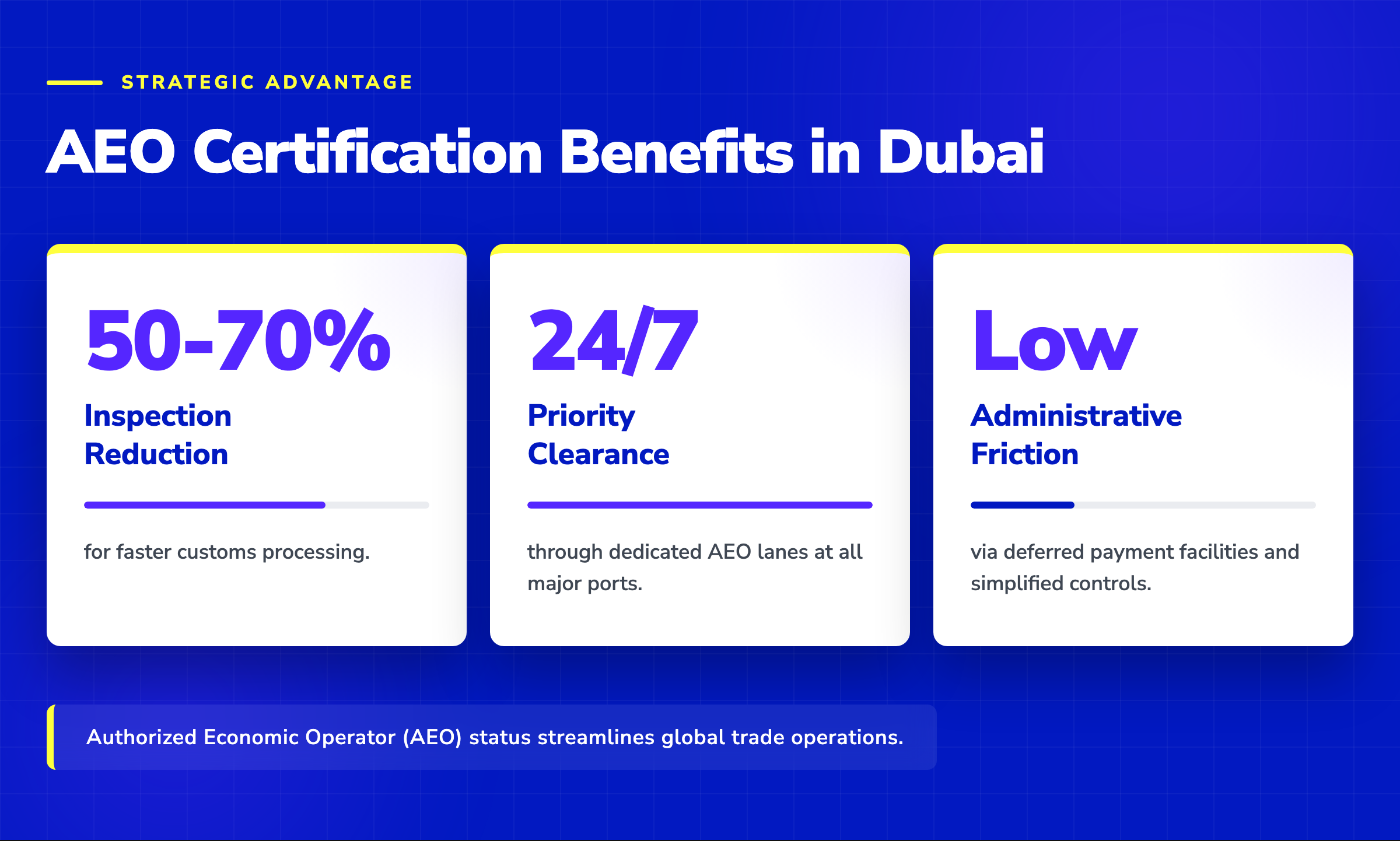
AEO Certification Benefits provide significant advantages for compliant traders. Authorized Economic Operator status, granted by the UAE Federal Customs Authority, reduces inspection times by 50-70% and enables self-assessment of duties. In 2025, AEO-certified operators handled 35% of Jebel Ali's high-value cargo with zero detention rates, compared to 15% average delays for non-AEO shipments. Benefits include fewer physical inspections, pre-clearance for express shipments, and mutual recognition with EU and USA programs, streamlining international trade operations.
Country-Specific Requirements add complexity to international shipments. For USA trade, the Automated Export System (AES) filing is mandatory for exports from the USA to Dubai, with non-filing causing delays in 20-30% of shipments. European Union trade requires EORI (Economic Operators Registration and Identification) numbers for all transactions. According to compliance data, 28% of UAE-EU cargo via Jebel Ali in 2025 utilized EORI-integrated filings, reducing clearance times by 40%. China trade mandates CCC (China Compulsory Certification) for electronics and toys, with UAE customs rejecting non-compliant goods that affected 12% of China-UAE air freight in 2025.
Free Zone Advantages significantly simplify compliance for many businesses. JAFZA, DAFZA, and DMCC offer 100% foreign ownership, zero corporate taxes, and streamlined customs procedures. Free zones enable duty deferral and eliminate import VAT on qualifying goods, with processing times up to 70% faster than mainland ports. In 2025, free zones handled 22% of UAE's total cargo volume, demonstrating their importance in the logistics ecosystem. However, goods must still meet all safety and documentation requirements, particularly for eventual mainland entry.
Documentation Requirements vary by shipment type and destination but typically include core documents that must be prepared accurately. Commercial invoices must detail goods description, value, and terms of sale. Packing lists should specify contents, weights, and dimensions. Certificates of origin may require chamber of commerce attestation. Specialized shipments need additional permits – pharmaceuticals require health ministry approvals, food products need municipality clearances, and dual-use goods require special export licenses.
Customs Clearance Process has been significantly digitized to improve efficiency. Pre-clearance options allow documentation submission before cargo arrival, reducing dwell time. Duty payment can be processed electronically through registered customs agents. Physical inspections, when required, are scheduled through the customs system with priority given to AEO operators. The integration of AI and risk assessment systems has reduced average clearance time from 3-4 days to 24-48 hours for compliant shipments.
Prohibited Items and Sanctions Compliance require careful attention to avoid serious penalties. Each destination country maintains specific lists of prohibited items, from cultural materials to certain technologies. Sanctioned destinations require enhanced due diligence, with financial institutions often requiring additional documentation for payment processing. Dual-use goods that could have military applications face the strictest controls, requiring special permits and end-user certificates.
Successful Dubai cargo operations depend on meticulous attention to regulatory compliance. While the requirements may seem complex, working with experienced providers who understand these regulations ensures smooth clearance and avoids costly delays. The investment in proper compliance procedures pays dividends through faster processing, reduced inspections, and enhanced reputation with customs authorities.
Frequently Asked Questions About Dubai Cargo Services
What is a Key Account Centre and how does it benefit my business?
A Key Account Centre is a volume partnership tier granted by major carriers like DHL, FedEx, and UPS to their highest-volume partners. This designation provides access to significantly discounted rates – typically 40-65% below retail pricing – due to the consolidated shipping volumes. For businesses shipping from Dubai, partnering with a Key Account Centre means accessing these wholesale rates without meeting the volume requirements independently. The benefits extend beyond pricing to include priority handling during peak seasons, dedicated account management, and access to premium services at standard rates. This status is particularly valuable in Dubai's competitive market where shipping costs can significantly impact profitability.
How quickly can I get a cargo quote from Dubai?
Modern cargo service providers in Dubai leveraging AI-powered technology can generate comprehensive quotes in under 10 minutes. This represents a dramatic improvement from traditional freight forwarders who typically require 24-48 hours for quotations. The speed is achieved through real-time API connections to carrier systems, automated rate calculations, and pre-negotiated tariffs. Quick quotes include all components – base rates, fuel surcharges, customs fees, and any additional charges – providing complete transparency. This rapid response time enables businesses to make faster decisions, respond to customer inquiries immediately, and capitalize on time-sensitive opportunities. For express shipments, you can get your real-time express quote instantly through automated systems.
What's the difference between express logistics and air freight?
Express logistics and air freight serve different shipping needs despite both using air transport. Express logistics handles time-critical shipments typically under 70kg, offering door-to-door service with delivery in 1-5 days globally. Major integrators like DHL, FedEx, and UPS operate their own aircraft and ground networks, providing end-to-end tracking and guaranteed delivery times. Express services include customs clearance and last-mile delivery in the price. Air freight, conversely, handles larger commercial cargo using passenger and cargo airline capacity, with typical delivery in 3-7 days. Air freight requires separate arrangements for pickup, customs clearance, and final delivery, making it more suitable for larger shipments where cost-per-kilogram matters more than speed. Express logistics costs more per kilogram but offers simplicity and speed, while air freight provides better economics for shipments over 100kg.
Can I track my shipment across different carriers in one place?
Yes, unified tracking platforms now enable monitoring of all shipments through a single dashboard, regardless of carrier or service type. This technology aggregates tracking data from multiple sources – whether using DHL for express, Maersk for sea freight, or Emirates SkyCargo for air freight – presenting updates in one interface. The benefits include reduced time spent checking multiple carrier websites, consistent status updates across all shipments, and automated alerts for exceptions or delays. Advanced platforms also provide predictive analytics, estimating arrival times based on historical data and current conditions. This consolidated visibility is particularly valuable for businesses managing complex supply chains with multiple shipping modes and carriers.
What should I look for when choosing a cargo company in Dubai?
Selecting the right cargo company requires evaluating multiple critical factors. First, verify direct partnerships with major carriers rather than reseller arrangements – this ensures better rates and service reliability. Look for Key Account Centre status which provides access to volume discounts of 40-65% below retail rates. Technology capabilities matter significantly; ensure they offer real-time quoting, unified tracking, and API integration for seamless operations. Geographic coverage should span your target markets, ideally 220+ countries for global reach. Industry certifications like ISO 9001:2015, AEO status, and IATA licensing indicate operational excellence and compliance capabilities. Evaluate their service portfolio – providers offering express, freight, warehousing, and customs clearance eliminate the complexity of managing multiple vendors. Finally, assess their industry expertise in your specific sector, whether e-commerce, pharmaceuticals, or manufacturing, as specialized knowledge ensures proper handling and compliance.
Do I need different providers for express, freight, and warehousing services?
No, using multiple providers creates unnecessary complexity and often increases costs. Integrated logistics providers offer comprehensive solutions covering express logistics, air and sea freight, warehousing, and customs clearance through a single partnership. This approach provides several advantages: consolidated invoicing simplifies accounting, single point of contact reduces communication complexity, and bundled services often qualify for volume discounts across service types. Integrated providers can also offer seamless transitions between services – for example, storing inventory in their warehouse and fulfilling orders via express shipping as needed. They provide better visibility across your entire supply chain and can optimize routing decisions based on complete information. For businesses seeking efficiency, partnering with a provider offering comprehensive freight forwarding solutions alongside express and warehousing services delivers superior results compared to managing multiple vendor relationships.
Sources & References
This article draws on research and data from the following verified sources:
- UAE Freight & Logistics Market Share & Size 2031 Outlook
- Shipping lines cut Middle East routes posing risk to trade flows
- Middle East: Disruption ripples through global supply chains
- Middle East and Africa Shipping and Logistics Market Report
- Air cargo demand up 5.6% in January 2026
- E-Commerce Air Freight Dubai 2026: The Complete Fulfillment Guide
- Mathezfreight - Crisis in the Middle East 2026: impact on freight transport
- Ken Research - Middle East Air Cargo Market 2019-2030
- Gulf News: Container shipping heads toward a harder 2026
- Air Cargo Week: Gulf conflict disrupts air cargo capacity
- Middle East Air Cargo Services Market Outlook (2022-2033)
- GCC Air Freight Transport Market Size | Share Report 2033 - IMARC
- United Arab Emirates Air Cargo Market Report Size Share Growth
- Sea Freight Rates from Dubai: Rate Calculation Guide 2025-26
- Shipping costs set to rise as companies halt cargo through Arabian Gulf
- Effective 01 JANUARY 2026 - Emirates SkyCargo
- Air Cargo Shipping Cost Per Kg by Route (2026 Pricing Guide)
- Air freight rates soar as Middle East conflict blocks trade routes
- Hidden Moving Costs from Dubai | 2026 Customs & Port Fees
- Middle East conflict cuts air cargo capacity and drives rate increases
- Middle East: Impact on Air- and Seafreight - MBS Logistics
- 2026-03-16 Supply Chain Update Middle East - Marken
- United Arab Emirates (UAE) CEP Market Analysis 2026 and ...
- IMO 2025 regulations|UAE hazardous cargo rules|Anil Darya L.L.C-FZ
- UAE MPCI Cargo Filing FAQs – Compliance & Requirements
- UAE Advance Cargo Manifest implementation- Operational Guidelines
- Mandatory MPCI Compliance for UAE Shipments: Key Updates and Timelines
- UAE Advances Maritime Cargo Compliance Through MPCI
- Dubai Import Regulations: What Businesses Must Prepare Before Shipping
- Upcoming UAE Regulatory Changes 2025: What Shippers Need to
- UAE Express Delivery Market Report and Forecast 2026-2034
- UAE Logistics Market Size is Expected to Reach USD 95.2 Billion
Tags
Related Articles
Ready to optimize your logistics?
Whether you need express shipping, freight forwarding, or warehousing — our AI finds the best rates and routes for your business.