
Complete Guide to Freight Forwarding in Dubai: Air, Sea & Road Solutions
What is Freight Forwarding and Why Dubai is a Global Hub
Freight forwarding is the coordination and management of shipments across multiple transportation modes and borders, enabling businesses to move goods internationally without directly operating transport infrastructure. It encompasses air, sea, and road logistics services, customs brokerage, warehousing, and supply-chain finance—allowing shippers to focus on core operations while specialized intermediaries handle complex logistics networks. For businesses seeking comprehensive freight forwarding services, understanding Dubai's unique position in global trade is essential.
Dubai serves as a critical maritime and air hub linking Europe and Asia, with geographic advantages that have established it as one of the world's premier logistics gateways. The emirate's strategic location enables efficient transshipment of goods between continents, reducing transit times and costs for international commerce. According to Mordor Intelligence, the UAE freight and logistics market was valued at USD 23.05 billion in 2026 and is projected to reach USD 31.63 billion by 2031, growing at a CAGR of 6.55%.
The infrastructure supporting Dubai freight forwarding operations is world-class. Jebel Ali Port stands as one of the largest container ports globally, with DP World's USD 2.5 billion expansion program pushing national throughput capacity past 100 million TEU in January 2025, representing an 8.3% increase over 2024 volumes. This mega-terminal, combined with the fourth container terminal and revamped cargo aprons at Dubai International Airport, has significantly reduced air-sea transshipment dwell times for high-value goods.
Dubai International Airport retained its top global ranking for international tonnage, supported by Emirates SkyCargo's 140-destination network. The Coherent Market Insights report shows that air freight contributed 46.62% of market revenue in 2025, reflecting the Emirates' status as a global re-export hub. The dedicated freight forwarding market specifically was valued at USD 21.56 billion in 2025 and is anticipated to reach USD 35.08 billion by 2032, with a CAGR of 7.2%.
The UAE government has implemented trade-friendly initiatives including the establishment of free trade zones across major cities like Dubai, Abu Dhabi, and Sharjah. These zones offer 100% foreign ownership, 0% corporate and income tax, and world-class infrastructure, significantly reducing barriers to international trade and attracting foreign direct investment. Key free zones like JAFZA (Jebel Ali Free Zone Authority), DAFZA (Dubai Airport Free Zone Authority), and DMCC (Dubai Multi Commodities Centre) facilitate seamless trade operations.
Dubai and Abu Dhabi jointly housed 52% of the population and generated more than 70% of retail sales in 2024, concentrating parcel densities that make rapid delivery economically viable. Government-run digitization programs simplify business licensing and customs procedures, encouraging omnichannel logistics models. Major logistics operators are reinforcing Dubai's hub status through significant capital commitments—UPS unveiled a USD 100 million Dubai South logistics district in March 2025 featuring automated sortation and regional distribution infrastructure.
Types of Freight Forwarding Services in Dubai
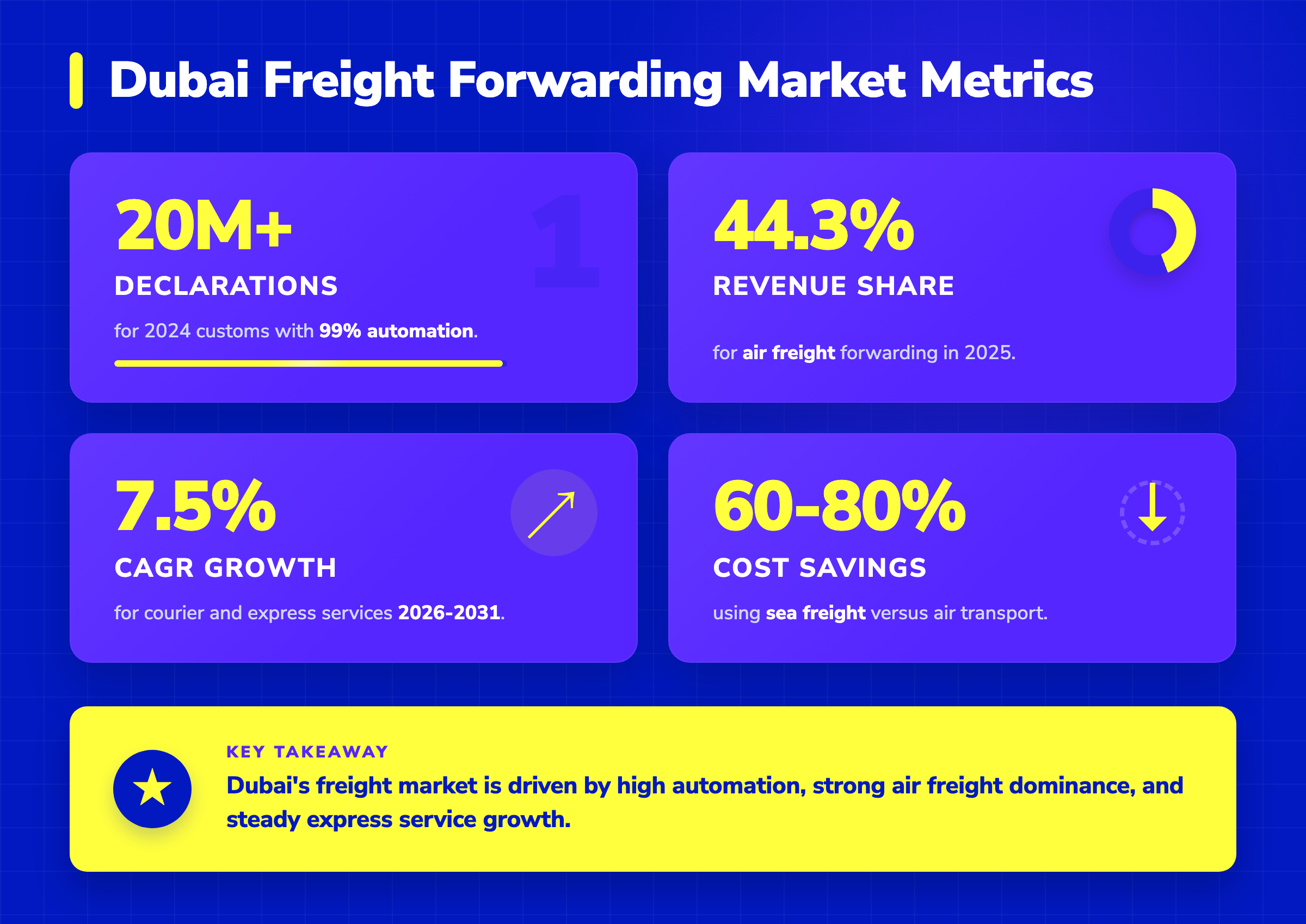
Dubai's position as a global logistics hub enables freight forwarders dubai to offer comprehensive multimodal solutions. The market leverages world-class infrastructure to provide air, sea, road, and integrated logistics services. According to Mordor Intelligence's 2026 analysis, air freight dominates forwarding revenue at 44.33% in 2025, while sea freight leads tonnage growth at 8.55% CAGR (2026-2031).
Air Freight: Speed vs Cost Analysis
Air freight prioritizes speed for high-value goods like electronics and pharmaceuticals, contributing 46.62% of market revenue in 2025 via Dubai International Airport's global ranking for international tonnage and Emirates SkyCargo's extensive network. Air freight solutions from Dubai offer rapid transit—typically 1-3 days to Europe, 2-5 days to Asia, and 1-4 days to the US—but at 3-5 times the cost of sea freight due to fuel and capacity constraints.
Specialized cool-chain facilities support pharmaceutical yields, with Emirates SkyCargo unveiling a dedicated temperature-controlled cargo corridor in May 2025 connecting the UAE with key global pharmaceutical hubs. However, tight capacity management elevates premiums during peak seasons, making cost-benefit analysis crucial for shippers.
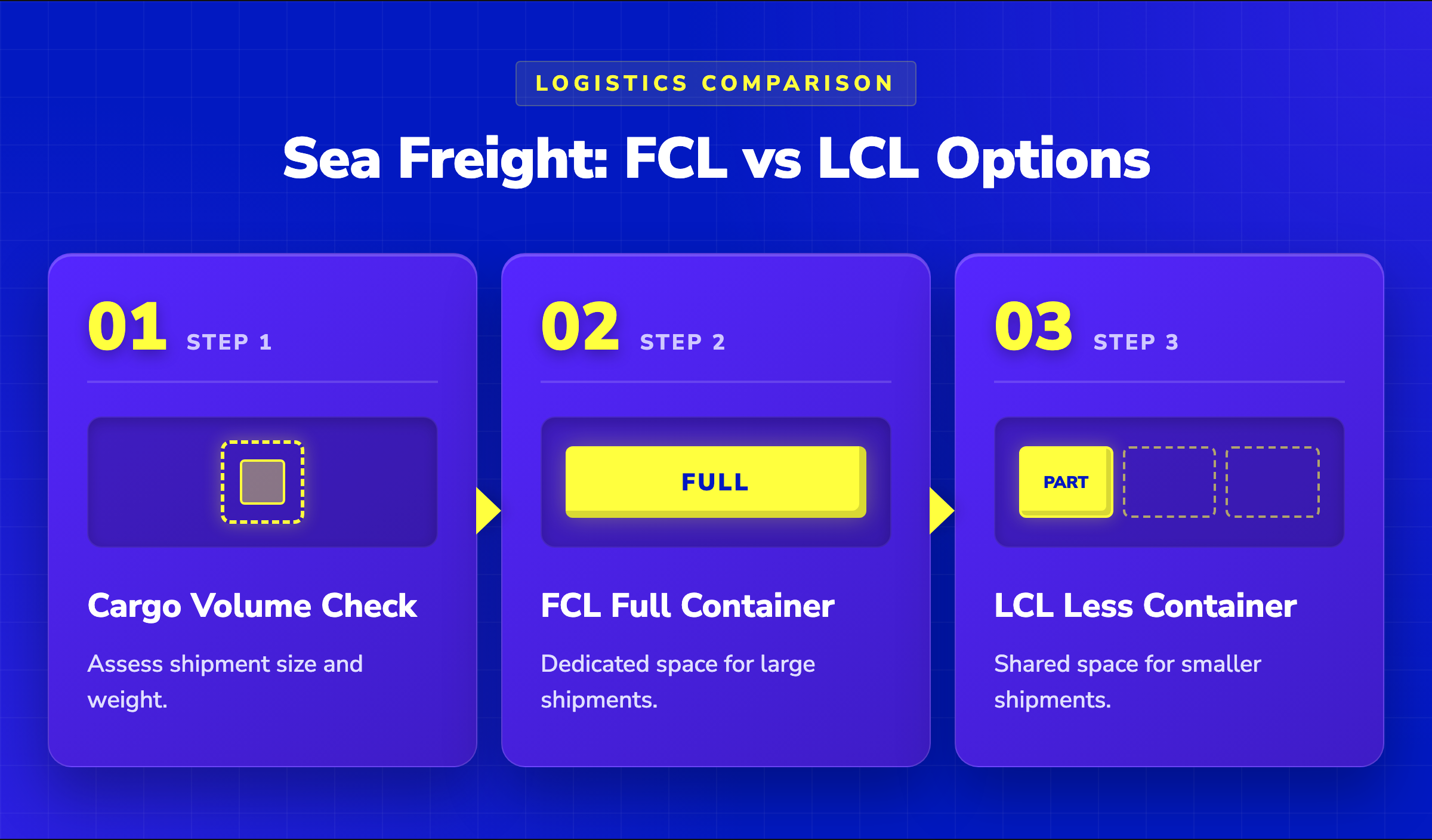
Sea Freight: FCL vs LCL Options
Sea freight dominates bulk cargo movements with 50% market share in 2021 and accelerating growth driven by Jebel Ali Port's 100 million TEU capacity. Sea freight services suit bulk and containerized volumes like petrochemicals and consumer goods, offering two primary options:
- FCL (Full Container Load): Provides dedicated 20ft/40ft dry or reefer containers for efficiency, ideal for large shipments. Standard 20ft containers offer 1,172 cubic feet capacity for 10-15 tons of palletized goods, while 40ft containers provide 2,390 cubic feet for up to 25-28 tons.
- LCL (Less than Container Load): Consolidates smaller cargoes for cost-sharing, reducing expenses by 40-60% for volumes under 15 cubic meters compared to FCL, though with longer handling times.
Port-to-port services focus on Jebel Ali-Fujairah gateways for rapid customs clearance, while door-to-door options integrate trucking and warehousing. DP World's USD 2.5 billion expansions enable just-in-time supply chains with improved efficiency.
Road Freight: GCC Connectivity
Road freight supports final-mile and inter-emirate hauls, vital for connectivity through the GCC road freight network. Cross-border procedures benefit from digitization, though stricter weight rules and congestion fees for hauls over 200 km push modal shifts. Truck types include:
- Standard 20-40 ton rigs for containers
- Specialized reefers for perishables
- Flatbed trucks for oversized cargo
- Heavy haul vehicles for industrial projects
Dubai-Abu Dhabi corridors enable same-day promises, bolstered by UPS's USD 100 million Dubai South investment in 2025 for automated sorting, serving the 55 million consumers across GCC markets.
Multimodal Solutions
Multimodal transport integrates truck, rail, sea, and air for carbon reduction and cost savings. According to Coherent Market Insights, intermodal offerings are gaining traction amid emissions mandates from 2025. Examples include air-sea transshipments at Jebel Ali-Dubai Airport with reduced dwell times post-2025 upgrades, or road-rail-sea combinations for bulk cargo from oil fields to ports.
These integrated solutions raise UAE competitiveness, targeting net-zero emissions via load consolidation and digital tracking. Sea forwarding's 8.12% CAGR complements air freight's speed for optimal routing decisions.
Specialized Services
Forwarding companies in dubai also offer specialized handling for dangerous goods, project cargo, and temperature-controlled shipments. The market includes dedicated facilities for pharmaceuticals, perishables, and high-value electronics, supported by certifications like IATA dangerous goods handling and GDP (Good Distribution Practice) for pharmaceuticals.
How Freight Forwarding Works: The Complete Process
Understanding the freight forwarding process is crucial for businesses engaging in Dubai freight forwarding. The process leverages Dubai's advanced infrastructure, including Jebel Ali Port and Dubai International Airport (DXB), which handled over 1.5 million tonnes of air cargo in 2024. According to KGRN Shipping's 2025 guide, digital tools like Dubai Trade and Mirsal 2 systems have reduced clearance times by up to 50%.
Step 1: Shipment Inquiry and Requirements Gathering
The process begins with an initial consultation where shippers provide cargo details—type, weight, dimensions, origin, destination, and preferred mode (air, sea, or road). This enables freight forwarders to assess needs and issue tailored quotations based on terms like FOB (Free on Board) or CIF (Cost, Insurance, and Freight). In Dubai's market, this step is critical amid the UAE's logistics sector growth of 6.2% in 2024, driven by e-commerce and trade volumes exceeding AED 3 trillion annually.
Step 2: AI-Powered Rate Comparison Across Carriers
Modern freight forwarders use AI-driven platforms to compare rates and book space with carriers like Maersk and MSC for sea freight via Jebel Ali Port (world's 10th busiest in 2024 with 14.5 million TEUs) or Emirates SkyCargo for air shipments from DXB. Dubai's digital freight platforms have cut quoting time by 70%, supporting multimodal options amid UAE's projected 7% logistics CAGR through 2026. This technology integration enables instant access to competitive rates across multiple carriers.
Step 3: Documentation Preparation and Customs Clearance
Forwarders compile essential documents including commercial invoices, packing lists, bills of lading (for sea freight), airway bills (for air freight), certificates of origin, and HS codes. These ensure compliance with UAE and destination regulations, submitted via automated systems like Mirsal 2 for clearance. Dubai Customs processed over 20 million declarations in 2024 with 99% automation, minimizing delays. Free zones like JAFZA enable duty-free re-exports, boosting efficiency for 60% of UAE shipments.
Step 4: Cargo Pickup and Consolidation
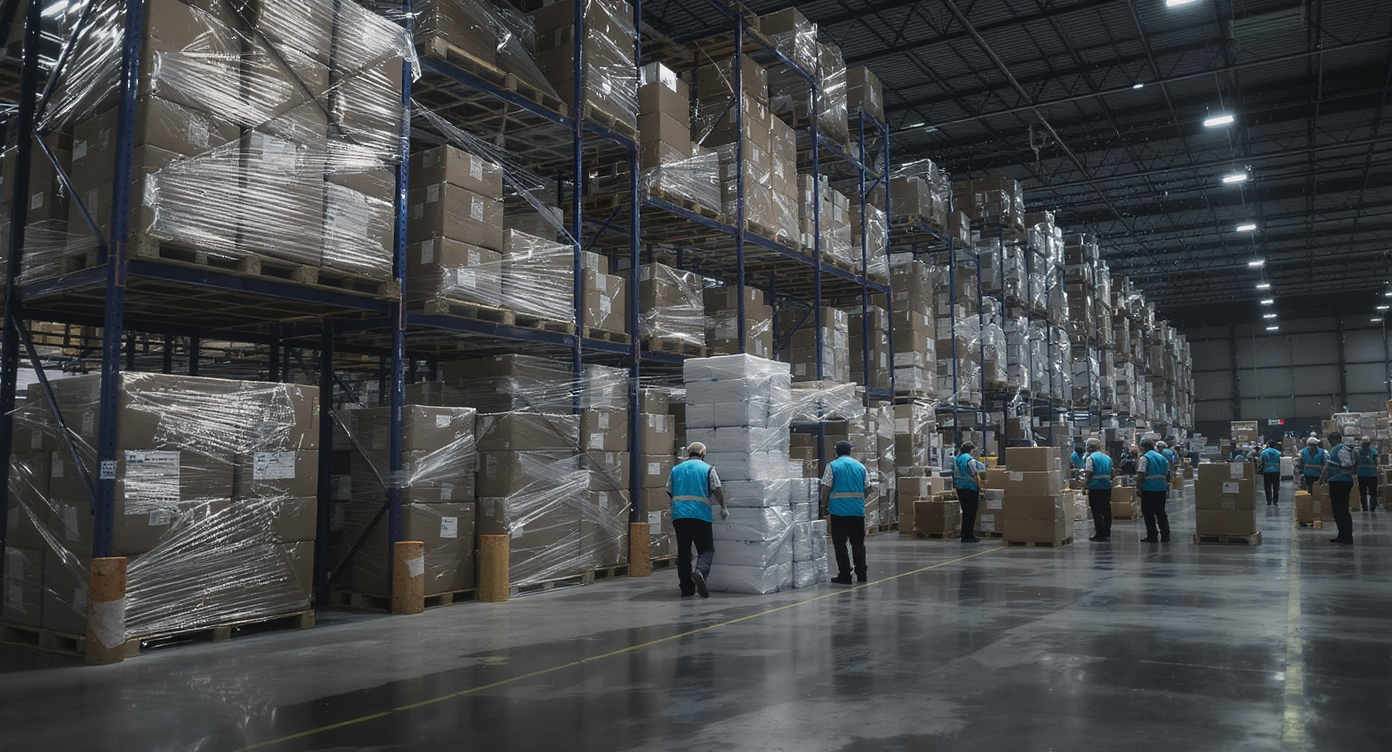
Post-booking and clearance, forwarders arrange secure pickup, labeling, and transport to warehouses or ports for consolidation. This is especially important for LCL shipments grouping multiple consignments to cut costs by 20-30%. In Dubai, this leverages JAFZA's facilities, where consolidation handles 40% of sea exports. Trained teams ensure safe handling for fragile goods, with GPS tracking implemented from the pickup stage.
Step 5: International Transit and Tracking
Once cargo is consolidated and loaded, international transit begins. Modern freight forwarders provide real-time tracking throughout the journey, whether by air, sea, or road. This visibility is crucial for supply chain management, allowing businesses to plan inventory and inform customers accurately. Integration with express logistics services enables expedited options when needed.
Step 6: Destination Clearance and Final Delivery
Upon arrival at the destination, freight forwarders manage customs clearance using their network of global agents. According to Cargoline's comprehensive guide, this includes preparing destination country documentation, paying duties and taxes, and arranging final delivery to the consignee's location. The entire process benefits from Dubai's position as a trade hub with established procedures for over 220 destinations worldwide.
Air Freight from Dubai: Speed and Global Connectivity
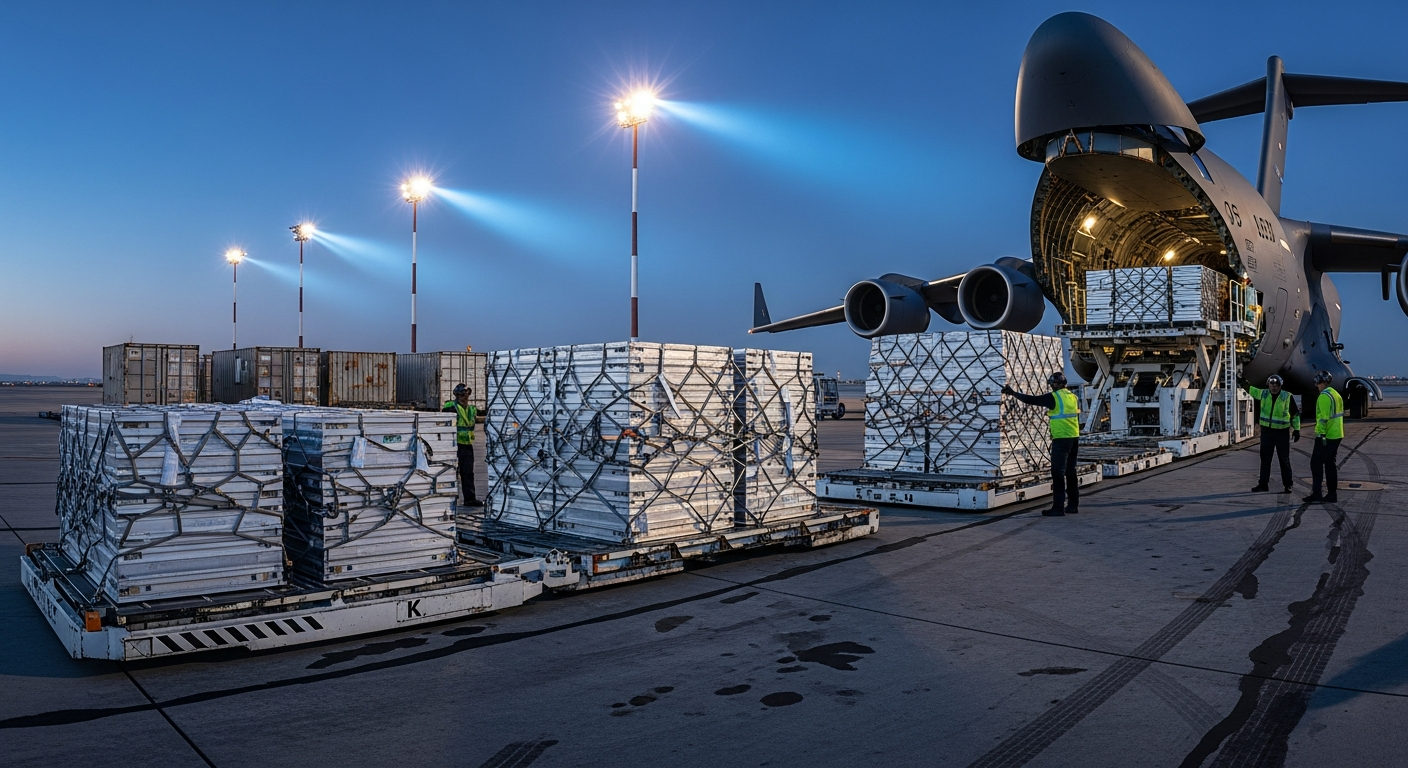
Dubai's air freight infrastructure centers on two major facilities that enable rapid global connectivity. Dubai International Airport (DXB) handles established high-volume operations, processing 1.8 million tonnes of cargo in 2022 and achieving a 20.4% growth in Q4 2023 to 506,018 tons. According to IMARC Group's GCC analysis, DXB's role in Dubai Airport Free Zone (DAFZA) with over 3,000 enterprises drives significant air freight activity.
Al Maktoum International Airport (DWC) is undergoing major expansion with a US$35 billion investment to become the world's largest airport, enhancing UAE's air freight infrastructure amid booming e-commerce projected at USD 632 billion by 2032 with a 22.5% CAGR from 2024. This dual-airport strategy positions Dubai to handle growing cargo volumes efficiently.
Emirates SkyCargo leverages Dubai's hubs for extensive global connectivity, contributing to the Middle East's freighter fleet growth to 150 aircraft in 2023 (up 8%), with global freighter capacity at 12.5 million tonnes according to Gitnux's 2026 industry statistics. Recent market dynamics show capacity constraints at Gulf hubs like Dubai, reducing Asia-Europe flows by up to 40% and pushing rerouting, yet Middle East-Asia demand rose 12.9% in January 2026.
Transit Times and Service Levels
Typical air freight transit times from UAE/Dubai maintain competitive speeds: UAE to USA (2-3 days), Europe (1-2 days), and Asia (1-2 days), aligned with express shipping efficiencies in international logistics. These reflect Dubai's strategic position, bolstered by free trade zones like Jebel Ali Free Zone (JAFZA) that lower customs processing times. The IATA reports global air cargo demand grew 5.6% year-over-year in January 2026, with international traffic up 7.2%.
Air Freight Rate Factors
Air freight rates from Dubai are influenced by multiple variables including weight, dimensions, commodity type (such as perishables, pharmaceuticals, and e-commerce goods), and urgency levels. According to Metro Global's 2026 analysis, factors are driving costs higher due to Gulf hub capacity reductions and global capacity remaining below pre-conflict norms, with world cargo traffic at 66.6 million tonnes in 2023 and RTKs up 4.8%.
UAE's pharmaceutical and e-commerce sectors fuel demand, positioning Dubai as a top freight forwarding hub. The growth in these sectors, combined with Dubai's strategic location and infrastructure investments, ensures continued prominence in global air freight networks.
Need a shipping quote?
Get AI-optimized rates from DHL, FedEx & UPS — up to 65% below retail. Quote in under 10 minutes.
Sea Freight from Dubai: Cost-Effective Ocean Solutions
Jebel Ali Port, operated by DP World, stands as the largest container port in the Middle East and ranks among the world's top 10 busiest facilities. According to Tradlinx's port analysis, the facility handles 15.5 million TEUs in 2024 with a capacity of 19.4 million TEUs annually, served by over 140-220 shipping lines connecting to more than 180 ports worldwide.
In July 2024, Jebel Ali set a monthly record of 1.4 million TEUs, following a first-half total of 7.3 million TEUs (up 3.9% year-on-year), as reported by GCC Business Watch. This growth was driven by inbound cargo from Asia and UAE trade agreements like Comprehensive Economic Partnership Agreements (CEPAs).
FCL (Full Container Load) Options
For FCL shipments from Dubai via Jebel Ali, standard options include:
- 20ft containers: 1,172 cubic feet capacity, ideal for 10-15 tons of palletized goods like electronics or machinery
- 40ft containers: 2,390 cubic feet, suited for bulkier loads up to 25-28 tons such as consumer goods
- 40ft High Cube (HC) containers: Extra 9 inches height providing 2,700 cubic feet, optimal for tall cargo like furniture or textiles
These container types leverage the port's deep-water berths (up to 67+) and automated terminals for efficient handling of full loads in global trade routes, as detailed in UNIS's port profile.
LCL (Less than Container Load) Consolidation
LCL services offer consolidation benefits by pooling smaller shipments (typically minimum 1-2 cubic meters per shipment) into full containers, reducing costs by 40-60% for volumes under 15 cubic meters compared to FCL. According to The Maritime Standard, Jebel Ali's breakbulk handling reached 5.36 million tonnes in 2024 (up 23% year-on-year) with a 630,000-tonne monthly record in October 2025, supporting weekly groupage to major markets.
Transit Times from Jebel Ali
Typical sea freight transit times from Jebel Ali reflect the port's extensive connectivity:
- UAE to USA: 18-25 days via major shipping lines to East/West Coast ports
- UAE to Europe: 12-18 days to ports like Rotterdam or Southampton
- UAE to Asia: 7-14 days to India, China, or Southeast Asian destinations
These transit times are influenced by vessel schedules from 140+ shipping lines and seasonal factors. The robust throughput of 15.5 million TEUs and ongoing infrastructure investments ensure reliable schedules amid global supply chain demands.
Sea Freight Cost Factors
Sea freight costs from Dubai depend on container type, destination, seasonal fluctuations, and current market conditions. The port's efficiency and scale provide competitive advantages, with MFC reporting that CEPA trade deals have significantly boosted volumes, helping maintain cost competitiveness for Dubai-based shippers.
Road Freight and GCC Connectivity
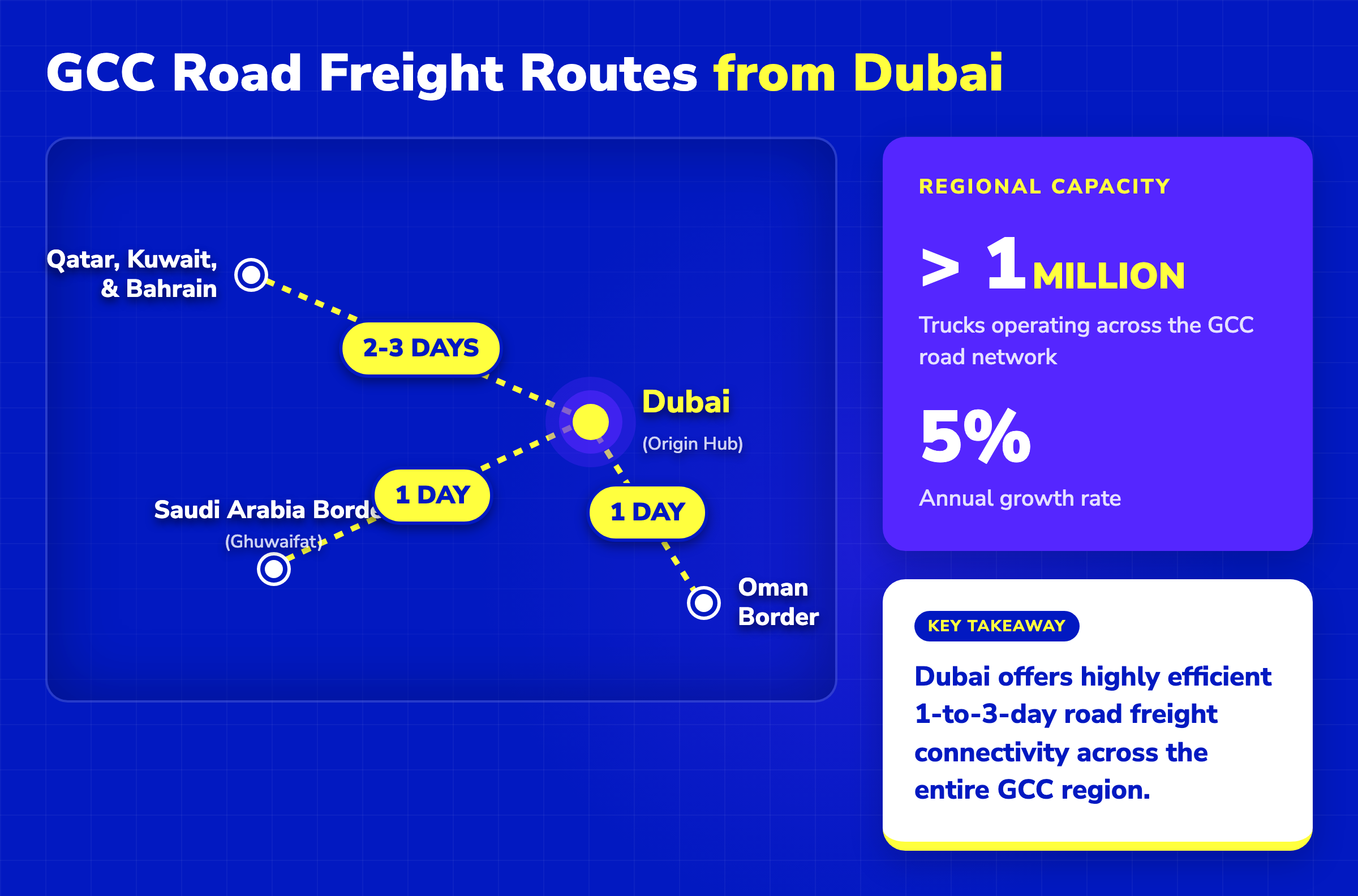
Dubai leverages its position in the expansive GCC road network for efficient freight forwarding to Saudi Arabia, Kuwait, Oman, Bahrain, and Qatar. According to GRC's Transportation and Logistics Industry Outlook, the network features well-maintained highways with over 1 million trucks operating regionally and growing 5-9% annually, making road freight the dominant mode for intra-GCC land cargo.
GCC Road Network from Dubai
Key connectivity routes include:
- Saudi Arabia: Direct links via UAE-Saudi border at Ghuwaifat, integrated into freight pipelines like ADNOC's 1,200 km network operational since 2016, handling up to 22,000 tonnes daily. Saudi Arabia commands 52.60% of GCC contract logistics market share in 2025 with SR200 billion (USD 53.31 billion) invested in infrastructure including 59 logistics centers.
- Oman: Connected through expanded highways and Port of Duqm initiatives, benefiting from GCC's pipeline of road projects and Oman's Indian Ocean gateway strategy.
- Bahrain: Accessible via King Fahad Causeway from Saudi Arabia, enabling seamless extension from Dubai routes with five-hour customs clearance for just-in-time flows.
- Qatar and Kuwait: Supported by regional multimodal plans like Gulf Railway for future land-bridge efficiency. Qatar's GWC reported QAR 1.582 billion (USD 434.25 million) revenue in 2024 from freight forwarding and trucking.
The Mordor Intelligence GCC report shows the road freight sector grows at a 5% CAGR (2020-2025), with full truckload (FTL) capturing 30% market share driven by high-volume consignments and free trade zones.
Cross-Border Procedures
Freight forwarders in Dubai handle streamlined customs via single-window platforms like UAE's Advanced Trade and Logistics Platform, reducing documentation complexity. According to RSA Global's analysis, GCC harmonization efforts address gaps in cross-border infrastructure, though investments of approximately 5% GDP are needed per World Bank estimates.
Key requirements include customs documentation and transit permits, aided by free zones like JAFZA (expanding 360,000 sq ft with AED 90 million/USD 24.51 million investment) for simplified bonded trucking through warehousing and distribution facilities.
Truck Types for Regional Transport
Common truck types operating in Dubai/UAE freight forwarding include:
- Flatbed: For oversized/general cargo, prevalent in FTL operations (30% market share)
- Refrigerated (Reefer): Essential for perishables amid rising e-commerce, supporting intra-GCC trade growth
- Container Chassis: Standard for intermodal transport from Jebel Ali Port to GCC borders
- Heavy Haul: Used for industrial projects, aligned with Vision 2030's USD 50 billion approvals in 2024
Over 1 million trucks operate regionally, supported by 20%+ government subsidies on fuel costs, as noted in the RSA Global report.
Transit Times Within GCC
Typical road freight from Dubai achieves 1-3 days to most GCC destinations: 1 day to Oman/Saudi borders, 2-3 days to Qatar/Kuwait/Bahrain via established highways, subject to customs processing and traffic conditions. The planned Gulf Railway promises further efficiency improvements.
Market context from Research and Markets shows the UAE freight logistics market at USD 21.63 billion in 2025, rising to USD 30.19 billion by 2030, while the Middle East truck freight market reached USD 44.31 billion in 2024 with a 5.3% CAGR.
Comparing Freight Forwarding Options: Air vs Sea vs Road
Selecting the optimal freight forwarding mode requires understanding the trade-offs between cost, speed, and cargo suitability. In Dubai's dynamic logistics market, each mode serves specific business needs while contributing to the overall freight forwarding ecosystem.
Cost Comparison Framework
Air freight commands the highest costs while sea freight offers the most economical solution for bulk shipments. According to Mordor Intelligence's market analysis, air freight forwarding yielded 44.33% of forwarding revenue in 2025, reflecting its premium positioning for time-sensitive cargo. Sea forwarding is projected to outpace air at an 8.12% CAGR (2026-2031), driven partly by cost advantages as capacity additions and digitized paperwork widen the appeal of Jebel Ali and Fujairah gateways.
Road freight occupies the middle ground for cost-effectiveness on regional hauls. However, stricter weight rules and congestion fees encourage modal shift for inter-emirate hauls over 200 kilometers, indicating that road costs become less competitive for longer distances.
Transit Time Comparison
Air freight remains the fastest option, essential for factory-to-market lead-time needs in electronics and fast fashion sectors. Dubai International Airport retained its top global ranking for international tonnage, supported by Emirates SkyCargo's 140-destination network, enabling rapid connections to the UAE to USA shipping corridor and UAE to Europe logistics routes.
Sea freight is the slowest but most capacity-efficient mode. However, recent infrastructure improvements are reducing traditional dwell times. DP World's USD 2.5 billion program pushed national throughput capacity past 100 million TEU in January 2025, an 8.3% jump over 2024 volumes, with Jebel Ali's fourth container terminal shrinking air-sea transshipment dwell times.
Road freight provides medium transit times for regional distribution. Dense population clusters in Dubai and Abu Dhabi enable parcel carriers to meet same-day service promises at scale, with domestic CEP flows representing 64.72% of revenue share in 2025.
Cargo Suitability by Mode
Different cargo types naturally align with specific transport modes based on their characteristics:
- Air freight: Ideal for high-value electronics, pharmaceuticals, fashion items, and perishables requiring speed
- Sea freight: Optimal for bulk commodities, containerized consumer goods, raw materials, and heavy machinery
- Road freight: Best for regional distribution, final-mile delivery, and time-sensitive GCC trade
Reliability Factors
Weather and seasonal impacts vary significantly by mode. Air freight faces minimal weather delays due to modern aircraft capabilities, while sea freight is more susceptible to seasonal monsoons and port congestion. Road freight in the UAE experiences challenges from summer heat and occasional dust storms affecting visibility.
Carrier performance and digital integration are increasingly critical differentiators. Digital platforms now furnish instant quotes and real-time container tracking, cutting administrative friction and enabling SMEs to bypass traditional brokerage queues. According to Coherent Market Insights, courier, express, and parcel revenue is climbing faster at 7.52% CAGR (2026-2031) thanks to e-commerce surges and same-day delivery promises.
Decision Matrix for Mode Selection
When choosing between air, sea, and road freight from Dubai, consider these factors:
- Urgency: Air for 1-5 days, road for 1-3 days regionally, sea for 7-25 days internationally
- Budget: Sea offers 60-80% cost savings versus air for non-urgent shipments
- Cargo type: Perishables and high-value goods favor air, bulk commodities suit sea
- Volume: LCL sea freight for 1-15 cubic meters, FCL for larger volumes, air for under 500kg
- Destination: GCC markets accessible by road, intercontinental requires air or sea
The UAE Freight Forwarding Market, valued at USD 21.56 billion in 2025 and expected to reach USD 35.08 billion by 2032, reflects growing demand for integrated multimodal solutions that optimize these trade-offs.
Choosing the Right Freight Forwarder in Dubai
Selecting a freight forwarder in Dubai requires careful evaluation of carrier relationships, technology capabilities, and industry experience. As the UAE's freight forwarding market grows from USD 21.56 billion in 2025 to a projected USD 35.08 billion by 2032 at a 7.2% CAGR, choosing the right partner becomes increasingly critical for business success.
Key Evaluation Criteria
Carrier Relationships form the foundation of effective freight forwarding. Prioritize forwarders with Key Account Centre (KAC) status from major carriers, as this unlocks priority capacity, negotiated rates, and dedicated support amid surging volumes. According to Mordor Intelligence, air freight forwarding held 44.33% of forwarding revenue in 2025, while sea forwarding grows at 8.12% CAGR (2026-2031). Strong carrier partnerships ensure access to capacity during peak seasons when Jebel Ali Port's 100 million TEU capacity and Emirates SkyCargo's network face high demand.
Technology Capabilities differentiate modern freight forwarders dubai from traditional operators. Look for AI-powered operations, real-time tracking, and instant quoting capabilities. Digital platforms cut administrative friction for SMEs, exemplified by UPS's USD 100 million Dubai South investment in March 2025 for automated last-mile sorting to support e-commerce growth. These technological advantages translate directly to faster service and lower costs for shippers.
Experience and Expertise matter particularly in Dubai's complex logistics landscape. Established firms with free zone expertise navigate documentation inconsistencies between mainland Dubai and Jebel Ali, where full foreign ownership and zero taxes attracted USD 5 billion in 2024 logistics FDI, including major investments like Kuehne+Nagel's e-commerce hub.
Service Scope Requirements
Top freight forwarders integrate express shipping, warehousing, and customs clearance for end-to-end solutions. The Coherent Market Insights report shows courier, express, and parcel (CEP) revenue grows at 7.52% CAGR (2026-2031), with domestic CEP at 64.72% revenue share in 2025. Leading operators bundle these services with freight to maximize utilization amid 32% year-over-year e-commerce shipment growth.
Warehousing dominates logistics segments, capturing over 50% market share, while customs brokerage adds premium margins via digitized processes and emissions-reporting mandates from 2025. DP World's expansion to 180 global freight-forwarding offices by end-2024 enhances GCC supply chains, demonstrating the importance of comprehensive service offerings.
Technology Differentiators
Modern freight forwarders leverage technology for competitive advantage:
- AI-powered rate comparison: Instant quotes across multiple carriers and modes
- Real-time tracking: End-to-end visibility from pickup to delivery
- Automated documentation: Reduced errors and faster customs clearance
- Predictive analytics: Proactive issue resolution and route optimization
Red Flags to Avoid
When evaluating forwarding companies in dubai, watch for these warning signs:
- Lack of proper licensing from Dubai Economic Department or relevant free zones
- No established carrier partnerships or Key Account status
- Hidden fees not disclosed in initial quotations
- Limited technology capabilities or manual-only processes
- No physical presence in key logistics hubs like JAFZA or DAFZA
Major players dominating Dubai's freight forwarding market include DHL Global Forwarding, DB Schenker, CEVA Logistics, Emirates SkyCargo, and Aramex, according to market research. These established operators leverage strong carrier relationships and advanced technology platforms to maintain market leadership.
Have a quick question? Get answers instantly on WhatsApp.
Industries and Use Cases for Dubai Freight Forwarding
Dubai's strategic location and world-class infrastructure support diverse industries through comprehensive freight forwarding solutions. The emirate's logistics capabilities, anchored by Jebel Ali Port's 100 million TEU capacity and Dubai International Airport's global air freight dominance, serve sectors ranging from e-commerce to oil and gas.
E-commerce: Inventory Distribution and Peak Season Management
Dubai's dense population concentration and extensive free zone network enable efficient e-commerce fulfillment at scale. According to Mordor Intelligence, domestic CEP flows captured 64.72% revenue share in 2025, while international parcels grow at 7.85% CAGR (2026-2031) to serve 55 million GCC consumers. UPS's USD 100 million investment in Dubai South (March 2025) created automated last-mile sorting infrastructure specifically for handling peak e-commerce volumes.
E-commerce businesses leverage bonded warehousing in free zones for inventory distribution, with Kuehne+Nagel's dedicated e-commerce hub supporting efficient returns management. Government digitization programs simplify customs procedures for omnichannel models that blend traditional storefront and social commerce operations.
Manufacturing: Supply Chain Optimization
Manufacturing operations rely heavily on Dubai freight forwarding for both raw material imports and finished goods exports. Air freight forwarding claims 44.33% of revenue (2025) for time-sensitive electronics and fast fashion exports from Jebel Ali Free Zone. Sea forwarding, growing at 8.12% CAGR (2026-2031), handles bulk raw materials with digitized tracking and consolidation services.
According to Mordor Intelligence's Middle East analysis, multinational firms established 40% of their distribution centers in Gulf free zones (2024) for deferred assembly, temperature-controlled storage, and just-in-time imports through Jebel Ali's rapid clearance systems. FDI inflows into metals and petrochemicals sustain robust containerized volumes, optimized by intermodal truck-rail-sea networks.
Trading Companies: Re-export Operations
UAE's duty-free re-exports and single-window customs systems drive commodity movements, with Dubai generating over 70% of retail sales (2024). Jebel Ali's strategic position buffers Asia-Europe reroutes amid supply chain disruptions, with the port handling 15-20% rate increases in 2024 due to Red Sea diversions.
Forty-five free zones offer bonded warehousing for consolidation services, attracting USD 5 billion in logistics FDI (2024). Digital platforms enable instant quotes for SMEs engaged in trading activities. Sea freight's 41.89% Middle East market share (2024) supports bulk trading via Jebel Ali's ultra-large vessel berths and deep-water capabilities.
Oil & Gas: Project Cargo and Specialized Equipment
The oil and gas sector requires specialized freight forwarding for equipment shipping and project cargo. Petrochemical FDI fuels bulk shipments, with project cargo handled via Jebel Ali's specialized engineering facilities and GDP-certified storage for equipment destined for Abu Dhabi's clean energy projects.
DP World's USD 2.5 billion expansion (2025) enhanced heavy-lift capabilities, while revamped cargo aprons reduced air-sea transshipment times for high-value oilfield equipment. The UAE's 5.95% CAGR leads Middle East forwarding growth, attracting specialized flows for aluminum and biopharma-adjacent energy cargo.
Healthcare: Temperature-Controlled Logistics
Healthcare and pharmaceutical industries demand precise temperature control and regulatory compliance throughout the supply chain. Emirates SkyCargo's dedicated temperature-controlled cargo corridor (launched May 2025) connects the UAE with key global pharmaceutical hubs, ensuring cold chain integrity. Specialized cool-chain facilities at Dubai International Airport support pharmaceutical yields, with GDP (Good Distribution Practice) certified operations ensuring compliance with international standards.
The sector benefits from Dubai's position as a regional distribution hub, enabling urgent deliveries of medical supplies and equipment across the Middle East and beyond. Free zone advantages and streamlined customs procedures facilitate rapid movement of time-sensitive healthcare products.
Frequently Asked Questions About Dubai Freight Forwarding
What is the difference between a freight forwarder and a shipping line?
A freight forwarder acts as an intermediary that arranges transportation on behalf of shippers, coordinating with multiple carriers (shipping lines, airlines, trucking companies) to move cargo from origin to destination. They handle documentation, customs clearance, consolidation, and provide door-to-door logistics solutions. In contrast, a shipping line owns and operates vessels that physically transport containers across oceans. While shipping lines focus on port-to-port ocean transport, freight forwarders in Dubai offer comprehensive logistics services including air, sea, and road options, leveraging relationships with multiple carriers to find optimal routes and rates. Freight forwarders essentially serve as travel agents for cargo, while shipping lines are like the airlines that operate the actual vessels.
How long does customs clearance take in Dubai?
Customs clearance in Dubai typically takes 1-3 business days for standard shipments with complete documentation, thanks to the emirate's advanced digital systems. Dubai Customs processed over 20 million declarations in 2024 with 99% automation through platforms like Mirsal 2, significantly reducing processing times. Air freight clearance can be completed within 4-6 hours for express shipments, while sea freight may require 24-72 hours depending on cargo type and inspection requirements. Free zone shipments often clear faster due to simplified procedures, with JAFZA enabling duty-free re-exports that can clear within hours. Factors affecting clearance time include documentation accuracy, cargo type (restricted goods require additional permits), and whether physical inspection is required. Working with experienced freight forwarders who understand Dubai's customs procedures can minimize delays.
What documents are required for international freight from Dubai?
International freight from Dubai requires several key documents: a commercial invoice detailing the transaction, packing list specifying contents and quantities, bill of lading (for sea freight) or airway bill (for air freight) as proof of shipment, and certificate of origin confirming where goods were manufactured. Additional documents may include export permits for restricted items, dangerous goods declarations for hazardous materials, phytosanitary certificates for agricultural products, and letters of credit for payment terms. Free zone shipments may require specific zone documentation. The UAE's Advanced Trade and Logistics Platform has digitized many processes, but accuracy remains crucial—incorrect documentation is a leading cause of shipment delays. Professional freight forwarders maintain compliance teams to ensure all documentation meets both UAE export requirements and destination country import regulations.
How do I choose between air and sea freight for my shipment?
Choosing between air and sea freight depends on four key factors: urgency, budget, cargo characteristics, and destination. Air freight is ideal when you need delivery within 1-5 days, are shipping high-value goods (electronics, pharmaceuticals), or have perishable items requiring speed. It's also suitable for smaller shipments under 500kg where the higher cost per kilogram is offset by speed. Sea freight becomes optimal for non-urgent shipments (7-25 days transit time), bulk cargo or full container loads, heavy items where air freight would be prohibitively expensive, and when you need to minimize shipping costs (sea freight typically costs 60-80% less than air). Consider your inventory holding costs, customer delivery expectations, and cash flow when making this decision. Many businesses use a combination—air freight for urgent orders and sea freight for regular inventory replenishment.
What should I look for when selecting a freight forwarding partner?
When selecting a freight forwarding partner in Dubai, prioritize companies with Key Account Centre status with major carriers, as this provides access to better rates and priority capacity—critical given that air freight forwarding held 44.33% of forwarding revenue in 2025. Technology capabilities are essential: look for AI-powered rate comparison, real-time tracking, and automated documentation systems that reduce errors and speed up processes. Verify proper licensing from Dubai Economic Department or relevant free zones, and confirm they have physical presence in key logistics hubs like JAFZA or DAFZA. Comprehensive service offerings should include express shipping, warehousing, and customs clearance under one roof. Red flags include hidden fees, lack of carrier partnerships, manual-only processes, and no established track record. Major players like DHL Global Forwarding, DB Schenker, and CEVA Logistics offer reliability, while specialized forwarders may provide better rates for specific trade lanes or cargo types.
Can I track my freight shipment in real-time?
Yes, modern freight forwarders in Dubai offer real-time tracking capabilities throughout your shipment's journey. Advanced tracking systems provide visibility from pickup to final delivery, including milestone updates like customs clearance, port arrivals, and transshipment points. Digital platforms used by leading forwarders integrate with carrier systems to provide unified tracking across air, sea, and road modes—particularly important as digital integration drives the 7.52% CAGR growth in courier and express services (2026-2031). GPS-enabled tracking for road freight within GCC provides precise location data, while IoT sensors can monitor temperature and humidity for sensitive cargo. Most forwarders offer mobile apps and web portals where you can access tracking information 24/7, receive automated alerts for status changes, and download proof of delivery documents. This transparency helps with inventory planning, customer communication, and quick resolution of any issues that arise during transit.
Sources & References
This article draws on research and data from the following verified sources:
- Mordor Intelligence - UAE Freight & Logistics Market Share & Size 2031 Outlook
- Coherent MI - UAE Freight Forwarding Market Size Opportunities 2025-2032
- Ken Research: UAE Logistics Market
- Step-by-Step Freight Forwarding Process from Dubai | Simple Guide
- Explain Freight Forwarding Process 9 Best Steps | Megaspeed Cargo
- Complete Guide to Freight Forwarding Services in Dubai - Cargoline
- GCC Air Freight Transport Market Size | Share Report 2033 - IMARC
- Air Cargo Industry Statistics: Market Data Report 2026 - Gitnux
- Air Cargo Demand up 5.6% in January 2026 - IATA
- Air freight faces tighter capacity, higher costs and more complex routing decisions - Metro Global
- Air Cargo Demand Surges 5.6% in January 2026 - Dubai Smart Rental Index
- DP World's Jebel Ali Port Sets New Record with 1.4 Million TEUs
- Jebel Ali Port hits new monthly container handling record
- Jebel Ali Port Sets Breakbulk Cargo Record - The Maritime Standard
- Jebel Ali, Khalifa Port, Fujairah, Khor Fakkan, Port Khalid - tradlinx
- Jebel Ali, United Arab Emirates - Global Trade Hub - UNIS
- Jebel Ali Port breaks nine-year record for container volume in July
- DP World and ICTSI show strongest revenue growth in 2023
- MARKET UPDATE CONTAINER PORTS & TERMINALS
- GCC Transportation and Logistics Industry Outlook
- Future of GCC's Road Freight Sector - RSA Global
- United Arab Emirates Freight And Logistics - Research and Markets
- Middle East and Africa Truck Freight Market - Cognitive Market Research
- UAE Express Delivery Market Report and Forecast 2026-2034
- UAE Logistics Market Size is Expected to Reach USD 95.2 Billion
- UAE Contract Logistics Market Size & Outlook, 2025-2030
Tags
Related Articles
Ready to optimize your logistics?
Whether you need express shipping, freight forwarding, or warehousing — our AI finds the best rates and routes for your business.