
Shipping Costs & Express Rate Factors Guide: What Affects Your International Quote
In today's volatile international shipping landscape, understanding air cargo price dynamics has become critical for Dubai-based businesses navigating disrupted trade routes and surging costs. With Middle East tensions driving rate increases of up to 80% on some corridors and carriers implementing emergency surcharges, the traditional approach of relying on static rate cards and single-carrier relationships no longer delivers competitive pricing.
This comprehensive guide reveals how modern AI-powered multi-carrier comparison technology transforms access to enterprise-level shipping rates, enabling businesses of any size to achieve the same 65% cost savings previously reserved for high-volume shippers. Whether you're importing from China, exporting to the USA, or managing complex multi-country distribution, understanding these pricing factors empowers smarter logistics decisions.
Understanding Air Cargo Pricing: The Complete Cost Breakdown
The fundamental difference between air cargo pricing and express logistics pricing structures can dramatically impact your bottom line. According to recent market analysis, express air freight services from major carriers like DHL, FedEx, and UPS operate on integrated door-to-door models with fixed pricing structures, typically costing $6.50-$12.00 per kilogram for shipments under 100kg. In contrast, traditional air freight through freight forwarders operates on an airport-to-airport basis, with base rates of $3.50-$8.50 per kilogram that fluctuate significantly based on weight and market conditions.
The pricing divergence becomes particularly critical at scale. For a 50kg shipment from Shenzhen to Los Angeles, express courier costs total $390 ($7.80/kg), while air freight costs $550 ($11.00/kg). However, this relationship reverses dramatically for larger shipments—at 1,000kg, air freight drops to $4.69/kg versus express at $4.80/kg, with the break-even point occurring between 800-1,000kg.
Volumetric vs Actual Weight Calculations and Their Impact on Costs
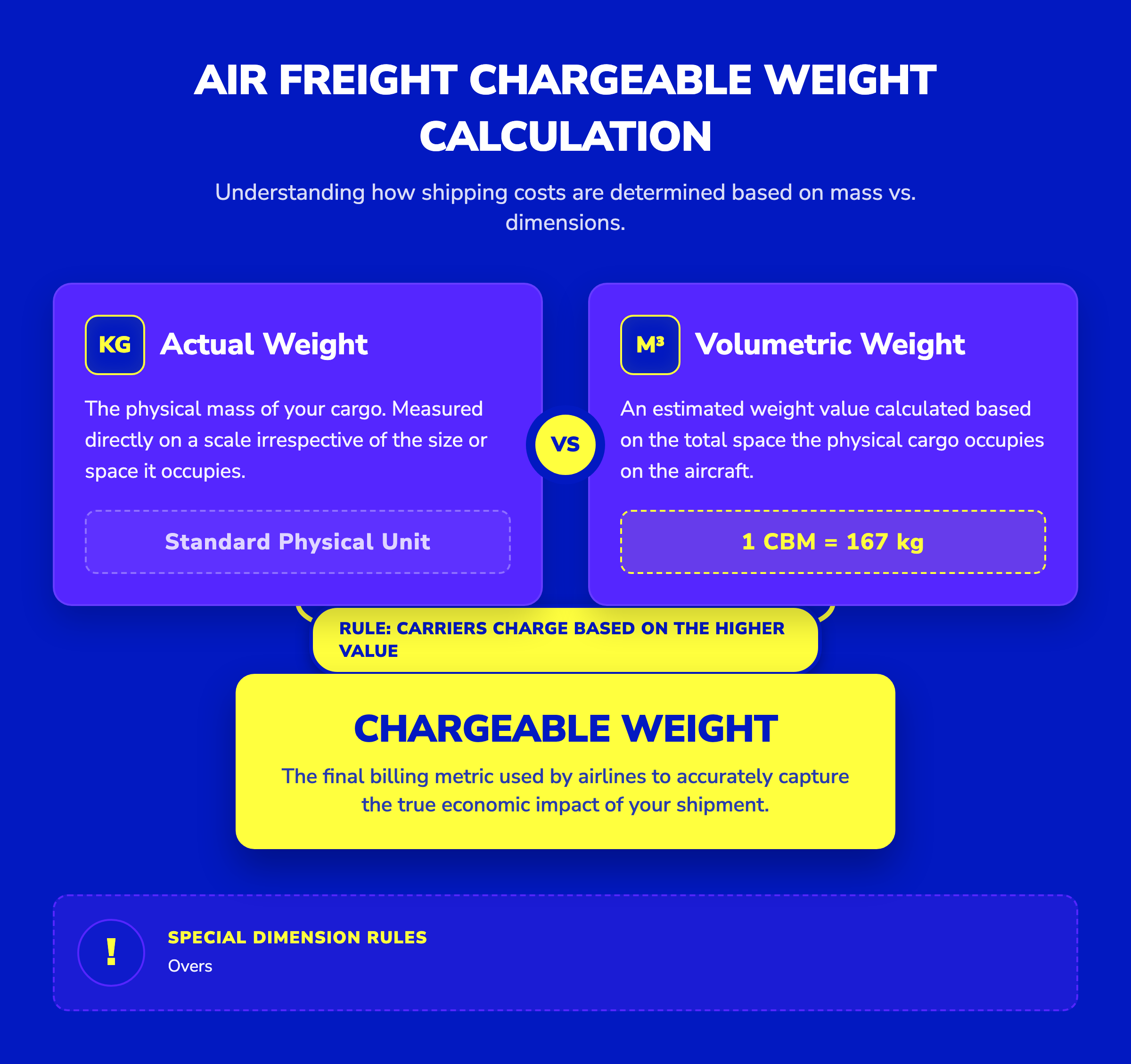
Air cargo pricing employs a chargeable weight system that uses whichever is greater: actual weight or volumetric weight. This calculation significantly impacts final costs, particularly for low-density cargo. Emirates SkyCargo's 2026 rate card specifies charges per kilogram of gross weight, with minimum thresholds applied to various service categories. For example, pickup from forwarder premises is charged at AED 0.15 per kg with a minimum of AED 75, while express release within 4-6 hours costs AED 0.50/kg with a minimum of AED 50.
The volumetric calculation method means that bulky, lightweight items are charged based on dimensional weight rather than actual weight, directly inflating per-kilogram costs for shippers. This structural difference between air cargo and express services creates pricing advantages for express couriers on lightweight, high-volume shipments under 100kg.
Base Rates, Fuel Surcharges, Security Fees, and Handling Charges
International air cargo price rates have experienced significant volatility. According to Freightos data, as of early 2023, rates stabilized around $3.00-$7.00 per kilogram, still elevated from pre-pandemic levels of $2.50-$5.00/kg due to increased fuel and labor costs.
Hidden fees substantially increase total costs across both express courier and air freight services:
- Express Courier Surcharges: Remote area fees ($20-50), residential delivery ($5-15), oversized handling ($50-100)
- Fuel surcharge: 20-40% of base rate across all carriers
- Security fees: AED 0.15-0.50/kg ($0.04-0.14/kg) depending on service level
- Merchandise Processing Fee (MPF): 0.3464% of declared value
- Customs clearance: $75-150
- Insurance charge: AED 0.55/kg on chargeable weight
- Manual customs data entry: AED 150 per Master Air Waybill
- Dry ice charges: AED 11/kg (minimum AED 220)
- Security seal fee: AED 20 per seal
These ancillary charges can add 30-50% to base rates, making transparent quoting essential for accurate cost planning.
Why Static Rate Cards Are Obsolete in 2026's Dynamic Pricing Environment
Static rate cards have become obsolete in 2026's volatile market. Middle East disruptions have fundamentally reshaped air cargo pricing dynamics, as reported by Metro Global:
- Hong Kong to Europe routes: +30% increase since Middle East conflict outbreak
- India to US routes: +60% increase
- India to Europe routes: +80% increase
These dramatic increases reflect capacity constraints—approximately 30% of Asia-Europe air cargo capacity normally routes through the Middle East. With options severely constrained, carriers are implementing emergency surcharges. According to The National, major carriers including MSC have declared "end of voyage" status for Arabian Gulf ports, with emergency freight rates now ranging from $1,800-$3,800 per container for affected regions.
The 2026 market reality demands real-time quotes rather than reliance on published rate cards. The hybrid model—70% base inventory via air freight plus 30% buffer stock via express—has emerged as optimal, delivering blended costs 30-40% below 100% express shipping, with documented savings of $146,400 annually on 20,000kg monthly shipments.
Key Factors That Determine Your International Shipping Costs
Understanding the specific factors that drive international shipping costs enables businesses to optimize their logistics spend and make informed carrier selections. From route-specific dynamics to seasonal fluctuations, each element plays a crucial role in determining your final air cargo price.
Route-Specific Factors: US to Dubai, UK to Dubai, China to Dubai Corridor Analysis
International air cargo rates to Dubai vary significantly by origin due to distance, fuel surcharges, and hub connectivity. Dubai International Airport handled 2.11 million tons of freight in 2023, up from 2 million tons in 2022, with projections reaching around 3 million tons in 2024. This massive volume creates competitive dynamics that directly impact pricing.
For context on corridor dynamics, Dubai to US East Coast LCL rates range from $55-$75 per CBM with 25-35 days transit time, while Dubai to UK LCL costs $40-$55 per CBM with 18-25 days transit. Dubai to Shanghai 20-foot container rates fluctuate between $800-$1,200 with 10-20 days transit time. Reverse corridors face elevated risks from 2026 regional tensions, with Maersk suspending bookings to/from UAE and imposing emergency freight rates of $1,800-$3,800 per container on affected Gulf routes, plus MSC's $800 per container surcharge for rerouting.
The us to dubai shipping cost has been particularly impacted by Hormuz Strait disruptions, which have spiked container costs with no viable alternatives, pushing air cargo premiums higher as exporters shift modes to maintain supply chain continuity.
Shipment Characteristics: Weight, Dimensions, Commodity Type, Declared Value
Costs scale dramatically with weight and dimensions. The chargeable weight calculation uses the higher of actual or volumetric weight, typically calculated at 1 CBM = 167 kg for air freight. Oversized cargo incurs surcharges of up to 50-100% above standard rates.
Commodity type significantly affects rates:
- Hazardous or high-value goods (electronics, pharmaceuticals) add 20-50% premiums for specialized handling and security
- Standard 20-foot container capacity ranges from 21,000-27,000 kg
- 40-foot containers hold 26,000-28,000 kg, with per-kg costs dropping for denser loads
- Dubai-Hamburg 40-foot container at $2,800 total equals just $0.11/kg for 25,000 kg shipment
Declared value triggers insurance costs of 0.5-2% of value, with valuation charges especially impacting shipments over $100,000, amplifying total costs by 5-15% in UAE freight forwarding.
Service Level Requirements: Express vs Standard, Door-to-Door vs Airport-to-Airport
Service level selection dramatically impacts your shipping cost from uk to dubai and other international routes. Express air services delivering in 1-3 days cost 50-85% more than standard services requiring 5-10 days. This mirrors sea-air tradeoffs where 1,000 kg to Europe costs $3,500 by air versus $400-600 via sea LCL.
Door-to-door service adds 20-35% over airport-to-airport rates due to:
- Local trucking and last-mile delivery
- Customs clearance handling
- UAE terminal processing fees
- Documentation management
FCL becomes more economical than LCL above 15 CBM, while annual contracts with forwarders can save 20-35% through carrier negotiations and volume commitments.
Seasonal Demand Fluctuations and Capacity Constraints Affecting Rates
Dubai's freight volumes have grown steadily, but 2026 sees unprecedented spikes from Hormuz/Suez disruptions. According to Cognitive Market Research, the Middle East logistics market projects 10.7% CAGR to 2026 amid capacity strains.
Peak seasons and conflicts inflate rates by 20-50%:
- Q4 e-commerce surge (October-December)
- Ramadan period shipping peaks
- Chinese New Year factory closures
- Summer vacation capacity constraints
Fuel volatility and container shortages drive additional 15-30% fluctuations, making multi-carrier quote comparison essential for cost optimization.
Regulatory Requirements and Documentation Complexity by Origin Country
Documentation requirements vary significantly by origin, directly impacting air freight charges from china to dubai and other corridors. Complex regulatory compliance adds both time and cost to shipments:
- China origins require detailed commercial invoices, packing lists, and certificates of origin
- US exports mandate Electronic Export Information (EEI) filing for shipments over $2,500
- UK post-Brexit documentation includes customs declarations and potential EORI numbers
- Pharmaceutical and food products require additional health certificates and permits
Manual documentation processing can add AED 150-500 per shipment, while errors trigger delays and additional charges.
Express vs Standard Air Freight: Cost and Service Comparison
The choice between express and standard air freight services fundamentally shapes your logistics costs and operational efficiency. Understanding when each option delivers optimal value enables strategic shipping decisions.
Express Carriers (DHL, FedEx, UPS) vs Traditional Air Freight Forwarders
Express carriers dominate international shipping with integrated networks and guaranteed service levels. According to DeliverIt's comprehensive comparison, DHL maintains the broadest global reach and commitment to environmentally sustainable shipping options, while FedEx excels in fast overnight shipping with more than 50,000 locations across its U.S. network. UPS handles the highest daily package volume at 24.3 million shipments and provides the most cost-effective ground shipping infrastructure.
Traditional air freight forwarders typically negotiate bulk rates with carriers to offer competitive pricing for larger shipments, presenting an alternative for businesses prioritizing cost over speed.
Transit Time vs Cost Trade-offs for Different Business Needs
The international speed hierarchy reveals clear trade-offs:
- DHL Express Worldwide: Next business day delivery to major global destinations
- FedEx International Priority: 1-3 business-day delivery to most international destinations
- UPS Worldwide Expedited: 2-5 business-day delivery
- Economy options: FedEx International Economy and UPS Standard deliver in 4-6 business days but cost 30-40% less than express services
From Dubai to Pakistan, quoted rates show significant variation: DHL charges AED 454.79 to AED 526.69 (highest), FedEx averages AED 274.34, and UPS offers the cheapest cargo service in dubai at AED 87.89 for this specific route.
Service Inclusions: Tracking, Insurance, Customs Clearance, Delivery Confirmation
All three major carriers provide comprehensive service inclusions that justify their premium pricing:
Tracking and Visibility: Real-time tracking with detailed shipment visibility across all carriers. DHL receives praise for efficient tracking with multi-language support, while UPS provides simplified delivery experiences with real-time updates.
Customs Clearance: FedEx International Priority ensures customs-cleared, door-to-door delivery of packages up to 68kg. DHL offers door-to-door deliveries without extra charges and maintains an International Help Desk Center. UPS provides detailed tracking for heavy packages with exceptional efficiency for large shipments.
Insurance Coverage: All three carriers offer insurance as part of their service portfolios, with pricing varying based on package size, weight, destination, and declared value.
When Express Logistics Makes Financial Sense Despite Higher Base Rates
Express logistics becomes financially justified in specific scenarios where the premium cost delivers measurable business value:
Time-Sensitive Shipments: When next-business-day or 1-3 day delivery is critical for business operations, DHL's express services typically deliver faster than economy alternatives. FedEx International Priority runs a close second with reliable 1-3 business-day delivery to most international destinations.
High-Value Cargo: For valuable items requiring guaranteed delivery windows and comprehensive tracking, the premium cost of express services provides risk mitigation that justifies higher base rates.
B2B and Document Shipments: In the UAE market, FedEx is commonly used for structured B2B and document shipments where speed and reliability command premium pricing.
Heavy Freight Requirements: UPS excels at handling larger shipments and freight services, with infrastructure and expertise superior to most competitors for heavy items. FedEx International Priority Freight ensures delivery of heavy-weight items above 68kg within 5 days.
Reliability Requirements: LateShipment reports that UPS maintains the strongest domestic reliability record with UPS Ground averaging around 95% on-time performance for standard deliveries, while FedEx express services typically exceed 98% on-time performance.
How Volume Partnership Rates Transform Your Shipping Costs
Volume partnership programs represent one of the most effective strategies for reducing international shipping costs, yet many businesses remain unaware of how to access these preferential rates without meeting high minimum thresholds.
What Key Account Centre Status Means for Pricing Access
A Key Account Centre represents a volume partnership tier that major express carriers reserve for their highest-volume customers. This status unlocks preferential pricing structures, priority service access, and dedicated support resources typically unavailable to standard business accounts. Companies achieving this status benefit from negotiated rates that reflect their strategic value to the carrier.
The significance of Key Account Centre status extends beyond simple discounts. Partners at this level receive customized pricing models, flexible payment terms, and direct access to carrier decision-makers for issue resolution. This relationship transforms shipping from a transactional cost to a strategic partnership.
How Aggregators Achieve 40-65% Savings Below Retail Rates
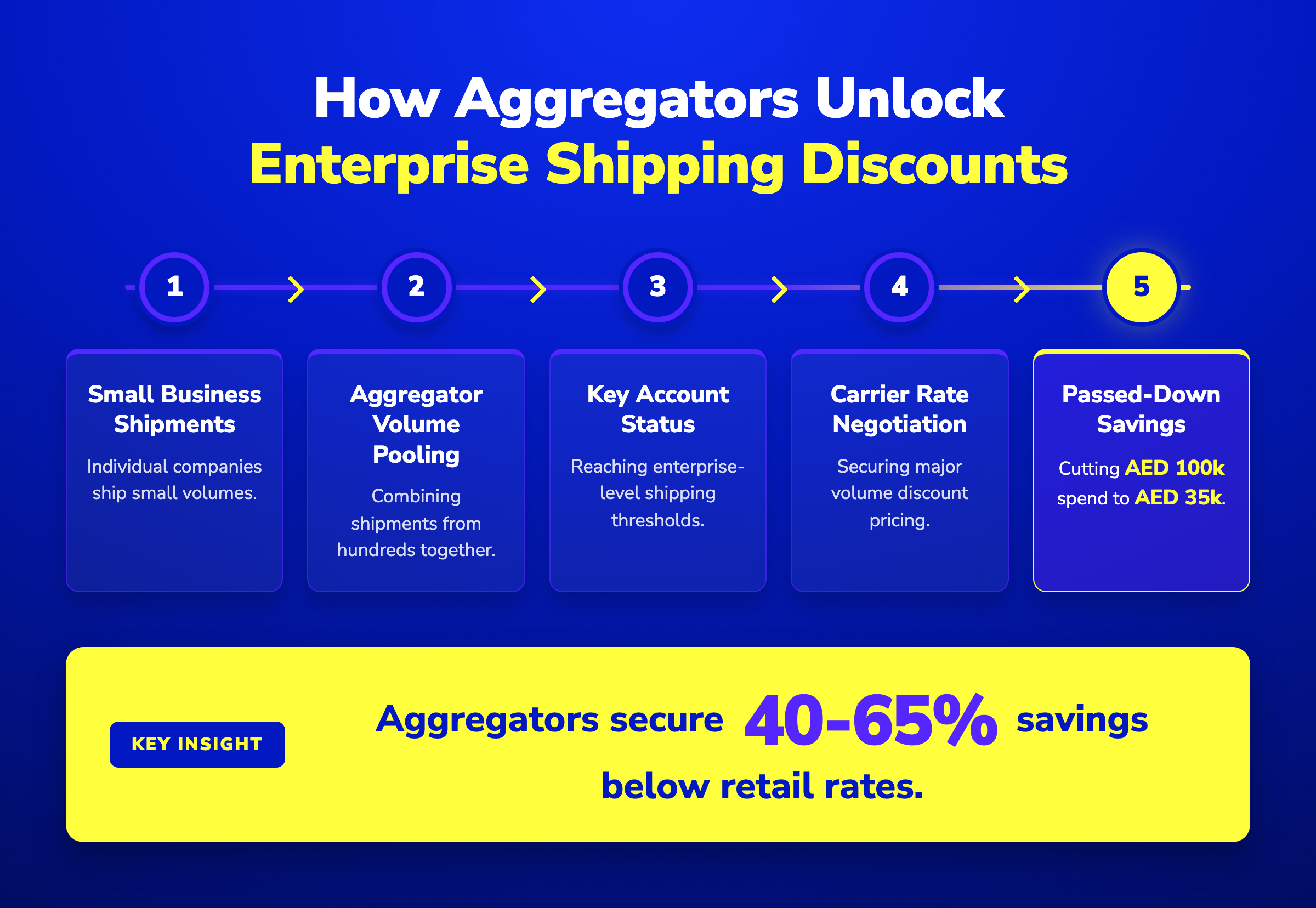
Logistics aggregators leverage collective volume to negotiate Key Account Centre rates with major carriers, then pass these savings to individual businesses. By consolidating shipments from hundreds of companies, aggregators achieve the volume thresholds that unlock enterprise-level pricing.
The aggregation model works because carriers prefer dealing with high-volume partners who provide consistent, predictable shipping volumes. This allows aggregators to secure rates typically 40-65% below published retail prices, making enterprise-level savings accessible to businesses shipping as few as 10 packages per month.
Need a shipping quote?
Get AI-optimized rates from DHL, FedEx & UPS — up to 65% below retail. Quote in under 10 minutes.
Volume Threshold Requirements vs Aggregated Buying Power Benefits
Direct Key Account Centre status typically requires minimum annual shipping volumes that exclude most small and medium businesses. These thresholds often start at millions of dirhams in annual spend or tens of thousands of shipments per year.
Through aggregated buying power, businesses bypass these requirements entirely. Instead of meeting individual volume thresholds, companies benefit from the aggregator's total volume across all clients. This democratizes access to preferential rates, allowing a startup shipping 50 packages monthly to receive the same percentage savings as a corporation shipping 50,000.
Real-World Cost Comparison: Retail Rates vs Key Account Rates
The practical impact of Key Account Centre rates becomes clear when comparing actual shipping costs. While specific rate data varies by carrier and route, businesses accessing these rates through aggregators consistently report savings of 40-65% compared to booking directly with carriers at retail rates.
For context, if a business typically spends AED 100,000 monthly on express shipping at retail rates, accessing Key Account Centre pricing through an aggregator could reduce costs to AED 35,000-60,000 for the same service level. These savings flow directly to the bottom line, making aggregator partnerships increasingly attractive for cost-conscious businesses.
The AI-Powered Multi-Carrier Rate Comparison Process
Modern AI-powered logistics operations have revolutionized how businesses access competitive shipping rates. This technology-driven approach streamlines quote generation while ensuring optimal carrier selection based on real-time data.
Step 1: Customer Submits Shipment Details via Email, Phone, or Web Form
The process begins when customers input essential shipment details through their preferred channel. Key information includes origin and destination (such as USA to UAE), package weight, dimensions, and service preferences. According to Nventory UAE's shipping estimator, modern tools calculate both dimensional weight (Length x Width x Height / 139 divisor) and actual weight for accurate quotes. In Dubai's e-commerce sector, this step supports high-volume freight forwarding where average parcel weights range from 1-10 kg for express air cargo.
Step 2: AI Agents Capture Requirements and Classify Shipment Characteristics
AI technology parses submissions to classify critical factors including zone-based distance, volumetric weight, hazardous materials status, and applicable surcharges (fuel, residential, peak season). Advanced systems handle 100+ carriers simultaneously, identifying express service tiers (economy, standard, express) for UAE routes. This automated classification delivers 15-30% average savings through intelligent rule application, crucial in Dubai where e-commerce delivery costs average AED 20-50 per order.
Step 3: Real-Time API Queries to DHL, FedEx, and UPS for Key Account Rates
The system queries live APIs from DHL, FedEx, and UPS, pulling Key Account rates that reflect volume-discounted commercial pricing. ShipStation's rate calculator demonstrates how these comparisons work in seconds for UAE shipments. For example: FedEx Ground (1-5 days, from USD 10), UPS Express Saver (3 days, USD 37.45), DHL (4-10 days, USD 14.16). In UAE's 2026 market, API integrations cut quote generation time by 80%.
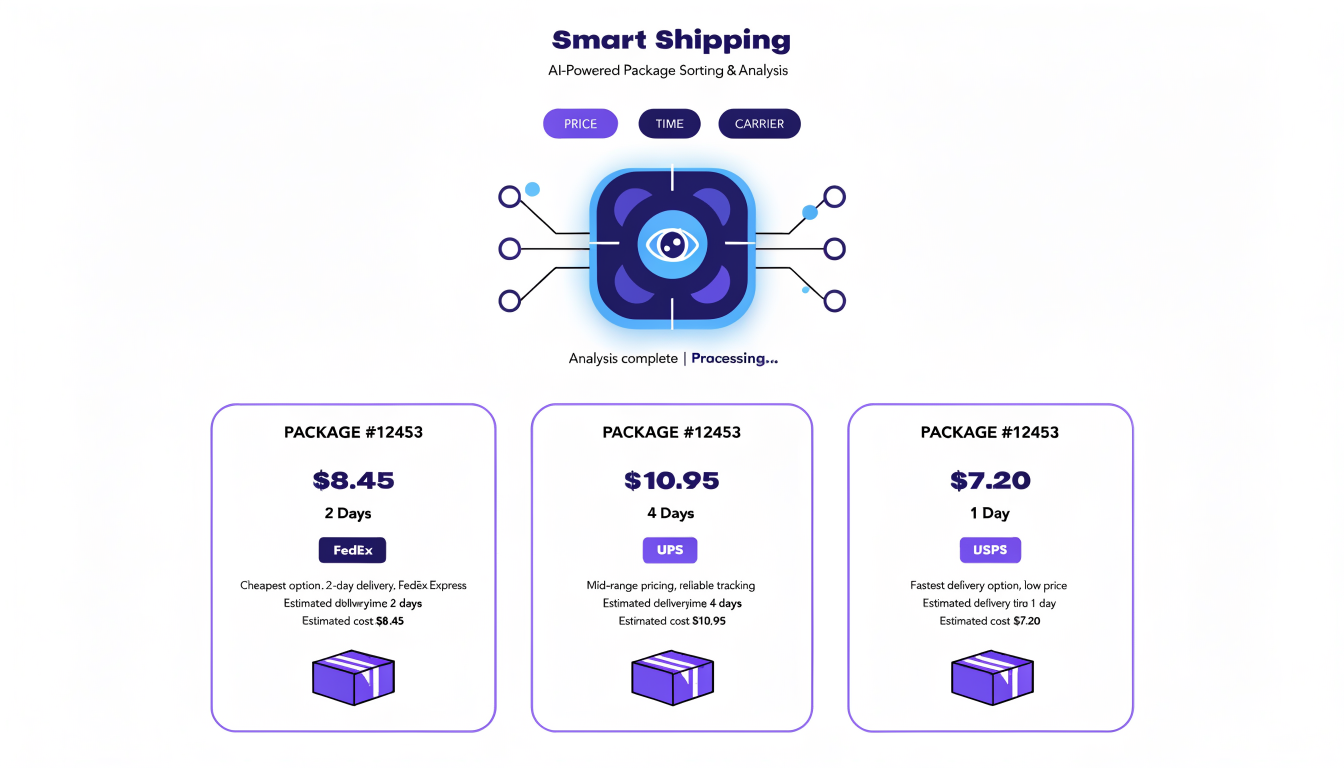
Step 4: AI Comparison Engine Evaluates Price, Transit Time, and Service Level
The AI engine ranks options by total cost (base rate plus fees), transit time, and service quality metrics. Airpals reports savings up to 89% through intelligent sorting. For Dubai/UAE international logistics, 2026 benchmarks show USA-UAE express averages USD 13.66 (DHL, 6-15 days) to USD 21.18 (23-36 days). Multi-carrier tools reduce costs 15-30% via comprehensive carrier coverage.
Step 5: Best Option Recommendation Delivered in Under 10 Minutes
Within 10 minutes of initial submission, customers receive a comprehensive recommendation highlighting the optimal carrier based on their specific requirements. This recommendation includes total cost breakdown, expected transit time, and service features, enabling informed decision-making. To get your real-time multi-carrier rate comparison, businesses simply need to submit their shipment details through any available channel.
Step 6: Booking Confirmation and Pickup Scheduling Within 20 Minutes
Once the customer approves the recommended option, the system automatically confirms the booking with the selected carrier and schedules pickup within 20 minutes. This rapid execution eliminates delays common with traditional booking processes, ensuring shipments move quickly from origin to destination.
Step 7: Unified Tracking Across Whichever Carrier Was Selected
Post-booking, customers receive unified tracking capabilities regardless of which carrier handles their shipment. This single-dashboard approach simplifies shipment monitoring, providing real-time visibility without the need to navigate multiple carrier websites or tracking systems.
Route-Specific Cost Analysis: Major Dubai Trade Corridors
Understanding route-specific pricing dynamics helps businesses optimize their international shipping strategies. Each major trade corridor presents unique cost drivers and optimization opportunities.
UAE to USA: Cost Drivers, Transit Times, Carrier Performance Comparison
The UAE to USA shipping solutions corridor represents one of Dubai's most critical trade routes. According to MoveConnector's 2026 guide, sea freight for a 20-foot container ranges from AED 18,000–25,000 ($4,900–6,800) to the East Coast and AED 22,000–28,000 ($6,000–7,600) to the West Coast.
For smaller shipments, LCL pricing varies by volume:
- 0.5–1 CBM: $140–$190
- 8–12 CBM: $650–$880
Transit times differ significantly by destination. East Coast routes (New York, New Jersey, Miami) average 45–60 days, while West Coast routes (Los Angeles, San Francisco) take 50–65 days, primarily due to Red Sea routing disruptions.

Air cargo price from Dubai to USA ranges from $2.50–$5.00 per kilogram for standard shipments. More detailed pricing shows:
- 1–10 kg shipments: $7–$10/kg
- 300+ kg shipments: $4–$5.50/kg
- Express air service: 3–4 days transit
- Standard air freight: 7 days transit
Major carriers operating this route include Emirates SkyCargo, Qatar Airways Cargo, Turkish Cargo, and Lufthansa Cargo, all maintaining established networks through Jebel Ali port.
UAE to UK: Brexit Impact on Documentation and Customs Processing Costs
The UAE to UK corridor has experienced significant changes post-Brexit, with increased documentation requirements adding complexity and cost to shipments. While specific rate data requires additional research, businesses report increased customs clearance times and documentation fees impacting total landed costs.
Key considerations for this route include:
- Enhanced customs declarations requirements
- Potential EORI number requirements for regular shippers
- Increased scrutiny on product classifications and valuations
- Additional documentation for regulated goods
UAE to China: Manufacturing Return Logistics and E-Commerce Fulfillment Rates
According to Agora Freight, air freight from UAE to China takes 1–5 days, while ocean freight on a port-to-port basis requires 15–25 days. This corridor serves critical manufacturing return logistics and e-commerce fulfillment needs, with businesses balancing speed requirements against cost considerations.
The route supports:
- Manufacturing component returns and warranty replacements
- E-commerce reverse logistics for Chinese marketplaces
- Sample shipments for production approval
- Time-sensitive spare parts delivery
UAE to Europe: Multi-Country Distribution Considerations and Cost Optimization
European distribution from Dubai requires careful planning to optimize costs across multiple destination countries. Businesses must consider:
- Consolidated shipments to central European hubs
- Country-specific customs and VAT requirements
- Intra-European distribution networks
- Express versus economy service selection by market
GCC Regional Rates vs International Corridor Pricing Structures
GCC regional shipping presents distinct advantages compared to international corridors:
- Simplified customs procedures within GCC union
- Shorter transit times enabling ground transport options
- Lower documentation requirements
- Competitive pricing due to proximity and volume
Businesses shipping within the GCC often achieve significant savings by leveraging regional carrier networks and consolidated ground services rather than express air options.
Hidden Costs and Fee Structures in Air Cargo Pricing
Understanding hidden costs proves essential for accurate budgeting and avoiding surprise charges that can inflate your air cargo price by 30-50% above quoted base rates.
Fuel Surcharges and How They're Calculated Across Different Carriers
Fuel surcharges, often labeled as PXF or similar codes, are calculated as a percentage of the base freight rate or per kilogram, adjusted monthly or quarterly based on jet fuel prices. These typically add 15-30% to the base rate across carriers. Emirates SkyCargo applies AED 0.15 per kg fuel surcharge (minimum AED 30) for most commodities worldwide from UAE.
For Middle East to Europe lanes, overall air cargo costs range from $2.80-$4.50/kg including surcharges, benefiting from high-volume competition. However, these rates fluctuate with oil prices, making fuel surcharge monitoring critical for cost management.
Security Fees, Handling Charges, and Airport-Specific Costs
Security fees and handling charges apply per Master Air Waybill (MAWB) or per kilogram, with significant variations at Dubai International Airport (DXB):
- General handling: AED 50 per MAWB worldwide from DXB
- Dangerous goods inspection: AED 220 per MAWB at DXB (since October 2024)
- Valuables handling: AED 0.50 per kg (minimum AED 150)
- Special commodities (AVI/HUM): AED 0.15 per kg (minimum AED 75)
- Security seal fees: AED 20 per seal
Valuation charges at DXB-linked routes show wide variance: AED 2,057 to Brussels (January 2025), AED 1,102 to London (October 2024).
Customs Clearance, Duties, and Documentation Fees by Destination
Customs-related fees vary significantly by destination, often charged per MAWB for valuables or human remains. From UAE, Emirates SkyCargo lists:
- India: AED 136 (since May 2022)
- Belgium: AED 484 (January 2025)
- China: AED 257 (January 2025)
- Singapore: AED 213 (September 2022)
- Saudi Arabia: AED 489 (September 2022)
Additional documentation charges include:
- Dry ice certification: AED 11/kg (minimum AED 220)
- Address correction: AED 50 per request
- Shrink wrapping: AED 30 per package
Remote Area Delivery Surcharges and Address Correction Fees
Remote area surcharges apply to non-standard locations, with Emirates SkyCargo charging AED 400 for express (within 12 hours) or AED 350 for normal (3-4 days) address corrections. Truck transfers at DXB's Emirates Fresh terminal or for human remains cost AED 1,800 per truck.
In Dubai/UAE freight forwarding, these fees add to base rates of $3-9/kg internationally, with volume discounts at 100kg+ thresholds reducing per-kg impact. For example, rates drop from $6.50/kg at 100kg to $4.50/kg at 1,000kg.
Currency Fluctuation Impact on International Rate Stability
Currency fluctuations create additional cost volatility, particularly for businesses with multi-currency operations. The 2026 regional conflicts have tightened capacity, elevating all fees further. According to Economic Times, Middle East disruptions have pushed air rates up 70% on affected routes.
Businesses can mitigate currency risk through:
- Fixed-rate contracts in stable currencies
- Currency hedging for large shipment volumes
- Regular rate reviews and carrier negotiations
- Multi-carrier strategies to access best available rates
Industry-Specific Shipping Cost Considerations
Different industries face unique shipping challenges that directly impact their logistics costs and service requirements. Understanding these sector-specific needs enables better optimization of shipping strategies.
E-commerce and Retail: High-Volume, Time-Sensitive Shipment Cost Optimization
Dubai's e-commerce sector prioritizes express air freight for time-sensitive, high-volume deliveries. Dubai International Airport handled over 2 billion tons of air freight in 2023 amid growing e-commerce demand. The UAE logistics market, driven by retail transshipments through Jebel Ali Port, is projected to exceed $30 billion by 2026.
Recent Strait of Hormuz disruptions have dramatically impacted e-commerce logistics solutions, with container rates spiking to $1,800–$3,800 per container for UAE-bound cargo. This has prompted retailers to shift to costlier air express options, accepting 10–15% higher costs including port handling fees to maintain just-in-time inventory. MSC's $800 per container rerouting fee exemplifies the additional charges businesses now face.
E-commerce optimization strategies include:
- Consolidated express forwarding to reduce per-parcel costs
- Zone-skipping to minimize last-mile expenses
- Multi-carrier strategies for redundancy during disruptions
- Automated rate shopping for each shipment
Healthcare and Pharma: Temperature-Controlled and Regulatory Compliance Costs
Pharmaceutical shipments from UAE require GDP-certified (Good Distribution Practice) temperature-controlled logistics, adding 20–30% to base rates. Specialized reefer containers and compliance with Dubai Customs' blockchain platform, which cuts declaration times to under 10 minutes, mandate extra validation for biologics.
According to Mordor Intelligence, the express forwarding market in Middle East, including UAE pharma, is set to grow from USD 21.81 billion in 2025 at 5.56% CAGR to USD 28.60 billion by 2030.

Key pharma shipping cost factors:
- Temperature monitoring equipment and validation
- Compliance documentation adding 2–4% to costs
- All-risk insurance at 3,000–6,000 AED for 150,000 AED shipments
- Priority handling fees for time-sensitive medications
Manufacturing: Just-in-Time Delivery vs Cost-Effective Consolidation Strategies
UAE manufacturers balance just-in-time (JIT) air express for critical components against consolidated sea freight via Jebel Ali and Khalifa Port. The freight forwarding sector expands at 5.95% CAGR for the UAE, optimizing high-volume loads to offset 5% CIF-based customs duties and demurrage fees.
Amid Hormuz volatility, JIT shifts to air incur 10–15% premiums over base quotes. Consolidation saves costs via Al Maktoum Airport's capacity for bulk forwarding, supporting UAE's aluminum exports (15% of global trade) and fertilizer shipments through efficient routing.
Oil and Gas: Specialized Equipment Shipping and Project Cargo Considerations
Oil and gas project cargo faces unique challenges. According to Gulf News, tanker rates have surged to 525 Worldscale (~$350,000 daily earnings) with insurance spikes up 50% due to Hormuz tensions.
In 2023, Hormuz flows averaged 20.9 million barrels/day, with UAE's Habshan-Fujairah pipeline bypassing at 1.5 million bpd capacity. However, most exports rely on vulnerable routes, adding war surcharges and idle vessel costs. Freight forwarders handle project cargo engineering for oilfield gear, with emergency rates reaching $1,800–$3,800/TEU.
Have a quick question? Get answers instantly on WhatsApp.
Choosing the Right Express Logistics Partner for Cost Optimization
Selecting the optimal express logistics partner requires careful evaluation of multiple factors beyond simple rate comparisons. The right choice can unlock significant savings while improving service quality.
Evaluation Criteria: Rate Access, Technology Integration, Service Coverage
When evaluating logistics partners in Dubai's competitive market, three critical criteria determine success:
Rate Access: Multi-carrier aggregators provide competitive benchmarking across providers, unlocking volume discounts through consolidation while avoiding single-carrier dependency. In UAE, aggregators like ClickPost (450+ carriers) and AfterShip (859+ global partners) offer automated carrier recommendations, reducing rates through AI-driven selection.
Technology Integration: Essential for cost efficiency, modern platforms require API connectivity with e-commerce systems for seamless order processing. Leading solutions provide AI-driven tracking and omnichannel integration, streamlining operations across the Middle East.
Service Coverage: Comprehensive coverage across UAE, Saudi Arabia, Oman, Kuwait, and Qatar with cross-border e-commerce capabilities, last-mile optimization, and returns management proves ideal for international express shipping.
Single-Carrier vs Multi-Carrier Aggregator Cost and Service Comparison
According to Fidelitone's analysis, the choice between single-carrier and multi-carrier strategies significantly impacts both costs and service quality:
| Aspect | Single-Carrier | Multi-Carrier Aggregator |
|---|---|---|
| Cost | Volume discounts via consolidation; unified billing | Superior rate comparison; access to 450-859 carriers for lowest rates |
| Service Reliability | Consistent experience, single accountability | Redundancy reduces disruptions; greater capacity and flexibility |
| Management | Simplified contracts and reporting | Higher complexity offset by automation platforms |
| UAE Fit | Suitable for concentrated Dubai operations | Scalable for GCC cross-border growth |
Multi-carrier strategies yield better overall value in UAE's dynamic logistics market, with 2024 aggregators rated 4.4-4.6/5 for performance.
Account Management Structure and Billing Consolidation Benefits
Single-carrier relationships offer centralized communication—one contract, unified SLAs, and fewer invoices—reducing administrative costs in UAE express shipping. However, aggregators provide consolidated billing across multiple carriers, enabling unified reporting and escalations while preserving multi-provider benefits.
Key advantages of consolidated account management:
- Single point of contact for all shipments
- Unified invoicing across all carriers
- Centralized dispute resolution
- Comprehensive reporting dashboards
Technology Requirements: API Integration, Tracking Visibility, Automated Workflows
Modern logistics demands sophisticated technology integration. Critical requirements include:
API Integration: Essential for Dubai e-commerce, enabling automated label generation and NDR (non-delivery report) management. Leading platforms pre-integrate with major e-commerce systems.
Tracking Visibility: Real-time multi-carrier tracking reduces customer support queries by up to 40%. Branded tracking pages maintain brand consistency while providing transparency.
Automated Workflows: AI-powered carrier selection and route optimization drive 10-20% efficiency gains. Platforms achieving 4.6/5 ratings demonstrate how automation transforms operational efficiency.
In UAE's 2026 market, technology-enabled aggregators deliver 20-30% cost optimization through intelligent carrier selection and automated processes.
Frequently Asked Questions About Air Cargo Pricing
What factors have the biggest impact on air cargo prices from Dubai?
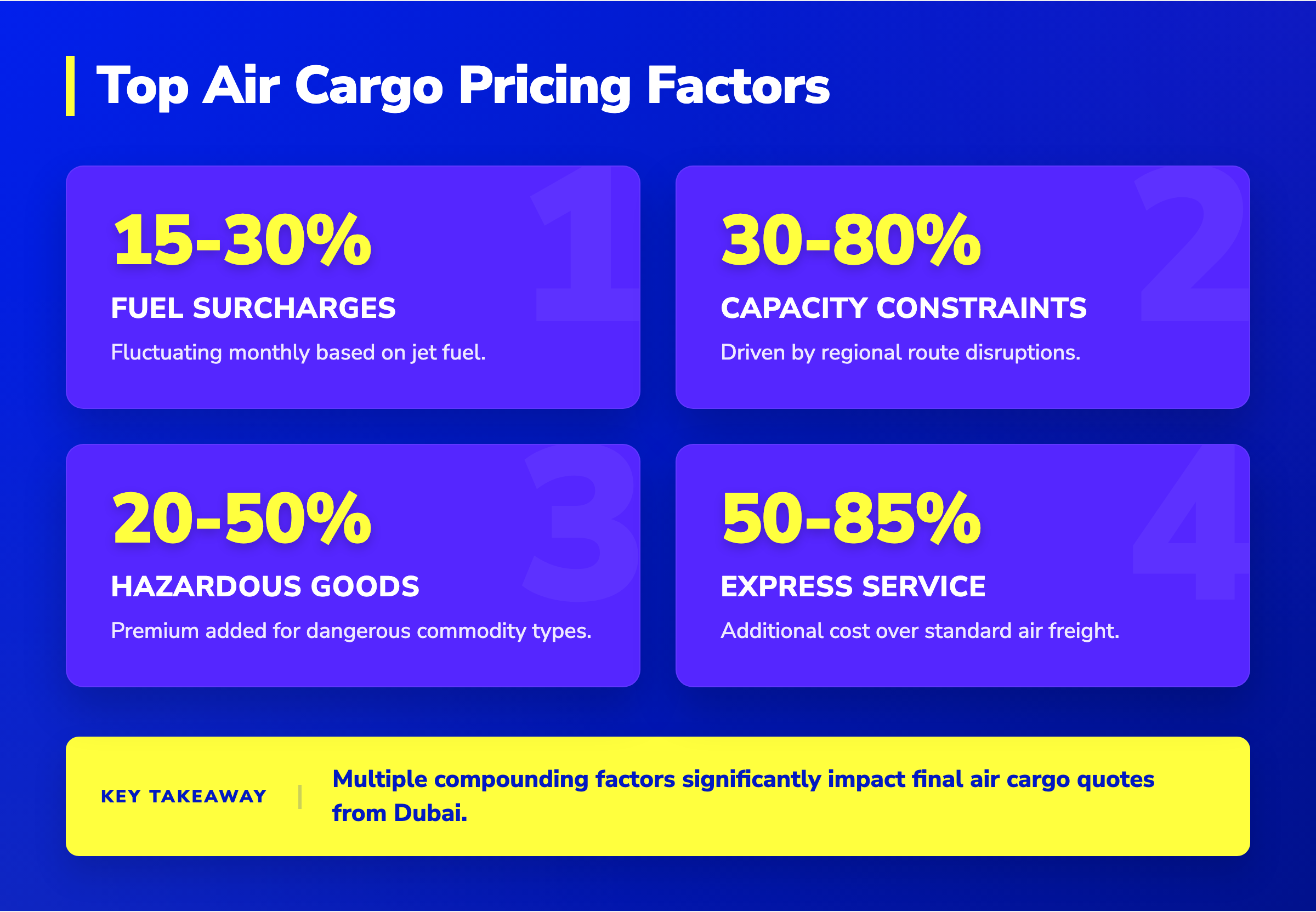
The most significant factors affecting air cargo price from Dubai include route distance, shipment weight and dimensions, current fuel surcharges, and market capacity constraints. Weight calculations use either actual or volumetric weight (whichever is greater), with volumetric weight calculated as Length × Width × Height ÷ 139 for express services. Fuel surcharges currently add 15-30% to base rates and fluctuate monthly based on jet fuel prices. The 2026 Middle East disruptions have created severe capacity constraints, with approximately 30% of Asia-Europe air cargo capacity affected, driving rate increases of 30-80% on major corridors. Additional factors include commodity type (hazardous goods add 20-50% premiums), service level selection (express costs 50-85% more than standard), seasonal demand peaks, and documentation complexity by destination country.
How do Key Account Centre rates compare to standard carrier pricing?
Key Account Centre rates typically deliver savings of 40-65% compared to standard published carrier rates. These preferential rates are reserved for high-volume shippers meeting strict annual thresholds, often requiring millions of dirhams in yearly shipping spend. The substantial discount reflects carriers' preference for predictable, high-volume partnerships that provide consistent revenue streams. Through logistics aggregators, smaller businesses can access these same Key Account Centre rates without meeting individual volume requirements. The aggregator's combined volume across all clients qualifies for top-tier pricing, which is then passed to individual shippers. This democratizes access to enterprise-level rates, allowing a company shipping just 50 packages monthly to receive similar percentage discounts as corporations shipping 50,000 packages.
What's the difference between volumetric and actual weight pricing?
Volumetric weight pricing ensures carriers are compensated fairly for the space cargo occupies, not just its physical weight. The calculation divides cubic dimensions by a factor (typically 139 for express air services or 167 for standard air freight). For example, a large but lightweight box measuring 100cm × 80cm × 60cm would have a volumetric weight of 34.5kg using the express factor (480,000 ÷ 139), even if it actually weighs only 10kg. Carriers charge based on whichever is higher—volumetric or actual weight. This system significantly impacts costs for businesses shipping bulky, low-density items like furniture, textiles, or packaging materials. Understanding this calculation helps optimize packaging to minimize wasted space and reduce shipping costs. Dense items like machinery or books typically charge on actual weight, while lightweight, bulky items charge on volumetric weight.
How can businesses access volume discounts without meeting minimum thresholds?
Businesses can access volume discounts through logistics aggregators who consolidate shipments from multiple companies to achieve carrier volume thresholds. These aggregators hold Key Account Centre status with major carriers like DHL Key Account Centre partnership, FedEx, and UPS, qualifying for enterprise rates typically requiring millions in annual shipping spend. By joining an aggregator's platform, even small businesses shipping irregularly can benefit from these negotiated rates. The model works because carriers prefer dealing with high-volume partners providing predictable shipping volumes. Aggregators also offer additional benefits including unified billing across carriers, single-point account management, and technology platforms for rate comparison. This approach delivers the same 40-65% savings as direct volume contracts without long-term commitments or minimum volume requirements.
What should I look for when choosing an express logistics aggregator?
When selecting an express logistics aggregator, prioritize providers with established Key Account Centre partnerships across multiple major carriers, ensuring access to the best rates for each shipment. Technology capabilities prove critical—look for real-time API integration with carriers, automated rate comparison tools, and unified tracking platforms. The aggregator should offer comprehensive geographic coverage matching your shipping needs, particularly for key trade routes from Dubai. Evaluate their billing and account management structure, preferring single-invoice consolidated billing and dedicated support teams. Check their track record with similar businesses in your industry and request references. Consider additional services like customs clearance support, returns management, and integration with your existing systems. Finally, ensure transparent pricing without hidden fees and verify their credentials including IATA licensing and relevant certifications for your industry's requirements.
Can I use my existing DHL/FedEx/UPS account through an aggregator?
Most logistics aggregators operate using their own carrier accounts to leverage volume-based Key Account Centre rates, meaning you typically cannot use your existing individual carrier accounts through their platform. This structure enables the aggregator to consolidate volume across all clients and negotiate better rates than individual businesses could achieve. However, this doesn't mean abandoning existing relationships—many aggregators offer hybrid solutions where you can maintain direct carrier accounts for specific needs while using the aggregator's accounts for better rates on most shipments. Some platforms also provide white-label solutions maintaining your brand identity on shipping labels and tracking pages. The transition usually involves minimal disruption, with aggregators handling account setup and integration. You'll receive consolidated billing from the aggregator rather than individual carrier invoices, simplifying accounting while maintaining full shipment visibility and control.
Sources & References
This article draws on research and data from the following verified sources:
- Emirates SkyCargo - Effective 01 JANUARY 2026 Rate Card
- Freightos - Air Freight: Shipping Charges, Rates, Cost & Quotes
- The National News - Shipping costs set to rise as companies halt cargo through Arabian Gulf
- Metro Global - Air freight faces tighter capacity, higher costs and more complex routing decisions
- Air Cargo Week - Gulf conflict disrupts air cargo capacity and pushes freight rates higher
- Cole International - Shipping Costs Rise as Middle East Unrest Disrupts Air and Ocean Freight
- Alliance Cargo Express - International Air Freight Rates
- Journal of Commerce - Asia-Europe air cargo space tightens as rates, fuel surcharges soar
- Sea Freight Rates from Dubai: Rate Calculation Guide 2025-26
- Oil shipping, insurance costs spike as Hormuz tensions test UAE trade routes
- Middle East and Africa Shipping and Logistics Market Report
- DeliverIt - DHL vs FedEx vs UPS: A Comprehensive Comparison
- LateShipment - DHL vs FedEx vs UPS: Comparing Services, Pricing, and Reliability
- Synctrack - DHL vs UPS vs FedEx: Which Courier is Best For International
- NextDayFlyers - Showdown of shipping giants (FedEx vs UPS vs DHL)
- Quiqup - Best International Shipping Companies in the UAE (2026)
- Clarion Shipping - Shipping Company in Dubai vs Freight Forwarder
- Shipping Cost Estimator — Free Carrier Rate Tool | Nventory UAE
- Shipping Rates Calculator: Compare & Estimate Costs - ShipStation
- Compare Shipping Rates | Shipping Calculator All Carriers - Airpals
- Shipping Cost Calculator from United States to United Arab Emirates
- 14 Best International Shipping Solutions in 2026 - Outvio
- 5 Best Freight Marketplaces to Compare Rates (2026) | EximGPT
- Parcel shipping to Dubai | Compare & save - JUMiNGO
- Moving from UAE to USA in 2026: Customs, Costs & Shipping Guide
- Shipping Cost from Dubai to USA 2025 Guide - Nautical Gulf
- Freight from United Arab Emirates to the US - iContainers
- International Shipping from Dubai to USA – Complete Guide for 2026
- International shipping from the UAE: Freight Air & Ocean
- The Flying Engineer Air Cargo Shipping Cost Per Kg 2026 Guide
- Economic Times Air Freight Rates Soar
- Circuit News Air Freight Rates Soar
- Mordor Intelligence: Middle East Freight Forwarding Market Size, Share & 2030 Growth
- Uncargo: How to Avoid Hidden Fees in International Shipping: 5 Tips for 2026 Importers in Dubai
- Single-Carrier vs. Multi-Carrier Shipping: Which is Right for You?
- Multi-Carrier vs. Single Carrier: Which Is the Right Choice For ...
- Single-Carrier vs. Multi-Carrier Shipping: Which is Better? | Syncware
- Multi-Carrier Shipping vs. Single Carrier Approach - Swotzy
- The Report Cubes - UAE Express Delivery Market Report and Forecast 2026-2034
- OpenPR - UAE Logistics Market Size is Expected to Reach USD 95.2 Billion
- Data Insights Market - United Arab Emirates (UAE) CEP Market Analysis 2026
- Grand View Research - UAE Courier, Express, and Parcel Market Size & Outlook, 2033
Tags
Related Articles
Ready to optimize your logistics?
Whether you need express shipping, freight forwarding, or warehousing — our AI finds the best rates and routes for your business.