
To ship clothing from the UAE as a business, use express courier for samples and small orders, and switch to air freight for larger wholesale cartons. The product description on your commercial invoice matters most for avoiding customs delays: it must be precise and match what customs expects to see.
Your apparel shipment can be one bad invoice description away from a customs hold. A vague entry like "clothes" invites questions and delays, while a specific description like "men's 100% cotton knitted T-shirts" makes clearance smoother. This guide covers shipping garments from the UAE, from choosing the transport mode to getting the paperwork right, for brands and traders in retail and apparel.
How to Ship Clothing from the UAE as a Business
Garment exports from the UAE need a commercial invoice and a packing list, and are declared to UAE customs on export. How fast your goods move depends less on the carrier and more on the quality of this paperwork. A clear, detailed invoice lets customs classify and clear your goods quickly; a vague one can stop the shipment while they ask questions.
Key Steps for a Successful Apparel Export
- Choose the Right Mode: Use express for small, urgent orders and samples. Use air freight for bulk wholesale cartons to save on costs.
- Classify Your Garments: Find the correct Harmonized System (HS) code for each item. This depends on whether the garment is knitted or woven, its fibre content, and who it's for.
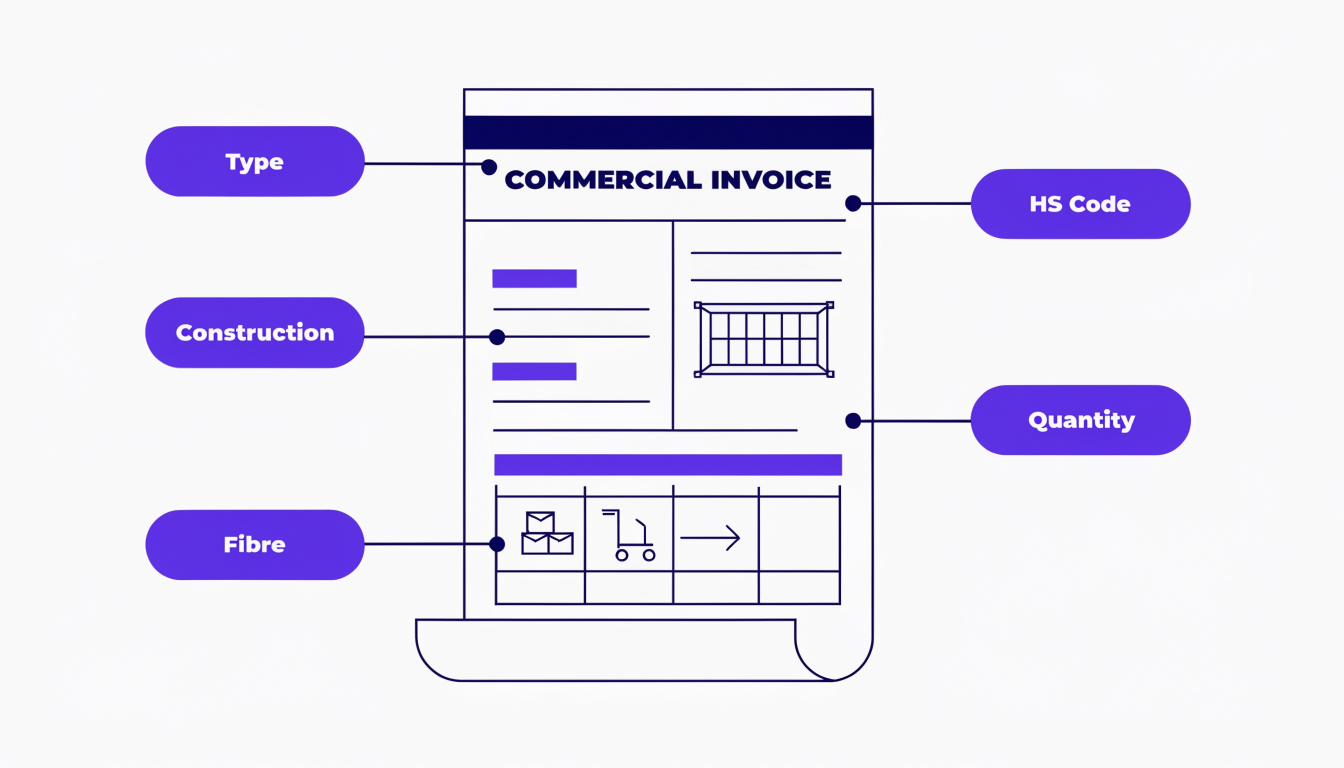
- Create a Perfect Commercial Invoice: Describe each garment with technical precision. Include the HS code, material composition, construction type (knitted/woven), gender, quantity, and value.
- Check Destination Rules: Verify the labelling, branding, and import rules of the destination country before you ship.
- Pack for Protection: Use strong cartons, eliminate empty space, and label every box clearly with the order reference.
Express or Air Freight: Choosing by Weight and Deadline
The choice between express courier and air freight depends on your shipment's size, weight, and urgency. Garments are often light but bulky, making volumetric weight a critical cost factor.
When to Use Express Courier
Express services from carriers like DHL, FedEx, and UPS are ideal for time-sensitive, door-to-door deliveries. This is the best choice for sending samples, fulfilling e-commerce orders, and shipping smaller B2B consignments. Infinity Logistics holds Key Account status with all three major carriers, offering business express rates up to 65% below retail for worldwide express from the UAE.
When to Use Air Freight
For larger wholesale orders, air freight usually costs less per kilo than express. Transit is airport to airport and takes a few days longer, and the point where it becomes cheaper depends on the lane and your carton sizes, so compare both. Infinity arranges air freight for larger orders as well as express.
Understanding Chargeable Weight: The 5,000 vs. 6,000 Rule
Carriers bill you based on chargeable weight, which is the higher of the actual weight and the volumetric weight of your carton. Volumetric weight is a measure of a package's density—the space it occupies.
The formula is simple, but the divisor changes by mode:
- Express Courier Divisor: 5,000. Volumetric Weight (kg) = (L x W x H in cm) / 5,000.
- Air Freight Divisor: 6,000. Volumetric Weight (kg) = (L x W x H in cm) / 6,000.
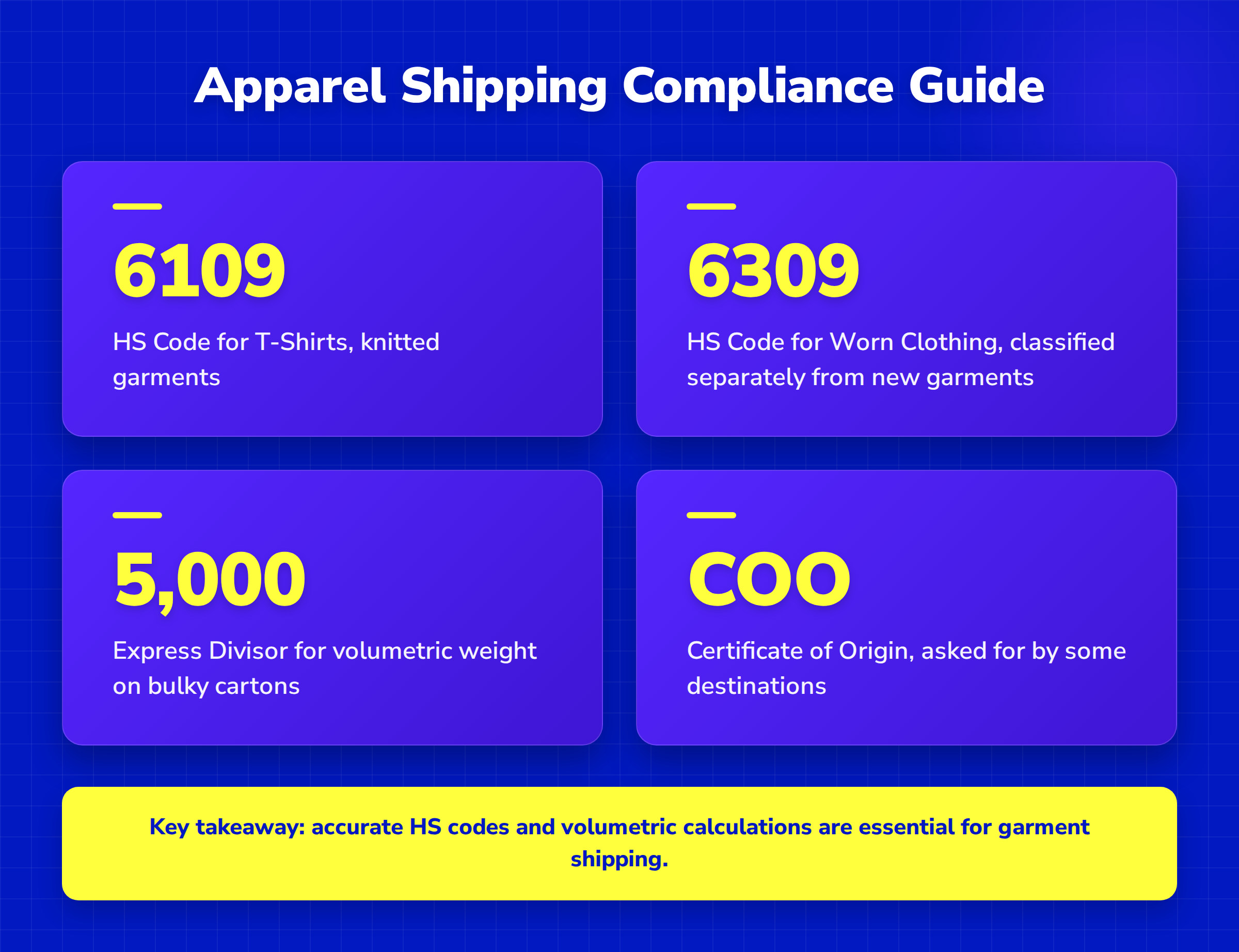
Garments are light for their size, so they are often billed on volumetric weight. The lower divisor for express means the same box has a 20% higher chargeable weight by courier than by air freight, which is one reason air freight usually works out cheaper for large wholesale shipments.
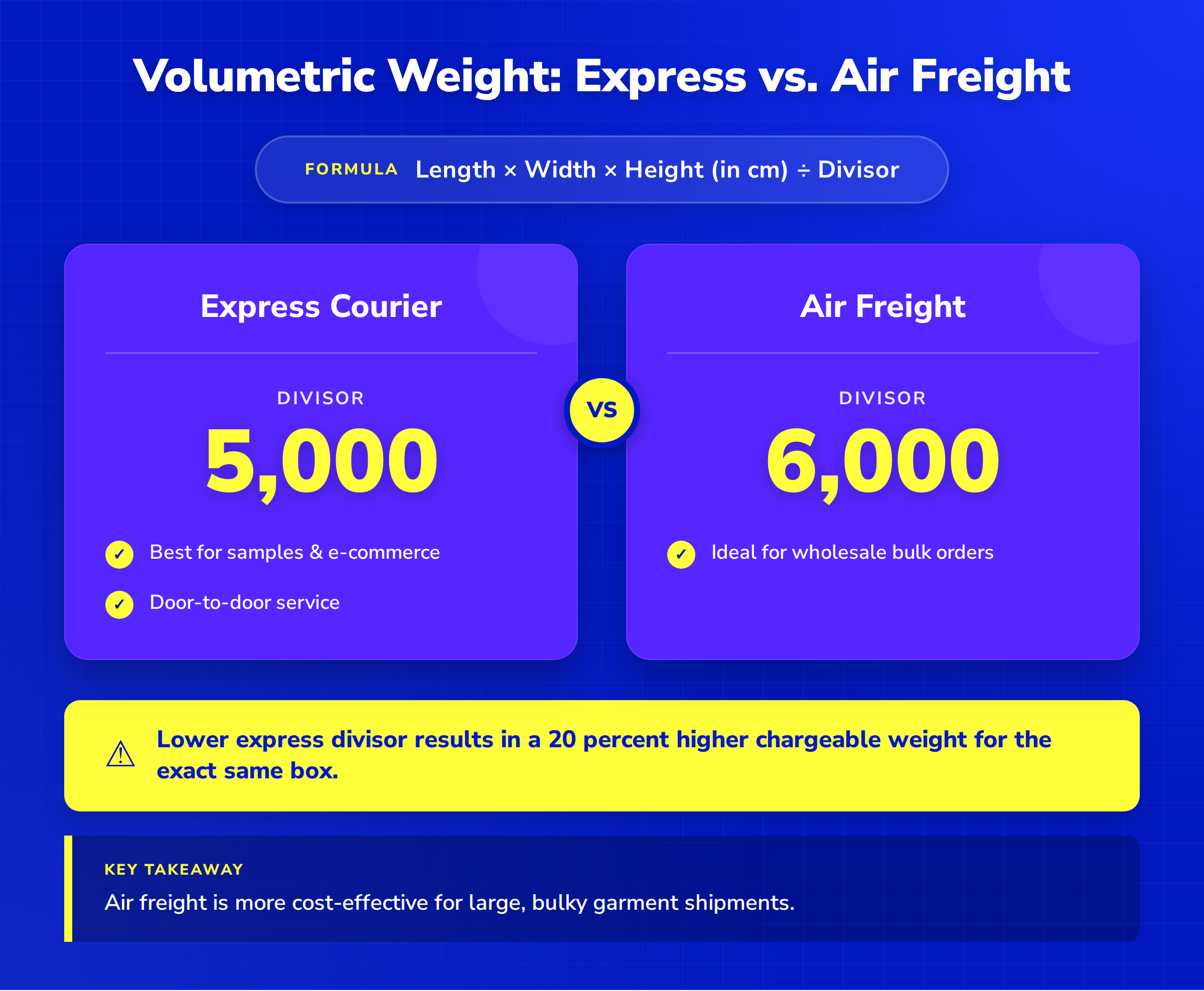
Express vs. Air Freight for Garments
Aspect Express Courier (DHL, FedEx, UPS) Air Freight Best For Samples, e-commerce orders, urgent B2B shipments Wholesale cartons, bulk stock replenishment Service Door-to-door Airport-to-airport (door-to-door available) Volumetric Divisor 5,000 6,000 (IATA standard) Pricing Higher cost per kg, but includes final delivery Lower cost per kg, best for heavy/bulky goods
HS Codes for Garments: Knitted versus Woven
The Harmonized System (HS) is a global standard for classifying traded products. For apparel, the first and most important distinction is how the fabric is made. Getting this wrong is a common reason for customs delays when shipping garments from the UAE. According to the World Customs Organization, which maintains the system, apparel is primarily split into two chapters.
HS Chapter 61: Knitted or Crocheted Garments
HS Chapter 61 covers all articles of apparel that are knitted or crocheted. This means the fabric is constructed from a single, continuous thread looped together, making it stretchy. Think of T-shirts, sweaters, hoodies, leggings, and hosiery. The clothing HS code for these items will always start with "61".
HS Chapter 62: Woven Garments
HS Chapter 62 covers apparel that is not knitted or crocheted, which almost always means it's made from woven fabric. Woven fabrics are made by interlacing multiple threads (warp and weft) at right angles. This fabric is generally less stretchy. Think of dress shirts, suits, jeans, blazers, and formal trousers. The HS code for these items will start with "62".
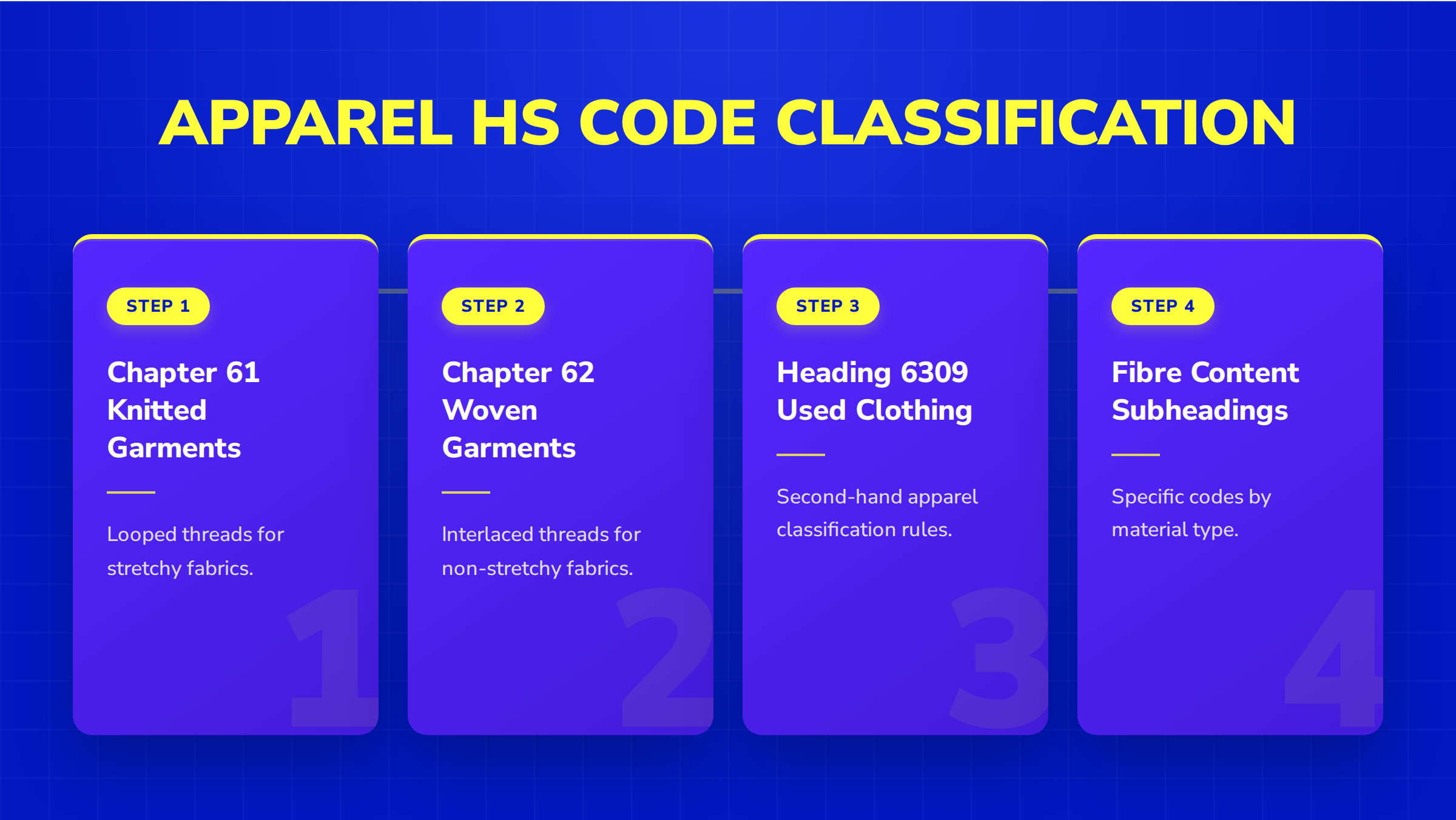
HS Heading 6309: Used Clothing
If you are shipping second-hand apparel, it does not belong in Chapters 61 or 62. Worn clothing is classified separately under HS heading 6309. Many countries have strict restrictions or even prohibitions on importing used clothing, so always check destination rules before shipping.
How Fibre Content Changes the Code
Within each chapter, the specific HS code is determined by the garment type, gender, and—crucially—the fibre content. For example, under heading 6109 for "T-shirts, singlets and other vests, knitted or crocheted," the US Harmonized Tariff Schedule has a specific subheading (6109.10.00) for T-shirts made of cotton.
Describing Garments on the Commercial Invoice
The commercial invoice is the most important document when shipping garments from the UAE. It tells customs exactly what is in the box. A vague description can trigger an inspection; a precise one helps a quick release.
Bad vs. Good Invoice Descriptions
Here’s how to describe a shipment of T-shirts. The "bad" example invites questions from customs; the "good" example gives customs what it needs.
Apparel Invoice Description: Bad vs. Good
Bad Description (Vague & Incomplete) Good Description (Specific & Compliant) Clothes Men's short-sleeve knitted T-shirts, 100% cotton. HS Code: 6109.10.
The 5 Essential Details for Every Garment Description
Your commercial invoice should include these five points for every line item.
- Garment Type & Gender: What is it and who is it for? (e.g., "Women's dress," "Men's trousers," "Infants' bodysuits").
- Construction: Is it knitted or woven? This determines the HS chapter.
- Fibre Content: What is it made of, with percentages? (e.g., "80% Cotton, 20% Polyester").
- Quantity & Unit Value: How many pieces and what is the value of each? This is required even for samples.
- HS Code: The correct 6-digit (or longer) classification code. PwC reported in 2025 that Dubai and Abu Dhabi announced a move to a 12-digit tariff, so give the most precise code you can.
Finally, ensure the total piece counts and weights on your invoice and packing list perfectly match the details on the carrier's airway bill.
Need a shipping quote?
Get AI-optimized rates from DHL, FedEx & UPS — up to 65% below retail. Quote in under 10 minutes.
Samples, Returns, and Wholesale Orders
Different types of shipments have specific documentation requirements. Whether you ship clothing samples internationally or manage bulk returns, the paperwork must be in order.
Shipping Samples
Even if you are not charging your client, samples need a realistic value on the commercial invoice for customs (for example, the production cost). Shippers often mark them "Samples, no commercial value – value for customs purposes only"; check with your carrier how it wants samples described before you ship.
Managing Returns
If a customer sends goods back to you in the UAE, the return comes into the UAE as an import. Keep the original export paperwork (invoice, packing list, export declaration): it shows the goods' history and helps customs treat the return correctly. Ask your forwarder how the return will be declared before you book.
Wholesale Orders
For large wholesale orders, a detailed packing list is essential. It should list the contents of every carton, including:
- Carton number (e.g., 1 of 50)
- SKU, style, and color of the garments inside
- Size breakdown and quantity per size
- Net and gross weight of the carton
This carton-level detail helps forwarders, customs and the receiving warehouse process your shipment.
Destination Rules to Check Before You Ship
Compliance doesn't end at the UAE border. The country you are shipping to has its own set of rules that can impact your shipment.
Labelling Requirements
Many countries have textile labelling rules. For example, Regulation (EU) No 1007/2011 requires garments sold in the EU to be labelled with their fibre composition in the language of the country where they are sold. The US asks for fibre content, country of origin (where the garment was made, which may not be the UAE) and the maker's or seller's identity. Check the destination's rules for:
- Fibre content
- Country of origin
- Care instructions (washing, drying, ironing)
Branded Goods and Counterfeits
Carriers and customs authorities have zero tolerance for counterfeit goods. Shipping items that infringe on a brand's intellectual property is illegal and will result in seizure and destruction of the goods, plus potential fines. If you are shipping legitimate branded apparel, be prepared to provide proof of authenticity if requested.
Used Clothing Restrictions
As mentioned, used clothing falls under HS heading 6309. Many countries restrict or ban the import of used garments for commercial purposes due to health and safety concerns. Always verify the destination country's policy before attempting to ship second-hand apparel.
Packing Garments for Transit
Good packing protects your apparel from damage and moisture and helps you control shipping costs.
Protect and Condense
Each garment should be folded neatly and placed in a protective polybag. Pack the bagged items into a strong, double-walled corrugated carton. Fill the carton to capacity, using void-fill material like air pillows to eliminate any empty space. This prevents the box from being crushed and its contents from shifting.
Measure and Label
Once packed, measure the final dimensions (L x W x H) and weigh the carton to get the gross weight. This data is needed to calculate your chargeable weight and get an accurate shipping quote. Use our free chargeable weight calculator to see how your carton dimensions impact your cost.
Finally, label every carton with the shipper and consignee details, the carton number (e.g., "1 of 10"), and the order reference number. Clear labelling is essential for traceability.
How Infinity Handles Apparel Shipments
Infinity Logistics ships apparel for UAE businesses by express and by air freight.
Infinity holds Key Account status with DHL, FedEx and UPS at the same time and is the #2 DHL partner in the UAE. Our AI agents compare the three in real time, so most enquiries get a quote in under 10 minutes.
Business express rates are up to 65% below retail. When a consignment is heavy enough that air freight works out cheaper, we quote that too. We work from our office in Ajman Free Zone and our warehouse in Dubai Investment Park, and were Highly Commended as Express Logistics Company of the Year at the Logistics Middle East Awards 2022.
Ready to ship your apparel without the headaches? Get an apparel shipping quote from Infinity today.
Frequently Asked Questions
What HS code do T-shirts use?
T-shirts are classified under HS heading 6109, which covers "T-shirts, singlets and other vests, knitted or crocheted." The full code depends on the fibre content: a cotton T-shirt is usually 6109.10, and one made of other textile materials, such as polyester, usually falls under 6109.90. Always check the exact code against your product's material composition.
Can I send clothing samples by DHL, FedEx or UPS from Dubai?
Yes. Express carriers like DHL, FedEx and UPS carry clothing samples from Dubai. Prepare a commercial invoice with a realistic value for the samples (for example, their production cost), and check with the carrier how it wants samples marked, such as "Samples – value for customs purposes only".
Do garment shipments need a certificate of origin?
It depends on the destination country and any trade agreement you want to use. A Certificate of Origin (COO) certifies the country where the goods were made. Some countries ask for one on textile imports, so check the destination's requirements before shipping. Infinity Logistics can advise whether a COO is needed for your shipment.
How is chargeable weight worked out for bulky cartons?
Chargeable weight is the higher of the package's actual weight and its volumetric weight. For express, volumetric weight is (Length x Width x Height in cm) / 5,000; for air freight, the divisor is 6,000. Because clothing is light but bulky, it is often billed on its volumetric weight.
Can used clothing be shipped abroad?
Yes, but with significant restrictions. Used or "worn" clothing is classified under HS heading 6309, not in the main apparel chapters (61 and 62). Many countries heavily regulate or prohibit the commercial import of used clothing for health and safety reasons. You must verify the destination country's specific regulations before attempting to ship second-hand garments.
Sources & References
Official and industry sources referenced in this guide:
- 2026 HTS Revision 17 - Harmonized Tariff Schedule
- [PDF] DUBAI CUSTOMS SERVICE GUIDE
- Central Customs Tariff System | Federal Authority for ...
- Chapter 61
- [PDF] Importing into the United States A Guide for Commercial Importers
- instructions for completing the commercial invoice
- Commercial invoice requirements when clearing or filing entry ...
- Regulation - 1007/2011 - EN - EUR-Lex
Tags
Related Articles
Ready to optimize your logistics?
Whether you need express shipping, freight forwarding, or warehousing — our AI finds the best rates and routes for your business.