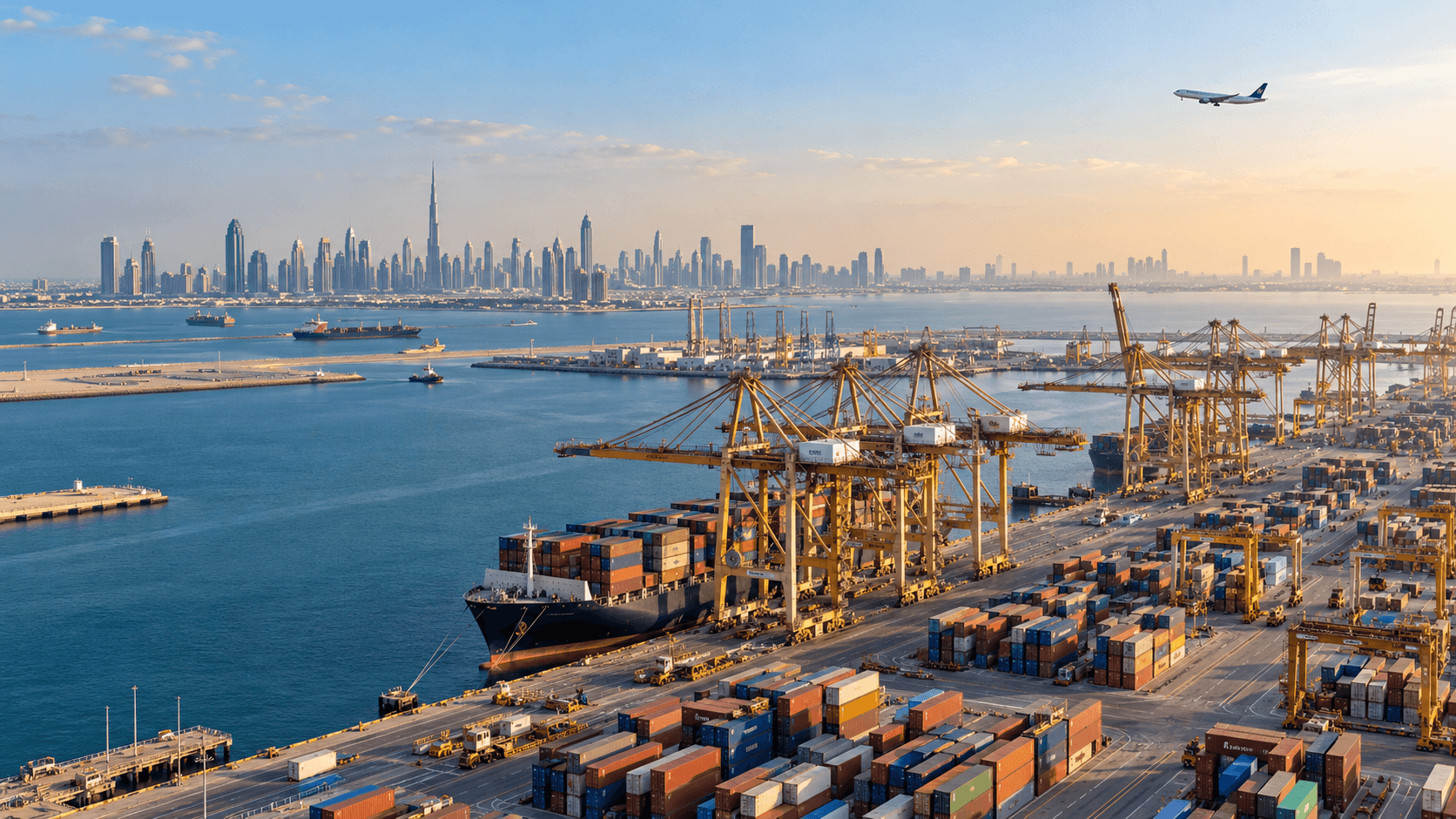
When your cargo needs to arrive faster than a ship but cheaper than a plane, sea-air freight is the middle ground. Goods travel by ocean for the long leg to keep costs down, then switch to an aircraft for the last leg to save time. Dubai is set up for that switch, which makes it a practical transfer point for cargo moving on from Asia to Europe and Africa.
Dubai connects Jebel Ali Port with Al Maktoum International Airport (DWC) through its logistics corridor, with separate arrangements available for flights from Dubai International (DXB). This guide explains the transfer, customs process and information needed to assess a sea-air route.
What is Sea-Air Freight?
Sea-air freight is a multimodal transport service where cargo travels the first part of its journey by ocean vessel and the second part by aircraft. A central hub, like Dubai, serves as the transshipment point where goods are transferred from a shipping container to an air freight container (ULD) for final delivery. This hybrid model is designed to offer a balance between the low cost of ocean shipping and the high speed of air cargo.
Sea-air is usually cheaper than flying the whole way and faster than shipping the whole way. It is not a single product but a way of combining two services: sea freight for the first leg and air freight for the second.
How a Sea-Air Shipment Moves Through Dubai
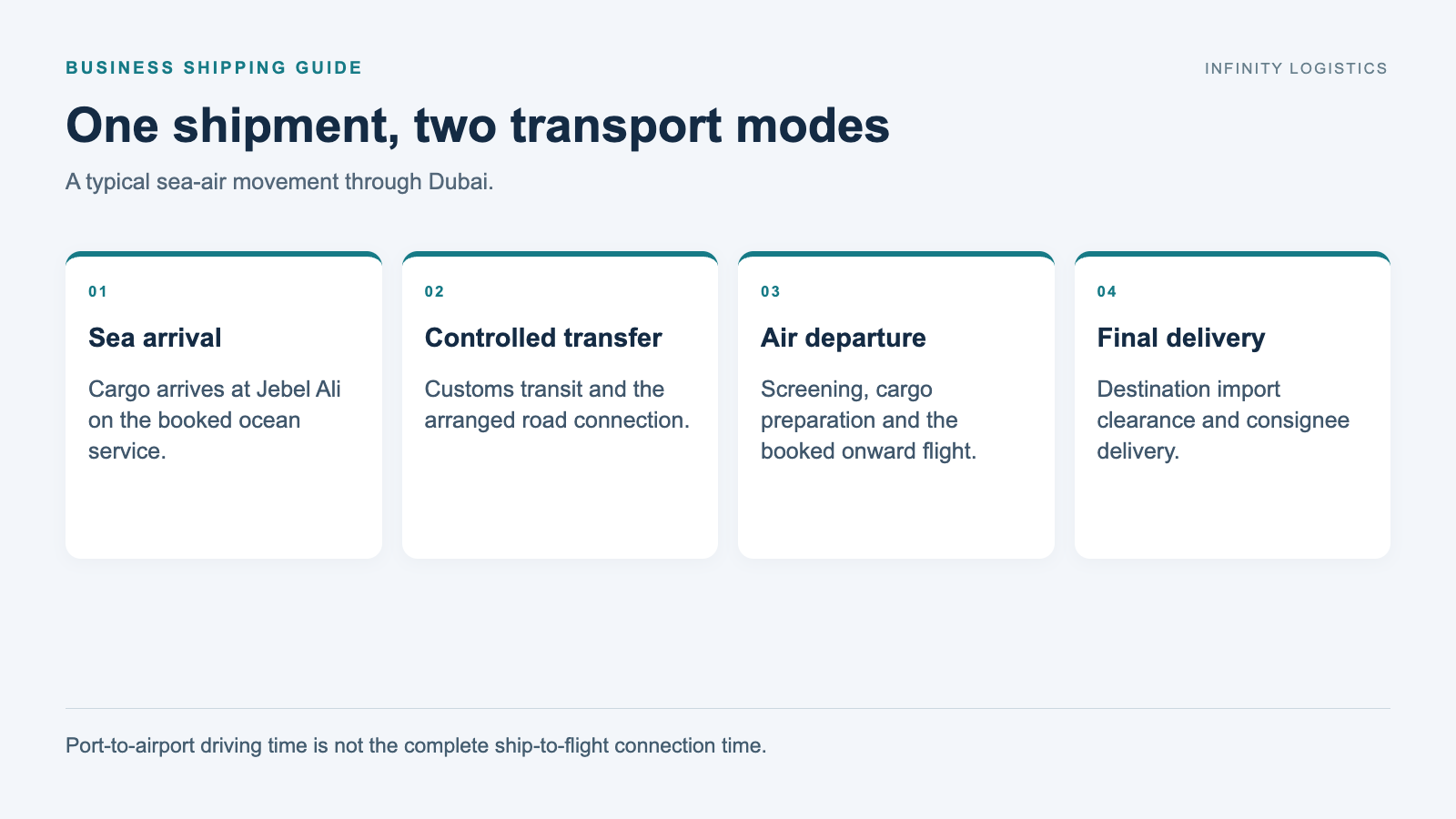
A sea-air move through Dubai follows four steps. The cargo normally moves in transit under customs bond rather than being imported into the UAE; your forwarder confirms the customs procedure for each shipment.
Step 1: Arrival by Ship at Jebel Ali Port
The journey begins when your cargo, packed in a standard ocean container, arrives at DP World's Jebel Ali Port. It is declared to customs as goods in transit that will leave by air.
Step 2: Bonded Transfer by Road to the Airport
Once the container is offloaded, it goes by truck over the dedicated bonded road link between Jebel Ali Port and Al Maktoum International Airport (DWC), inside the Dubai Logistics Corridor. For cargo flying from Dubai International (DXB), Dubai Airports runs a road feeder service between the two airports through a virtual trucking corridor, secured by e-seal monitoring and controlled by Dubai Police.
Step 3: Flight Out of DWC or DXB
At the selected cargo terminal, the consignment is prepared for its onward flight and loaded as required by the airline. The connection depends on vessel discharge, customs processing, cargo readiness, screening and available flight capacity; confirm the full transfer window in the quote.
Step 4: Delivery at Final Destination
Upon arrival at the destination airport, the cargo undergoes standard import customs clearance for that country and is delivered to the consignee. The process is managed by a freight forwarder who coordinates both the sea and air legs of the journey.
Why Dubai Works as a Sea-Air Hub
Dubai works well for sea-air because its port, free zone and airports were built to connect.
The Dubai Logistics Corridor
The core of Dubai's sea-air model is the Dubai Logistics Corridor. Jebel Ali Free Zone (JAFZA) describes it as a single customs-bonded area of roughly 200 square kilometres that links Jebel Ali Port, JAFZA and Al Maktoum International Airport (DWC). Because the corridor is one customs zone, cargo moves between the port and the airport without the usual exit and entry procedures.
A Short Port-to-Airport Connection
JAFZA describes a corridor connection of less than one hour between the port and airport. That infrastructure figure is not a promise that vessel discharge, customs, screening and aircraft loading all finish in an hour. Infinity confirms the operational connection for your booking.
Dedicated Infrastructure and 24/7 Operations
The bonded road connection and round-the-clock cargo facilities support sea-air transfers. Cargo still has to meet terminal cut-offs, documentation requirements and the booked flight schedule.
Sea-Air vs. Air Freight vs. Sea Freight
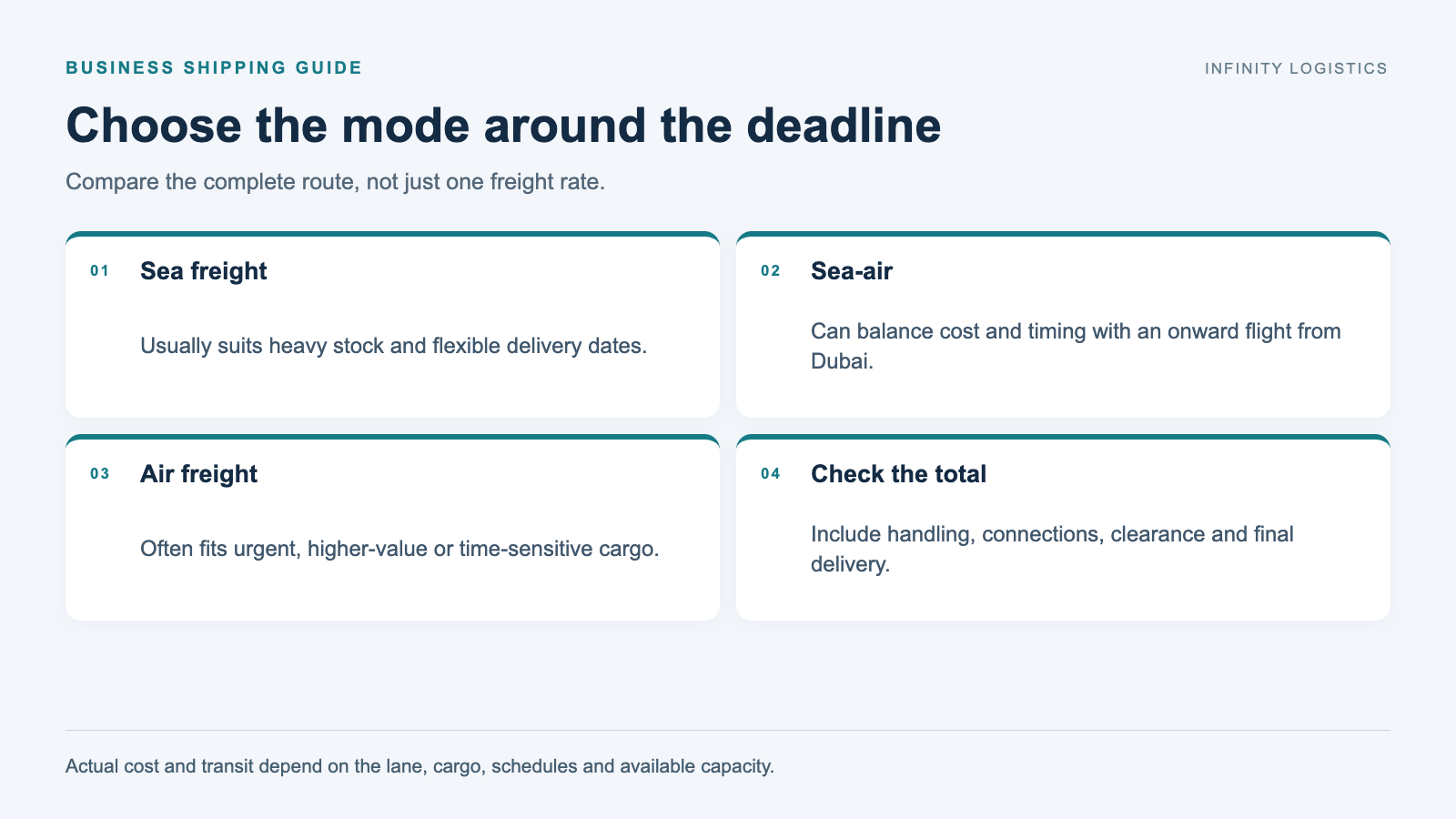
Choosing a freight mode means balancing cost, speed and cargo type. Here is how the three modes compare. Transit times depend on the lane; the sea and air figures below are the ones Infinity publishes for its own services.
Comparison of Freight Modes
This table provides a general framework for deciding between the different options. Actual transit times and costs will vary based on the specific origin, destination, and cargo details.
| Mode | Indicative Transit Time | Relative Cost | Best For |
|---|---|---|---|
| Sea Freight | Longest; for example 12 to 18 days China to Jebel Ali, port to port | Lowest | Large volume, heavy, or low-urgency goods where cost is the primary driver. |
| Sea-Air Freight | Between sea and air; depends on the lane | Medium | Time-sensitive goods that are too expensive to fly entirely by air (e.g., electronics, fashion, seasonal items). |
| Air Freight | 3 to 7 days standard; 1 to 3 days express air freight | Highest | Urgent, high-value, or perishable goods where speed is the top priority. |
The Core Trade-Off: Cost vs. Speed
If your deadline is flexible and your budget is tight, sea freight fits. If the shipment is urgent and cost matters less, fly it. Sea-air sits in between: faster than shipping all the way, cheaper than flying all the way.
When Sea-Air Makes Sense, and When It Does Not
Sea-air is not right for every shipment. Here is when it fits and when it does not.
Need a shipping quote?
Get AI-optimized rates from DHL, FedEx & UPS — up to 65% below retail. Quote in under 10 minutes.
When Sea-Air Is a Good Fit
- Time is important, but pure air is too expensive: This is the classic case. For product launches, seasonal retail or restocking, waiting weeks for a container ship is too slow, but the margins don't support flying the whole volume.
- Your cargo is stuck: If an ocean shipment is delayed due to port congestion or other issues, converting the final leg to air freight from a hub like Dubai can help recover lost time and meet a critical deadline.
- You need to bypass air capacity bottlenecks: During peak seasons, direct air freight capacity from major production hubs in Asia can be scarce and expensive. Shipping by sea to Dubai and then flying to the final destination can be a more reliable and cost-effective alternative.
When Sea-Air Is Not the Right Choice
- For extremely urgent cargo: If a shipment must arrive in 1-3 days, such as for emergency medical supplies or critical machinery parts, only pure express air freight will suffice. The sea leg of a sea-air move inherently adds weeks to the total transit time.
- For very heavy, low-value bulk goods: The air leg is charged on chargeable weight, the greater of actual and volumetric weight. For dense, low-value goods like raw materials, the air leg makes the total cost too high, and sea freight all the way is usually the better choice.
Documents and Customs for a Sea-Air Move
Because a sea-air shipment uses two transport modes and passes through the UAE on its way to another country, the documents must be precise. The cargo normally moves under a transit customs procedure.
Key Documents Required
Your freight forwarder will manage the paperwork, but you will need to provide the following:
- Commercial Invoice: Details the transaction, including seller, buyer, goods description, and value.
- Packing List: Provides a detailed breakdown of the shipment, including the contents, weight, and dimensions of each package.
- Bill of Lading (B/L): The contract for the sea freight leg of the journey.
- Air Waybill (AWB): The contract for the air freight leg. Have the 6-digit HS code for each item ready, as carriers can ask for it on the air waybill.
Goods in Transit Under Bond
A key idea in sea-air through Dubai is that the cargo moves in transit under bond. According to the Dubai Customs Customer Guide, goods in transit pass through UAE customs territory without import duty, as long as they leave within the time allowed. That is why the ship-to-plane transfer avoids the full import and re-export process.
What to Send for a Sea-Air Quote
To tell whether sea-air fits your shipment and to price it, your logistics provider needs a few details. Complete details up front make the quote faster and more accurate.
Be ready to provide the following:
- Origin and Destination: The specific port of loading and the final destination airport or city.
- Commodity and HS Code: A clear description of the goods and their 6-digit Harmonized System (HS) code.
- Weight and Dimensions: The gross weight and the length, width, and height of each piece or pallet. This is essential for calculating chargeable weight for the air leg.
- Ready Date and Deadline: The date the cargo will be ready for pickup and the required delivery date.
How Infinity Handles Sea and Air Freight from Dubai
Infinity Logistics sells both sea freight and air freight from the UAE, so a sea-air move can be planned and quoted as one job that combines the two. Ask for it when you request a quote, and we will confirm how it works on your lane.
One Partner for Both Legs
Infinity runs sea freight into Jebel Ali and air freight out of Dubai, so both legs can sit with one team instead of two separate forwarders.
Strategic Warehousing Network
Infinity has warehousing in JAFZA, Dubai Investment Park (DIP) and Al Quoz, if your cargo needs storage in Dubai before it flies on.
Express for Pieces That Cannot Wait
Infinity Logistics holds Key Account status with DHL, FedEx, and UPS at the same time and is the #2 DHL partner in the UAE, with business express rates up to 65% below retail. If part of a shipment cannot wait for the sea leg, it can go by express instead.
Tell us your deadline and your budget. Infinity will provide a clear assessment of whether sea-air is the right strategy for your lane. To see if this hybrid solution can optimize your supply chain, get a freight quote today.
Frequently Asked Questions
Is sea-air cheaper than air freight?
Usually, yes. Flying only part of the route costs less than flying all of it, but more than shipping all the way by sea. The difference depends on the lane, so compare the quotes.
How long does the ship-to-plane transfer take in Dubai?
The corridor offers a short physical connection between Jebel Ali and DWC, but the complete ship-to-flight transfer also includes unloading, customs processing, screening and airline cut-offs. Ask for the connection time for the actual sailing and flight; do not treat the road transfer time as the total dwell time.
Which Dubai airport handles sea-air cargo?
Al Maktoum International Airport (DWC), in Dubai South, has a dedicated bonded road link to Jebel Ali Port, which makes it the natural airport for sea-air cargo. Dubai International Airport (DXB) is linked to DWC by a road feeder service through a virtual trucking corridor, and Dubai Airports says DXB also supports rapid transfer of full container loads between the quayside and its apron.
Does sea-air cargo clear UAE customs?
Yes, transit cargo is still subject to UAE customs declarations and controls. It normally moves under bond rather than being released for local consumption. Duty suspension depends on meeting the applicable transit and exit conditions, which the forwarder confirms for the shipment.
Can dangerous goods travel via sea-air?
Some dangerous goods may be suitable, but both the shipping line and airline must accept the exact commodity and packing configuration. Maritime and air requirements differ. Provide the SDS/MSDS and have the packaging, labels and documentation reviewed for both legs before booking.
Sources & References
Official and industry sources referenced in this guide:
- [PDF] Customer Guide
- Cargo - Dubai Airports
- What is the Dubai Logistics Corridor | Jebel Ali Free Zone ...
- [PDF] Jebel Ali Port and Port Rashid - DP World
- Dubai Customs
- GCC Unified Guide for Customs Procedures at First Points ...
- Sea-Air
- Central Customs Tariff System | Federal Authority for Identity ...
- HS Code.pdf
Tags
Related Articles
Ready to optimize your logistics?
Whether you need express shipping, freight forwarding, or warehousing — our AI finds the best rates and routes for your business.