
For businesses shipping from Dubai to Oman, Qatar, Kuwait and Bahrain, the key decisions are mode, delivery timing and customs treatment. Eligible duty-paid goods may move within the GCC without duty being collected again when the required evidence and procedures are accepted. This does not remove destination taxes, fees or product restrictions.
This guide explains how to choose between road freight and express, typical transit times, and how the GCC customs union and the Makasa duty transfer system work. We will cover the exact documents you need to prepare to ensure smooth, cost-effective delivery. This article focuses on Oman, Qatar, Kuwait, and Bahrain; for information on UAE to Saudi Arabia shipping, please see our dedicated guide.
Shipping from Dubai to the GCC: the short answer
Infinity’s confirmed road planning estimates are Muscat: 48 hours; Qatar: 3–5 days; Bahrain and Kuwait: 3–5 working days. Confirm the departure, delivery scope and border allowance for your booking.
The GCC customs union uses a first-point-of-entry approach. For eligible foreign goods already cleared with duty paid in the UAE, the onward movement needs the correct customs evidence. Have the broker check eligibility and destination requirements before assuming no further duty is payable.
Road freight or express: which fits
Choosing the right mode is the first step. It depends on the size, weight and urgency of your shipment. The rule of thumb is simple: trucks for pallets, express for parcels.
FTL vs. LTL: The Choice for Palletized Cargo
For larger shipments, road freight is usually the most economical option. It comes in two service types: Full Truck Load (FTL) and Less than Truck Load (LTL).
- FTL (Full Truck Load) is a dedicated vehicle for your shipment alone, suited to loads that justify a dedicated vehicle or require a dedicated schedule. The truck is loaded at your premises and driven to the destination, with less handling on the way.
- LTL (Less than Truck Load), also called groupage, shares space on a truck with other shippers. It suits smaller loads that can share space, and you pay only for the space your cargo uses. Infinity's LTL runs on scheduled weekly departures.
When to Use Express Services
For urgent documents, samples and small, high-value parcels, the express networks are usually the better choice: door to door, with customs clearance handled by the carrier.
Infinity holds Key Account status with DHL, FedEx and UPS for express to the GCC. As the #2 DHL partner in the UAE, Infinity offers business express rates up to 65% below retail. Our AI agents compare all three carriers in real time, so most enquiries get a quote in under 10 minutes.
Road transit times from Dubai
Infinity’s confirmed road planning estimates are Muscat: 48 hours; Qatar: 3–5 days; Bahrain and Kuwait: 3–5 working days. Confirm the departure, delivery scope and border allowance for your booking.
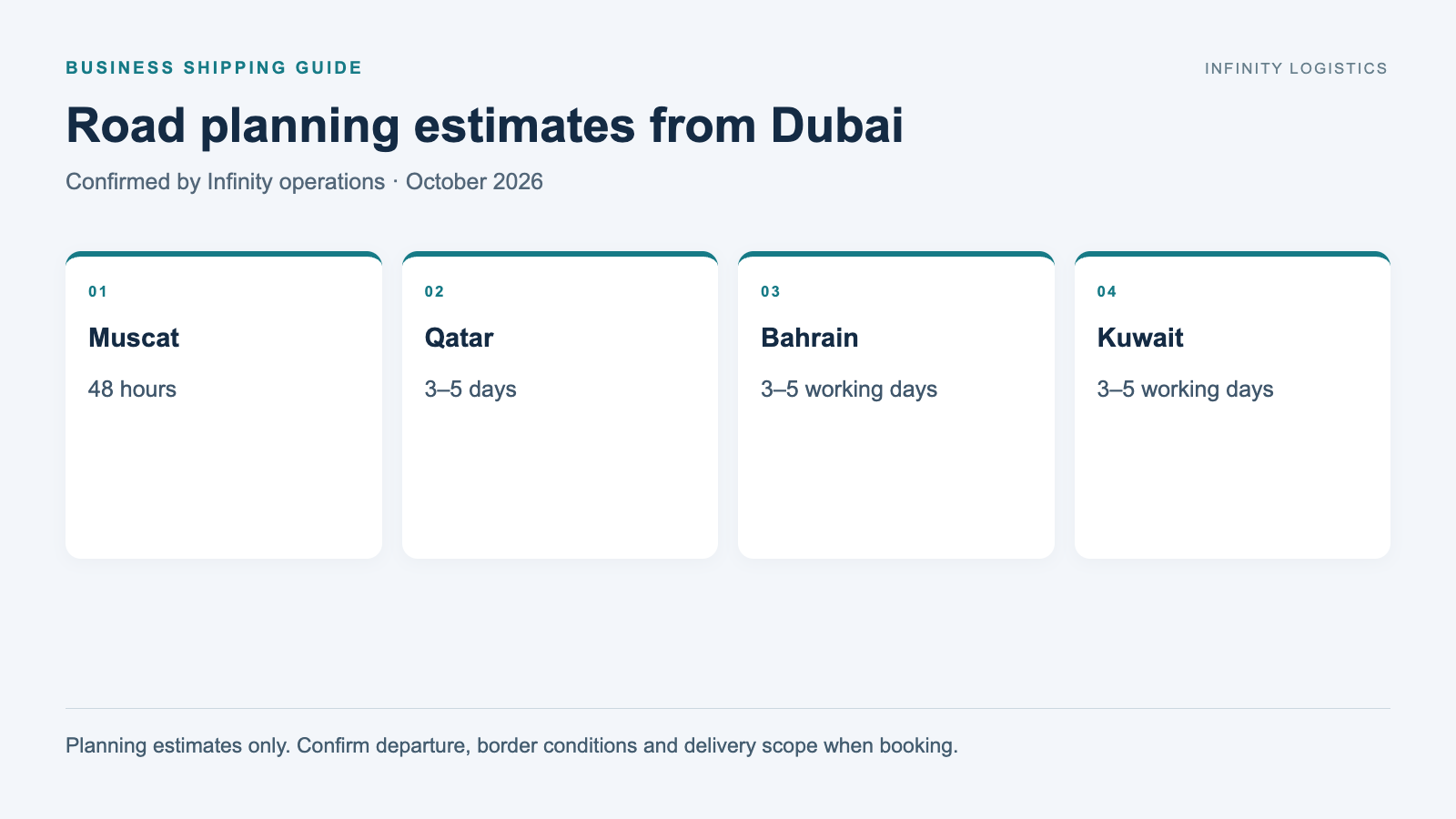
Published Road Transit Times from Dubai
Infinity confirmed the estimates below in October 2026. They are planning estimates, not guaranteed delivery commitments. Customs inspections, document readiness and the booked departure can change the timing.
| Destination Country | Major City | Published Transit Time (FTL/LTL) | Key Border Crossing |
|---|---|---|---|
| Oman | Muscat | 48 hours | Hatta / Al Wajajah |
| Qatar | Doha | 3–5 days | Salwa (via Saudi Arabia) |
| Bahrain | Manama | 3–5 working days | King Fahd Causeway (via Saudi Arabia) |
| Kuwait | Kuwait City | 3–5 working days | Nuwaiseeb (via Saudi Arabia) |
Source: Infinity’s operations confirmation, October 2026. Muscat and Qatar are stated in hours/days; Bahrain and Kuwait are stated in working days. Confirm how the estimate applies to your pickup and delivery addresses.
Factors Affecting Transit Times
These are published estimates. Actual delivery can be affected by border traffic at crossings like Hatta, Ghuwaifat and the King Fahd Causeway. The factor you control most is the accuracy and completeness of your shipping documents, which helps clearance and cuts inspection delays.
The GCC customs union in plain words
Understanding the GCC customs union is the key to avoiding unnecessary costs. The six member states (UAE, Oman, Qatar, Kuwait, Bahrain, and Saudi Arabia) operate as a single customs territory. This has three important consequences for businesses shipping from Dubai.
The 5% Common External Tariff
The GCC applies a common external tariff, which for most goods is 5% of the CIF value (cost, insurance and freight). According to the GCC Secretariat General, customs duty is collected at the first point of entry into the GCC. Once duty is paid and the goods are cleared, they can move on to another member state without paying customs duty again. This is the "single point of entry" principle.
Duty-Free Movement for GCC-Origin Goods
Goods produced in any GCC member state get "national treatment": they move freely between member states under national invoices and the single customs declaration, without customs duty.
How Free Zone Goods are Treated
A common point of confusion involves goods held in a UAE free zone, such as JAFZA (where Infinity has warehousing) or Ajman Free Zone (where its office is). Under the GCC customs union rules, foreign goods taken out of a free zone are treated as imports from outside the GCC and pay customs duty once they leave the zone: 5% for most goods.
Makasa: how not to pay duty twice
The mechanism that stops goods being taxed twice as they move between GCC states is called Makasa: an automated transfer of customs duty between member states. If you ship duty-paid goods from Dubai to the rest of the GCC, it is worth understanding.
Need a shipping quote?
Get AI-optimized rates from DHL, FedEx & UPS — up to 65% below retail. Quote in under 10 minutes.
What is a Statistical Export Declaration?
When you re-export foreign goods from the UAE (where duty has already been paid) to another GCC country like Oman or Qatar, you don't use a standard export declaration. Instead, you file a Statistical Export Declaration. This document informs Dubai Customs that the goods are not a new export from the UAE but are simply moving within the GCC customs union.
How the Makasa Stamp Prevents Double Duty
Makasa links your statistical export declaration to the duty you originally paid. When the declaration is filed, the Makasa stamp records that duty was already paid in the UAE.
As the U.S. Department of Commerce explains, this stamp on the declaration is presented to the destination customs office to prove duty was already paid, thus avoiding re-collection.
This tells the customs authority in, for example, Kuwait that the duty for the shipment was settled in the UAE, so it is not charged to you again.
The Role of the Original Import Declaration
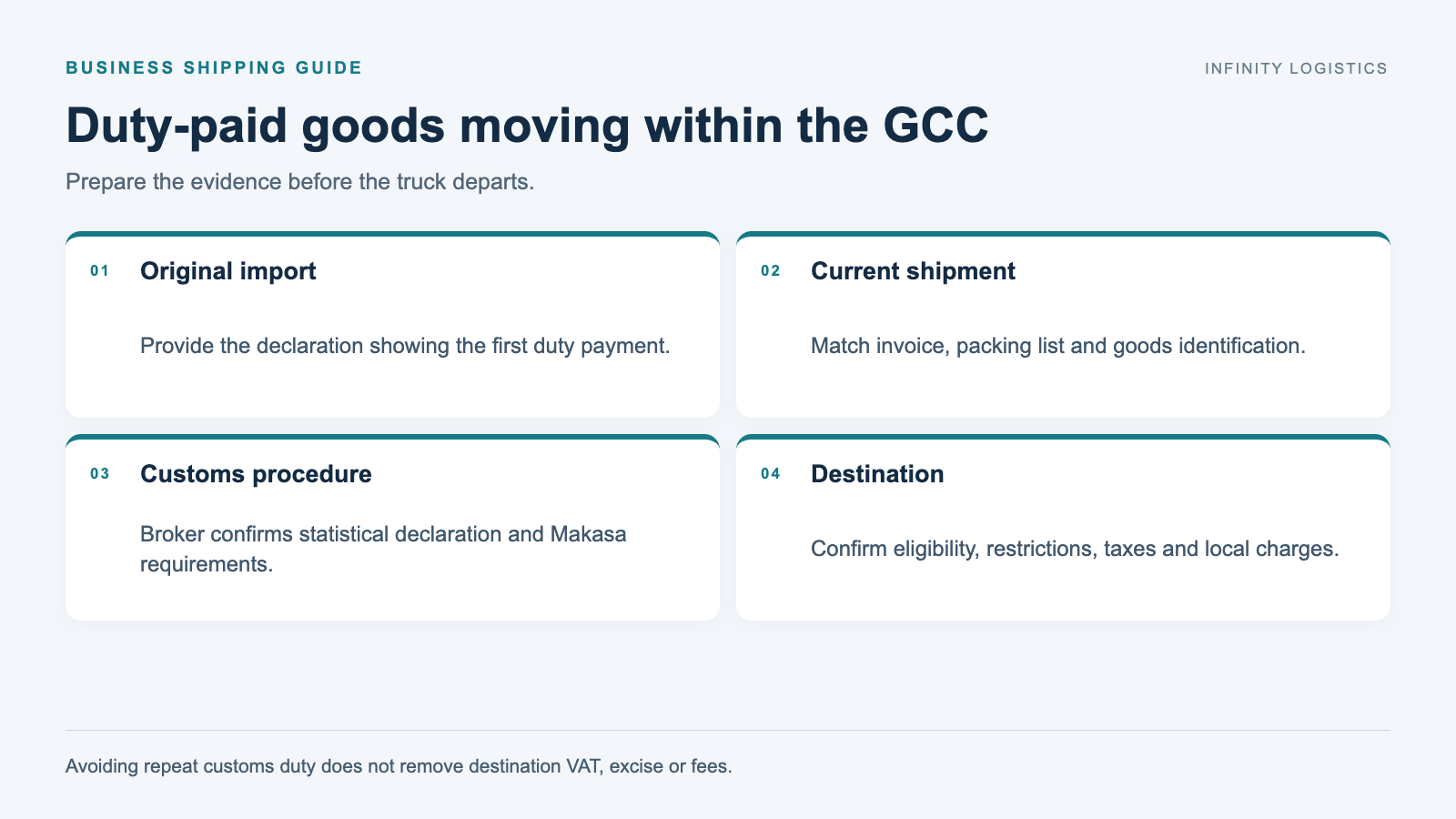
To use Makasa, you have to show that duty was paid in the first place. That is why Dubai Customs asks for a copy of the original UAE import declaration: it links your statistical export declaration to the original import and confirms the goods are duty-paid.
Documents for GCC road shipments
Incorrect or incomplete paperwork is a common cause of delays on GCC road shipments, especially on cross-border routes such as Dubai to Doha, so your documents need to be accurate. Infinity's customs clearance team can prepare the export paperwork for GCC shipments.
Export Invoice and Packing List
These are the foundational documents for any commercial shipment.
- Export Invoice: Must detail the shipper, consignee, item descriptions, quantities, unit values, total value, and Harmonized System (HS) codes for each item.
- Packing List: Must break down each package, including its contents, weight and dimensions. The total weight and piece count must match the invoice and the carrier's road consignment note.
The Makasa Documentation Set
To successfully use the Makasa system and avoid paying duty twice, you must provide your freight forwarder with:
- A commercial invoice and packing list for the current shipment.
- A clear copy of the original UAE import declaration that shows duty was paid when the goods first entered the country.
With these documents, your logistics partner can file the statistical export declaration and obtain the digital Makasa stamp required for clearance at the destination.
Special Considerations for Oman: The Hatta Border
For cargo from Dubai to Oman, the main land route is through the Hatta border crossing. Dubai Customs guidance says goods exported to or through Oman are cleared at the Hatta border, so accurate paperwork submitted in advance is important to avoid your truck being held there.
How Infinity handles GCC shipments
Infinity Logistics is a WCA Inter Global member and was Highly Commended as Express Logistics Company of the Year at the Logistics Middle East Awards 2022.
FTL and LTL Road Freight Solutions
Infinity's GCC road freight service offers dedicated FTL trucks and scheduled weekly LTL departures from Dubai to Oman, Qatar, Bahrain and Kuwait. Infinity also has warehousing in JAFZA, Dubai Investment Park and Al Quoz.
Key Account Express for Urgent Shipments
For documents and parcels, Infinity holds Key Account status with DHL, FedEx and UPS at the same time. As the #2 DHL partner in the UAE, we offer business express rates up to 65% below retail.
Fast Quotes and Documentation Management
Founded in 2017, Infinity uses AI agents that compare DHL, FedEx and UPS in real time, so most enquiries get a quote in under 10 minutes. Our customs team can prepare the UAE-side export paperwork, including the statistical export declaration for Makasa. Get a GCC quote today.
Frequently Asked Questions
How long does road freight from Dubai to Muscat take?
Infinity’s current planning estimate for Dubai to Muscat is 48 hours. Actual timing depends on the booked departure, border traffic, inspections and complete documents. Confirm the delivery window when booking.
Do I pay customs duty again when goods go from the UAE to Oman?
Eligible duty-paid foreign goods may avoid repeat duty collection when the required GCC procedure and proof of original duty payment are accepted. Provide the original import declaration and ask the broker to confirm the statistical declaration and Makasa requirements. Destination VAT, excise, fees and restrictions are separate.
What is a Makasa stamp?
A Makasa stamp is a digital confirmation issued by customs in the exporting GCC country (e.g., Dubai Customs) that is attached to a Statistical Export Declaration. It serves as proof to the customs authority in the destination GCC country (e.g., Qatar) that the applicable customs duty for the goods was already paid at the first point of entry into the GCC. This automated system prevents the double-payment of duties on goods moving between member states.
What is the difference between FTL and LTL?
FTL stands for Full Truck Load, and LTL stands for Less than Truck Load. In FTL, you hire an entire truck for your exclusive use, making it ideal for large shipments (depending on vehicle capacity and cargo dimensions), high-value cargo, or time-sensitive deliveries. In LTL, your shipment shares space on a truck with cargo from other customers. LTL is a more economical option for smaller shipments (depending on dimensions and scheduling) that do not require a dedicated vehicle.
Can I send goods from a free zone to another GCC country without duty?
No, this is a common misconception. Foreign goods held in a UAE free zone (like JAFZA or DMCC) are outside the UAE's customs territory. Under the GCC customs union rules, when they leave the free zone they are treated as imports from outside the GCC and pay customs duty, 5% for most goods. Your customs broker confirms where the duty is collected for your route.
Sources & References
Official and industry sources referenced in this guide:
Tags
Related Articles
Ready to optimize your logistics?
Whether you need express shipping, freight forwarding, or warehousing — our AI finds the best rates and routes for your business.