When you agree on shipping terms, one small detail can create a big problem: who pays the import duty and VAT? For UAE businesses, the choice between DAP (Delivered at Place) and DDP (Delivered Duty Paid) is the difference between a smooth delivery and a surprise bill for your customer. Both terms get the goods to the buyer's door, but they split the costs and risks of import clearance completely differently.
Under DAP incoterms, the buyer is responsible for import clearance and paying any local duties and taxes. Under DDP, the seller handles and pays for everything. The wrong choice can leave you with unexpected costs or a shipment stuck at customs.
DAP vs DDP: The Short Answer
The entire difference between DAP and DDP comes down to one question: who is responsible for import clearance and paying the associated duties and taxes?
- DAP (Delivered at Place): The seller delivers the goods to the destination, but the buyer pays for import clearance, duty, and VAT.
- DDP (Delivered Duty Paid): The seller delivers the goods to the destination and also pays for import clearance, duty, and VAT.
Here’s a quick summary:
| Responsibility | DAP (Delivered at Place) | DDP (Delivered Duty Paid) |
|---|---|---|
| International Transport | Seller Pays | Seller Pays |
| Import Clearance | Buyer Handles & Pays | Seller Handles & Pays |
| Import Duty & VAT | Buyer Pays | Seller Pays |
| Delivery Location | Buyer's Named Place | Buyer's Named Place |
The critical takeaway for any UAE exporter is to choose DDP only if you are certain you can legally act as the importer in the destination country. If there is any doubt, DAP incoterms provide a safer, more predictable option.
What DAP Means in Shipping
DAP, or Delivered at Place, is an Incoterm from the International Chamber of Commerce (ICC) that can be used for any mode of transport. It defines a clear point where cost and risk transfer from the seller to the buyer.
Seller's Obligations Under DAP
When a UAE business sells on DAP incoterms, its primary responsibility is to get the goods to the buyer's specified location. This means the seller arranges and pays for:
- Transport: All costs to move the goods from their origin in the UAE to the named destination abroad (e.g., the buyer's warehouse).
- Export Clearance: Handling all customs formalities required to export the goods from the UAE.
- Risk: The seller bears all risk of loss or damage until the goods arrive at the destination, ready for unloading.
The seller's job is done once the goods are at the agreed-upon place, on the arriving truck or plane, ready for the buyer to unload.
Buyer's Obligations Under DAP
Once the shipment arrives, the responsibilities shift to the buyer. The buyer must:
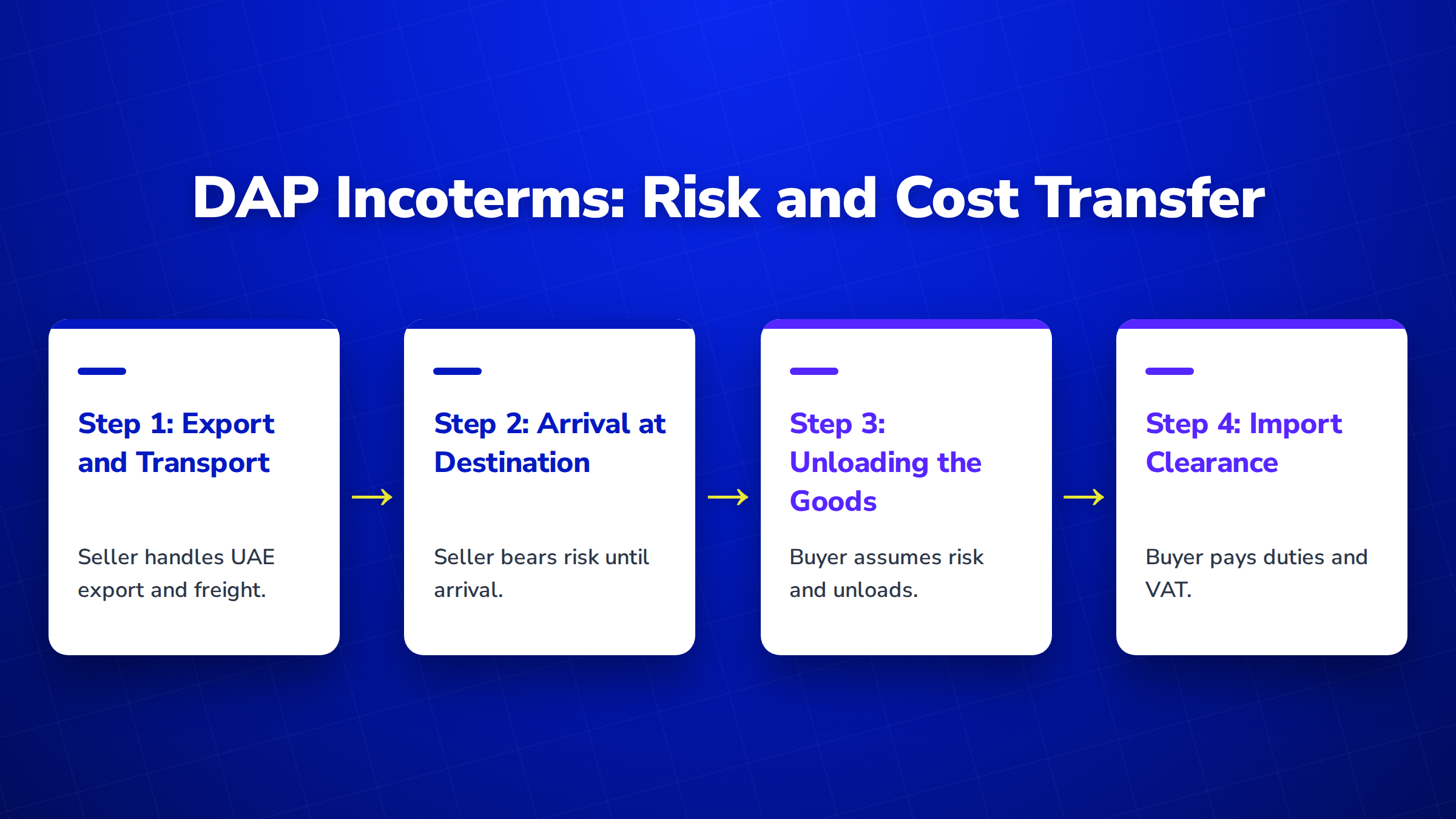
- Unload the Goods: The buyer is responsible for the cost and risk of unloading the shipment.
- Handle Import Clearance: The buyer must act as the official Importer of Record, dealing with the destination country's customs authorities.
- Pay All Import Costs: This is the most important point. According to the ICC Academy, under DAP the buyer pays the import costs: import duty, VAT or GST, and any other local taxes or customs fees.
What DDP Means
DDP, or Delivered Duty Paid, represents the maximum obligation for the seller. It is often seen as the most customer-friendly option, but it carries significant risks for the exporter.
Seller's Maximum Obligation
Under DDP incoterms, the seller does everything DAP requires and more. The seller arranges and pays for:
- Transport: All costs to the named destination.
- Export Clearance: All formalities to exit the UAE.
- Import Clearance: The seller must also handle all customs formalities in the buyer's country.
- Duties and Taxes: The seller pays all import duties, VAT, and other taxes. This is the fundamental definition of ddp meaning.
The seller delivers the goods to the buyer's location fully cleared, with nothing left for the buyer to pay. This is why it's called Delivered Duty Paid.
Buyer's Convenience
For the buyer, DDP is the simplest arrangement. They receive their goods at their door with no surprise bills from customs or the carrier. The price they agreed with the seller is the final, all-inclusive landed cost. However, this convenience for the buyer creates a major compliance burden for the seller.
DAP vs DDP Side by Side
Choosing between dap vs ddp requires understanding how each task is allocated. A mistake in your sales quote can erase your profit margin. This table breaks down the key differences for a shipment originating from the UAE.
| Task & Cost | DAP (Delivered at Place) | DDP (Delivered Duty Paid) |
|---|---|---|
| Main Freight Cost | Seller | Seller |
| Export Clearance (from UAE) | Seller | Seller |
| Risk Transfer Point | At named destination, before unloading | At named destination, before unloading |
| Import Clearance (at destination) | Buyer | Seller |
| Import Duty Payment | Buyer | Seller |
| Import VAT/GST Payment | Buyer | Seller |
| Who is the Importer of Record? | Buyer | Seller (or their agent) |
| Who is contacted for customs payment? | Buyer | Seller |
Why DDP is Not Always Possible
While DDP shipping seems attractive for offering a seamless customer experience, it's often impractical or even impossible for a UAE exporter. The seller's obligation to handle import clearance is not just a matter of paying fees; it's a legal and administrative challenge.
The Importer of Record Problem
Many countries require the Importer of Record (IOR)—the entity legally responsible for a shipment's import—to be a registered entity within that country. A UAE-based company often cannot act as the IOR in a foreign country without a local business registration or tax ID. The ICC itself cautions that sellers should not use DDP if they cannot directly or indirectly handle import formalities.

Local Registration Requirements
To fulfill DDP obligations, a seller might need to register for VAT or GST in the destination country, obtain an importer code, or appoint a fiscal representative. This adds complexity and cost that many businesses are not prepared for. If you agree to DDP without having these arrangements in place, your shipment will be stopped at the border, and your buyer will be forced to step in—destroying the very convenience DDP was meant to provide.
When in Doubt, Use DAP
For many B2B shipments, including larger consignments of air freight, DAP incoterms are the safer choice. They place local compliance with the party best placed to handle it: the buyer, who is already established in that country. This avoids legal hurdles for the seller and keeps the division of responsibilities clear.
Worked Example: A UAE Exporter Shipping Abroad
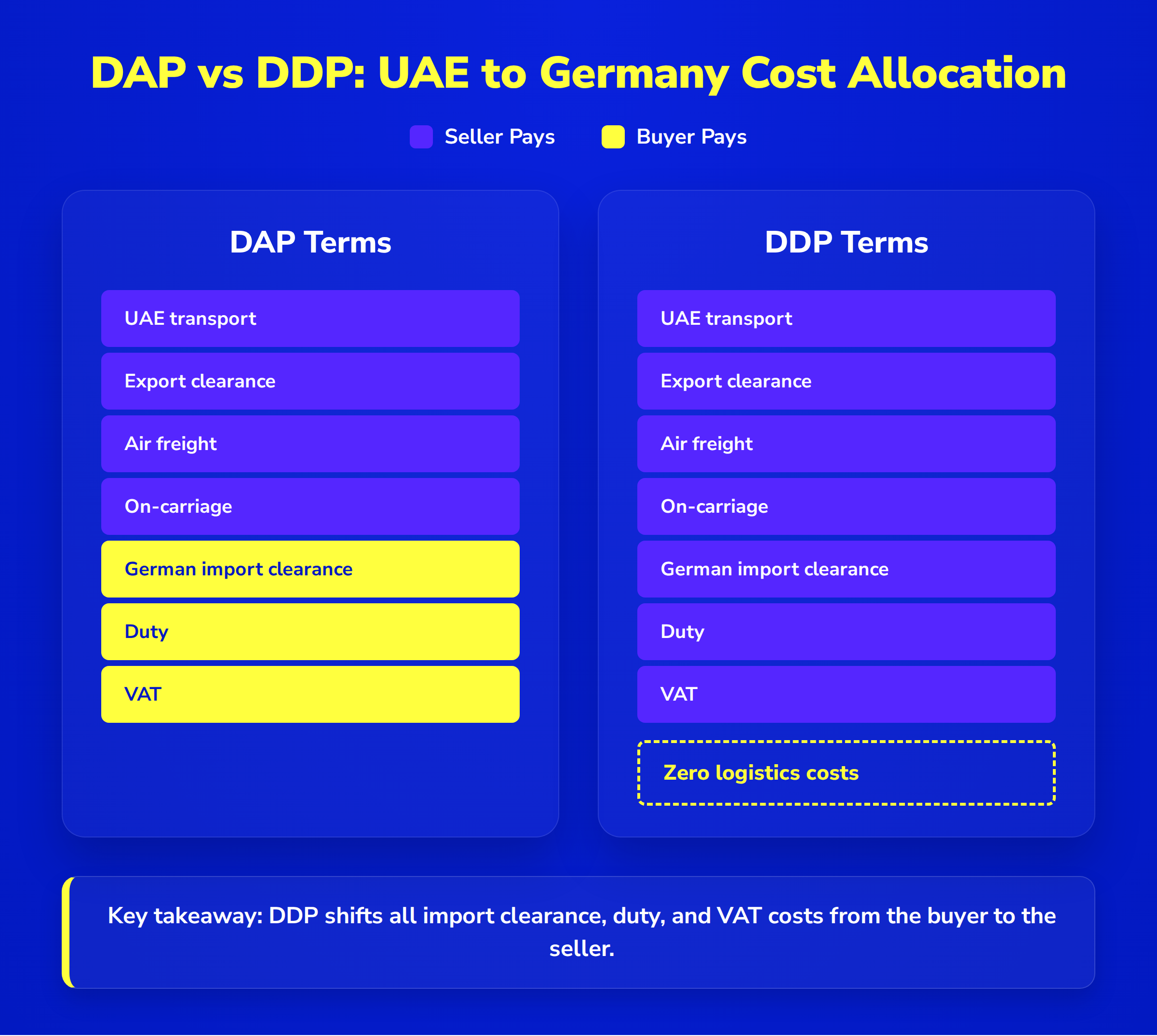
Imagine a UAE exporter shipping a pallet of machine parts from a warehouse in Dubai Investment Park to a buyer's facility in Germany. Here’s who gets billed for what under each term.
Scenario 1: Shipment on DAP Terms
The UAE exporter (the seller) receives bills for:
- Local transport in Dubai to the airport.
- UAE export clearance fees.
- Air freight from Dubai to Frankfurt.
- On-carriage from Frankfurt to the buyer's German warehouse.
The German buyer receives bills for:
- German import clearance (brokerage fee).
- German import duty.
- German import VAT (Einfuhrumsatzsteuer).
Under DAP, the seller's price covers transport to the door, but the buyer handles all import costs.
Need a shipping quote?
Get AI-optimized rates from DHL, FedEx & UPS — up to 65% below retail. Quote in under 10 minutes.
Scenario 2: Shipment on DDP Terms
The UAE exporter (the seller) receives bills for:
- Local transport in Dubai to the airport.
- UAE export clearance fees.
- Air freight from Dubai to Frankfurt.
- On-carriage from Frankfurt to the buyer's German warehouse.
- German import clearance (brokerage fee).
- German import duty.
- German import VAT.
The German buyer receives only the bill for the goods. All logistics and import costs are covered by the seller. This is only possible if the seller has a way to act as the Importer of Record in Germany.
Express Shipments: Paying the Receiver's Duties
For smaller express shipments, the lines can seem blurry, but the principle remains the same. Carriers like DHL, FedEx, and UPS have systems that reflect the dap vs ddp choice.
By default, express shipments are sent on terms equivalent to DAP. The carrier pays the duties and taxes on the receiver's behalf so the goods clear quickly, then bills the receiver for those charges, which can include a handling fee. The receiver pays before or on delivery.
Express account holders can change this default and have the destination duties and taxes billed to the shipper instead. When Infinity books your worldwide express from the UAE, ask for duties and taxes to be billed to you, and your buyer pays nothing on delivery. In effect, the shipment then works like DDP.
Importing into the UAE on DAP or DDP
The same logic applies when your UAE business is the buyer. The Incoterm on your supplier's invoice determines who pays the import charges.
According to the official UAE Government portal, most goods imported into the UAE are subject to:
- 5% Customs Duty on the CIF (Cost, Insurance, and Freight) value.
- 5% VAT, which is calculated on the CIF value plus the customs duty.
If you buy on DAP incoterms, you are the importer. You or your appointed agent, like Infinity Logistics, will handle the UAE customs clearance and you will be billed for the 5% duty and 5% VAT.
If you buy on DDP incoterms, your overseas supplier is responsible for paying these charges. The price you pay them should be the final landed cost, with no extra bills from customs.
How Infinity Handles DAP and DDP Shipments
Agreeing on the right Incoterm is the first step. Executing it flawlessly is the next. At Infinity Logistics, we ensure there are no surprises for you or your customer.
As a WCA Inter Global member, Highly Commended as Express Logistics Company of the Year at the Logistics Middle East Awards 2022, we start by confirming whether your sale is on DAP or DDP terms, then plan the shipment around it.
Infinity's AI-powered system generates quotes in under 10 minutes, comparing options from our partners. As the #2 DHL partner in the UAE and a Key Account holder with FedEx and UPS, Infinity Logistics offers business express rates up to 65% below retail. This single quote clearly outlines the costs for either a DAP or DDP shipment, so you can price your sale accurately.
For DAP shipments, we arrange the transport and export clearance and give your buyer the tracking and documents they need to clear the goods. For DDP shipments, we arrange for the destination duties and taxes to be billed to you where the carrier and the destination allow it, so your buyer pays nothing on delivery.
Before you finalize your next international sale, get a quote from Infinity. We'll help you choose the right Incoterm and price the shipment before you quote your buyer.
Frequently Asked Questions
Who pays import duty under DAP?
Under DAP (Delivered at Place), the buyer pays all import duties, taxes (such as VAT or GST) and customs clearance fees in the destination country. The seller's responsibility for cost and risk ends when the goods arrive at the named destination, ready for unloading.
Is DDP the same as 'duties and taxes paid' on an express shipment?
Functionally, yes. DDP (Delivered Duty Paid) is the formal Incoterm for a sales contract where the seller agrees to pay all import costs. "Duties and Taxes Paid" (DTP) or "Bill Shipper" is the operational instruction you give to an express carrier like DHL or FedEx to execute a DDP-style delivery. By selecting this option, the shipper (seller) agrees to be billed for the destination duties and VAT, ensuring the receiver pays nothing on delivery.
Can a UAE seller always ship DDP?
No. A seller can only ship DDP if they can legally act as the Importer of Record (IOR) in the destination country. Many countries require the IOR to be a locally registered entity. If a UAE seller does not have a legal presence or a registered agent in the destination country, they cannot fulfill the import clearance obligation of DDP incoterms. In such cases, DAP is the correct and safer term to use.
Does the Incoterm decide who owns the goods?
No, Incoterms do not determine the transfer of ownership or title to the goods. Incoterms rules, including DAP incoterms and DDP, only define the allocation of costs, risks, and responsibilities for the delivery of the goods between the seller and the buyer. The transfer of title is a separate legal matter that should be explicitly defined in the sales contract.
Which is better for e-commerce orders, DAP or DDP?
For business sellers shipping orders to their customers, DDP (Delivered Duty Paid) usually gives the better experience: the buyer sees one price and faces no customs bill on delivery. Shipping DAP can lead to refused parcels when buyers were not expecting to pay extra. DDP only works if duties can be billed to you as the shipper, which Infinity can arrange on express shipments to many destinations.

Sources & References
Official and industry sources referenced in this guide:
- DAP & DDP Incoterms® 2020 explained: Key differences
- [PDF] National regulatory barriers to the Incoterms® 2020 rules
- Incoterms® 2020 - ICC
- Customs duty | The Official Platform of the UAE Government
- Know Your Incoterms - International Trade Administration
- Delivered at Place (DAP) Definition | UPS Supply Chain Solutions
- Choosing the right incoterms for your goods | business.gov.uk
- Value Added Tax FAQ | FedEx United Arab Emirates
- Guides, References & Public Clarifications
- Frequently Asked Questions | DHL Express Global Payment Portal
- Frequently Asked Questions
Tags
Related Articles
Ready to optimize your logistics?
Whether you need express shipping, freight forwarding, or warehousing — our AI finds the best rates and routes for your business.