
The price you are quoted for shipping and the price you pay can be two very different numbers. The reason is almost always chargeable weight, the universal rule carriers use to bill for space, not just weight. Understanding this one concept is the key to checking any freight quote and avoiding costly surprises, especially for UAE businesses shipping light, bulky goods.
Chargeable weight is the higher of two figures: your shipment's actual weight (what it weighs on a scale) and its volumetric weight (a calculated weight based on its dimensions). Carriers charge for whichever is greater to ensure they are compensated for the space your cargo occupies on a plane, truck, or ship.
What is chargeable weight?
Every vehicle used for transport has limits on both weight (payload) and space (cubic capacity). A truck might be able to carry 20,000 kg, but it could be completely filled by just 2,000 kg of styrofoam boxes. To solve this, the logistics industry created a method to account for both mass and volume, ensuring that light but large items are billed fairly. This method is the foundation of how to calculate chargeable weight.
The "Greater Of" Rule
The core principle is simple. For every shipment, two weights are determined:
- Actual Weight (or Gross Weight): This is the straightforward weight of the packed goods, including all packaging, as measured by a scale.
- Volumetric Weight (or Dimensional Weight): This is a calculated figure that translates the shipment's volume (its dimensions) into a weight equivalent using a specific formula.
The carrier will invoice you based on whichever of these two numbers is higher. According to Maersk, this ensures that carriers can maximize revenue per cubic metre of space, preventing revenue loss on low-density goods that block capacity for heavier freight.
Why Carriers Charge for Space
Aircraft and container ships are constrained by both weight and volume. A pallet of pillows might weigh very little but can fill a cargo container that could otherwise hold heavy, dense machinery. By using chargeable weight, carriers protect their revenue and capacity. This is especially critical in high-volume hubs like Dubai, where air cargo capacity at DXB and DWC is a premium commodity.
How to calculate volumetric weight
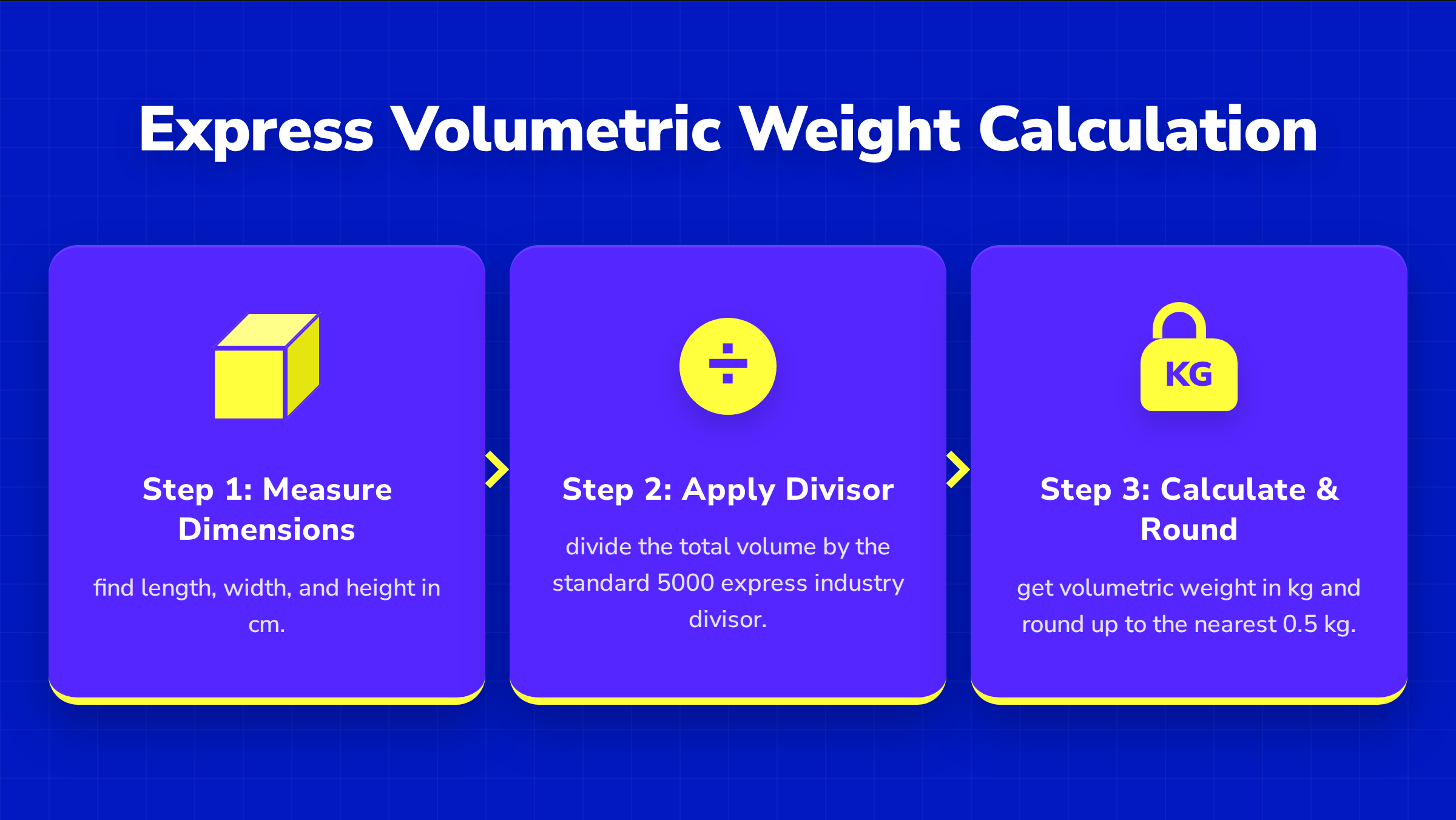
Calculating volumetric weight is a straightforward, three-step process. The only thing that changes between shipping modes is the final number you use in the calculation—the divisor. Here is the universal process of how to calculate chargeable weight based on volume.
Step 1: Measure the Packed Carton
Using a measuring tape, find the longest point on each of the three dimensions of your fully packed shipment. It is critical to measure the final, packed box at its outermost points, including any bulges.
- Measure the Length (L) in centimetres (cm).
- Measure the Width (W) in centimetres (cm).
- Measure the Height (H) in centimetres (cm).
Step 2: Calculate the Cubic Volume
Multiply the three measurements together to get the total volume of the shipment in cubic centimetres (cm³).
Formula: Volume (cm³) = Length (cm) x Width (cm) x Height (cm)
Step 3: Divide by the Mode's Divisor
This is the most important step. You divide the cubic volume by a specific number, known as the volumetric divisor or DIM factor. This number is different for express, air, and sea freight. The result is the volumetric weight in kilograms (kg).
Volumetric Weight (kg) = Volume (cm³) / Volumetric Divisor
Express: the 5000 divisor
For international door-to-door services, the major global integrators use a more aggressive divisor, which makes light, bulky goods more expensive to ship via express.
DHL, FedEx, and UPS International Standard
When you are using express shipping from Dubai, carriers like DHL, FedEx, and UPS use a standard divisor of 5000 for international shipments. This has become the industry benchmark for time-definite parcel delivery.
Volumetric Weight Formula (Express):
(L x W x H in cm) / 5000 = Volumetric Weight in kg
This formula means that for express carriers, every 5,000 cubic centimetres of space is considered equivalent to 1 kg. As a Key Account Centre and the #2 DHL partner in the UAE, Infinity Logistics has direct insight into how this rule is applied. Infinity compares DHL, FedEx, and UPS for every shipment, ensuring this calculation is priced at the best of three, with business rates up to 65% below retail.
Rounding Up
It's important to note that express carriers typically round the final chargeable weight up to the next half-kilogram or full kilogram. For example, a chargeable weight of 10.2 kg will often be billed as 10.5 kg. A 2026 dimensional weight guide confirms that DHL Express often rounds up to the nearest 0.5 kg.
Air freight: the 6000 divisor
For general airport-to-airport cargo, the standard is set by the International Air Transport Association (IATA) and is slightly more generous to shippers of bulky goods than the express standard.
The IATA Standard
The globally accepted divisor for air freight is 6000. This is the figure most airlines and freight forwarders, including WCA Inter Global members like Infinity Logistics, use for their calculations.
Volumetric Weight Formula (Air Freight):
(L x W x H in cm) / 6000 = Volumetric Weight in kg
This standard is confirmed by numerous industry sources, including a guide from SSLT Global, which outlines the IATA volumetric weight formula.
166.67 kg per Cubic Metre
Using the 6000 divisor is equivalent to stating that one cubic metre (CBM) of space is equal to 166.67 kg of weight. If your cargo's density is less than 166.67 kg/CBM, it will be charged based on its volume.
Sea freight: weight or measure
Sea freight, particularly Less-than-Container-Load (LCL) shipping, uses a different but conceptually similar system known as "Weight or Measure" (W/M).
1 Cubic Metre = 1,000 kg
For LCL sea freight, the calculation is simpler. The carrier or consolidator compares the shipment's volume in cubic metres (CBM) to its weight in metric tonnes (1,000 kg).
1 CBM is considered equivalent to 1,000 kg.
The freight charge is based on whichever figure is higher. For example, if a shipment is 1.5 CBM and weighs 800 kg (0.8 tonnes), it will be charged as 1.5. If it is 1.5 CBM and weighs 1,800 kg (1.8 tonnes), it will be charged as 1.8.
The Revenue Tonne
The billable figure in sea freight is often called the revenue ton (RT). The revenue ton is simply the higher of the volume in CBM or the weight in tonnes. As explained by Shipping and Freight Resource, this ensures the shipping line is compensated fairly for both heavy, dense cargo and light, voluminous cargo.
Need a shipping quote?
Get AI-optimized rates from DHL, FedEx & UPS — up to 65% below retail. Quote in under 10 minutes.
Worked example: one carton, three modes
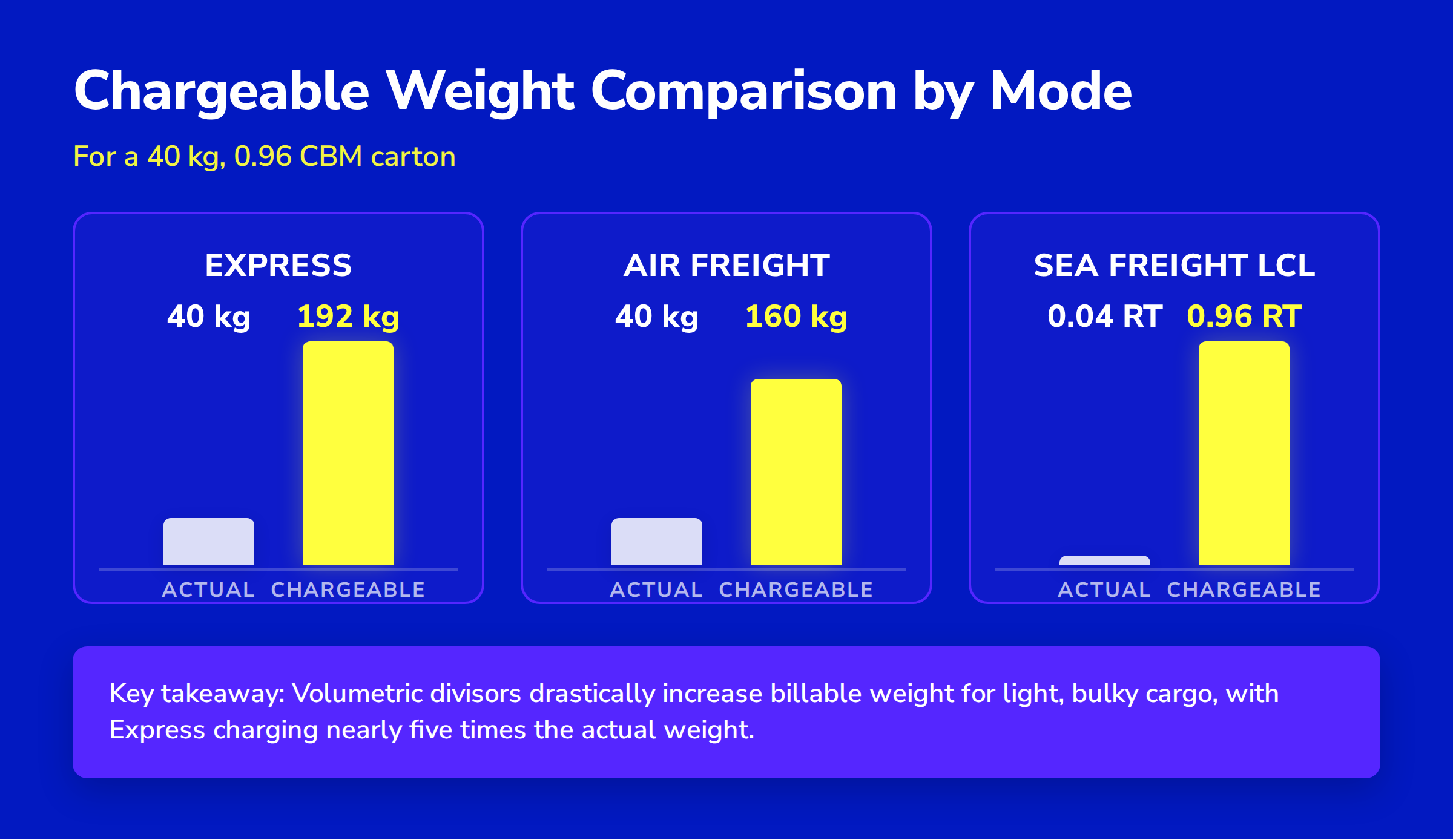
Let's see how to calculate chargeable weight for the same large, light carton across all three modes. This side-by-side comparison shows why the divisor is so important.
Shipment Details:
- Dimensions: 120 cm (L) x 80 cm (W) x 100 cm (H)
- Actual Weight: 40 kg
First, calculate the volume: 120 x 80 x 100 = 960,000 cm³. This is 0.96 CBM.
| Mode | Calculation | Volumetric Weight | Actual Weight | Chargeable Weight |
|---|---|---|---|---|
| Express | 960,000 cm³ / 5000 | 192 kg | 40 kg | 192 kg |
| Air Freight | 960,000 cm³ / 6000 | 160 kg | 40 kg | 160 kg |
| Sea Freight (LCL) | 0.96 CBM vs 0.04 Tonnes | 0.96 Revenue Tonnes | 0.04 Revenue Tonnes | 0.96 Revenue Tonnes |
As you can see, the same 40 kg box is billed as 192 kg by express and 160 kg by air freight. This is why understanding the correct volumetric weight formula is essential. To run the numbers for your own cartons, use our chargeable weight calculator. Infinity's AI-powered quoting agents can run these comparisons in real time, delivering accurate, multi-modal quotes in under 10 minutes.
Bulky goods: where quotes go wrong
The single biggest source of billing disputes in logistics comes from light, bulky goods. Items like furniture, lighting, insulation, and empty plastic containers have very low actual weight compared to the space they occupy.
Furniture and Light, Bulky Goods
When a shipper requests a quote for furniture shipping and only provides the weight, any quote given is purely an estimate. A 40 kg sofa can easily have a volumetric weight of over 250 kg once packed. If the quote was based on 40 kg, the final invoice will be a shock.
Always Send Dimensions
This is the most important takeaway for any shipper. To get an accurate quote, you must provide the carrier or forwarder with the exact, final packed dimensions (L x W x H) for each piece, along with the weight. At Infinity Logistics we ask for dimensions with every weight, so the quote reflects what the carrier will bill and there are no surprises when the cargo is measured.
Consolidate or Repack to Cut Volume
If your volumetric weight is high, consider ways to reduce the shipment's volume. Can items be repacked more efficiently? Can they be disassembled? Sometimes, vacuum-packing soft goods can dramatically reduce their volume. Reducing the dimensions, even by a few centimetres, can have a significant impact on the final chargeable weight and cost.
Frequently Asked Questions
What is the difference between volumetric and chargeable weight?
Volumetric weight (or dimensional weight) is a calculated weight based on a package's dimensions (L x W x H) and a specific divisor. Chargeable weight is the final weight used for billing; it is the higher value when comparing the volumetric weight and the actual (scale) weight of the shipment.
Why is my courier charging more than the scale weight?
Your courier is charging more than the scale weight because your package is light but large for its weight. Under the "greater of" rule, its calculated volumetric weight is higher than its actual weight. Therefore, the courier is billing you based on the space it takes up in their aircraft, which is represented by the higher volumetric weight.
Is the divisor the same for every carrier?
No. The divisor varies by shipping mode. For international express services like DHL, FedEx, and UPS, the standard divisor is 5000. For general air freight, the IATA standard is 6000. For sea freight, the comparison is typically 1 CBM to 1,000 kg. Always confirm which divisor is being used when you get a quote. Infinity Logistics, which holds Key Account status with DHL, FedEx, and UPS simultaneously, navigates these differences to find the optimal rate for clients.
How is sea freight charged?
Less-than-Container-Load (LCL) sea freight is typically charged based on "Weight or Measure" (W/M). The freight forwarder calculates the shipment's volume in cubic metres (CBM) and its weight in metric tonnes (1,000 kg). The charge is based on whichever number is higher. This billable unit is called a "revenue ton."
How can I get an accurate shipping quote?
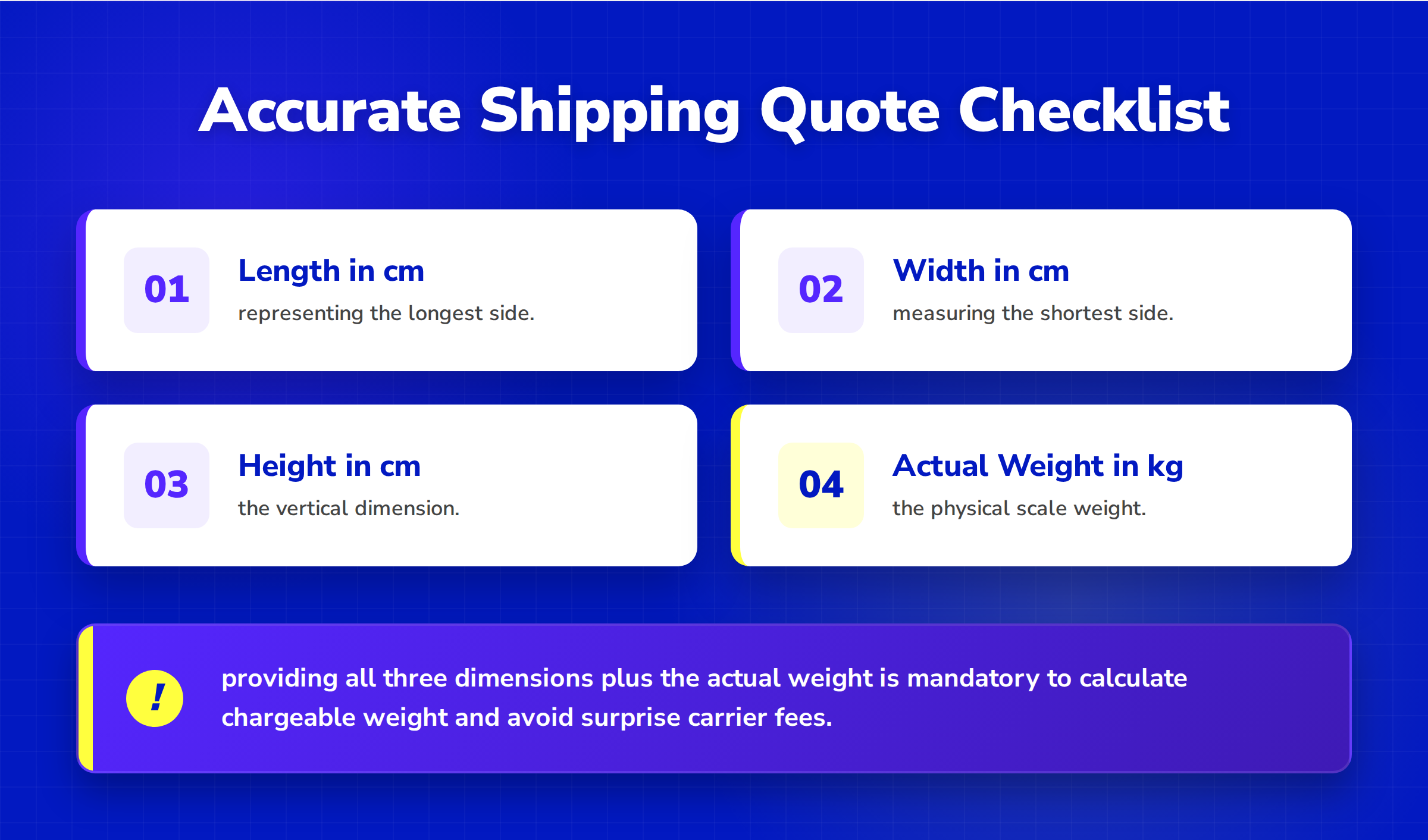
To get a quote that will not change when the carrier measures your cargo, provide three pieces of information for your packed goods: the length, the width, and the height (in cm), along with the actual weight (in kg). Without the dimensions, any quote for air or express freight is just an estimate and is subject to change once the carrier measures the cargo.
How do I know if Infinity Logistics is right for my business?
If your business in the UAE regularly ships internationally via express or freight and you want to ensure you're getting accurate, competitive pricing without surprise fees, Infinity is a strong fit. As a multi-carrier platform with business rates up to 65% below retail and quotes based on full dimensions, we are built for traders, e-commerce sellers, and general businesses who value transparency and cost-efficiency. To see how we can help, get a quote by providing your shipment's full details.
Sources & References
Official and industry sources referenced in this guide:
Tags
Related Articles
Ready to optimize your logistics?
Whether you need express shipping, freight forwarding, or warehousing — our AI finds the best rates and routes for your business.